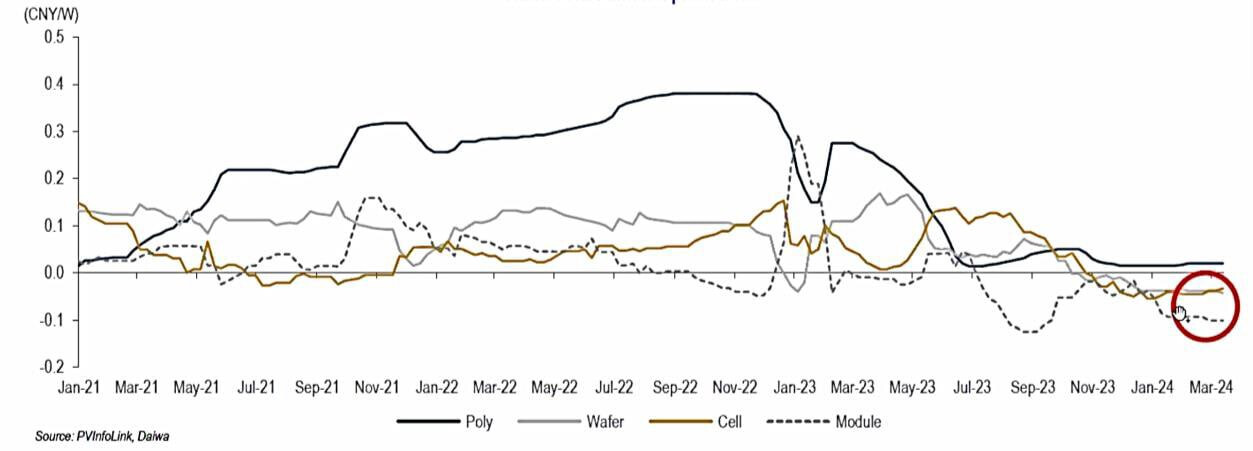
Do the renewable energy producers (Tata Power, Adani Green etc) stand to advantage (Vis-à-vis traditional players using Thermal/Coal etc.) from the decline in global decline in module prices? Spready between Cost of production and selling price etc.
A falling cost curve permits faster adoption and hence imparts Scale. Whether they manufacture internally or buy from others, falling prices enable them to take a larger market share of the energy pie. More so when the cost of alternative technologies like thermal etc is increasing.
Do we have an idea on the Cost Structure and Profit Margins on the various processes on Solar Manufacturing and installation and whether there are any listed peer companies for across the world to compare the valuation with for each of the processes
For e.g some of the lifecycle stages
Poly Silicon Manufacturing
Ingot Manufacturing
Cell Manufacturing
Module Manufacturing
Inverter and which technology
Transformers ( Inverter Duty Transformers / Power Transformers )
EPC Players
Service & Maintenance
Any other?
Module Manufacturing- JA Solar, First Solar, hanwa,
Inverter and which technology-Sungrow , soalredge , Enphase
Transformers ( Inverter Duty Transformers / Power Transformers )- majorly small and big companies supply these
EPC Players-Many
Service & Maintenance- Many
Any other : Inverter has been the most profitable segment in China and US. Other segments include Junction box companies and offering comprehensive solutions including cables etc
Movements of Net Profit Margins across main PV industry chains- Profits have markedly diminished across diverse segments, and certain sectors are encountering challenges stemming from prevalent industry-wide losses.
All sub-components of the value chain like cables, aluminum frames, glass, inverters, etc all will benefit including evacuations and grid connectivity components like transformers, SCADA etc
Solar string inverters are best suited for solar systems with fewer than 15 panels. They offer high efficiency, easy maintenance, and a relatively lower cost.
On the other hand, central inverters are more suitable for larger commercial or industrial solar systems with 15 or more panels.
I guess different type of Transformers are required in a Solar Project. Considering this, what is the contribution of Inverter Duty Transformers ( Step Up transformers) & Power Transformers in a Solar Project.
Our interactions with Transformer companies suggest for 100 MW Solar plant requires 200-300 MVA Inverter duty transformers while Power transformer required should be 100 MVA , assuming power factor of 1.
@KuntalShah
Special thanks to you and Team Oaklane for the patience and the meticulous answers.
Thanks everyone for collaborating effectively in putting up a great set of questions.
This has been a really productive session. I personally will take some time to absorb all that was shared today in so much detail.
Kuntal is also providing us with a collated Solar Industry AMA Q&A doc early next week.
There might be some unanswered questions uploaded in the LIVE Q&A thread. @KuntalShah Please check that and also include the answers as possible in the collated Q&A doc. Many Thanks once again for this super effort from Team Oaklane
We are pleased to share a compiled PDF document containing all questions and answers from the recent AMA session on the solar industry, held on October 25, 2024 by Kuntal Shah, Partner Oaklane Capital. This document provides a detailed overview of the topics discussed, covering areas such as global demand and supply dynamics, advancements in solar technology, and insights into the solar value chain.
We extend our sincere gratitude to all participants for their insightful questions.