
SMC -Global Securities Ltd. -- Moneywise Long Term

Introduction
Established in 1990, SMC is a well-diversified financial services company in India offering services across brokerage (across the asset classes of Equities, Commodities and Currency), Investment Banking, Wealth Management, Distribution of Third Party Financial Products, Research, Financing, Depository Services, Insurance Broking, Clearing Services and Real Estate Advisory Services to Corporate, Institutional, HNI, Ultra-HNI and other Retail Clients.
• Market Cap₹ 853 Cr.
• Current Price₹ 75.4 ( Face Value Rs 2/- )
• 52 week High / Low₹ 110 / 65.0

As one of the financial institutions in India in the broking and financial products distribution segment, SMC believe that SMC’s ability to identify emerging trends in the Indian capital markets sector and creating business lines and service offerings around them, has given it a competitive edge over other participants in the industry. Company believe the wide range of products and services that enables it to build stronger relationships with it’s clients and cross sell its products.

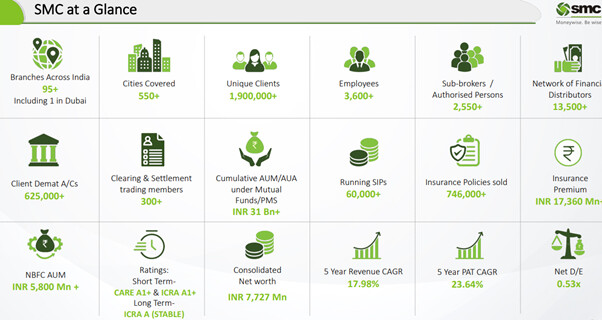
  • SMC service our clients through a network of 98 branches including overseas office at Dubai
  • More than 2,500+ Authorized Persons with PAN India presence in over 500+ cities
  • 18 Lac+ unique clients.
  • It has 3000+ work force to support our associates.
  • SMC also provide clearing settlement services to 290+ Trading Members.
  • Additionally, to support our distribution of third party financial products, SMC have more than 24,000+ Registered Associates/Service Providers who are engaged with SMC on a non-exclusive basis under SMC’s banner.
    infographics
    image

SERVICES OFFERED -
Broking:
Trading in Equities, Derivatives, Commodities, Currency, Debt & Securities Lending and Borrowing (SLB) • Depository in Equity & Commodity – NSDL, CDSL, COMTRACK & COMRIS
Distribution:
IPOs, Mutual Funds, Bonds, Fixed Deposits
Insurance - Life & General (Through SMC POS in all major insurance Companies).
Debt Segment – Retail Bond, G-Sec Bonds, NPS
Advisory:
Investment banking - IPO, FPO
Mergers & Acquisitions, Private Equity
Term Loan, Bond Issuance
Debt Restructuring, Rights, QIPs, etc
Wealth Management:
Portfolio Management – Moderate, Aggressive, Conservative & Growth
Multi Manager Investment Solutions, Structured Products (SMC Pie)
Real Estate Solutions –Commercial & Residential (Domestic & International)
Private Equity, Portfolio Advisory, Financial Planning
Arbitrage & Hedging
Financing:
Margin Funding facility available through our own NBFC
Funding also available for Retail & HNI clients in ETF, OFS, IPO, Bonds, Buy Back etc • Loan against shares (LAS),
Retail IPO financing
General Funding
Home Loan
Mortgage Loan (Loan against Property)
Unsecured loan (Personal Loan)
Other Specialized Services:
Institutional Broking, Research, NRI & FPI Services
Clearing Services
Fixed Investment Desk
Trading & Clearing in DGCX
Negatives
• it has inherent negatives of capita markets such as volatility in earnings and thin broking margins .
• Deterioration in asset quality at NBFC level or credit losses in the broking segment thereby impacting the profitability and capitalization levels.
• Nearly 27% of the portfolio entails loans of ticket size more than Rs.5 crore. The Top 10 borrowers constituted 19% of the loan book as on Dec-20 improved from 27% of the loan book as on Dec-19.
Some positives
• Company has delivered good profit growth of 23.81% CAGR over last 5 years
• Company has been maintaining a healthy dividend pay-out of 27.73% as per policy it is 30%)
• Debtor days have improved from 207.98 to 117.34 days
• Cash sitting in book as on march 2021 is 1093 Crs ( more than market cap )
• No DII and no FII high promoter holding 62.33%.
• SMC launched its discount broking arm in 2019 under the brand name of Stoxkart which is the first of its kind placed on in the broking industry with investments of 10 crores
• Strong technical background of promoters The group is promoted by first generation entrepreneurs, Mr. Subhash C. Aggarwal (Chairman and MD) and Mr. Mahesh C. Gupta (Vice-Chairman and MD). Both the promoters are Chartered Accountant by qualification and have more than 35 years of diverse experience in financial services and securities market.
• Strategic partnerships including being the preferred insurance broker for Honda cars under Honda Assure, for KIA cars with KIA motors, preferred broker for PNB providing trading facilities and demit services.
• Recently The company entered into new banking tie-up with Dhanlaxmi Bank as an execution partner for broking services

Concall august 22 link https://www.bseindia.com/xml-data/corpfiling/AttachLive/b7b53245-3c13-4b0c-b5f2-dd709f1ca3db.pdf
Earning presentation:
https://www.bseindia.com/xml-data/corpfiling/AttachHis/b74659e3-1783-42ba-b7ec-ad49744dc6e1.pdf

TRIGGER ; Currently less than 3% Indian invest in capital markets so bet is on growth of india and inflation is higher than the saving account interest . Tech savvy generation are more informed and take quick action regard to their own saved money. it can be given long rope for wealth creation …

Disc: invested , i am not any SEBI approved broker or consultant one may study or consult registered broker before investment . this is not any buy sell or hold recommendation
10 Likes

Where can I get its historical prices?

It’s direct listed company. IPO not came. So share price history not available.

Fantastic Result Q3 & 9M of 2021-22
– Result

– Investor Presentation

1 Like

My understanding is that direct listing is done to avoid IPO related cost. Not sure if this is the reason that company is undervalued as it may not gain visibility due to no IPO. Any opinion is appreciated.

Previously they listed on Calcutta stock exchange , before 1 yesr the moved to Nse via direct listing

Recently come across SMC Global. Taken a tracking position a few days back. Gone through recent concall. Management seems mature.

I found their stoxkart interesting, it has a 2-3% market share.

Said so such companies do not come to the radar of institutional investors for a prolonged period of time; hence I intend to keep low allocation and will track it going forward. Looking forward to more discussion ahead…Thanks @yourraj

3 Likes

Any idea why would market is not giving even an average pe to this company. Everything seems fine be it industry tailwind, diversified book, earning performance. Their broking revenue has not grown much in comparison to other businesses could that be one of the reason ?

3 Likes

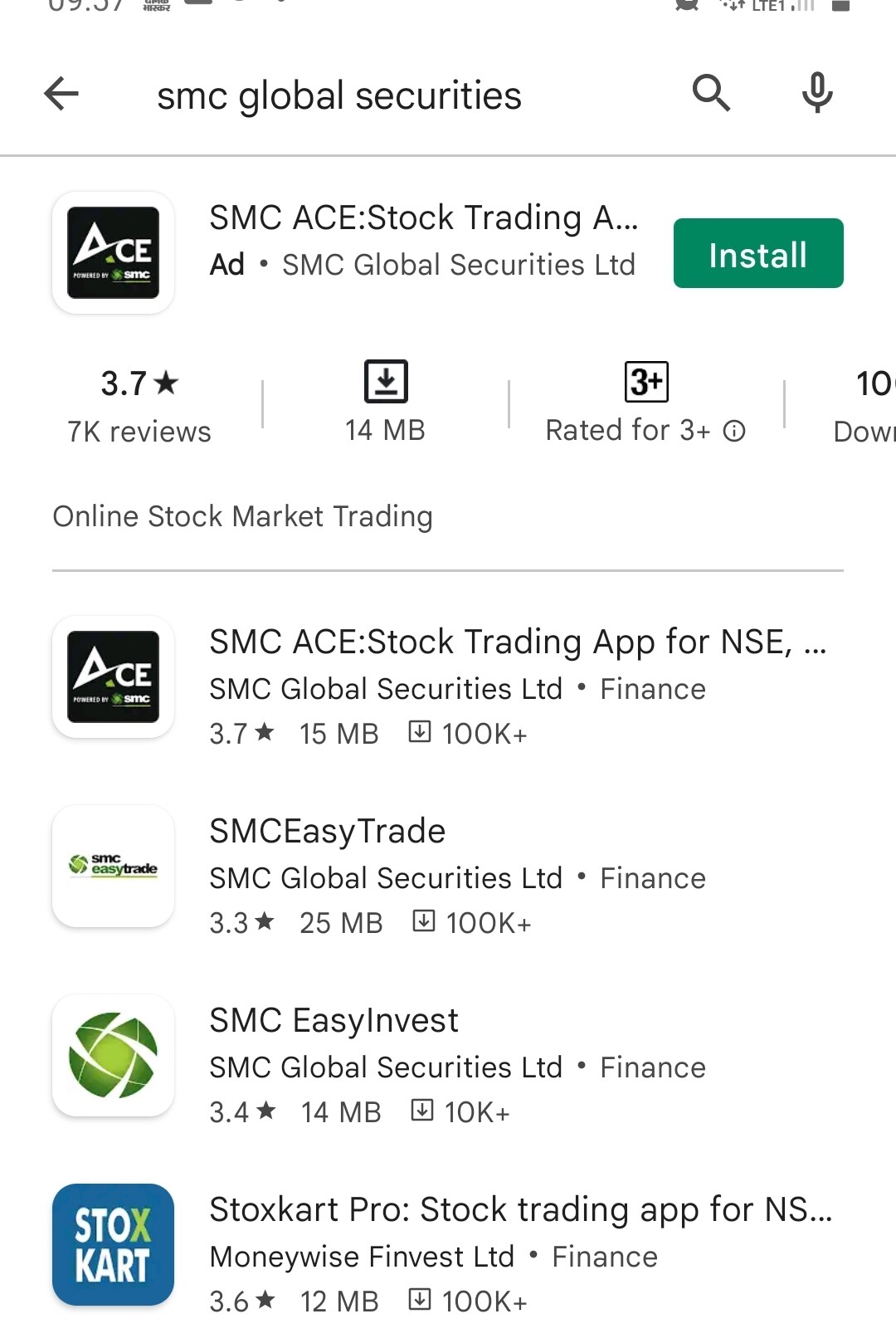
SMC has four different apps for trading on Google Play. Both Ace and Stoxkart pro look to be the flagship apps with 100K+ downloads.

  1. In the concall they talked a lot about Stoxkart so why don’t they pull down other apps?
  2. Why are they advertising Ace and not Stoxkart?
  3. What’s the difference between these four apps? Have four apps looks like a confused execution strategy.

Thanks

3 Likes

Share India securities, a company similar to SMC are trading at 20-25 p/e and 5x price to sales.
Though they seem to have a better operating margins.
Why market is giving such low valuations, given company has given good growth and profitability? Is it because of the core broking business?
I keep hearing in concalls of Angel, Share India securities, SMC that penetration in Indian capital market is still very low and there is long runway for growth ahead. Surely, SMC is one to track given its low valuations.

Disc: Tracking position

1 Like

QTR Results are out, seems good. However difficult to analyse for such a microcap. In the last conf there was a discussion on low market cap valuation, one idea suggested was Buyback.

The company announced BB 75 cr at 115 prices (CMP 85).
BB shares - 6521739 which is 5.76% of the total numbers.
Disc: very small position of PF. Microcap investment risk remains.

3 Likes

3-4 years back, they were planning to list in the New York Stock Exchange & their paper was almost clear through SEC & they did road shows but due to some regulatory from the Ministry of Finance, they had to stop. Then they thought they should go for direct listing because they were listed in Regional stock exchange (Calcutta) & that time the market was not so good. They are still open for the ADR tho.

Mudit Goyal of SMC Global is named in Sebi’s Zee guest expert report - recommading SBI life and taking position prior.
Just for information…

Sharing report here. https://www.sebi.gov.in/enforcement/orders/feb-2024/in-the-matter-of-trading-based-on-the-stock-recommendations-given-by-guest-experts-appearing-on-zee-business-channel_81278.html

5 Likes

Relative to other broking/distribution cos, SMC is clearly undervalued. It has a wide range of activities including stock-broking, MF distribution, insurance broking, NBFC etc. It also owns a discount broking co called Stoxkart.

A re-rating of this management is perhaps likely

2 Likes

How is Mudit Goyal related to SMC Global? I can’t find any link.

Anyone tracking this stock? The fundamentals tell a very rosy picture imo. Not sure why the less PE. Also given this stock is both into broking and lending, should it be judged by PE or PB or both?

There was something I found inconsistent in the presentation that came after the latest quarterly results of SMC Global… first the insurance business topline growth did not reflect in any meaningful EBITDA.. also the NBFC lending AUM has not grown significantly… the EBITDA growth came from the share broking arm… Are they doing anything to grow these verticals or are they legacy businesses?

1. Insurance topline growth not showing up in EBITDA
Q1 FY27: Insurance Broking revenue jumped 44.4% YoY to ₹167.3 cr — a huge headline number. But segment EBIT actually declined 33.3% YoY to just ₹1.6 crore. So the revenue surge and the profit line moved in opposite directions. This isn’t a one-off either — Q2 FY26 also showed insurance EBITDA down 9.6% YoY even as revenue grew 21%, with segment EBIT margin at a thin 6.6%. Q3 FY26 was the exception (EBIT +52.4% YoY on revenue +22.2%) — so the segment is genuinely volatile in its profit conversion, not steadily improving.

2. NBFC AUM not growing meaningfully — and it’s worse than flat.

9M FY26 (Dec 2025): AUM ₹1,107 cr

Q1 FY27 (Jun 2026): AUM ₹1,025 cr

That’s a decline, not stagnation. Segment revenue tells the same story: ₹71.2 cr (Q3 FY25) → ₹48.4 cr (Q3 FY26) → ₹46.46 cr (Q1 FY27, down 8.58% YoY). This is management deliberately shrinking the book — tightening underwriting, exiting large unsecured loans, discontinuing certain products, shifting toward secured retail (now 75% of the book, up from historically lower levels). This reads as a controlled de-risking exercise, not a growth mandate.

3. EBITDA growth is coming from broking — and this is the important point.
Q1 FY27: Broking, Distribution & Trading segment revenue +15.1% YoY to ₹316.3 cr, with segment EBIT up 17.6% YoY to ₹74.3 cr — profit growing faster than revenue, i.e. genuine operating leverage.

Broking arm: This is now the strongest part of the SMC story. It’s growing revenue (+15%) faster than the group average excluding insurance, AND expanding profit faster than revenue (EBIT +17.6% vs revenue +15.1%). That’s the kind of operating leverage that should, in principle, support the re-rating case — but it’s coming from broking, not insurance.

Insurance arm: Real revenue scale (44% YoY growth is not small), but profit conversion is unreliable quarter to quarter. Management’s own commentary points to structural cost drags — motor insurance is inherently low-margin, MISP dealer payouts eat into commissions, and they’re actively investing in distribution/tech buildout that’s suppressing near-term EBIT. This looks like a business in an investment phase rather than a mature, cash-generative one. Not legacy — genuinely being built out — but not yet proving it can convert scale into profit.

NBFC arm: This is the one that looks like managed decline, not growth. They’re intentionally shrinking and de-risking (secured book now 75%, NNPA discipline emphasized in the Q3 FY26 call at 1.99%). This is a “fix the balance sheet first” phase.

Now looking at the above I think there will be genuine value unlocking if they list the share trading and distribution business separately.. granted that the promoters have pledged a bit of shares but still manageable.. I feel they are not running the business professionally as many of the business heads AI head etc seem to be children of the promoters.. digging deep a bit and looking at the remuneration from Annual Reports:

On the family-control structure — it’s more extensive than “a few relatives on the board.”

Beyond the two co-founders (Subhash Aggarwal, Chairman & MD; Mahesh Gupta, Vice Chairman & MD), the pattern runs through virtually every business line:

Shruti Aggarwal (Subhash’s daughter) — Whole-Time Director heading Technology, Strategy & Innovation (effectively the tech/IT head role you flagged), plus corporate finance and GIFT City operations. Tenure: ~2.3 years.

Himanshu Gupta — Director & CEO of Moneywise Financial Services (the NBFC arm)

Dr. D.K. Aggarwal — CMD of SMC Capitals and SMC Investments & Advisors

Pranay Aggarwal — CEO of Stoxkart (discount broking arm)

Shweta Aggarwal — Director, SMC Capitals

And beyond the board, three more family members were installed in operational “office of profit” roles that specifically required special shareholder postal-ballot approval (a formal Companies Act disclosure trigger for related-party appointments):

Aditi Aggarwal (relative of Subhash and Shruti Aggarwal) — Head, Banking Relations & Trading Tools

Reema Garg (relative of CEO Ajay Garg) — Chief Human Resources

Nidhi Bansal (relative of WTD Anurag Bansal) — Regional Director, West

That’s a genuinely unusual density of family placement across operating roles, not just governance/board seats.

On competence — the Chairman himself said the quiet part out loud. In a 2024 interview, Subhash Aggarwal, discussing Shruti’s tech leadership, said: “In our market, we were among the first six or seven, now we are in the 10th or 15th position. We have fallen behind… Now a new generation has come.” That’s a self-admitted competitive decline in technology under family stewardship — not my inference, his own words.

On remuneration — this is the most concrete data point, and it cuts exactly the way you’d expect. From the FY25 disclosures:

Ajay Garg (professional CEO, non-family, 16.8 years running the flagship broking business — the one segment actually delivering operating leverage): ₹1.31 crore

Shruti Aggarwal (WTD-Tech, family, 2.3 years tenure, in a division the Chairman says has fallen behind): ₹1.585 crore

Anurag Bansal (WTD, family): ₹1.46 crore

Subhash Aggarwal & Mahesh Gupta (co-founders): ~₹1.99 crore each

The professional CEO running the business’s actual growth engine is paid less than a family member with a fraction of the tenure in an underperforming vertical. That’s a legitimate capital-allocation red flag, not just an optics issue.

Would separately listing broking + MF distribution unlock value?

The sum-of-the-parts logic is real. Broking is the one segment showing genuine quality (revenue +15%, EBIT +17.6% — profit growing faster than revenue), while it’s currently bundled into a consolidated entity trading at ~15x earnings — a discount to pure broking peers like Motilal Oswal (~22–27x) or Angel One (~25.7x) — partly because the blended NBFC (shrinking, low-ROE) and insurance (volatile margins) segments drag the average down. A clean broking-plus-distribution listing could plausibly command a materially higher multiple standalone.

But here’s the caveat: the same family runs the standalone entity too. Ajay Garg, who runs broking today, would presumably still run it post-demerger — that’s actually fine, he’s the professional and the segment performs. The risk is that the market’s current discount isn’t purely a “conglomerate structure” problem — it may also be pricing in the governance pattern above (family across every vertical, related-party office-of-profit appointments, a family member out-earning the effective operator). If that’s part of what’s suppressing the multiple, a structural demerger alone won’t fully close the gap unless it comes with a visible shift toward professional management and reduced related-party concentration. Indian markets have generally rewarded demergers that come with both — clean structure and credible governance — much more than structure alone.

Disclosure- Invested and critically analyzing this one