

1. Executive Summary
Trishakti Industries Ltd is an infrastructure solutions provider specializing in the hiring of heavy earth-moving equipment, primarily cranes, man-lifters, and piling rigs. Historically a diversified family business, the company underwent a significant restructuring and management change in FY23-24 following a family separation. Under the leadership of the new management team (Suresh Jhanwar, Dhruv Jhawar, and Pranav Jhanwar), Trishakti has pivoted to a pure-play heavy equipment rental model targeting “Blue-Chip” clients in the Steel, Renewable Energy, and Infrastructure sectors.
Key Investment Thesis:
-
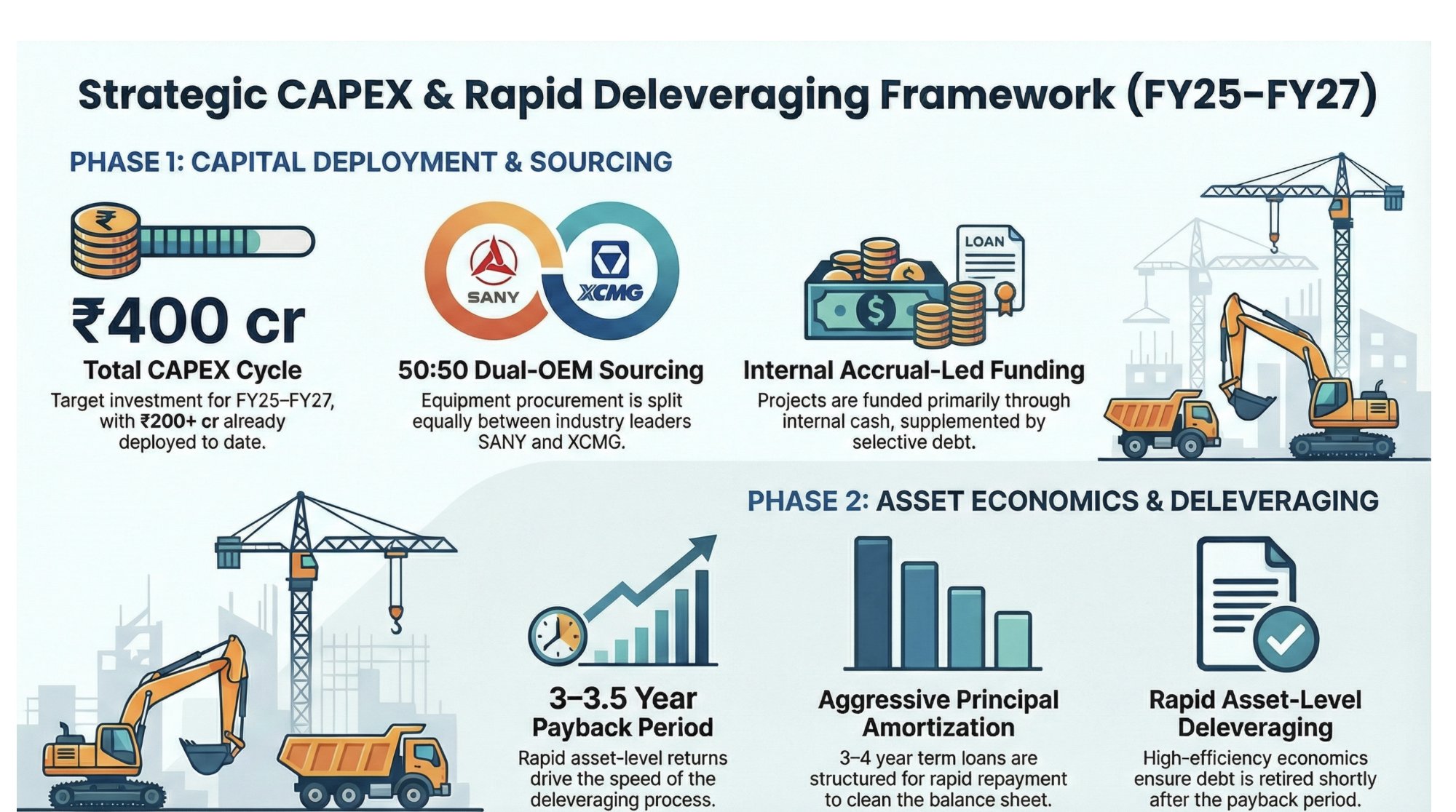
Rapid Scalability: The company is executing an aggressive INR 400 Crore Capex plan (FY25-FY28), with INR 154 Crore already deployed YTD in FY26.
-
Industry-Leading Margins: Delivering EBITDA margins of ~70% due to a strategic mix of new machinery (low maintenance) and high-yield asset selection.
-
Strategic Shift: Transition from a legacy trading/diversified model to a focused, asset-heavy infrastructure service provider with direct vendor codes for major conglomerates like Tata, L&T, and Reliance.
2. Company Overview & Business Transformation
2.1. History and Restructuring
-
Legacy (1985–2018): Originally incorporated in 1985 and listed in 1995. The company operated in logistics and equipment hiring but lacked a focused direction due to diverse family interests.
-
The Pivot (FY23-24): As detailed in the Office Visit* video, a family separation occurred in 2019-2020. The current management acquired full control in FY23.
-
Restructuring (FY25): The management spent ~10 months researching the post-COVID market landscape. They stripped down unrelated legacy businesses (oil & gas, trading) to focus entirely on heavy equipment rental. The company officially restarted aggressive operations in Q1 FY25.
2.2. Business Model
Trishakti operates on a B2B Heavy Equipment Rental model.
-
Direct Vendor Engagement: A core “business mantra” is avoiding sub-contractors. Trishakti works directly with end-users (Triple-A rated companies) to ensure payment security and better yields.
-
Asset Ownership: The company prioritizes owning its fleet to control quality and uptime. As of the video interview (March 2025), they maintained >60% equity ownership in their machines, focusing on cash flow rather than just asset accumulation.
-
Service-Led Rental: Unlike pure dry-leasing, Trishakti provides comprehensive operations and maintenance (O&M) support, including skilled operators (125+ personnel on payroll), which justifies premium rental rates.
-
3. Operational Highlights (FY26)
-
3.1. Fleet & Capex
-
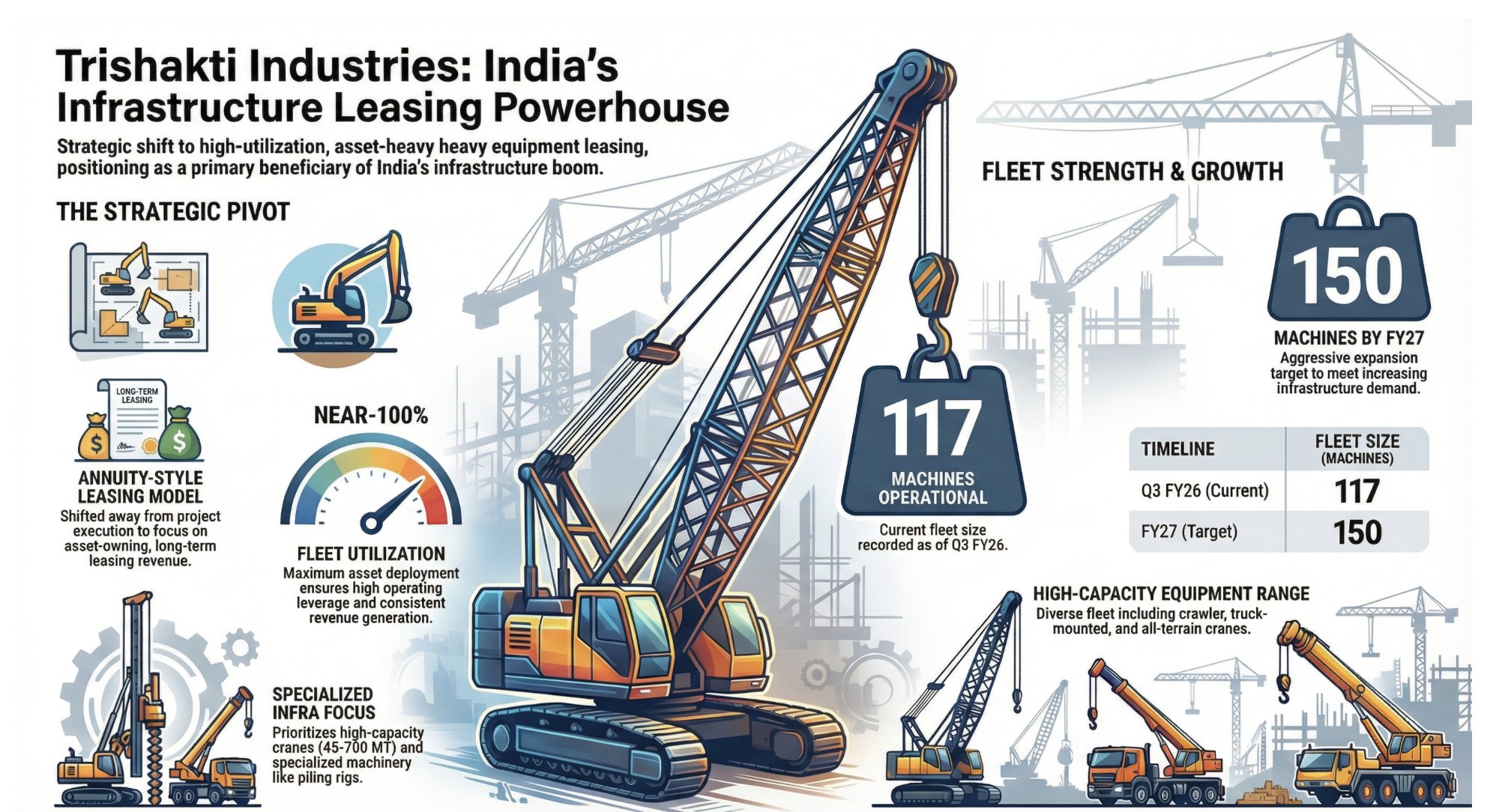
Current Fleet: 117 Machines (as of Jan 2026).
-
Capex Velocity:
-
Target: INR 100 Crore for FY26.
-
Achieved: INR 154 Crore deployed in the first 9 months of FY26.
-
Total Plan: INR 400 Crore Capex planned through FY28.
-
-
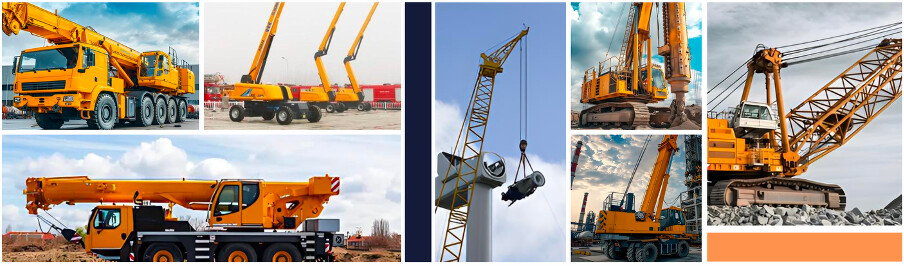
Asset Composition: The fleet includes Crawler Cranes (45MT-750MT), Truck Mounted Cranes, Man-lifters (Boom lifts), and Piling Rigs.
-
Utilization: Management reports 100% fleet utilization, driven by strong demand in the renewable energy sector.
3.2. Key Clients & Projects
-
-
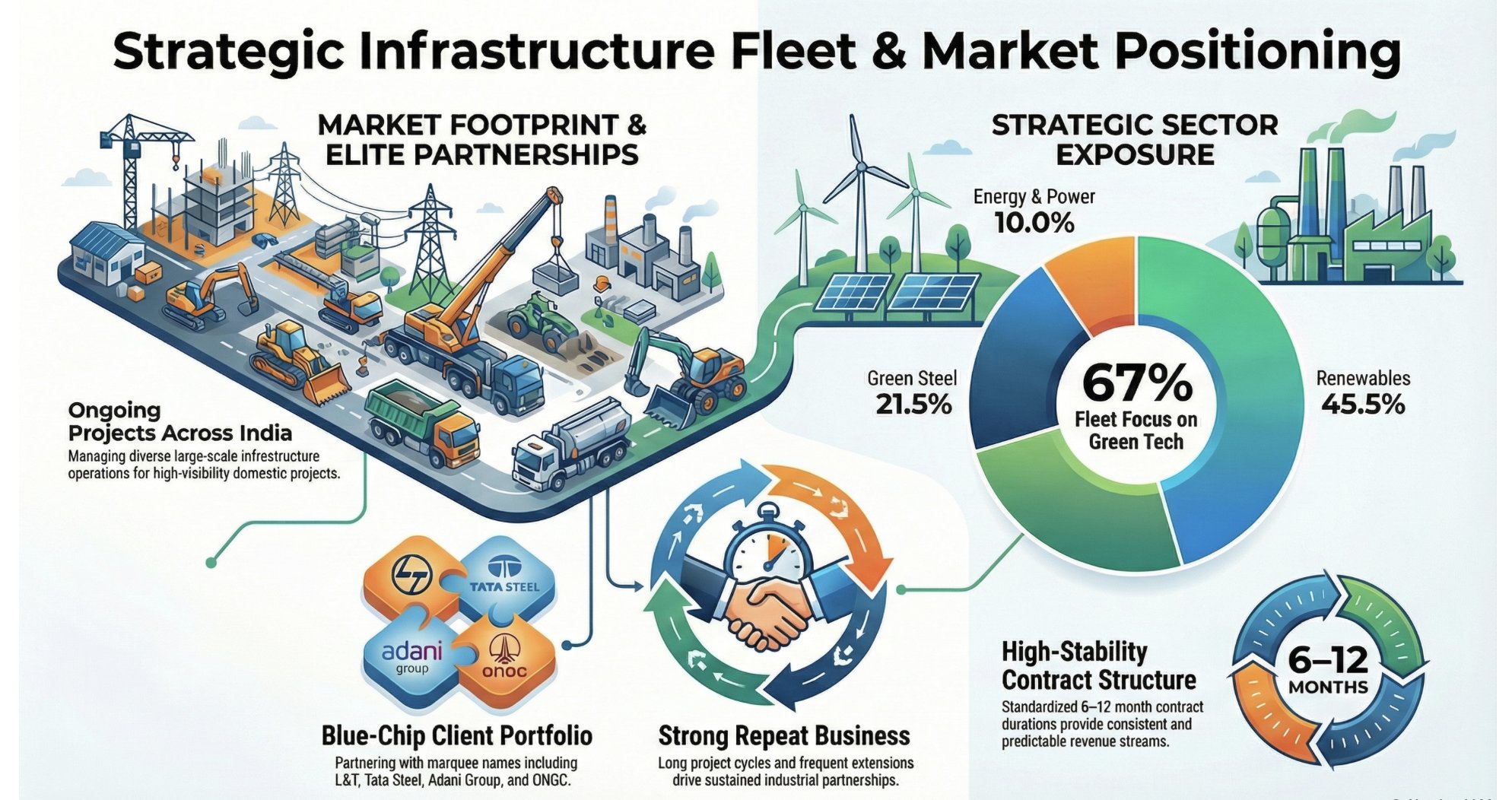
The company’s order book is anchored by marquee clients, reducing counterparty risk:
-
Steel: Tata Steel (Kalinganagar expansion), Jindal Group (working with all 5 Jindal companies).
-
Infrastructure: L&T (Bullet Train project), ITD Cementation (Underground Metro), NCC Ltd.
-
Energy: Reliance, NTPC, Adani Green, KEC International.
-
New Ventures: Expanding into Port Equipment (Reach Stackers) starting April 1, 2026.
4. Financial Performance Analysis (Q3 FY26)
4.1. Profit & Loss Statement
-
Revenue Growth:
-
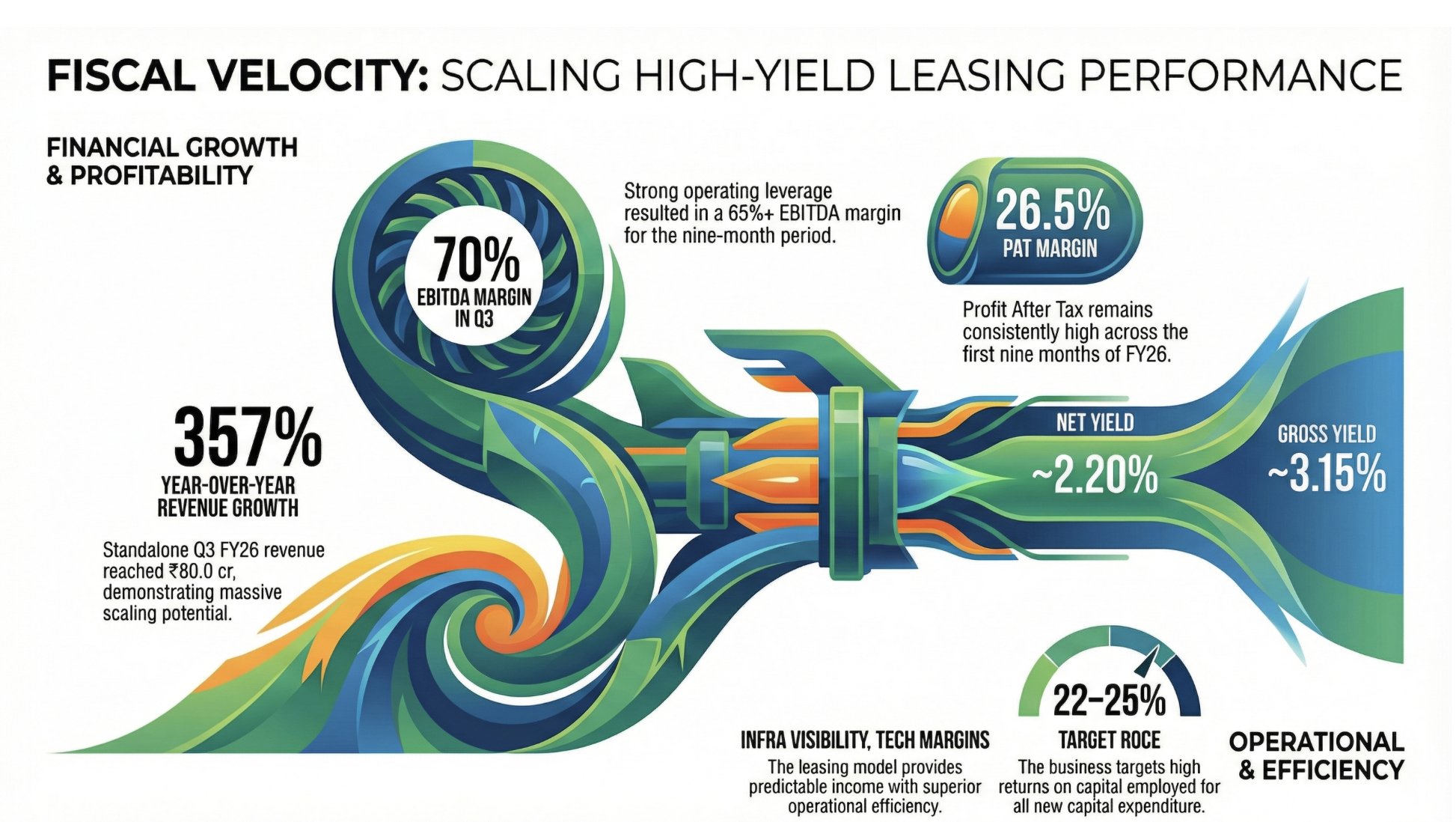
Q3 FY26 Revenue: INR 8.00 Cr (up 20% QoQ from INR 6.65 Cr).
-
9M FY26 Revenue: INR 18.74 Cr (up 37% YoY).
-
Analysis: The exponential growth (357% YoY for Q3) is due to the low base of the previous year during the restructuring phase. The QoQ growth reflects the rapid deployment of new assets.
-
-
Profitability:
-
EBITDA (Q3 FY26): INR 5.61 Cr.
-
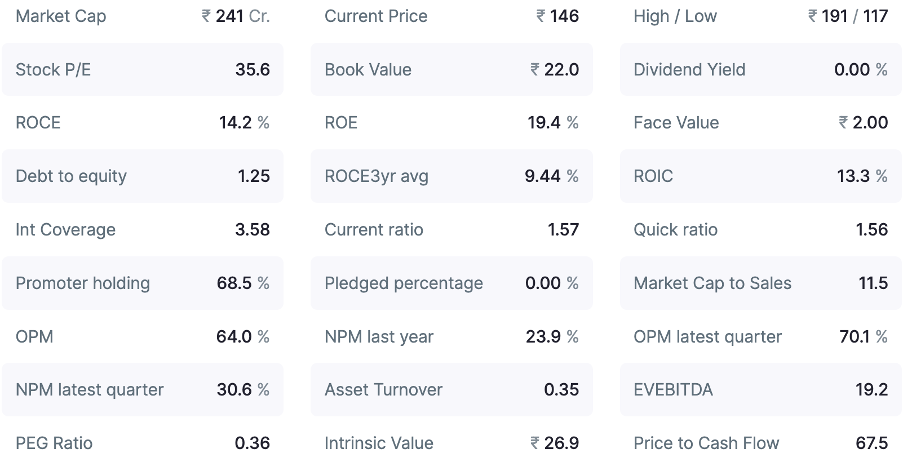
EBITDA Margin: ~70.1%.
-
PAT (Q3 FY26): INR 2.45 Cr (up 53% QoQ).
-
PAT Margin: ~30.6%.
-
4.2. Why are Margins So High?
-
-
During the Q3 FY26 earnings call, management explained the sustainability of their ~70% EBITDA margins:
-
New Fleet Advantage: The fleet consists largely of brand-new (2024/2025 make) machines.
-
Warranty Coverage: OEM warranties cover maintenance costs for the first 3 years, saving the ~5% maintenance cost typically incurred by competitors with older fleets.
-
Direct Leasing: Eliminating middlemen (sub-contractors) preserves margins.
-
Guidance: Management expects margins to stabilize at 60-65% long-term once maintenance costs kick in after year 3.
5. Working Capital Analysis
5.1. Trade Receivables
-
Status: Receivables have increased significantly in absolute terms, aligned with the rapid revenue expansion.
- As of Sept 30, 2025: INR 17.49 Cr (Trade Receivables).
-
Management Explanation: The “V-shaped” demand cycle has led to a temporary spike. There is a lead time of ~1.5 months between Capex deployment (buying the machine) and revenue generation (site entry, TPI inspection, logbook initiation).
-
Investor View: While high receivables are a risk, the client profile (Blue-chip/Triple-A) mitigates bad debt risk. The “payment security” of direct billing to companies like L&T and Tata is far superior to billing sub-contractors, even if the payment cycle is slightly longer (typically 45-90 days).
5.2. Working Capital Cycle
-
Inventory: Low inventory risk as the business is service-based. Inventory primarily consists of spares.
-
Payables: Trade payables stood at INR 9.54 Cr (Sept 2025), indicating the company is utilizing credit periods from OEMs effectively to manage cash flow.
6. Cash Flow Analysis
6.1. Operating Cash Flow (OCF)
-
Positive Cash Generation: Despite aggressive growth, the company claims to be cash-flow positive at the operating level. The strong EBITDA conversion (70%) is the key driver.
-
Reinvestment Strategy: The transcript highlights that internal accruals are the primary engine for the INR 400 Cr Capex plan. The company is reinvesting its monthly cash generation directly into down payments for new machines.
6.2. Capex & Investing Cash Flow
-
-
-
Aggressive Deployment: Spending INR 154 Cr in 9 months against a target of INR 100 Cr indicates high confidence and high demand.
-
Asset-Heavy Focus: The balance sheet shows a massive jump in “Property, Plant and Equipment” and “Capital Work in Progress” (CWIP), reflecting machines that are purchased but currently in transit or undergoing site induction.
6.3. Financing Cash Flow
-
Funding Mix:
-
Debt: The company utilizes bank finance (loans) but maintains a healthy Debt-to-Equity ratio. In the video, the CEO mentioned a secured loan D/E ratio of ~0.7x.
-
Equity: The company raised funds via two preferential equity rounds (INR 12-13 Cr mentioned in video) to fund the “margin money” (down payments) for new equipment.
-
Promoter Support: Promoters have infused unsecured loans (~INR 10-12 Cr) to support liquidity needs during this high-growth phase.
-
7. Future Prospects
7.1. Growth Targets
-
Revenue Guidance:
-
FY26: INR 20-22 Cr (Likely to surpass based on current run rate).
-
FY27: INR 60-65 Cr.
-
FY28: INR 90-100 Cr.
-
-
Fleet Expansion: Targeting a fleet size of 150 machines by FY27 (up from 117 currently).
7.2. Sectoral Tailwinds
-
Renewable Energy (Solar & BESS): The CEO identified this as the biggest growth driver. The shift to higher capacity solar modules and Battery Energy Storage Systems (BESS) requires specific heavy lifting equipment where Trishakti is positioning itself early.
-
Steel Expansion: Major capex by Tata Steel and Jindal requires massive erection and commissioning work, ensuring steady utilization for crawler cranes.
-
Bullet Train: A long-term project providing multi-year contract visibility.
7.3. New Frontiers
-
Port Logistics: Expansion into Reach Stackers and port handling equipment starting April 2026 offers a new revenue stream with potentially stable, long-term contracts.
-
Geography: Broadening presence across Central & Eastern India.
8. Risk Factors
-
High Receivables: Rapid growth has stretched working capital. Investors must monitor if the “Blue-chip” clients pay on time to prevent a cash crunch.
-
Execution Risk: Managing a fleet that has quadrupled in size (from ~30 to ~117) in under a year requires robust operational controls. Any lapse in machine uptime (breakdowns) could hurt the “100% utilization” narrative.
-
Debt Servicing: While the D/E ratio is currently managed, the INR 400 Cr Capex plan will require significant debt. A downturn in the infrastructure cycle could make servicing this debt difficult.
-
Key Man Risk: The turnaround is heavily driven by the Jhawar family (Dhruv and Pranav). Their continued involvement is critical.
9. Conclusion
Trishakti Industries Ltd presents a classic turnaround and high-growth story. It has successfully pivoted from a lacklustre legacy business to a high-margin, asset-heavy infrastructure play.
For an investor:
-
Positives: The company is capitalizing on India’s infrastructure boom (Capex cycle) with a clear strategy: buy new machines, lock in 70% margins, and reinvest cash flows. The focus on direct billing to Tier-1 clients creates a “quality” revenue stream.
-
Watchlist: The primary metric to watch is Operating Cash Flow vs. Receivables. If the company can convert its high EBITDA into actual cash collections efficiently, it is well-positioned to meet its FY28 revenue target of INR 100 Cr with substantial profitability.
=============================================================
Some sources to study further:
Office Visit* Video:
Pref @158 to Promoters and others in October 2025:
https://www.bseindia.com/xml-data/corpfiling/AttachHis/aa8fec05-b9c7-4983-a292-59c5f3a2735c.pdf
Pref @86 in October 2024:
https://www.bseindia.com/xml-data/corpfiling/AttachHis/9560644a-b224-45d4-bb9a-db215f5be26e.pdf
Latest Presentation:
https://www.bseindia.com/xml-data/corpfiling/AttachLive/3b4bf312-c24e-49db-af38-657b737227e9.pdf
-
===========================================================================
Compiled notes from here & there, No Buy/Sell recommendation
===========================================================================