I’m looking to start a discussion on how to play the current AI hardware boom through the passive components space, specifically looking at a potential indirect play here in India via Shivalik Bimetal Controls.
For quick context, MLCCs (Multi-Layer Ceramic Capacitors) are the unsung heroes of electronic circuits. They regulate stable voltage and suppress electrical noise. The massive explosion in AI servers (like those running NVIDIA architectures) has created a severe global MLCC shortage. A standard server might use a few hundred MLCCs, but an AI server requires thousands of ultra-high-capacitance, high-voltage MLCCs. Because these advanced chips operate under extreme power loads, global manufacturing capacity for these specific high-end components is stretched to the absolute limit.
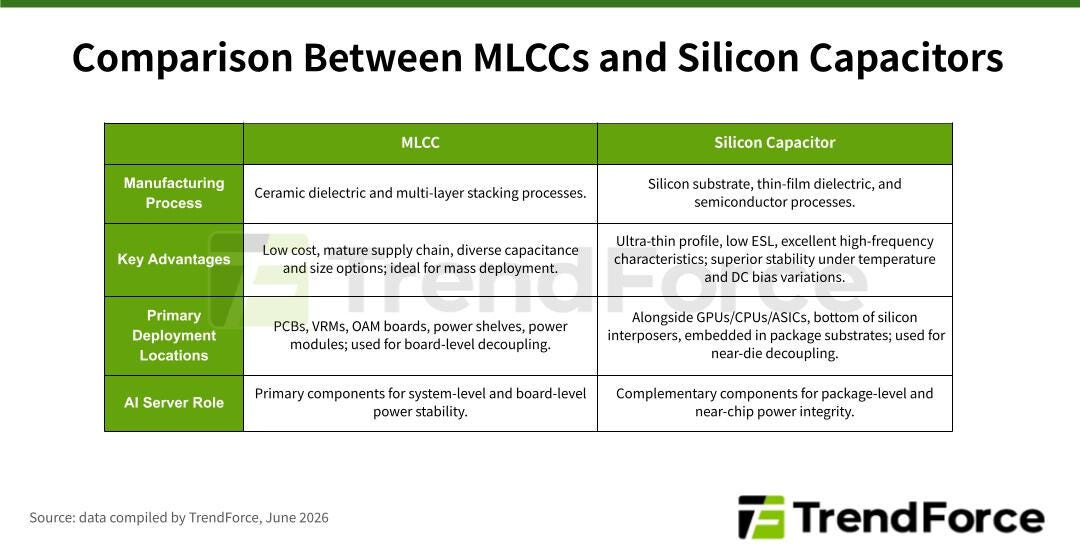
For quick comparision between MLCCs and Silicon Capacitors do check out the image from TrendForce
Looking at the global heavyweights, we are seeing massive moves:
- Murata Manufacturing & Samsung Electro-Mechanics (the absolute titans of MLCCs) are aggressively shifting their product mixes away from standard consumer tech to high-margin AI and automotive lines to capture this structural shift.
- Vishay Intertechnology (VSH) is also capitalizing heavily on this passive component supercycle, launching a massive multi-year capital expenditure program to scale up its power-tree portfolio and meet soaring AI component demand.
This brings me to my thesis and main question for the forum.
Shivalik Bimetal Controls itself doesn’t make MLCCs. They specialize in high-precision shunt resistors and bimetals. However, Vishay is one of Shivalik’s major global Tier-1 OEM customers. Given that AI hardware manufacturers are trying to secure entire component “packages” to avoid production bottlenecks, Vishay’s order books are expanding rapidly.
My questions for the forum:
1. Do you think Shivalik will see a significant, multi-year revenue tailwind as a direct proxy for Vishay’s booming AI demand?
2. Are Vishay’s localized expansion plans already translating into visible order backlog increases for Shivalik, or is this relationship too diluted to move the needle significantly?
Would love to hear your insights, data points, or alternative proxy ideas.
11 Likes
My 2 cents…
Vishay is in the passive components space where some products are benefiting from AI demand — but the specific product SBCL supplies to Vishay (precision shunt strips and components for current sensing) are not in the AI hardware shortage category, and Vishay’s AI-related capex expansion is not in a product line that can pull more SBCL content.
Hence SBCL’s investment thesis for the AI / electrification theme may not be so much on: AI servers → MLCC shortage
17 Likes
It’s a good development that the investors were waiting for. Going forward should lead to significant revenue and profitability growth as the company shifts to higher value products.
15 Likes
The Q1 FY27 earnings call for Shivalik Bimetal Controls Limited (SBCL) highlighted a strong start to the financial year, marked by record performance and a strategic shift toward becoming a more integrated, higher-value precision components and assemblies platform.
Source: https://www.shivalikbimetals.com/images/news/1598987262_309716684_1658495397_SBCL_Q1FY27_C1_14MB_MP3
1. Financial Summary(Q1 FY27 vs. Q1 FY26)
- Revenue: ₹182.2 Crore (↑ 33.4% YoY / ↑ 13% QoQ).
- EBITDA: ₹43.2 Crore (↑ 35.2% YoY / ↑ 23% QoQ).
- PAT: ₹33 Crore (↑ 44.9% YoY / ↑ 36% QoQ).
- Margins: Management noted that margin improvement was achieved despite rising employee costs as they invested in capacity and people.
2. Segment Highlights
- Shunts (Growth Engine): Revenue up 18.7%. The real story is the shift from strips to final components. Strip sales dropped to 1/3rd of previous levels as SBCL converted them into higher-margin parts. Roughly 75% of value-addition growth in shunts is coming from this conversion rather than just commodity price hikes.
- Bimetals (Turnaround): Grew 7.4%. After several flat quarters, management is seeing an uptick in domestic volumes driven by real estate and infrastructure.
- Electrical Contacts: This subsidiary is scaling, though silver prices (which doubled YoY) can impact reported revenue and gross margins. Management is focusing on absolute EBITDA and cash generation here.
3. The “Pune Vertical”: Cell Connecting Systems (CCS) & Busbars
The long-awaited Pune facility is a major catalyst:
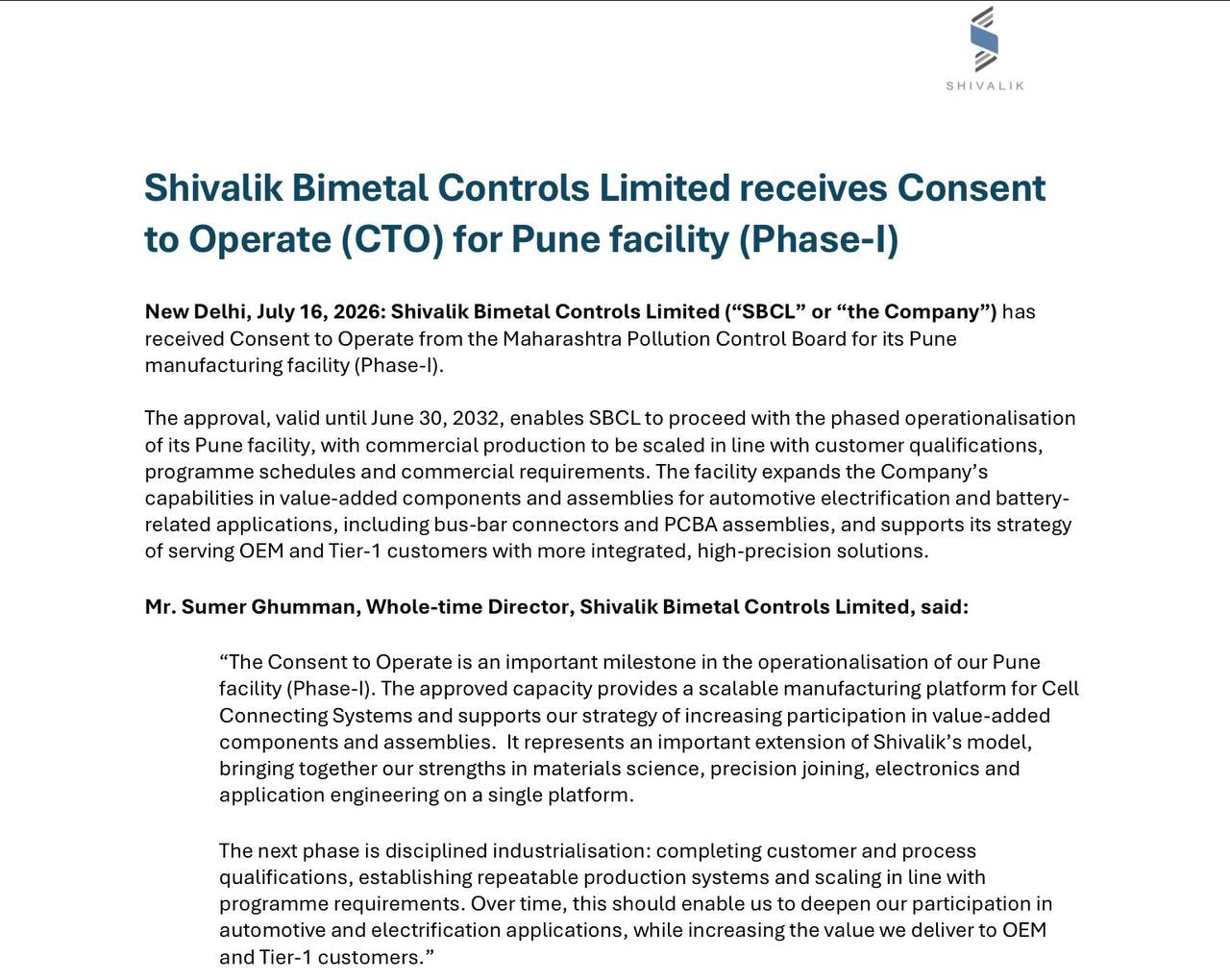
- Phase 1 Operational: The company has received “Consent to Operate” (CTO) for Phase 1.
- Targeting EVs: Focused on cell connecting systems and busbars for the 2-wheeler EV market, where safety (preventing battery fires) is a major selling point.
- Revenue Roadmap: Management sees this vertical reaching ₹300-400 Crore in 3 years. Year 1 is expected to contribute ~15-16% of total revenue.
- Low Capex for Pune: The incremental capex for Pune is only ₹20-25 Crore, as the high-cost processes are already established at their Solan facility.
4. Geography & Market Trends
- Americas Recovery: Shunt business in the US grew 30% YoY after a soft FY26. Key customers are showing resurgence, particularly in higher-value-added designs.
- Chinese EVs: Interestingly, SBCL is seeing increased demand from Chinese EV OEMs. These manufacturers prioritize accuracy for their Battery Management Systems (BMS) and are willing to source from India for high-precision shunts.
- Smart Meters: Remains a consistent growth driver for shunts.
5. Future Outlook & Strategic Moat
- Growth Guidance: Management is targeting 20-30% revenue growth for the full year.
- Inorganic Growth: SBCL is exploring JVs or acquisitions in specialized electronic materials (used in most electronic applications) and automotive fuses.
- Diversification: Concentration risk with their largest customer has dropped from 35-40% in the past to a much healthier 17-18% today.
Key Takeaway for Investors
SBCL is no longer just a “metal parts” company; it is becoming a resilient precision components and assemblies platform. The strategy of “Forward Integration” (moving from strips to components to assemblies) is starting to translate into stronger earnings quality and higher capture of the total engineering value.
Disc: Invested
33 Likes
Thanks Abhi, the market has given it a thumps up with 20% increase in the share price,
The current market cap is now 5300 Cr for a sales of around 600 crore TTM, valueing the company almost 9 times the sales
It would be interesting to know the next 2 to 3 quarter growth as it seems share price has gone ahead of profitability ,
Invested from lower levels
8 Likes
Surprisingly this time there has been no update on AGM. Anyone who attended the AGM and can post?
I asked ChatGPT to summarise my rough notes on AGM. Only surprise or new was that they have started developing (not production so please bear in mind) busbar even for ICE, which I thought will start after 3 years.
1. Pune plant — the main new opportunity
The Pune expansion appears to be primarily aimed at EV-related components, initially for Indian electric 2-wheelers.
- Two phases of investment.
- Phase 1 has already started.
- A smaller unit was set up first because it could be commissioned faster.
- Larger plant/Phase 2 is expected to start by November.
- Phase 1 + Phase 2 capex: roughly ₹25–30 crore.
- Land is sufficient for future expansion, so additional revenue can be generated mainly by adding machinery, rather than buying more land.
- Initially, there is one customer, but the company is developing products for multiple EV customers.
- There are several products/programmes under development, going through validation/testing.
- Importantly, the opportunity isn’t restricted to EVs; they are also developing non-EV applications.
- 250-300 crores revenues can be expected in 3 years time from phase 1 and 2.
2. Shunts
- **Domestic EV demand is picking up + the largest US/foreign existing customer is also increasing volumes..
- Tariff unlikely to impact business in future as most of it is now in assembly/sub-assembly format which is not tarriffed
3. Bimetallic strips (not very sure on following someone can verify)
- **India very few players and some european companies are shutting down - shall benefit the company
Welcoming others to bridge.
Disclaimer: I am not a financial advisor and nor a SEBI registered Analyst. The content shared here is only for learning and future reference purpose. All the names mentioned here are for example purpose. I may buy more, exit or partly sell the stock/bonds without any prior intimation. Please consult your own advisor before buying or selling.
8 Likes