Shivalik Bimetal Controls Ltd (SBCL)

Early days here with EBW Busbars. So bear with us as we try to separate the Wheat from the Chaff :)

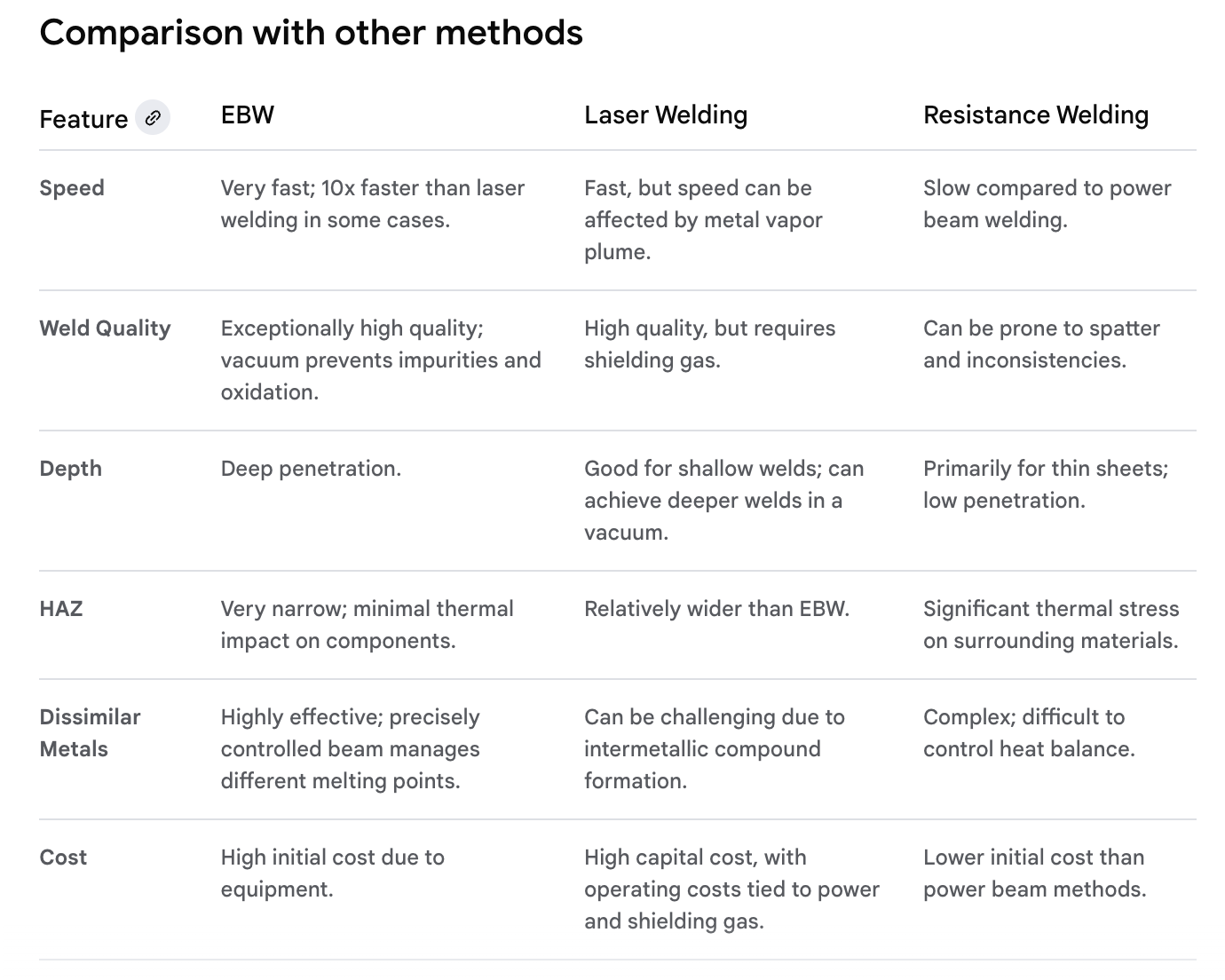
Source: https://camvaceng.com/case-study/electron-beam-welding-of-busbars-for-electric-vehicles/

Some indicators of use of EBW Busbar connectors in leading OEMs (subject to corroboration from domain experts like our own @GourabPaul )

  • Audi (e-tron, 71-95 kWh Packs): EBW is referenced for welding busbars in battery packs, creating high-strength, low-distortion joins for module interconnections. Ultrasonic welding supports tab-to-busbar connections, while resistance spot welding (with parallel electrodes) is noted for limited terminal-to-busbar applications, though challenged by access issues. Laser welding is used for thin Al/Cu foils in busbar tabs.

  • Ford (General EV Platforms, e.g., Mustang Mach-E, F-150 Lightning): EBW is advanced through partnerships (e.g., with CVE) for faster busbar welding in high-voltage components, outperforming laser techniques. Ultrasonic welding handles automotive busbars, while laser is used for precision terminal joins.

  • Hyundai/Kia (EV9, General Platforms, 76-99 kWh Packs): Laser welding (with pulse shaping) joins busbars to prismatic terminals, reducing heat and enhancing strength. Ultrasonic is used for Cu/Al busbar tabs, with EBW as a faster alternative for packs.

Please note Isabellen Hutte has set up a India International subsidiary in Pune, India in 2025. What has tilted the balance for ISBH India direct presence (when all these years a trading partner and distributor Office sufficed)? Is it that the volume of business from EBW Busbar connectors/shunts from India EV manufacturers is going to scale rapidly?

23 Likes

One query here
This mentions that for joining busbar with cells EBW has merit compared to other processes.
However SBCL is not a process provider .it is a product maker using EBW(i.e. Shunt).
Considering time is mentioned as USP, it seems this process is performed at same location where module/pack are manufactured.
How does SBCL fit in this?

3 Likes

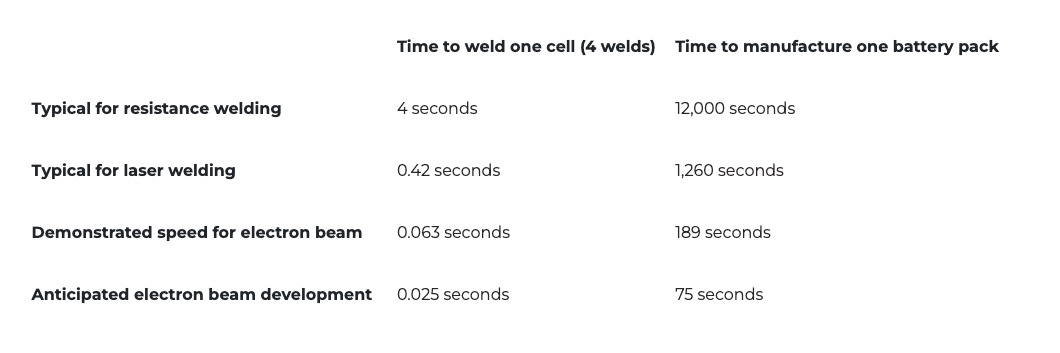
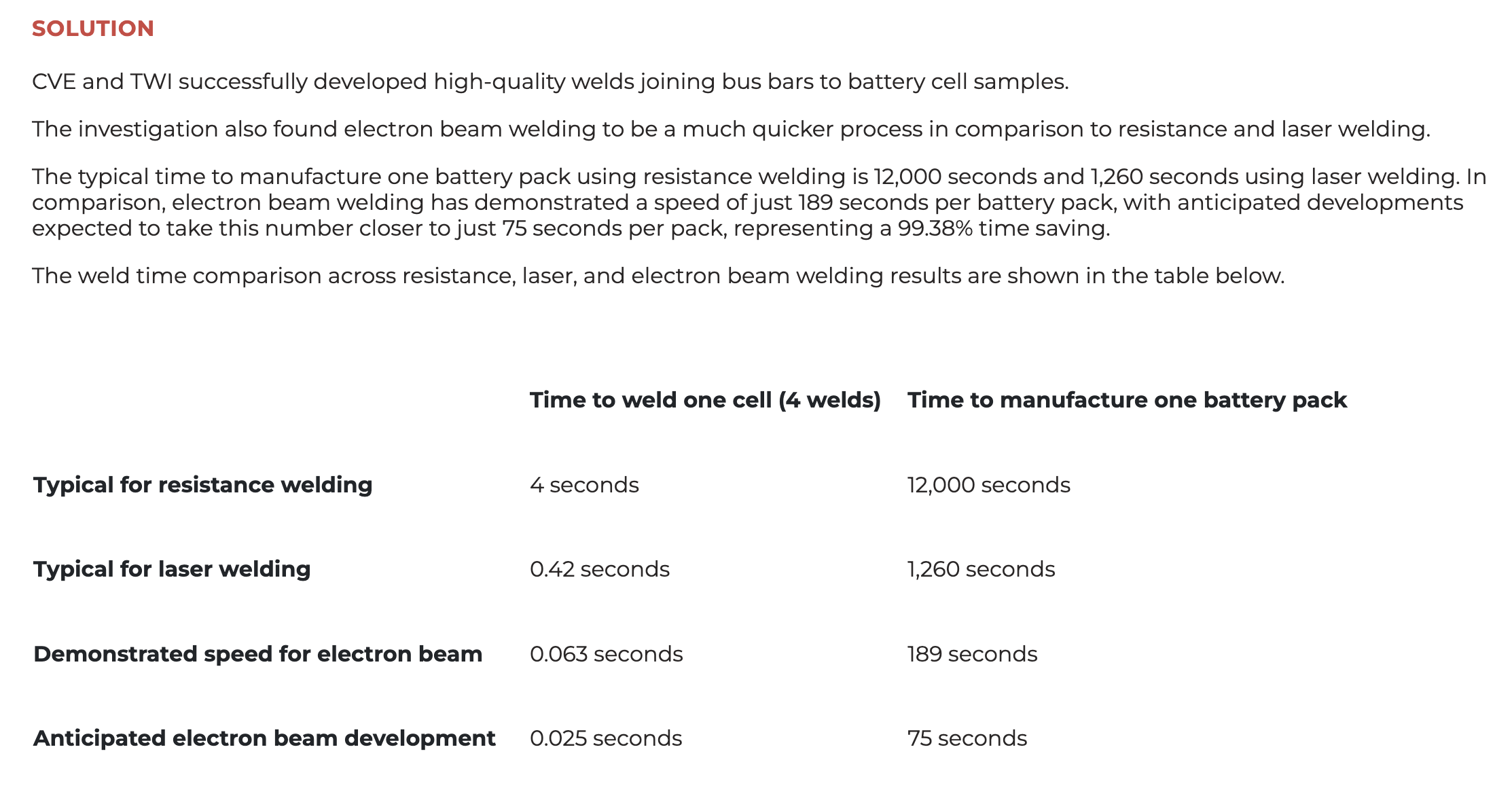
There was an investigation around using EBW and they found electron beam welding to be a much quicker process in comparison to resistance and laser welding.

The typical time to manufacture one battery pack using resistance welding is 12,000 seconds and 1,260 seconds using laser welding. In comparison, electron beam welding has demonstrated a speed of just 189 seconds per battery pack, with anticipated developments expected to take this number closer to just 75 seconds per pack, representing a 99.38% time saving.


The weld time comparison across resistance, laser, and electron beam welding results are shown in the table above.

(apologies for sharing a similar screenshot but just emphasizing the importance of EBW vs others)

How SBCL fits into the supply chain :-

  • Product makers (SBCL) → Take raw materials + processes, use EBW internally, and deliver finished busbar/shunt assemblies.
  • OEMs / Pack integrators → Receive ready-made EBW busbars and plug them directly into their module/pack manufacturing line.

And ISBH is EBW machine makers, contract welders.

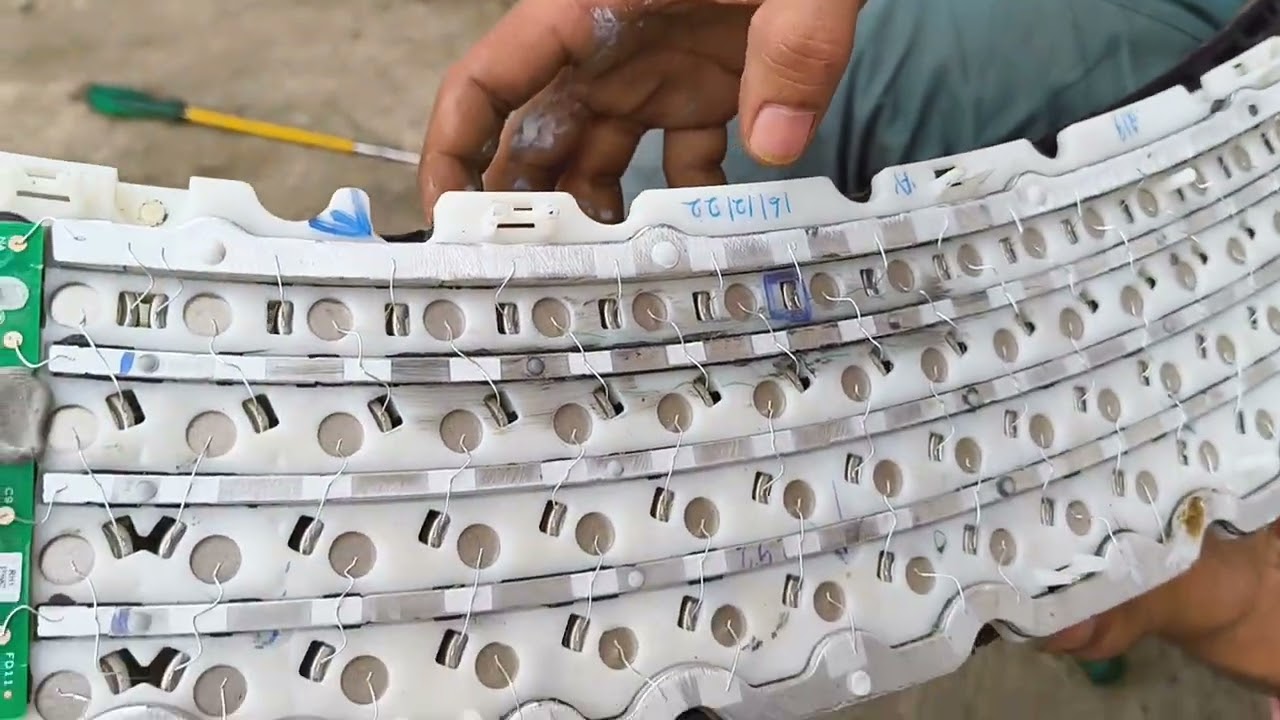
The ola 2W batt pack teardown is really good and provides a lot of good insights

  • The replacement cost , currently in the range of ₹66,000 to ₹88,000 , underscores that the battery pack remains one of the most valuable components in the scooter. Driving this cost down through localization efforts , such as the ramp-up of Ola’s own Bharat Cells , and by transitioning to higher-energy formats like 4680 cylindrical cells , will be critical to their competitive positioning.

Can be used a ref video too

15 Likes

Sbcl

  • Gross Margin: up 333 bps in Q2 and 296 bps in H1 to 47.08% and 45.84% respectively, reflecting improved mix and cost discipline.

  • YoY growth is visible and its kind of important coz they have stopped growing due to excessive stocking in last years.

  • QoQ flat - expected too given the stock px movement and Domestic smart meter companies threw the towel in results this season. Sbcl has some exposure to that front.

  • Achieved this in a steady volume environment, led by better price realisation, richer mix, and cost governance.

  • Looking ahead, our priorities are clear. Deepen forward-integration into assemblies, monetise EBW capacity with measured capex,

Awaiting an announcement on the new product front. Onto H2 and concall now.

@Donald Sir did you review results for SBCL ?

4 Likes

Q2-26 Con Call Highlights

  • India shunt sales grew 25.3%.
  • Asia excluding India sales grew by 38%, offsetting softness in Europe/US.
  • Focus on high-value assemblies, forward/backward integration, and improving cash conversion.
  • Q3/Q4 looks encouraging in terms of volume growth. So far, they are supplying pilot products. Once they start supplying commercial supplies, volume will grow.
  • Due to forward/backward integration in the next few quarters/years, expect margin improvement. From current 23% EBITA, it can improve by 200 basis points in the next 4 quarters.
  • Raw material does not have an impact as it is passthrough.
  • Q4 expected revenue contribution from PCBA to start and may contribute around 50-70 crore next year.
  • Data center and AI related business: Demand will grow 3-4 times in the next few years (on a smaller base). They sell some components which go into products that go directly into data centers. Currently, these components are imported but the company sees potential in local sourcing.
  • Working with partners to indigenize nickel alloy (started in Oct). Results have been encouraging and FY26 expects 25% of raw material sourced locally; the real benefit will be next year when indigenization reaches around 50%. This will improve cost of raw material as well as working capital cycle by up to 30 days.
  • Shunt demand comes from EV as well as from ICE vehicles. Growth is happening in Asia as many projects have started. Western markets are still figuring out what they want to do with EV.
  • Biggest growth market for EV, shunts, hybrid—specifically for two-wheeler EV—is coming from India. It has real potential to boost company sales in the short term.
  • Business has become resilient lately. A few years back, Vishay used to contribute 30-35% of revenue. Despite a sales de-growth of 20% CAGR from them, overall company revenue has grown 8-10% CAGR.
  • Vishay: Some of the business has shifted from them but received it indirectly from Vishay competitors. However, Vishay has some specialized products in development which need Shivalik products in them. So when their business materializes, they will benefit. If the business from them improves, it can come back to the same level as before within the next year itself. However, if the 50% tariff stays longer, it may impact the business as Vishay will look for alternatives.
  • Vishay was over-optimistic about their sales so they overordered, which resulted in building excess inventory currently undergoing correction.
  • Supplying to BYD through Vishay.
  • White label has already begun and will show in Q3/Q4.
  • PCBA advanced testing is ongoing at some customers. It shall contribute in Q4 but more meaningfully in the next year.
  • Earlier mentioned about 150 crore from PCBA. Not sure if this will materialize at the moment due to trade uncertainty.
  • Major Capex was done a couple of years back and not expecting significant capex in the near term.
  • In the process of entering into a new segment of electronic manufacturing. Shall announce soon.
  • Busbars: Working on IP-led development, still early to discuss.

US/Europe/US

  • Softness due to inventory correction as channel recalibration. Management expects this to be short term.
  • Underlying demand for precision resistor and assemblies remains strong.
  • 50% US tariff has impacted the sales. Although they have not lost sales, customers are ordering just enough. As a result, new orders and investor sentiment have been impacted. The company expects single-digit growth in FY26.
  • Aiming to get on-board OEMs directly but it is a time-consuming process.
  • US business has come down from 40% to 17-18%, but looks protected at the moment. Next year 15-17% growth is possible.
14 Likes

I heard Busbar few times but did not understand it properly, so did my own dig around.

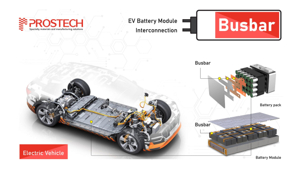
What is a Bus Bar in EV (answer from perplexity)?

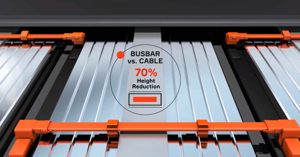
Busbar connectors in electric vehicles (EVs) are metallic strips or bars, typically made from copper, aluminum, or their alloys, used to conduct and distribute high-voltage electrical power efficiently within the vehicle’s electrical system. They serve as the main link connecting the battery pack cells and modules, transferring electrical energy from the battery to various vital systems such as the inverter, electric drive motor, onboard chargers, and control units.

In EVs, busbars replace traditional wiring to provide a more compact, lightweight, and robust connection that can carry higher current loads with minimal resistance and less power loss. This makes them critical for handling the high-voltage and high-current demands of modern EV battery systems, supporting efficient power delivery and safety. Furthermore, busbar connectors are often designed to withstand mechanical stresses such as vibrations, temperature changes, and thermal expansion encountered during vehicle operation, maintaining structural integrity and electrical reliability.

Using busbar connectors in EVs increases the mechanical and electrical capacity of battery modules, allows faster charging speeds by accommodating higher power flow, and improves thermal management by dissipating heat more effectively than conventional cabling. This technology also reduces the complexity and risk of wiring failures, lowers manufacturing costs, and facilitates easier maintenance and service, adding to overall vehicle reliability and performance.

Flexible busbar connectors are also common in EVs to integrate electrical connections within tightly spaced battery management systems, providing superior conductivity, flexibility, and reduced contact resistance.

I found above information helpful. Posting it here for the benefit of other who would like to understand it in little bit more details as Shivalik is targeting this segment.

13 Likes

Latest Concall highlights.

Future Outlook and Growth
• The new bus bar CAPEX and PCB assembly initiatives are expected to contribute significantly to revenue. Top 2 2w manufacturers would be sourcing it from Shivalik.
• ⁠Avg value addition per 2w is in the range of ₹2,000-3,000.
• ⁠Earlier these components were being imported.
• ⁠No competition in India in busbar assembly due to EB welding supremacy of Shivalik in India.
• ⁠Forecasted revenue for FY27 from these initiatives is 70-75 crores, growing to 150-200 crores in FY28, and 250-300 crores in FY29, that’s the reason for new facility in Pune.

• ⁠Have applied for ECMS scheme, likely to get approval from the govt. Were already in receipt of electronics PLI benefits.

• The company is actively developing domestic suppliers for raw materials to reduce working capital days.
• ⁠Shivalik is exploring new product verticals in the electronics application space, such as specific types of automotive fuses and inductors.
• ⁠More clarity on the tariff side, Shivalik Bimetal Controls Ltd. expects to see:

• Improved business from the US for both shunts and thermostatic bi-metals.
• A resumption of product developments that were paused due to tariff uncertainties, particularly for thermostatic bi-metal, as growth in that area can significantly come from the US market.
• The acceleration of the trend to convert raw material (strip) business into higher-value components (parts). This was partly driven by tariffs on copper and stainless steel in strip form, making component supply more advantageous even with reduced tariffs. This conversion will not only increases top-line value but also boosts the bottom line.
• Vishay business value returning to peak levels, as new components developed for major global EV manufacturers are now part of the company’s revenue.
• ⁠The company expects a 13-19% growth in the shunt business due to new customer developments, including Denso from Japan.

26 Likes

Q3 Call Highlights

General Update

  • EBITDA margin has improved to 24%.

  • Q3 remained challenging due to geopolitical uncertainty.

  • The company experienced reduced U.S. orders but expects this trend to reverse from Q4 onwards.

  • Margin expansion was driven by higher supplies of value-added products.

Business Overview

  • Operates in a high-entry-barrier segment.

  • Approvals are difficult to obtain, time-consuming, and have been built up over the years.

  • “Our aim is to be indispensable in the programs we participate in through reliability, responsiveness, and consistent quality. Over time, this translates into deeper share of wallet, stickier relationships, and more stable demand through cycles.”

  • The company aims to move up the value chain, improving value-added content per program as it scales.

  • Its forward integration journey focuses on participating in value chains where precision engineering commands premium pricing, since the customer’s cost of failure is high.

  • Future growth must come from improving economics and operational efficiency.

Segment Highlights

  • Target customers for the Electron Beam (EB) Welding business are primarily two-wheeler and four-wheeler manufacturers.

  • Previously, entire two-wheeler EV assemblies were imported, but growing local demand is driving domestic production—creating a strong demand opportunity for EB welding.

  • There is currently no competition in India, as no other firm offers EB welding capabilities domestically.

  • Each two-wheeler represents about ₹2,000–₹3,000 worth of components, with 60–65% material cost.

  • The business with Vishay has turned around, and the company expects to reach its previous peak volume by FY27.

  • In the Thermostatic Bimetal segment, real growth potential lies in the U.S. market. All major U.S. switchgear manufacturers are Shivalik’s customers. Once the tariff picture becomes clearer, the company plans to expand business with these clients.

  • Significant growth (18–20%) is expected in the Shunt business by FY27, driven by demand from Vishay, Denso (Japan), and 3–4 other Japanese OEMs, some of which have only recently started production.

Pune Facility

  • The Pune plant is a rented facility, currently in the ready-to-use phase.

  • It is being developed for bus bar and connector manufacturing, along with subsequent assembly operations.

  • The facility will support the e-mobility and energy storage application segments.

  • Launch is planned for 2026, with capacity addition beginning in Q1 FY27.

  • The project involves a ₹20 crore capex, fully funded through internal accruals.

  • The decision to set up the Pune facility was driven by strong order inflows requiring large-scale supply from April. Volumes turned out to be significantly higher than initially projected, prompting this expansion to be closer to key customers.

  • In FY27, the facility is expected to contribute around ₹70–80 crore in revenue, ramping up to ₹250–300 crore over the next 2–3 years.

U.S. Tariff Situation

(Turning challenges into opportunities)

  • The company did not lose any business due to the 50% tariff, though it did witness a substantial reduction in order volumes.

  • A large portion of U.S. exports previously consisted of raw EB-welded or shunt material—mainly welded strips supplied to Vishay.

  • Following the introduction of tariffs, both Vishay and Shivalik swiftly shifted from exporting raw strips to finished components.

  • This pivot was essential since the tariffs applied broadly to imports from India and included additional surcharges on copper and stainless steel.

  • Even as tariffs reduce to 18%, exporting raw material would remain unviable. However, by transitioning to component exports, the company has enhanced the value of its U.S. sales.

  • It now expects growth in exports of shunts and thermostatic bimetal components over the next few quarters.

  • Despite short-term disruption, the tariff situation ultimately turned into an opportunity, enabling higher-margin and more value-added exports.


New Products

  • The company is exploring the automatic fuse category, remaining open to technology tie-ups or acquisitions. This area offers room for innovation by integrating EB welding and developing new products.

  • It is also evaluating opportunities in automotive inductors, aligning with its precision engineering and automotive segment focus.

My Take

Q3 was a breakthrough quarter for Shivalik. The company successfully turned challenges into opportunities in its U.S. business by shifting focus toward selling more components rather than raw materials. What might have otherwise taken 18–24 months to achieve was accomplished within a single quarter, leading to a more profitable, higher-margin business mix.

Additionally, the Vishay business is gaining strong traction and is expected to reach new highs by FY27.

The decision to set up operations in Pune appears well-timed and strategically sound. By expanding beyond Solan and moving closer to the automotive and EV hub of Pune, Shivalik is positioning itself at the center of future growth. This proximity not only enhances business visibility, as management highlighted during the call, but also creates opportunities to collaborate more closely with leading EV manufacturersBajaj Auto being a likely example. Over time, the Pune facility should yield substantial benefits in terms of higher business volumes and deeper customer partnerships.

Note: Invested

21 Likes

Shivalik Bimetal Controls -

Q3 FY 26 results and Concall highlights -

Shivalik Bimetal Controls Limited (SBCL) is India’s only fully integrated manufacturer of precision thermostatic bimetals, low‑ohmic shunt resistors and silver contacts, critical components that enable accurate sensing, switching and thermal control across electric vehicles, smart meters, switchgear and energy‑storage systems

Headquartered in Himachal Pradesh with three manufacturing campuses and sales nodes in the US, EU and Asia, SBCL partners with 300+ OEMs/Tier‑1s in 38 countries

Details of company’s product portfolio -

Shunt Resistors - ultra low ohmic current sensing components. One can think of them as electrical traffic cops - precisely measuring the flow of current in a circuit. Company makes these components using Electronic beam welding - a difficult technology to master. These shunt resistors find applications in - BMS, Smart meters, Industrial drives, Gas metering, Charging Infra, Power modules

Thermostatic Bimetals - these r metal alloy strips that bend predictably with heat - causing opening / closing of circuits. Used as essential components for protection against overheating, for temperature control in various devices. Primarily used in - swithgears, geysers, irons, automotive thermostats and other Industrial applications

Electrical Contacts - they facilitate the on/off switching of circuits, regulating the flow of electrical power. Used in lighting and wire accessories, circuit breakers, smart meter latching relays, auto and electrical appliances. Company offers end solutions to market by providing ready to use sub-assemblies, combining the manufacturing of electrical contacts and joining them onto complex sheet metal stampings

Company’s Manufacturing facilities -

Plant 1 Solan - EB welded shunt resistors - peak revenue potential of 700 cr

Plant 2 Solan - Thermostatic Bimetals - peak revenue potential of 600 cr

Plant 3 Solan - Electrical contacts - peak revenue potential of 300 cr

Company’s expertise in Electronic beam welding -

Imagine using a super-focused, high-speed beam of tinyparticles (electrons) to melt and fuse metals like copper and manganese together with incredible accuracy

Think of it like a very precise beam welder, but instead oflight, it uses electrons in a vacuum to create strong and clean joints

Shivalik can build these specialised welding machines themselves for about half the cost of buying them from overseas

This allows us to make industry-leading shunt resistors that can measure electrical current with very high precision. Only a few companies have this expertise & SBCL stands as a leading EBW welder globally with large capacity

Company’s expertise in Diffusion Bonding -

Picture pressing different metals together very tightly under high heat and pressure for a specific time. Over time, the atoms from each metal mingle and create a strong, seamless bond, almost like they’ve become one, without disturbing the original properties of the alloys joined

It’s like slowly merging two pieces of dough together by pressing them, they become a single piece

This process allows Shivalik to quickly develop new combinations of metals (bimetals) with specific properties, which are essential for customers in industries like switchgear, HVAC, and electrical appliances

This can lock customers into using Shivalik’s designs for many years. Shivalik manufactures grades of bimetals using this method as a critical component with high-switching costs for global marquee clientele

In the same way, cold pressure bonding is also part of

Shivalik’s machinery capabilities, following the same process of diffusion bonding without heat

Q3 outcomes -

Revenues - 134 vs 123 cr, up 9 pc

Gross margins - 47 vs 44 pc

EBITDA - 32 vs 25 cr, up 30 pc ( margins @ 24 vs 20 pc )

PAT - 22 vs 18 cr, up 22 pc ( includes one time impact of aprox 1 cr towards implementation of new labour codes )

Sales breakup - Shunts : Bimetals @ 55:55 cr vs 51:55 cr

9M FY 26 outcomes -

Revenues - 408 vs 375 cr, up 8 pc

GMs @ 46 vs 43 pc

EBITDA - 95 vs 75 cr, up 27 pc ( margins @ 23 vs 20 pc )

PAT - 70 vs 55 cr, up 25 pc

Sales breakup - Shunts : Bimetals @ 171:174 cr vs 157:166 cr

Export : Domestic sales mix @ 56:44

For 9Ms FY 26 - GM expansion led by cost controls, favourable product mix, better operating leverage. EBITDA margin expansion led by operating leverage

Board has approved to set up an automotive busbars and assembly facility near Pune. Should go live by Q1 FY 27. Capex required for this facility should be around 20 cr - to be funded via internal accruals

US business for both Shunts and Bimetals should see substantial improvement wef Q4 as the tariffs stand reduced. Seeing that play out in real time

Company already has orders in hand for BusBars. Company was already supplying these in smaller Qty. As the order build up is picking up, they r obliged to expand their capacities in Pune ( near OEMs )

Should be able to clock 70 cr business in FY 27. By FY 29, this should ramp up to Rs 250-300 cr / yr kind of business

Making of BusBar assemblies requires EB welding ( just like shunt resistors ). Hence - it’s a natural extension for the company. At present, shall be making them for E-2W applications. Company is supplying to Bajaj and TVS e-2Ws. At present, no one else makes these BusBar assemblies in India. These BusBars should clock 14-15 pc kind of EBITDA margins

Value per BusBar assembly per vehicle should vary between Rs 1500 - 2500 / vehicle depending on the type of battery / electronics being used

Company’s supplies to Vishay Ltd ( in US ) are expected to be back to their peak levels ( last seen 2-3 yrs back ) - an added positive trigger

There are hardly any switchgear manufacturers in India who are not already company’s customer for Bimetals. Company now intends to gain mkt share in US

Also developing E-4W busbar assemblies in house. Once developed and accepted, can be a future growth engine

Busbar assembly made from EB welding process are inherently better than Busbars made from other techniques. EB welding is the most precise and efficient form of welding and doesn’t affect the flow of current even at the point of joint of 2 different materials

Looking to enter the Automotive Fuses space - used in Power window / Powered tailgates etc. These r high value fuses. The process of making these fuses also involves EB welding. Also looking at Automotive inductors ( used in ADAS, ECU systems )

Since the company already has the EB welding facilities, the incremental capex for the busbar assemblies is only @ 20 cr. This is just the assembly work ( after EB welding ). Hence, they ll be able to start supplies as soon as Apr 26

Topline growth in first 9Ms FY 26 has been @ 8-9 pc. Going forward, it should accelerate

Electrification of economy, demand from EVs, Data centres - all are tail winds for appliances / switchgears that use Shunts and Bimetals

Growth in Shunts business in FY 27 should be strong ie in mid to high teens ( on back of demand from Vishay, Denso and 2 more Japanese players )

Disc: hold a small tracking position, may add if company is able to deliver on its promises, not SEBI registered, not a buy/sell recommendation, posted only for educational purposes

6 Likes

Potential Indirect Tailwind for Shivalik Bimetal from Fuel Supply Uncertainty

The recent uncertainty surrounding LPG and petroleum product supply could act as a marginal catalyst for electric vehicle (EV) adoption , which may indirectly benefit component suppliers such as Shivalik Bimetal Controls Ltd.

Concerns about fuel availability—whether due to geopolitical disruptions or supply-chain constraints—can influence consumer perceptions regarding the reliability of conventional fuels. In certain regions, there have been reports of temporary supply disruptions or concerns about potential shortages of LPG and other fuels used in vehicles , which may prompt consumers to consider alternatives.

In contrast, EVs rely on electricity, which in India is supported by a rapidly expanding renewable energy base , particularly solar generation. India currently has significant solar capacity additions and periods of surplus daytime generation , which improves the long-term economics of EV charging. For consumers with rooftop solar installations, the effective marginal cost of charging an EV can be very low.

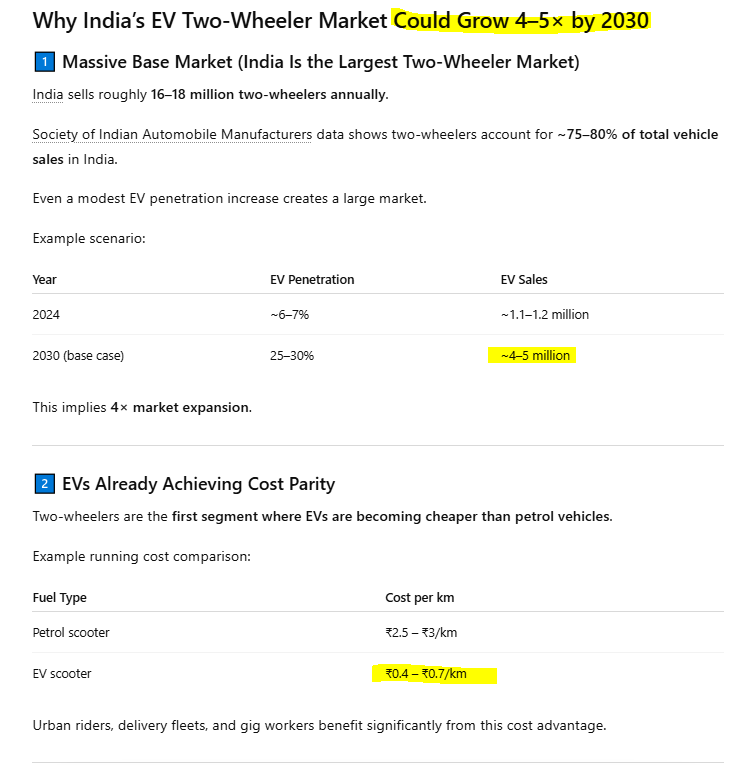
While fuel supply concerns alone are unlikely to drive large-scale EV adoption, they may accelerate decision-making for consumers already considering EV purchases , particularly in the two-wheeler segment where cost parity with internal combustion vehicles is increasingly visible.

This dynamic could indirectly support demand for EV components supplied by Shivalik. The company already supplies busbars and related components used in EV battery packs and power electronics to leading two-wheeler EV manufacturers in India.

Additionally, Shivalik’s Pune assembly facility is strategically located within a key automotive manufacturing cluster, positioning the company well to support the expanding EV ecosystem as OEM production scales.

Overall, while the current fuel supply situation is unlikely to be a primary driver of EV adoption, it may serve as a supportive narrative reinforcing the long-term transition toward electrification , which remains a structural growth opportunity for Shivalik Bimetal.

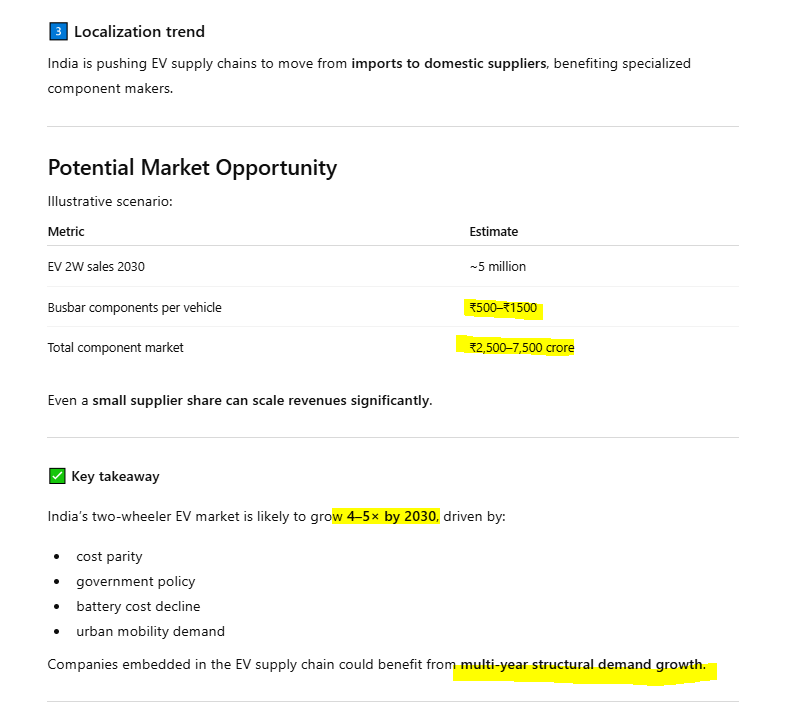
Overall EV market shall grow 4X in the next 4 years

..and Busbar market size could be 2500 to 7500 cr (overall)

Note: Invested. Used AI to rephrase thoughts.

9 Likes