
“The journey of a thousand miles begins with a single step” – Lao Tzu.
Yes, it is indeed heartening that India has become serious about REE and semiconductors. And my intention is certainly not to dissuade investors keen on the REE opportunity. But simply to discuss the realities. While India has set aside a significant sum for the development of this sector, it may be several years before we can see meaningful production esp. at the industrial level. Also, with inherently low supplies of certain key raw materials like dysprosium and terbium, India may very well still have to be dependent on China for raw materials. If and when we are finally able to manufacture RE magnets, the issue of cheap Chinese imports will have to be dealt with, similar to solar glass.
Investors will need to have patience and track this space closely.
Coal India is scouting for Rare Earth partnerships in Australia, Russia, Argentina, Chile, and Africa. The expansion will be fueled by the proceeds of the BCCL IPO, I think.
@karanshah137
Not able to get access to the link
@1957 it’s Working on my end; try using Incognito Mode or Clear Cookies

RecycleKaro inaugurated a Rare Earths and Advanced Materials Research Centre in Wada, Palghar (Maharashtra).
it’s a 5-acre research hub with a multi-year roadmap on urban mining and scaling recovery processes for rare and critical metals from complex e-waste like batteries and electronics.
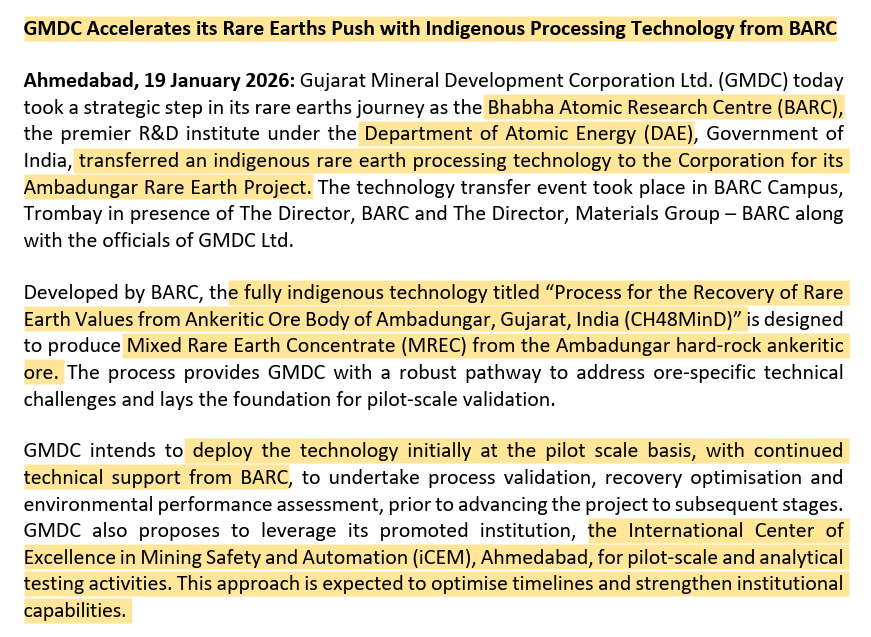
By adopting BARC’s indigenous “CH48MinD” technology, GMDC is tackling the complex technical challenge of recovering rare earth values from Ambadungar’s unique ankeritic ore. Honestly, it’s a pretty big deal for GMDC, moving from its roots as a lignite leader to becoming a cornerstone of India’s high-tech, green energy future. Right now, they’re doing some pilot testing at the iCEM facility in Ahmedabad just to make sure the process is efficient.
Read what management said here:
A bit about Aequs


Government is under-investing in a sector it claims to prioritize. Scaling up requires more than just mining. We require significant investment in downstream separation facilities and complex chemical plants that turn raw ore into usable oxides.
Mining is the easy part. Without foreign processing tech and downstream tie-ups, this goes nowhere for a decade. Near-term upside is limited to REO recycling players, everything else is policy theatre.

India’s latest move on rare earths
The Trump administration’s move comes days after India announced plans to give a boost to its government’s rare earths scheme. During the Union Budget 2026-27 presentation on February 1, finance minister Nirmala Sitharaman said that the government would support mineral-rich states like Andhra Pradesh, Kerala, Tamil Nadu and Odisha to develop dedicated rare earth corridors.
She also announced the Indian Semiconductor Mission 2.0, aimed at expanding the country’s semiconductor mission and give China’s competitive semiconductor industry a tough fight and break its monopoly.
Even as Jaishankar addressed ministeral meeting in the US, he highlighted India’s efforts in the critical minerals domain through initiatives including National Critical Minerals Mission and rare rarth corridors.
India’s backing of the US’s latest initiative to counter China’s global dominance on critical minerals also assumes significance because it comes days after New Delhi and Washington sealed a trade deal. As part of the agreement, the existing US tariffs on Indian imports were cut down to 18% from 50%.
54-country bloc designed to create a secure China-free supply chain for critical minerals and rare earths. Jaishankar recently attended a high-level summit in Washington, D.C., confirming India’s participation in the bloc. China currently controls approximately 70% of global rare earth mining and over 90% of processing capacity.
Interestingly, China has responded to these moves by tightening its own export licenses and restricting the export of rare earth processing technology. China has also reportedly pressured India not to divert supplies to the U.S.
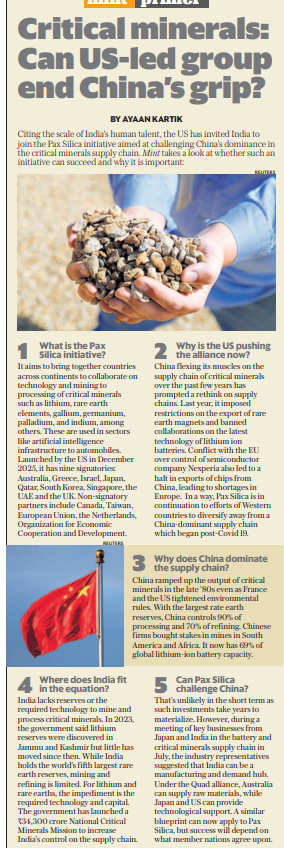
- The Pax Silica Initiative
Launched in December 2025, this alliance aims to foster global collaboration on the mining and processing of minerals essential for AI, tech, and automobiles (e.g., lithium, rare earths, gallium, and germanium).
-
Signatories: Nine countries including Australia, Japan, South Korea, Singapore, and the UAE.
-
Partners: Includes Canada, Taiwan, the EU, and the OECD.
2. Why the Alliance Exists
The US is pushing this now to counter China’s “muscle-flexing.” China has recently:
-
Imposed export restrictions on rare earth magnets.
-
Banned collaborations on lithium-ion battery technology.
-
Caused chip shortages in Europe following conflicts over company control (Nexperia).
3. China’s Current Dominance
China began scaling production in the 1980s while Western nations tightened environmental rules. Today, China controls:
-
90% of mineral processing.
-
70% of refining.
-
69% of global lithium-ion battery capacity.
4. India’s Role and Challenges
The US has invited India due to its vast “human talent,” but India faces significant hurdles:
-
Infrastructure: While India has the world’s 5th largest rare earth reserves, it lacks the technology and capital for mining and refining.
-
Action: The government has launched a ₹34,300 crore National Critical Minerals Mission to bridge this gap.
5. Can it Succeed?
The article suggests a challenge is unlikely in the short term because mineral investments take years to yield results. However, a “Quad-style” blueprint could work: Australia supplies raw materials, while the US and Japan provide the technology, and India serves as the manufacturing hub.[Summary From Gemini]
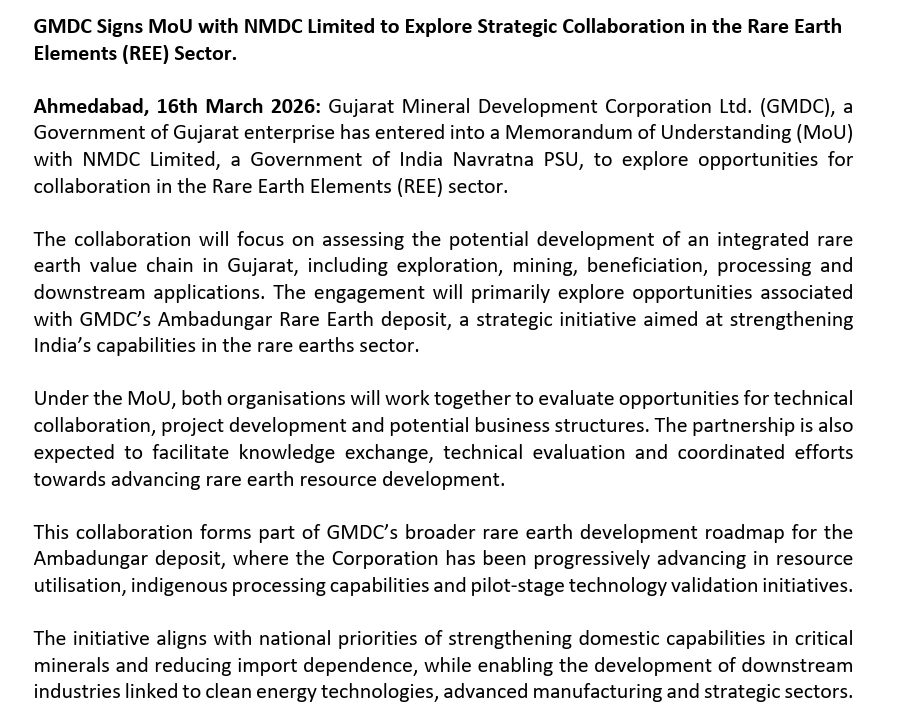
GMDC Signs MoU with NMDC to Explore Strategic Collaboration in the Rare Earth Elements (REE) Sector