Midwest Ltd
Midwest Ltd
Key things to note:
This was the missing piece for India’s EV & Wind Energy supply chain. Massive tailwinds for speciality chemicals and advanced metallurgy players.
The era of Sintered NdFeB begins now.
midwest Ltd into magnet
Just a clarification…The magnet business is unrelated to Midwest ltd…It’s a private firm in the name of Midwest Energy, which will get merged with Midwest Gold (listed) later.
India’s sitting on a literal goldmine right now. We’ve got the 3rd largest reserves of rare earth elements in the world, and honestly, these things are basically the “new oil,” since you need them for everything from EVs to fighter jets.
But there’s this huge irony. Even though we’re holding nearly 7% of what’s available globally, we’re somehow contributing less than 1% to actual production. Meanwhile, China’s basically running the show, handling about 90% of the refining.
Rare Earths are actually not very rare. What is rare is the processing of rare earths. Processing rare earth ore is a highly polluting and toxic process. First tones of ore are broken & ground. Then, hazardous chemicals are used for leaching and purification. When done in scale, these processes contaminate the environment, groundwater, and agriculture.
After all the stages are done, you may end with a few grams of rare earths from tonnes of ore, which are then sent for processing for greater purity.
It is because of the hazardous and polluting nature of the work, Europe and the US outsourced so much processing of rare earths to China that today China has nearly 90% of the world’s processing capacity of rare earth. Recommend The Rare Metals War: the dark side of clean energy and digital technologies by Guillaume Pitron for in-depth reading.
Totally agree with the processing point here, that’s where the real bottleneck and pollution risk lies.
But I’d slightly disagree on the Pollution angle.
Australia (Lynas) processes rare earths outside China under far stricter environmental norms. It’s more expensive, slower, and heavily regulated, but it proves that the capability does exist when policy, incentives, and strategic intent align.
The reason the US/EU outsourced wasn’t just pollution, it was also cost minimisation + complacency during decades of stable geopolitics. Today, with supply-chain risk being repriced, we’re already seeing processing capacity slowly move back despite higher costs.
So, everyone agrees that refining is the toughest challenge in rare earth elements production? Then why did we start with mining REE when we could have captured the refining diversifcation? Or am I missing something?
@Ankit_Mishra Well, Refining rare earths is the hardest and most valuable part, but you can’t realistically start there without mining first. Refineries need a steady supply of ore with known quality and composition; otherwise, they’re too risky and expensive to run. Mining gives countries control over raw material, real data about the ore, trained people, and regulatory experience, all of which are essential before building complex refining plants. So governments start with mining as the entry point, even if margins are low, and then move step-by-step toward refining and magnets.
China has huge amounts of unpopulated land. Nearly all of its population lives hugging the coast while we have very little unpopulated land in comparison. This makes mining much much easier for them. Just wanted to share this here.
That’s a valid point; land availability does make initial mining easier.
But I’d add one nuance: China’s real edge wasn’t just empty land; it was policy tolerance as well
The decisive advantage was centralized decision-making and long-term strategic focus, not just unpopulated land.
In a communist autocracy, the state can override local opposition, fast-track approvals, relocate communities, and absorb environmental costs in the name of national strategy. China could push mining and refining even when it was dirty, unpopular, or loss-making.
You very well know our democracy and its problems. Still, we can just hope, as this is very critical for our future
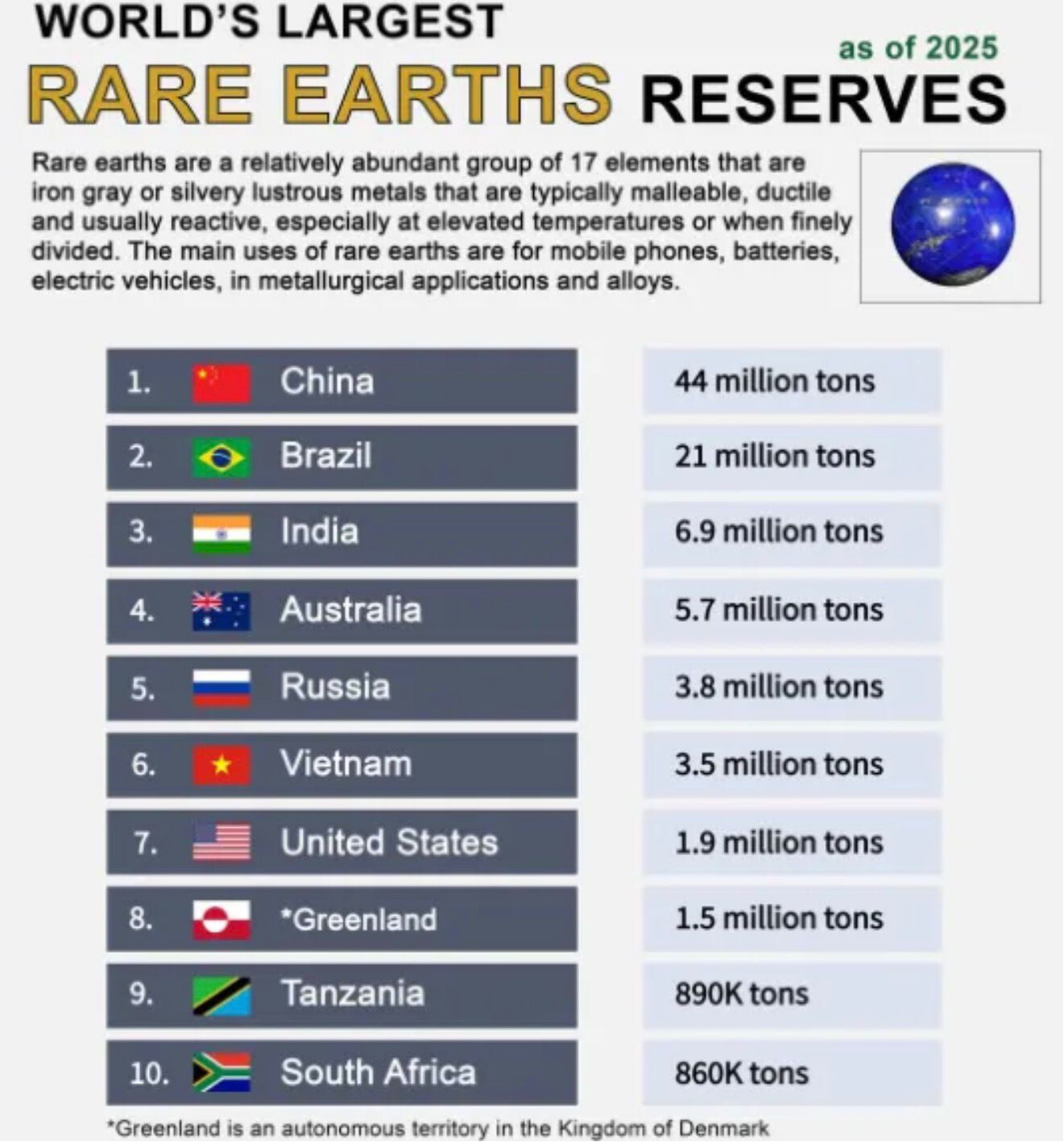
What really stands out is China’s massive lead. China alone holds about 44 million tons, far ahead of Brazil at 21 million and then India Australia Russia and others much lower down. This dominance is not just about mining but also about processing and refining where China is already years ahead of everyone else.
This also explains why Trump was so keen on Greenland. After the earlier focus on oil rich regions like Venezuela the global focus has clearly shifted from oil to metals and mining. Greenland may look small on the map but it holds strategically important rare earth deposits and gives long term leverage outside China.
The world has now clearly understood one thing very well future power will belong to those who control critical minerals. AI EVs semiconductors quantum physics and next generation defense systems cannot exist without them. This is exactly where China currently sits miles ahead of the rest of the world and that gap will be very hard to close.
https://www.techinasia.com/news/qatar-uae-to-join-us-led-ai-chip-initiative-pax-silica
India Soon to Join Pax Silicia - Sergio Gor
Fingers crossed i hope they focus on this and AI for better future else we wont stand anywhere against USA and China
India’s huge growth can come from recycling of metals (eg batx energies ltd)
Foreseen challenges to India’s rare earth ambitions
It may be challenging , but can we think of an alternative?
Leave aside REE’s use in Auto , Defence , EV, Renewables, Consumer electronics etc , India has a nuclear power target of 22 GW by 2032 (tripling from existing 7 GW) and 200 GW by 2047 for which REE plays a crucial role.
China started its full scale operation on REE in 1980 and became the leader. but we became a laggard though India started its operation in 1950 through Indian Rare Earth limited- a PSU under DAE for processing Monazite sand and getting Thorium & Uranium.
It was a lack of foresight that we went slow though we have the third largest deposits of REE. In the world. It is strange but true that till date India has been exporting REE such as Lanthanum, Cerium, Neodymium-Praseodymium, Samarium, Europium, Gadolinium and Yttrium (with more than 99% Purity) to countries like USA, Japan , UK, France even China.
With China taking the entire world on ride for rare earth, elements, India seems to have tightened it’s belt. SHANTI BILL passed and now Full scale plan for nuclear power which would also necessitate revamping our REE capacity.