SBFC Finance Ltd

I was surprised to see there are no active threads for this well run ~ $1Bn NBFC. So here goes (all data as of Mar’26 and beyond):

SBFC Finance Limited is an NBFC catering specifically to Small Business Owners and Self employed individuals. These include primarily MSME Service customers like shopkeepers, proprietors, traders, restaurants etc.(not manufacturers). The company approaches them with a loan ticket size of 5L - 30L as Loan Against Property (LAP) or Loan Against Gold (LAG).

Management & History

  • Company was started by Aseem Dhru (Executive Vice Chairman) and Mahesh Dayani (CEO) in Sep’17. They commenced business by buying out the retail portfolio of Karvy Financial Services in this year.
  • Mr Dhru is a veteran banker, with ~20 yrs track record with HDFC Group. He was instrumental in setting up the business banking team under Aditya Puri and served as Group Head. He also served as the MD&CEO of HDFC Securities for ~7 yrs. Mahesh Dayani has ~22 yr experience across HDFC, Kotak and ICICI in retail assets.
  • They were backed by Singapore based Clermont Financial Group and Arpwood Group, who infused ~845 crs into the company in FY18. They followed it up with another ~250 Crs in Apr’22.
  • In Aug’23, SBFC came out with ~1025 crs IPO, of which 600 Crs was Fresh issue and 425 Crs OFS. Prior to this, in May’23 it had also raised ~150 crs from Amansa (Akash Prakash).
  • Arpwood reduced their stake in the IPO, and finally completed exited in APr’24. Clermont has been trimming their stake from 55.2% at IPO to ~52.3% currently. Other prominent current shareholders include Aseem Dhru 2.99%, Mahesh Dayani 1%, Amansa 3.6%

Assets:

  • The company has total AUM of >11,900 Crs across 2L+ active customers.
  • It is present in 201 cities in 18+ states with 256 branches. Region wise AUM, ~35% each in North and South, 16% in West and 14% in East
  • Entire book is self-sourced (not reliant on DSAs). >99% of book is secured.
  • ~75% of the book is secured LAP and ~24% LAG
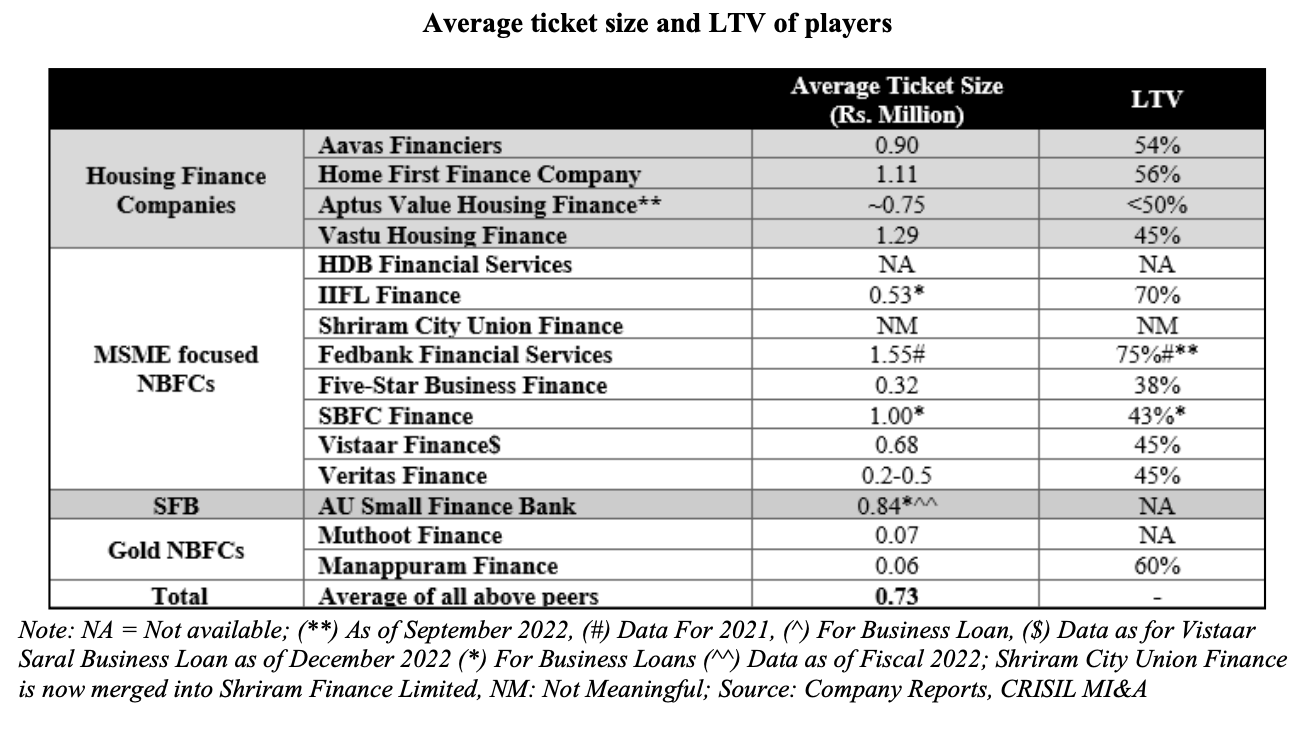
  • For LAP, Avg ticket size is ~10.5L at LTVs of 42.7% (~2.3x cover). Avg tenor is ~9-10Years (as of FY23)
  • For LAG, Avg ticket size is ~1.3L at LTV of 70.4% (1.4x cover). Avg tenor is ~9-11M
  • Of the LAP book, ~53% is Retail Trade, ~31% is other service and ~8% is Agri
  • Asset Quality: GNPA of ~2.66% and Net 1.55% (PCR ~42%) (Jun’26)
  • LAP: GNPA 3.14% ; LAG: GNPA 0.46% (Mar’26)

Liability Profile:

  • ~8,858 Crs debt, rated AA- (Stable). Avg borrowing cost ~8.4% (Jun’267)
  • ~57% is bank loans, ~14% is ECB/FCNR, ~8% NCDs
  • Maturity profile: Upto 1 yr~37%, 1-3 Yrs 46%, 3-5 yrs 17%

Key Financials & Ratios
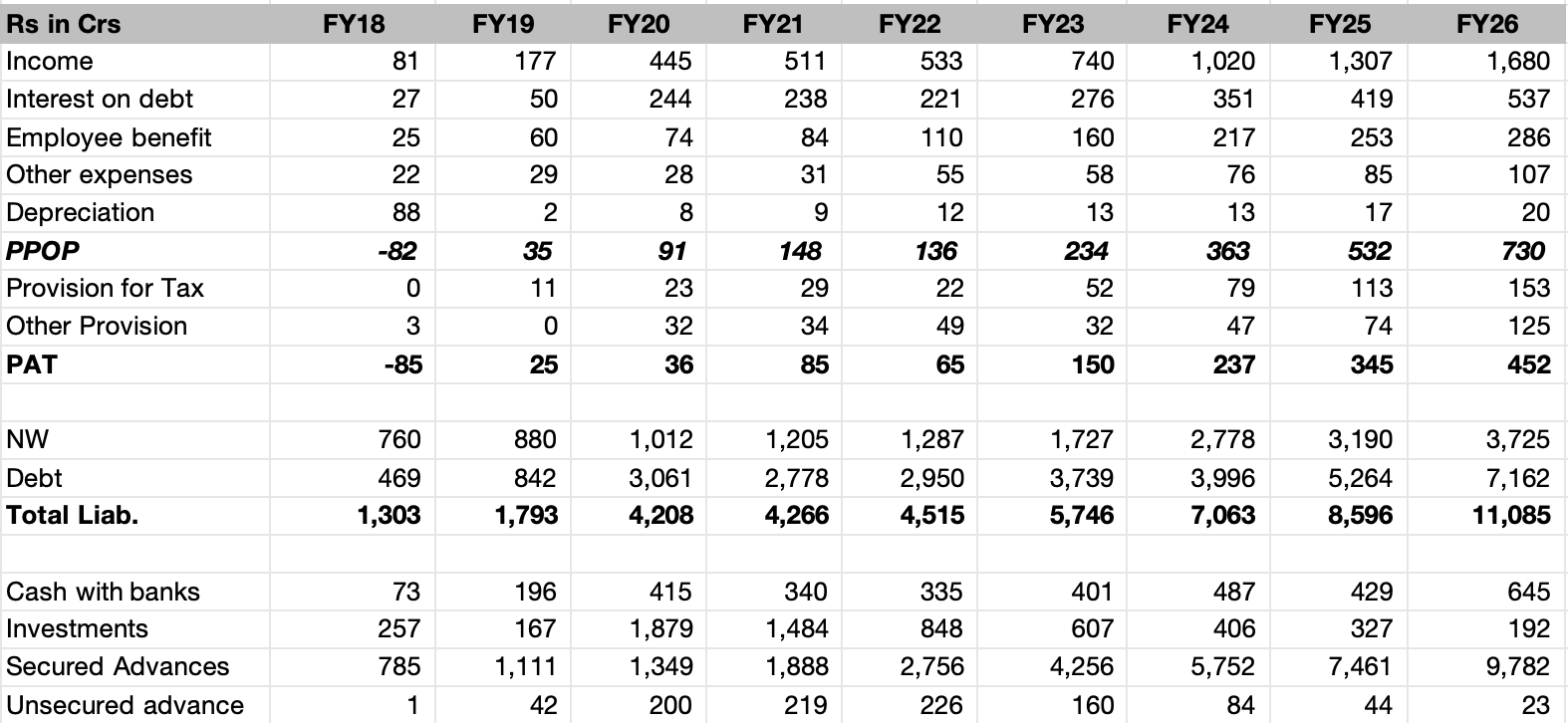
  • RoA Tree

A note on credit quality and growth and returns: If you notice, its AUM has grown by ~33% CAGR since FY19. Income yields are very high at ~17%. But despite this, GNPAs have averaged <2.5-2.6% indicating tight underwriting. A Caveat, high growth leads to expanding AUM making GNPA %age look optically smaller. Even if I take current GNPA with 2 yr old AUM, Avg. ratio is ~5%. Bajaj Fin. GNPAs are at 0.96%, and those on 2 yr old AUM at ~1.5%

Low credit costs, controlled opex and low interest costs lead to high RoAs of 4.5%. Multiply it with leverage and you get increasing ROEs of 13%. Higher RoAs are coming from increasing yields in recent years - company might be tilting towards riskier lending. As 75% of the book is ~10 yrs, impact on NPAs with full seasoning remains to be seen. PCR is also pretty low at ~42%, vs almost 60% for Bajaj Finance.

Leverage is quite low by industry standard - Bajaj fin. operates at ~4.7x, although its portfolio is granular retail (with lower GNPAs ~0.96% and RoA of ~3.8%). Bajaj Fin. ROE at 17.9%

Overall, great conservative and qualified management, growing & secured book, growing ROE, impact of portfolio seasoning needs to be monitored.
4 Likes

Risks:

  • As yet full seasoning of asset book is to be seen. Avg. tenor of loans around 5 yrs back was much higher at 12-13 years.
  • High growth rates and increasing yields on loan need to be watched. Customer segment is Service MSMEs, highly dependent on Urban consumption. In case of economy slowing down, the segment may be hit adversely.
  • Aseem Dhru wanted to retire at the start of this year into a non-executive role - he was persuaded by mgmt. to stay back, and continue as Exec. VC.
  • Long Term Committment of promoters - Clermont Group - to Indian mkts is not known. It remains a key overhang in case the decide to sell. Although with such a large block, they will need to sell to a competitor.

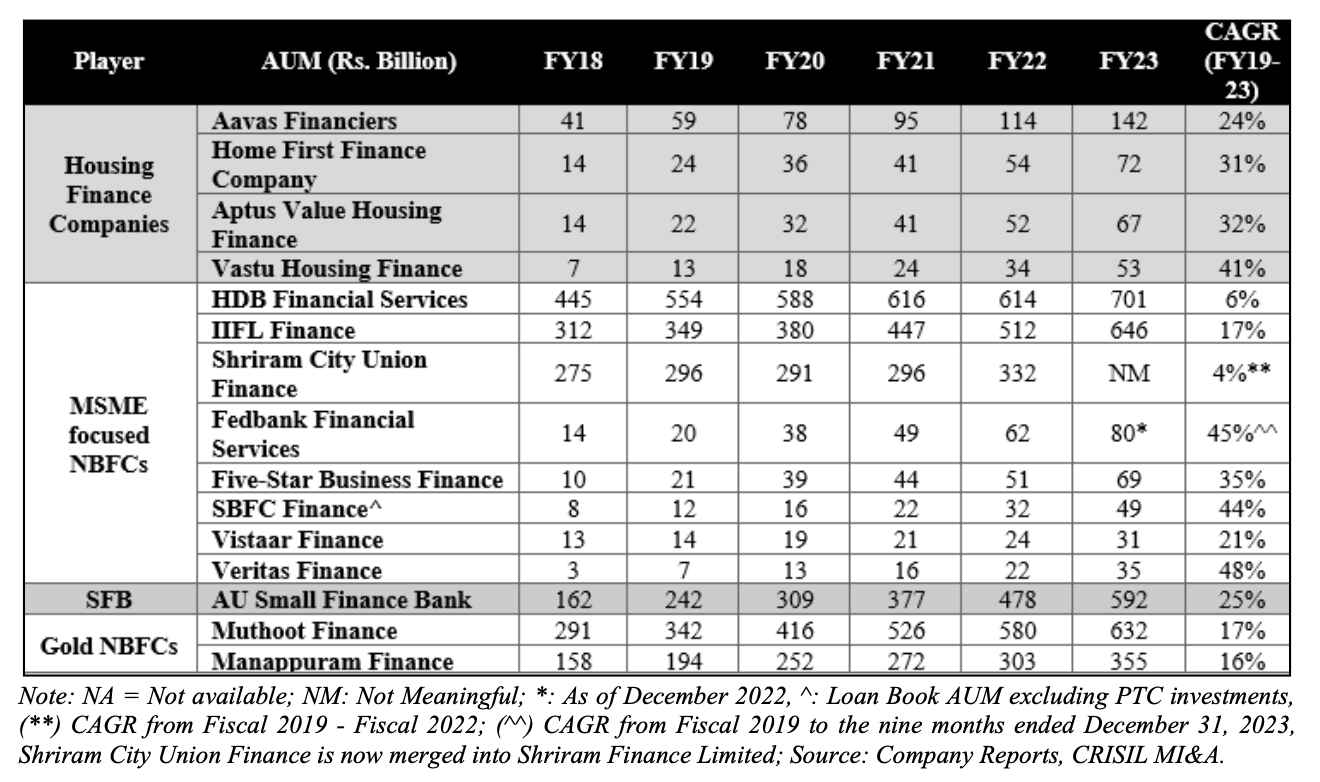
Competition

Disc: Invested

3 Likes

Would be nice to understand what’s the ideal P/B for msme lending sector in India. From the looks of it, i would assume Fivestar business as the most comparable name with SBFC.

Fivestar trades at 2x P/B now, after massive derating over last 12 mths. If I remember correctly, their income yields were north of 20% and ROE also healthy 18-20%. Promoter also has 3 decades experience running the company.

SBFC now trades at 2.5x P/B. Sectoral headwind includes rising competition. Lot of MFI’s (CaG, Satin, Spandana) were also entering the micro LAP segment.

Do you consider SBFC valuation to be reasonable? I did some brief research 2 yrs back and learnt secured lenders valued at 2.5-3x is reasonable while unsecured names deserve 1.5-2x. Not sure about these numbers given current market scenarios

2 Likes

@Rishidar Hi. Five-star’s target segment is Avg Ticket Size of 3-5L. I think they would sit in a segment lower than that of SBFC. Also, looking at their Avg. intt. yields of 25% and above on advances, I would place them more towards the informal and un-organized micro side of MSME segment. Personally for me, at those levels of intt. rates, a lending business starts looking more like they are aiming for only a return on investment, rather than the return of their investment. But, even SBFC has int. yields of 18%, so the distinction is mostly subjective I guess.

On the valuation part, I found SBFC to be reasonably valued, hence my investment in the business. On the P/B multiples, I would love a P/B<1x :grinning_face: .

2x or 3x or 1.5x is highly subjective and personal to the investor.

At the risk of sounding too patronizing, how I tend to look at it would be like this:

Business returns

  • Assume the book-value of an NBFC today is 100 crs. It earns 13% RoE, or a PAT of 13 crs. Assume the business will be able to sustain a 13% ROE for the next 10 years. At the end of Year 10, BV is going to increase to 339 Crs.

  • I get a chance to buy this business today for 2.5x BV, i.e. for 250 crs. I buy entire 100% and take it private, and hold the business for 10 years. Because I paid more than the BV, my return from holding the business will be less than the RoE it earns on the invested BV

For eg., in Year 1, business still earns 13 crs PAT. But on my purchase price of 250 Crs, my RoE comes to 5.2% (or 13% divided by 2.5)

Because the business is unlisted, I continue to hold it at 250 Crs value. At Year 10, it is now earning a PAT of 39 Crs, or 15.6% RoE on my 250 Crs investment. Further, my P/B has now reduced to 0.74x (250 divided by actual business BV of 339 Crs). My RoE reaches 13% somewhere between Year 8 and Year 9.

So, a) Paying a higher P/B multiple today only makes it longer for me to realize an adequate return from the business. b) If the business that I bought above, now suddenly increases the ROE that it earns to 18%, the ROE on my purchase price crosses 13% much faster, in year 4 itself.

A 2x P/B or 2.5x or even 5xP/B (like for Bajaj Finance) is then entirely a subjective matter. It is essentially a bet on a) how durable is the RoE (how long can it last) and b) can it increase going froward?

Valuation Return

  • Now, even in my first example, if at end of Year 10, I can sell the business at the same mutliple that i bought it at i.e. 2.5x, I will realize ~847.5 Crs which is 13% CAGR on my investment, the rate that the business itself earned.
  • If I sell at a higher multiple, I would earn even higher rate of return - 13% would be from business itself, and the balance would be from the valuation re-rating.

So, I have two sources of returns - 1) the Business return at whatever ROE the business can earn, and 2) the Valuation return - in case the mutliple gets re-rated when I sell.

Today, some people might feel 2.5-3x multiple for a Secured Lender is normal. 10 years later they may feel 4x is normal, or 1x is normal. Who knows? Its best to base the decision on Business returns, and attempt to figure out whether the ROEs can last at this level, and whether they can also expand.

Sorry, for the verbosity.

In one line, I dont know what is a reasonable valuation for Secured lenders, but I still bought SBFC at current levels.

4 Likes

Just adding this input. An excellent video by Aseem Dhru.

This video was played in Prof. Sanjay Bakshi’s workshop in Flame University in July 26.

Just sharing. Not invested.

1 Like