Satin Creditcare Network Ltd - Reaching out!


2 Likes

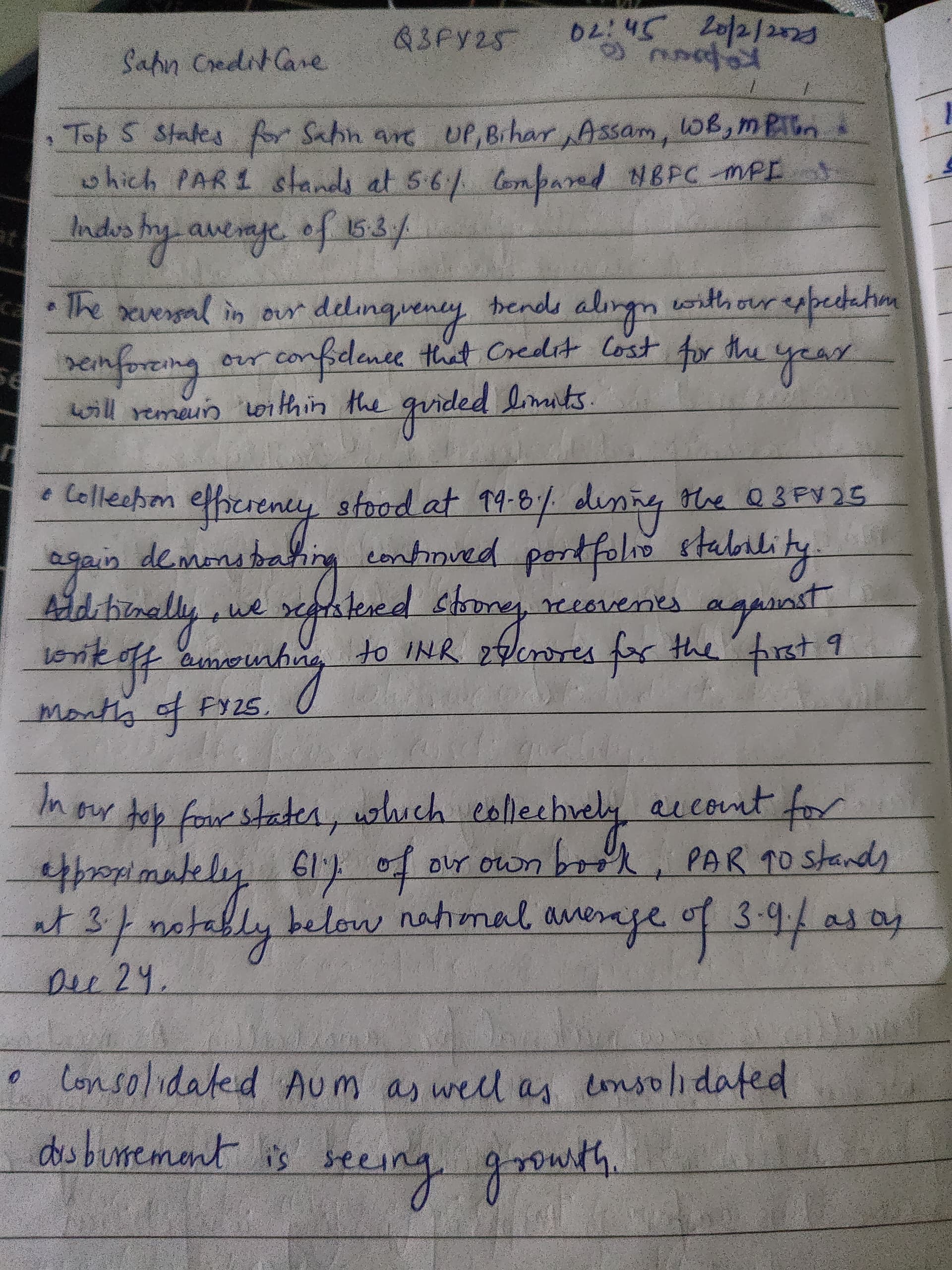
Disclaimer: Holding and bought today again. Will share concall notes shortly.In my opinion, it is quite undervalued in comparison to Arman and Credit. What is comforting is improving asset quality with very good collection efficiency. Credit cost also remains as per management guidance. Biggest holding in MFI space with Arman and credit access. I may be wrong in my understanding. Kindly take this with pinch of salt.


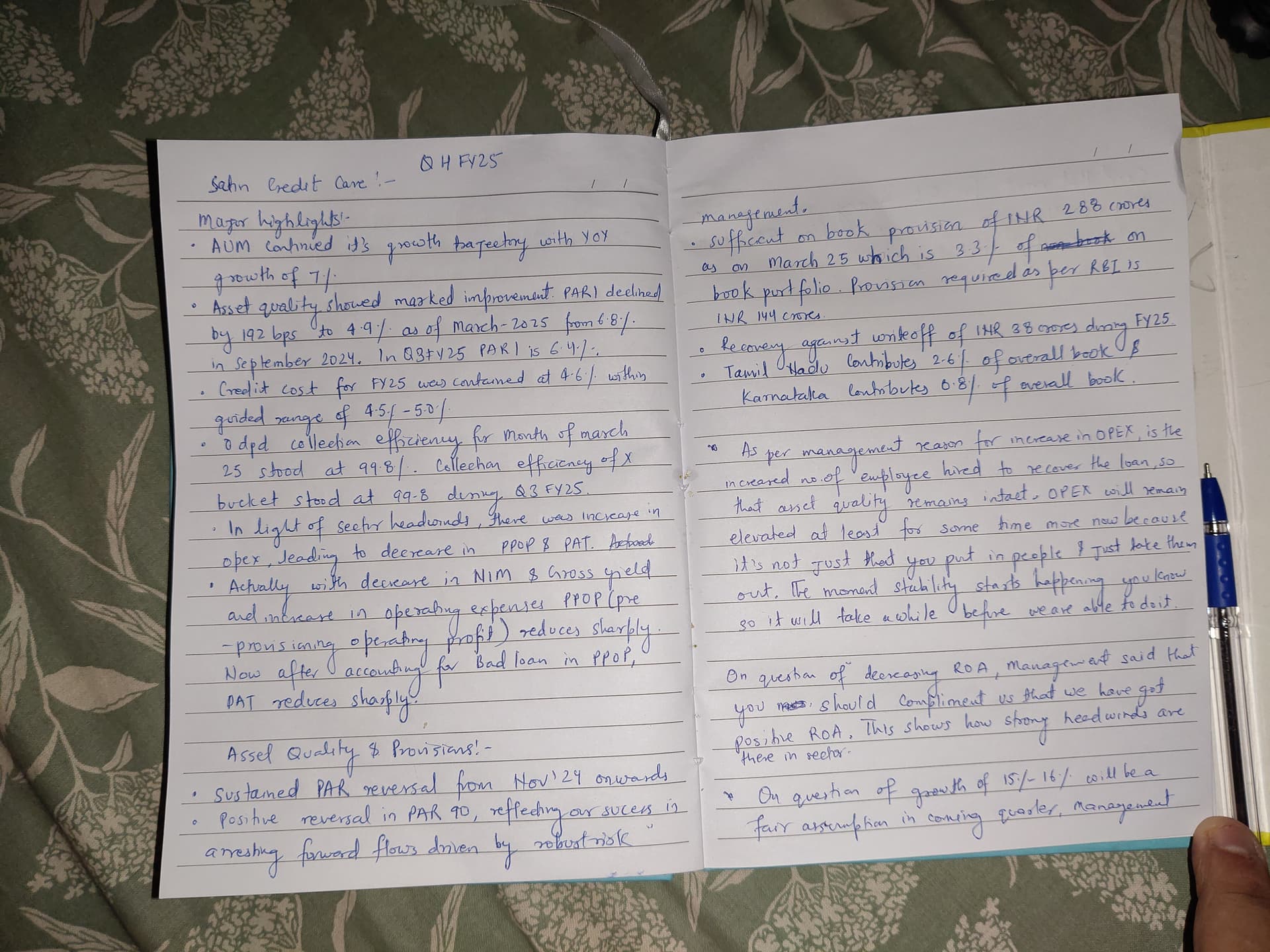
PAR 90 is peaked out, due to continuous effort by management, the heat of same is felt on increasing Opex which is need of hour to have good asset quality.Things still look haunted looking at pre-covid times what happens at loan book. Market is knowing this and that’s why discounting it.

Looking at Manappuram MFI Asirwad & Muthoot microfin,till now they have done very good job. I am fearing a lot in putting my hard earn money as they are not as renowned as Credit access and Arman. I am taking calculated risk here. My average buying price is 152.25. lower buying price will cover any margin for error and provide much needed margins of safety.

Let see where it ends. Will track business very closely.

5 Likes

Disclaimer: Holding and biased. Will certainly prove beneficial for sector. Found useful for sharing.

1 Like

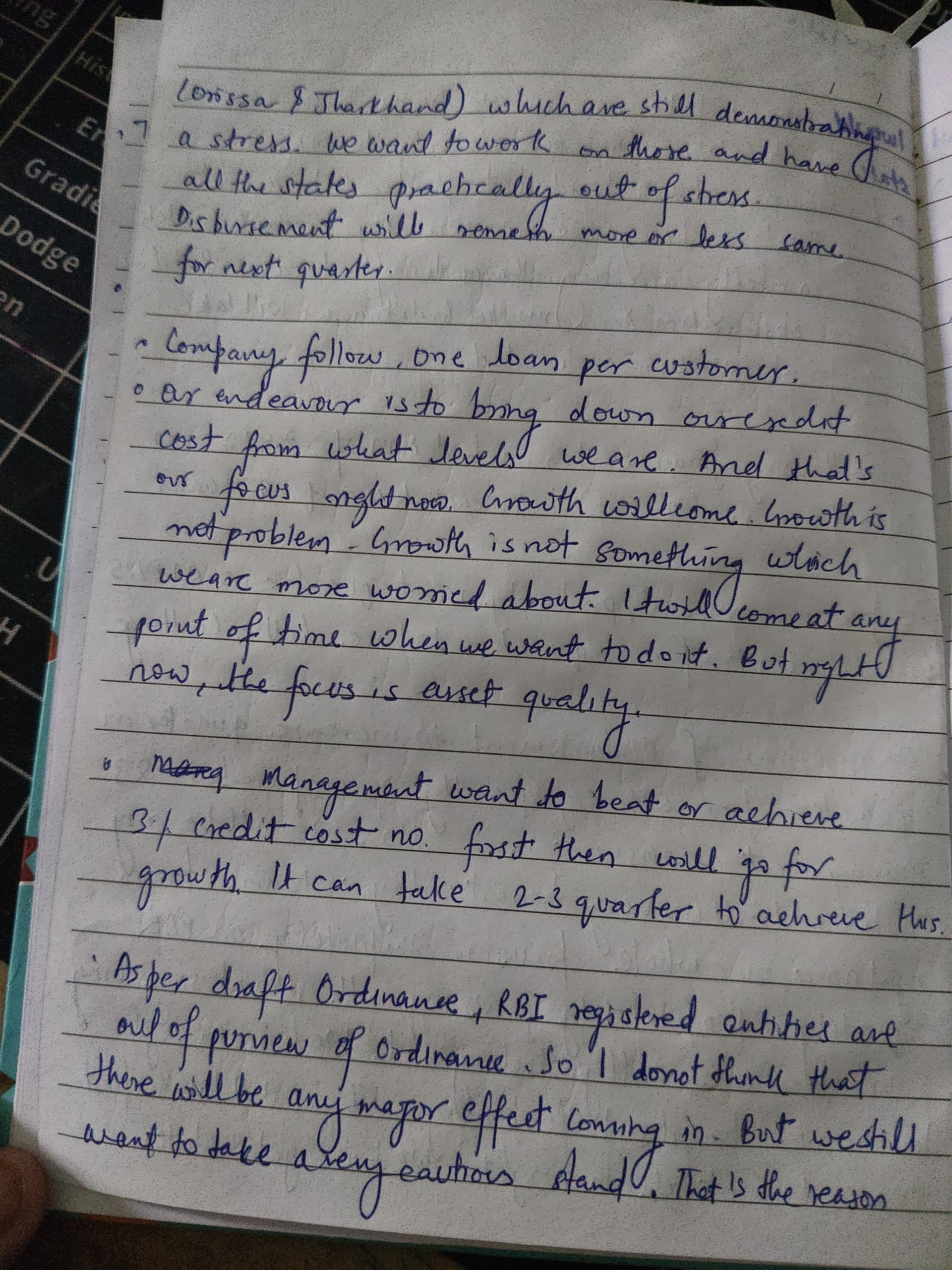
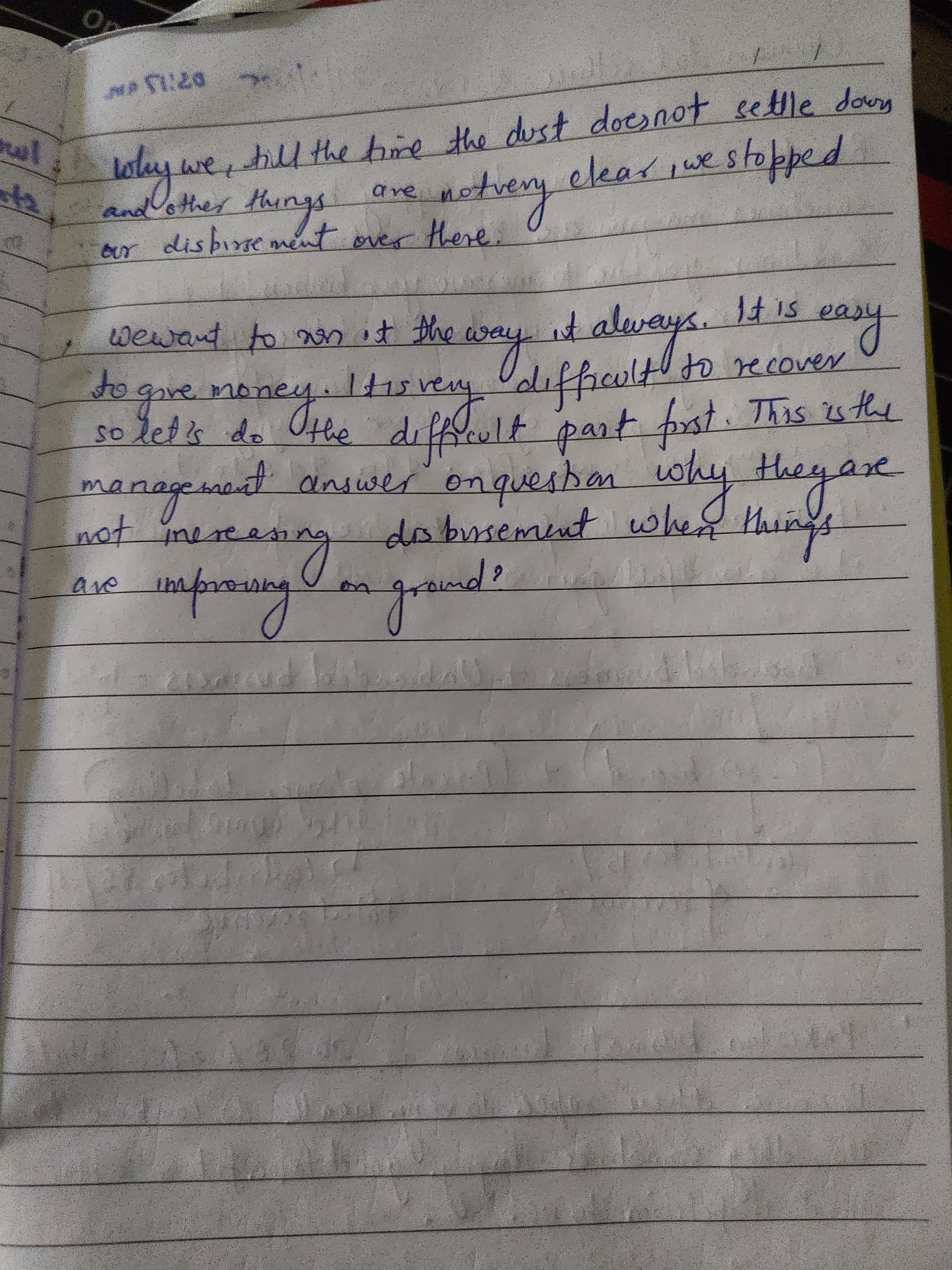
Implementation of guard rails will certainly hit the growth rate of business. Their rejection ratio of customers are increased by 4 % to around 72%. To further keep the growth momentum, management will open more branches close to 400. In short term it will increase cost to income ratio however improved asset quality will reduce credit cost.
Disclaimer: Holding and biased.

4 Likes

Recent management meet. Holding and biased.

Finest thing done by management in this quarter is the increase of PCR. In lending business it’s good to be conservative. Today I read very good line, Good investment at big discount always come with some sort of discomfort or doubt, else there would be no discount.

No body knows anything about anything beyond a point. This line gives me comfort that we are very small in this vast universe and not much things are in our hand to control others than peace of mind and senses of satisfaction.

2 Likes

Available much below book value. Stable asset quality. Good bargain. Invested. With the microfinance sector recovery it can do good.

4 Likes

Why this stock is trading at just 0.6 Price to book

Even the worst of the worst affected microfinance companies like Spandana, fusion, utkarsh sfb are trading at higher valuation than Satin credit

Is there anything which I am missing ?
Can any expert point out?

2 Likes

Even I spent long time undestanding that, I cound not come up with any convensing answer other than market is not notising et,
D - Building position.

4 Likes

that is how market works, we never know when the big player put in bigger orders. Also it is part of small-cap which is hardly running, accept few sectors which also included finance, NBFC and banking.

P.S. - Invested and Biased. Not a SEBI registered, please do your own due diligence.

2 Likes

In lending business, market always give good valuation to business which has seen multiple downcycle with good control over asset quality. That’s why satin is trading at such valuation. But also remember Good investment at big discount always come with some sort of discomfort, doubt or else there would be no discount.
Disclaimer: Invested and has become major part of portfolio at 145 rupees.

1 Like

Some anti-thesis pointers, in addition to the notes by above members

  1. Declining overall collection efficiency as of Q226 (from their investor presentation)

9mFY25 - 95.9
FY25 - 95.6
Q126 - 94
Q226 - 93.3

But, X bucket CE is holding in the range 99.3-99.8%. This means new loans are running smoothly. Older loans are still weakening and portfolio is not stabilized yet. Need to monitor this in Q3

  1. On medium term basis, before their next equity dilution, we would want the price to be above the book value. In their last dilution in Dec 2023, leverage was around 5.2x, currently it is at 3.68
3 Likes

Good thread explaining the current turnaround in business. With GNPA reduction and PAR improvement, profit is bound to increase as credit cost reduces further. Overall satisfied with pace of recovery. There is not much to loose here. Risk reward ratio is favorable.

Disclaimer: Holding and biased from 140-150 share price. Constitute major part in MFI space followed by Northern Arc with Arman and credit access grameen. Rerating seems to be imminent. “Bhagwan ke ghar dere hai par andere nahi hai.”:hugs::hugs:

3 Likes

Q3 / 9M FY26 – Key Positives Worth Noting (Satin Creditcare)

After going through Q3 & 9M FY26 numbers, a few points stand out for long-term investors:

• Profitability has clearly stabilised. 9M FY26 PAT stands at ~₹165 cr, showing recovery after a difficult FY24–FY25 phase.
• Asset quality continues to improve with GNPA at ~3.34% and NNPA at ~1.10%, which is reasonable for a microfinance-focused lender.
• Provision coverage is healthy at ~67%, indicating conservative balance-sheet management.
• Capital position remains comfortable with CRAR ~14.6% and strong liquidity (LCR ~140%).
• No stressed loan acquisitions and no NPA loan sales during the quarter — book clean-up appears genuine.

While leverage remains inherent to the business model and MFI cyclicality cannot be ignored, the worst seems behind operationally.

For long-term investors, this looks more like an earnings recovery and gradual re-rating story, not a short-term trade.

Would like to hear how others are viewing FY27 earnings sustainability.

3 Likes

Very valid questions asked by one of the persons in recent concall. With reduction in par number why you still guiding for 4 % credit cost? In my view , as soon as credit cost reaches to normalised value of 3.3 -3.4% , that will jack up the ROA close to 3 from current value of 2.2. Mr. Market can rerate satin from here. Satin P/B can reach to 1.3 to 1.8.

Disclaimer: Holding and biased and looking for interesting time ahead.

5 Likes

Satin Credit care business updates

AUM :up_arrow: 19%
Disbursement :up_arrow: 17%
Credit coat down from 3.8-4% from 4.6% in FY25
392 branches added in FY26
Collection efficiency improved
Cost of Borrowings down 49 bps

3 Likes

2.6% ROA at 0.9x book.

2.7% ROA at 3x book.

Same sector. Same cycle. One gets valued like a compounder, the other like its going to blow up tomorrow.

Satin Creditcare vs CreditAccess Grameen.

Lets talk about why this gap exists, whether its still justified, and what the street is missing.

FY26 snapshot

ROA.. SCNL 2.6% | CREDAG 2.7%

ROE.. SCNL 12.3% | CREDAG 10.7%

NIM.. SCNL 15.2% | CREDAG 13.9%

P/B.. SCNL 0.90x | CREDAG 2.98x

Satin is printing better ROE, higher NIM, and still trades at a third of the book multiple.

But before you call this a screaming mispricing lets understand why the street doesnt trust this name.

Because honestly, pre 2023 Satin deserved the discount.

-–

THE HISTORY OF PAIN

Chapter 1.. Demonetization + Farm Loan Waivers (FY17 to FY18)

41% of Satins book was sitting in UP alone. One state one risk.

When notes ban hit in Nov 2016 their borrower base mostly women running kirana stores, tailoring, dairy collapsed on cash flows overnight. Collection efficiency in UP MP Maharashtra tanked below 70%.

Then came the UP and Maharashtra farm loan waivers. This created a contagion in credit culture. Even non farmer borrowers refused to repay expecting waivers. Local netas were openly telling people mat do paisa wapas. Political interface at the ground level completely broke collections.

Net loss of 3.4 crore in FY18. Management was scrambling.

Chapter 2.. Assam blowup (FY20)

Around 250 crore exposure to Assam on a 6,400 crore book. Looks small on paper. But the ground reality was brutal.

Oct 2019 tea garden workers go into economic distress. Dec 2019 anti CAA protests erupt across the state. MFI field staff cant enter villages. Then local pressure groups start agitating specifically against microfinance demanding a complete ban.

Collection efficiency in Assam crashed to 50%.

Satin provisioned 29 crore for one state alone. Q3 FY20 profit fell 32% just because of this. Provisioning jumped 6x in a single quarter.

Then the Assam government passed the MFI Regulation Bill in Dec 2020. Collections restricted to gram panchayat offices only. No doorstep recovery allowed. For an industry where the entire model is built on weekly group meetings at the borrowers doorstep this was a death sentence for that geography.

Chapter 3.. COVID (FY21)

Final nail. Restructured 1,151 crore i.e. 21% of on book AUM. Net loss of 14 crore. Active borrowers went from 35.5 lakh to 28.1 lakh. AUM actually shrank from 8,100 to 7,617 crore.

-–

THE ROOT CAUSE UNDER ALL THREE EVENTS

Single product. Single geography. No buffer.

88% AUM in 4 states with zero secured lending. And every time they bled the management went to the market for equity. 16 rounds since inception. BVPS compounded at 9.8% over a decade vs 30% for CREDAG. Basically shareholders kept getting diluted at the worst possible times.

Market ka reaction was fair. Ye ek fragile naam tha.

-–

AB KYA BADLA? :counterclockwise_arrows_button:

Post FY23 Satin is structurally a different balance sheet.

UP concentration.. 41% down to 23.8%. Now present in 26 states + 5 UTs. No single state dominance.

Product pivot.. Non MFI went from 6.4% to 17% of consolidated AUM. Satin Housing Finance at 1,267 crore AUM. Satin Finserv MSME book at 1,054 crore. Secured assets that dont crater when MFI cycles turn.

This isnt theoretical. It got tested in real time.

FY25 overleveraging stress hit the entire sector. Bihar Punjab Tamil Nadu borrowers were over leveraged with 3 to 4 lenders each.

CREDAG response?

7.6% of portfolio written off. Q4 FY25 PAT collapsed to 47 crore from 397 crore year ago. ROA went from 5.4% to 0.7% in three quarters. Collection efficiency dipped to 91.9%. This from a company that hadnt posted a loss in its entire listed history.

Satin response?

Credit cost contained at 3.8%. FY26 PAT up 79%. Q4 PAT jumped 630% YoY to 162 crore. The housing and MSME book acted exactly as the diversification buffer it was designed to be.

Other operating improvements..

CoB down 43 bps to 10.82%

452 branches added

Liquidity at 2,092 crore

Zero dilution

-–

CREDAG KE BAARE MEIN BHI BOLNA ZAROORI HAI

CREDAG ka premium genuine hai.

AA minus rating means 9.2% CoB vs 10.82% for Satin. 160 bps on a 25,000 crore book is 400 crore annual interest savings. Their cost to income is 30.4% vs Satins 46%. Retention 87 to 88%. CreditAccess India BV parentage means no public market dilution ever. Unit economics are best in class.

No argument there.

-–

BUT MERA ISSUE YE HAI

3.3x P/B ka gap when underlying ROA is 10 bps apart?

SCNL is below its own book value while generating 12.3% ROE. Mathematically agar ROE stays above cost of equity toh ye gap compress hona chahiye.

If Satin holds 15%+ ROE for 4 quarters without an equity raise.. re rating from 0.9x to even 1.4x book is a 55% move. And thats just multiple expansion before any book value accretion.

Street abhi bhi purana Satin price kar raha hai. Woh Satin jo UP mein phasa tha. Woh jisne COVID mein 21% book restructure kiya. Woh jo har baar dilute karta tha.

Naya waala diversified hai. Secured buffer hai. Sector matching returns aa rahe hain. Aur dilution nahi ho raha.

Price ko fundamentals se milna padega eventually. Question is just timing. :magnifying_glass_tilted_left:

DYOR. I could be wrong and this stays a value trap for another 2 years. But the risk reward setup is worth watching closely

.

7 Likes

Concur with your thoughts, stock has been re-rating in last few months, should continue as the credit cycle normalises. But other than the comparison with Credit Access, its surprising that stock is still at discount to Fusion and Spandana as well.

2 Likes

Great start by Satin

3 Likes

After seeing Satin Creditcare’s Q1 FY27 Results it just tells me one thing.

This has to be rerated

Its Not about the ₹123 Cr PAT (+172% YoY) if it was not overlay provisions it would have been ₹159 Cr almost (250%+ YOY)

Just look at the credit cost and NNPA.

• Core credit cost is below 2% (Looks Elevated because of overlay provisions)

• management voluntarily created a ₹36 Cr overlay instead of maximizing profits.

• GNPA fell to 2.2%, NNPA just 0.3%

• PCR reached 115% ( Enough buffer for light to moderate stress)

• Collection efficiency is almost 99.9%

Revised AUM target from 25K crore to 32K crore for FY 2030

Nearly 19% of AUM now comes from secured businesses.

Cost to income will moderate in coming quarters as AUM increases (operating leverage will play out)

MSME and Housing are scaling rapidly, making Satin much more than just a microfinance company.

High growth.
Strong asset quality.
Conservative provisioning.
Diversified earnings.

All this will lead to stable and consistent earnings and Institutions love these type of NBFCs.

Given the current valuation i am super bullish you can’t give 0.9 Price to book to this book.

Don’t know how much longer will it take for rerating but this is definitely a steal deal even after 70-80% returns from the low.

Disc - Invested from 140 - 150 levels and significant part of portfolio. ( Not a buy or sell reco. do your own research).

6 Likes

Dis some projections

Base Case with 24 Percent AUM Growth

Under the Base Case SCNL utilizes its maturing branch network to deliver record breaking annual earnings of 701 crores. That is more than doubling its FY26 profit of 332 crores.

The key metric to watch is Cost to Income. It starts at 48.05 percent in Q1 and drops sequentially every single quarter landing at 39.43 percent by Q4. That is the branch maturation story showing up in actual numbers. Fixed costs staying flat while revenue scales.

The Base Case incorporates a prudent assumption for Assam flood impact. Three districts being Jorhat and Sivasagar and Charaideo experienced flooding affecting approximately 44000 borrowers with a portfolio exposure of around 149 crores. Of this 97 crores is fully covered by NatCat insurance. The remaining gap and collection delays push Q2 credit cost to 2.85 percent before normalizing to the 2.20 to 2.30 percent range in H2.

Bull Case with 28 Percent AUM Growth

Under the Bull Case SCNL secures a credit upgrade to A+ that compresses borrowing costs and avoids significant Assam provisioning through rapid insurance settlement and unleashes the full power of branch maturation to deliver 845 crores in consolidated PAT.

In the Bull Case Cost to Income crashes from 47 percent to under 35 percent by Q4. ROA expands to nearly 6 percent by year end. ROE crosses 30 percent in the final quarter. These are numbers that would put SCNL in the same league as CreditAccess Grameen which is the acknowledged efficiency leader in Indian microfinance.

The Bull Case assumes negligible Assam flood impact due to rapid insurance settlement and immediate customer rehabilitation and buffer preservation. Credit costs stay flat at the core run rate of 1.95 percent throughout.

6 Likes