
Sanathan Textiles Ltd.
Company: Sanathan Textiles Limited
Sector: Textiles – Polyester Yarn, Cotton Yarn & Technical Textiles
Exchange: NSE – Main Board
NSE Symbol: SANATHAN
Basic Details
- Market Capitalisation: Approximately ₹4,230 crore
- Issue Price: ₹321 per share
- Current Price: Approximately ₹496–501 (as of 30 October 2026)
- Listing Date: 27 December 2024
- Face Value: ₹10 per share
Market price and valuation figures are approximate and subject to daily changes.
Financial Highlights
FY26 – Consolidated Financials
- Revenue from Operations: ₹3,811.18 crore
- EBITDA: ₹284.35 crore
- Net Profit (PAT): ₹77.35 crore
- EBITDA Margin: 7.46%
- PAT Margin: 2.03%
- ROE: Approximately 4.2% (latest reported/TTM database figure)
- Debt-to-Equity: Approximately 0.79–0.81 (latest reported database figure)
- Revenue Growth (3-year CAGR): Approximately 5% based on FY23–FY26 consolidated revenue.
Three-year financial trajectory (Consolidated):
| Particulars | FY25 | FY26 | Growth |
|---|---|---|---|
| Revenue (₹ Cr) | 2,998.61 | 3,811.18 | 27.10% |
| EBITDA (₹ Cr) | 263.53 | 284.35 | 7.90% |
| EBITDA Margin | 8.79% | 7.46% | -133 bps |
| PAT (₹ Cr) | 160.45 | 77.35 | -51.79% |
Important observation: FY26 revenue grew approximately 27% YoY, primarily supported by the Punjab facility’s commissioning and ramp-up. However, PAT declined approximately 52% YoY. Higher depreciation and finance costs associated with the expanded asset base are important factors to monitor.
The business is therefore in a capacity-expansion and earnings-absorption phase. Investors should not extrapolate revenue growth directly into future EPS growth.
Business Overview
What they do:
Sanathan Textiles is an integrated yarn manufacturer with operations across polyester yarn, cotton yarn and technical textiles. Its manufacturing capabilities span from polymerisation to yarn production and specialised textile applications.
The company serves domestic and international customers across apparel, home textiles, industrial applications, automotive, infrastructure and specialised technical textile segments.
Key Products / Business Verticals:
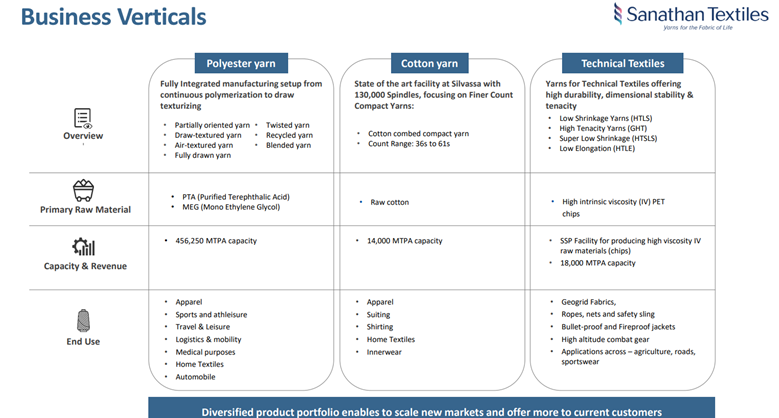
The company has manufacturing operations at Silvassa and has expanded its footprint through the Punjab facility operated by its wholly owned subsidiary, Sanathan Polycot Private Limited.
Market Position:
Before understanding the market position of Sanathan, we need to understand the basics of the Textile sector. This segment is highly commoditized and cyclical
Textile value chain transforms raw materials into finished products through several distinct stages
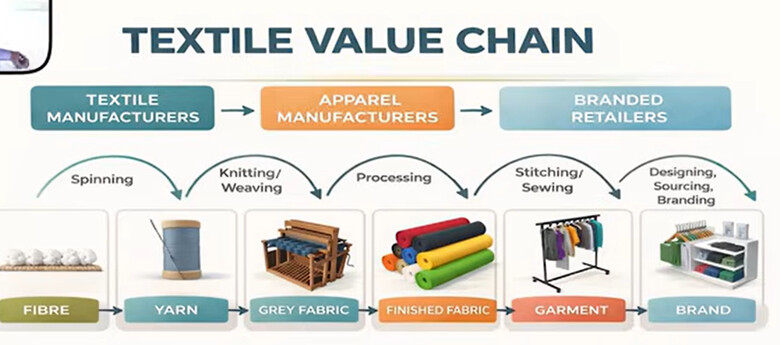
- Fibers: The process begins with basic raw materials, categorized into natural fibers (like cotton) and man-made fibers (like polyester).
Sanathan works exactly here in the segments
- Spinning: These fibers are spun into thick threads known as yarn.
- Fabric Formation: The yarn is then converted into grey fabric through two primary methods:
- Knitting: Creates light, stretchable fabrics (used for T-shirts, shorts, and hoodies).
- Weaving: Creates non-stretchable, structured fabrics (used for shirts, coats, and jackets).
- Processing & Finishing: The grey fabric is dyed and treated to become finished fabric.
- Garment Manufacturing: Finally, the finished fabric is cut and stitched into the end garment sold to brands and retailers.
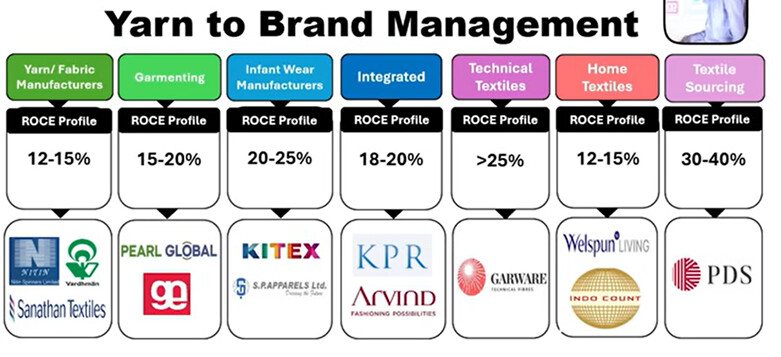
The textile industry follows a clear value chain with varying economic profiles. As businesses move from upstream (yarn/fabric) to downstream (garmenting) and integrated models, the return profile generally improves (you can see the ROCE Profile data). Sanathan Textiles is categorized as an upstream player focusing on the yarn and fabric segment.

The Technical Textile Play

Some Applications Of Sanathan Yarns For Technical Textiles & Industrial Yarns End-Use Are Used For:
-
The Geogrid Fabric Used In The Building Of Roads And Dams
-
Automotive Applications Like Airbags, Upholstery And Seat Belts
-
Coating Application For Flex Banner Fabric
-
Industrial Stitching Thread
-
Hose Pipes
-
Firefighting Equipment
-
Electrical Wires And Optical Cables
-
Nets For Fishing And Aquaculture
-
Industrial Ropes
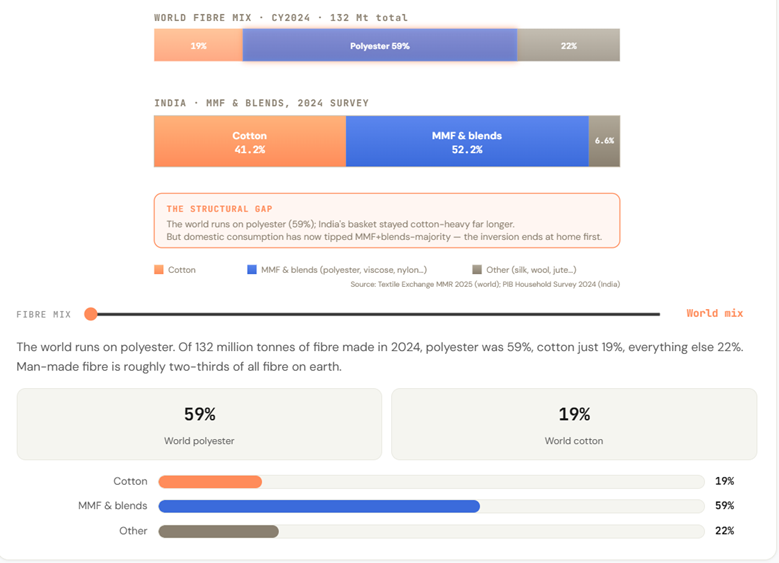
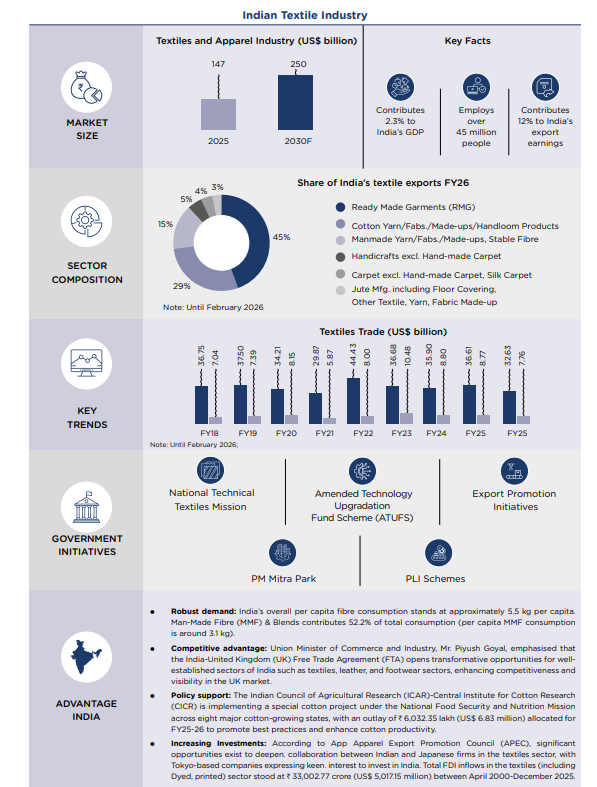
Textile as a sector in India –
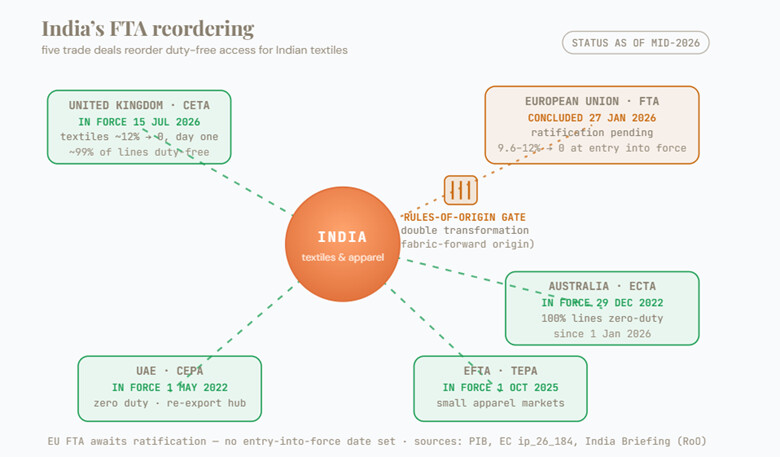
FTAs access a structural handicap, Improving Market access and reducing reliance on incentive and price discounting
Sanathan operates in a competitive, relatively fragmented textile industry. It competes with organised and unorganised manufacturers in polyester and cotton yarn, while specialised technical textiles provide an opportunity to move towards more differentiated products.
The key competitive advantages to evaluate are:
- Integrated manufacturing capabilities.
- Wide product portfolio and customised yarn offerings.
- Established customer relationships.
- Ability to manufacture specialised yarns.
- Manufacturing scale and operational flexibility.
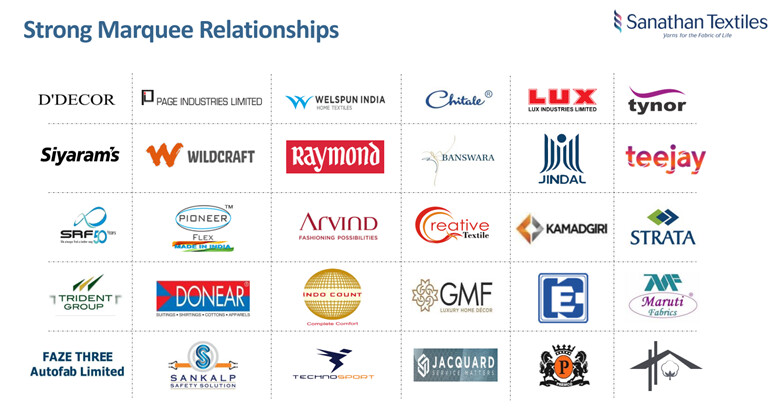
Key Customers:
The company serves a diversified domestic and international customer base. Investors should refer to the annual report and investor presentation for customer concentration and export exposure. I would avoid naming individual customers without independently verifying the latest disclosures.
Management Quality
Promoter Background:
Sanathan Textiles is promoted by the promoters associated with the Sanathan Group, with an established presence in the textile manufacturing industry.
The promoters have experience in polyester yarn, cotton yarn and textile manufacturing, and the business has developed manufacturing capabilities over several years.
Promoter Holding:
Approximately 78.6% based on the latest available market-data snapshot. Verify the latest NSE shareholding filing before posting.
Key Management:
The company is led by its promoter-led management team and professional executives responsible for manufacturing, finance, sales and business expansion.
Management Assessment:
The willingness to invest in additional manufacturing capacity and enter higher-value technical textile applications is encouraging.
However, management execution must now be assessed through:
- Capacity utilisation.
- EBITDA per kg.
- Working-capital efficiency.
- Return on incremental capital employed.
- Debt reduction and interest-cost management.
The key question is whether the new capacity will generate attractive incremental returns rather than simply increase the company’s asset base.
Investment Thesis
Positives
- Integrated manufacturing capabilities: The company’s polyester manufacturing operations provide integration from polymerisation to yarn production, potentially supporting cost efficiency and product flexibility.
- Diversified business model: Exposure to polyester yarn, cotton yarn and technical textiles reduces dependence on a single product category.
- Punjab facility expansion: The commissioning and ramp-up of the Punjab facility provide an opportunity for a meaningful increase in revenue and manufacturing scale.
- Technical textiles opportunity: Specialised yarns used in automotive, infrastructure, protective clothing, industrial and other applications offer opportunities for higher-value products.
- Forward growth potential: The company’s existing customer relationships and broader manufacturing footprint can support further volume growth if demand remains healthy.
- Operating leverage: Once the new facility achieves better utilisation, fixed-cost absorption could improve EBITDA and profitability.
Concerns
- Profitability versus revenue growth: FY26 revenue increased approximately 27%, but PAT declined approximately 52%. This is the most important issue to investigate.
- Higher finance and depreciation costs: The expansion has increased the capital employed, depreciation burden and financing requirements.
- Low return ratios: ROE and ROCE need significant improvement before the expansion can be considered value-accretive.
- Commodity exposure: PTA, MEG and crude-oil price movements influence polyester manufacturing economics. The ability to pass on raw-material cost changes is critical.
- Cyclical industry: Polyester yarn spreads, inventory levels, textile demand and Chinese manufacturing capacity can influence profitability.
- Working-capital requirements: Expansion can increase inventory, receivables and borrowing requirements, particularly during periods of weak demand.
- Execution risk: The Punjab facility must achieve sustainable utilisation and profitability without excessive discounting or additional leverage.
Valuation
Indicative valuation based on a share price of approximately ₹496–501:
- P/E Ratio: Approximately 55–70x, depending on the earnings period and data provider.
- P/B Ratio: Approximately 2.26x.
- EV/EBITDA: Approximately 18x (indicative market-data estimate).
Peer Comparison – Valuation Perspective:
Sanathan should not be valued purely as a conventional commodity yarn manufacturer if it successfully develops differentiated technical textile products and improves its integrated manufacturing economics.
However, a premium valuation needs to be supported by:
- Consistent double-digit earnings growth.
- Improving EBITDA margins.
- Better ROCE.
- Reduced finance costs.
- Stronger cash-flow generation.
At the current valuation, the market appears to be pricing in a meaningful recovery in earnings and benefits from the expanded capacity.
The biggest risk is that revenue growth materialises while margins and return ratios remain subdued.
Growth Catalysts
- Punjab facility utilisation: Improving utilisation of the newly commissioned facility could increase revenue and improve fixed-cost absorption.
- Technical Textiles expansion at Silvassa: The company has announced commercial production from its expanded technical textiles capacity and has communicated its intention to double this capacity. This could become an important medium-term growth driver.
- Higher-value product mix: Greater contribution from specialised and performance-oriented yarns could improve profitability and reduce dependence on conventional commodity yarn.
- Operating leverage: Improved capacity utilisation, manufacturing efficiencies and lower incremental fixed costs could support EBITDA growth.
- Export and customer diversification: Greater penetration into international markets and specialised applications could provide additional growth opportunities.
Red Flags to Watch
- PAT deterioration: FY26 PAT fell despite substantial revenue growth. This needs to reverse through operating profitability rather than one-off gains.
- Debt and interest costs: Monitor borrowings, finance costs, interest coverage and debt-to-equity as the expansion matures.
- Low ROCE: The company needs to demonstrate that new investments generate returns above the cost of capital.
- Commodity price volatility: PTA, MEG, crude oil and polyester yarn spreads can materially affect margins.
- Capacity utilisation: Announced capacity should not be confused with actual production, sales or profitable utilisation.
- Cash-flow conversion: Monitor operating cash flow, free cash flow and working-capital movements alongside reported PAT.
- Technical textile execution: Track actual commercial volumes, customer additions and segment profitability rather than relying only on capacity announcements.
- Promoter pledge and governance: Check quarterly shareholding disclosures, related-party transactions, auditor observations and any changes in promoter encumbrance.
My Personal assessment:
Sanathan is highly commoditized and cyclical company. Yarn and fabric manufacturers are generally capacity play
Sanathan Textiles is an interesting manufacturing expansion story with exposure to polyester yarn, cotton yarn and the potentially attractive technical textiles segment.
The company has already demonstrated its ability to expand revenue through capacity additions. The next stage, however, is more important: converting the expanded manufacturing base into sustainable earnings and higher returns on capital.
My thesis rests on three key variables:
- Punjab facility ramp-up and utilisation.
- Technical textiles becoming a meaningful and profitable growth contributor.
- Improvement in EBITDA margins, PAT, ROCE and free cash flow.
I would classify Sanathan as an earnings-recovery and capacity-utilisation opportunity, rather than a proven high-return compounder at this stage.
The business could create meaningful value if earnings improve substantially over the next few years. However, at the prevailing valuation, the margin of safety is not particularly comfortable.
What I would track over the next 2–4 quarters:
- Revenue growth versus volume growth.
- EBITDA margin.
- Punjab facility utilization.
- Technical textiles capacity utilisation and customer additions.
- Finance costs and net debt.
- ROCE and operating cash flow.
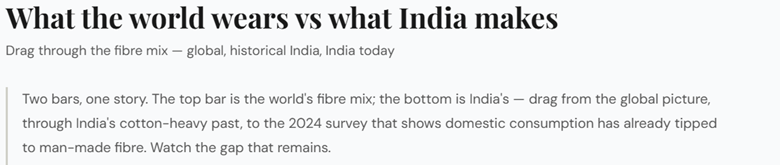
I generally avoid the yarn and fabric manufacturers but my inner sense is telling FTA will create a new winner in India in coming years, that is a huge amount of money and we Indians are not even used to this kind of opportunities, as manmade fiber are also related to employment opportunities and govt also focusing on that , and as Textile as one of the most beneficiary of all the FTAs I would like to play this theme via Sanathan. As per the management, current export (5% of total revenue) can easily be increased to 3x (15% of Total revenue ) if margin favor (tariff reduced )or once FTAs will come into action. And on top of that Sanathan has a very good presence in FTA counties via proxy or B2B customer indirectly.
I also like strategies like strategic location of Silvassa as close to the port and Punjab facilities close to north market and preparing Silvassa as export ready and Punjab as new opportunity for north Indian reason. While 1st phase of Punjab and extension of Silvassa technical textile facility already commercialized and phase 2 of Punjab and new MP facility work currently is in progress.
I also like the Idea of taking Debt for Punjab capex facility instead of equity dilution where debt is near to 7% interest cost or lower and debt reduction plan clearly discussed with investor
If you compare with other peers players like Filatex India or so , my personal feeling is that what Filatex is going to do or doing today , sanathan already did that 2 years back
At last, the guidance of 5800Cr revenue with 10-11% EBITA in FY27 and Approx. 7k in FY28 or so, if they can achieve this then forward valuation is quite reasonable for Sanathan
As crude and logistics is one of the major dependencies for sanathan which directly impact the margin, even though they can pass through the price ..I am watching this very carefully
Disclosures: invested from march low and don’t have any recent transactions