
S Chand- Transforming into a Complete Education content provider

Valuations are quite personal tbh but just to tell you how I look at it, it is trading 4x market cap to cash flow. The company is reducing its expenses and focusing on better cash conversion. The near term triggers like NCE/NCF Implementation might help the company to grow 20-25% for couple of years from current levels, in this scenario, the bottom line will grow much faster than top line.
While valuing I considered above points and added some margin of safety due to underlying risk and past track records before coming to a right valuations for me(There is no right answer). At the end, it’s a game of probabilities.
Disc: Invested, no recommendations

8 Likes

Some of the things which came to my mind -

During my school years, SCHAND books mostly came into my radar after 9-10th when focus shifted away towards science and mathematics stream. With the NEP, initial sense that I have got is that focus would be on wholistic dev of child and new age tech stuff and that would lead to more educational material related to -

  • Giving proper knowledge of history of India and world
  • Bolstering multi disciplinary thinking in child
  • Focus on ethics and values in child
  • Focus on life skills
  • Focus on ethics and values in child
  • Focus on new age technology skills

Initial sense I have gotten is that new curriculum will add new stuff to what is currently in the educational system and there will be some modifications as well. I do not know if there will be significant modification in science and maths where SCHAND is strong per my experience. Ofcourse I do not have any experience with other streams - Arts and Commerce if SCHAND books sell there as well or not.

Also, in the past CBSE used to say to schools that use NCERT books to teach students. And over time NCERT books got better as well to cover more material. If NEP comes, there can be similar risk again where NCERT updates all the curriculum and initially students flock to buy more NCERT material until SCHAND authors catchup. Some random thoughts while thinking what are NEP related risks… (can prove to be completely wrong)

6 Likes

Q1FY23 Revenue is 107 cr. It’s very nice to see the management is walking the talk. Last concall they said they should be able to do 90 cr revenue in Q1FY23 and also told the reasons that made sense. Now it’s showing in numbers too. Hope they will be able to meet the guidance given for FY23 excluding NEP/NCF being implemented.
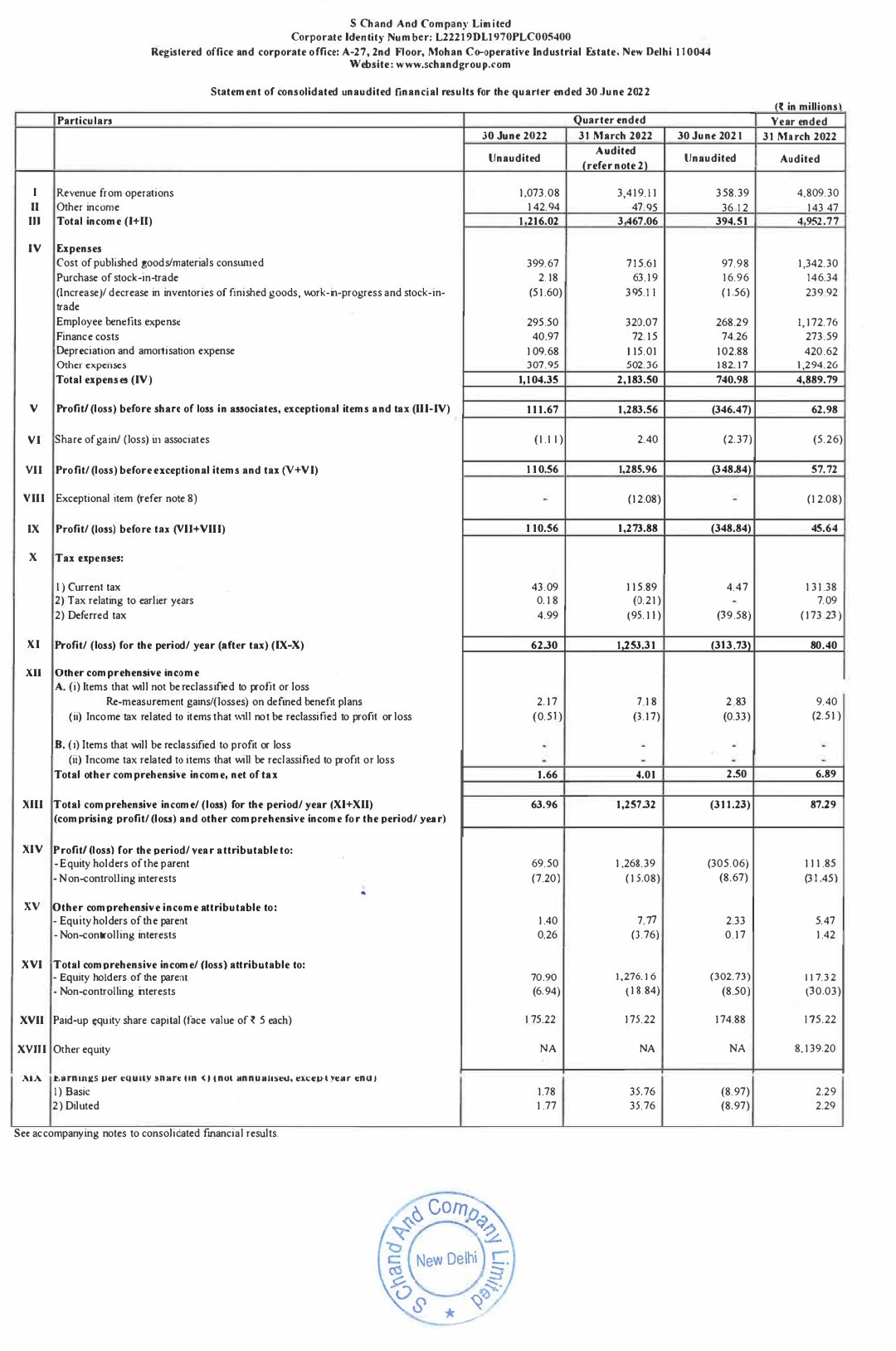
7 Likes

In the recent concall, the management stated that they wish to focus on their core publishing business rather than edtech businesses. They mentioned additional spends on edtech business won’t scale the revenues by significant amount. Hence, they will cut back on edtech spends.
Secondly, they mentioned that paper was no more available on credit to entire publishing industry. This will really help the big players becoming bigger, if the big players will be able to secure raw material timely and lead to market share gains. So far, they have secured most of the raw material supplies for the year and only 20% or so it left to be procured. (They import paper and buy from West Coast, Kuantum Papers in the domestic markets). Paper cost is 20-25% of their total cost as highlighted by management in the concall.

9 Likes

testbook was sold for 15 cr recently. according to q1fy23 concall

2 Likes

This stock is making a strong comeback. Significant improvement in fundamentals (both in P&L and Balance sheet). After multiple years of under-performance, looks like the company is poised for multi year growth. Their cash flows, debt and debtor days have shown remarkable improvement.

In the last quarter, FII “The Miri Strategic Emerging Markets Fund Lp” has taken 4.3% stake. Money control have included this stock in their latest coverage. https://www.youtube.com/watch?v=JhOLXeBFoNw

Anyone tracking this stock?

Disclosure: Invested

3 Likes

Yes, have been tracking.
Not sure if it’s a multi-year growth story - but looks undervalued for sure

  • Q1 FY25 was a steady quarter despite national elections and heatwave impacting school operations
  • Consolidated operating revenues were Rs 1,107 million, similar to Q1 last year
  • Highest ever gross margins at 72% vs 69% last year
  • EBITDA of Rs 84 million vs Rs 136 million last year
  • Minor PAT loss of Rs 30 million vs Rs 11 million profit last year
  • Lowest Q1 working capital metrics in company history - receivable days below 100 for first time
  • Net cash position of Rs 882 million, up from Rs 600 million in Q4 FY24
  • Engaged in content licensing partnerships with tech majors for Gen AI/LLM models
  • Forging strategic partnerships in test preparation segment
  • Focus on hybrid/blended learning model combining physical books and digital content
  • Limited adoption of new NCERT curriculum by schools so far
  • Expecting 40-50% adoption of new curriculum by schools this year if NCERT releases books on time
  • Full adoption expected to take 2-3 years
  • Expecting double-digit operating revenue growth in FY25
  • Upgraded EBITDA margin guidance to 17-19% range
  • Gross margins expected to be higher in FY25
  • NCERT expected to release new syllabus books for more classes by end of 2024
  • S Chand has books ready for all classes under new curriculum
  • Timing of NCERT book releases crucial for adoption and revenue impact
  • Full benefit of NCF expected to reflect in 2-3 years
  • Focus on blended learning approach with digital supplements to physical books
  • S Chand Academy, TestCoach and other digital platforms currently free, monetization expected in future
  • New revenue stream from content licensing for AI models
  • Maintaining strong cash position, not considering share buybacks currently
  • May look at buybacks next year if cash reserves cross Rs 100 crore threshold
  • Well-positioned to benefit from NCF implementation over next 2-3 years
  • Focusing on blended learning and digital content alongside core publishing business
  • Strong working capital management and cash position
  • Confident of double-digit growth and margin expansion in FY25
7 Likes
7 Likes

In a way it’s so true! Difficult for this age bracket to overcome temptations and focus on what truly matters.
Sweden story is a good case study in itself.

2 Likes

2 Likes

I could not find this announcement officially. But it was expected.

Official circular from NCERT.
Private schools may take a year or 2 for implementation. At this point of time it is by default considered adopted by KVS, NVS and other government CBSE schools. These school do not follow reference materials and private publication like S Chand. Thus full affect of change may be visible from next year only.
Mar 10, Doc 1.pdf (3.3 MB)

3 Likes

You are right, Management have themselves said that coming academic years book have already been printed and any change announced now would be of benefit in next FY results.

3 Likes

S chand is a company whose products have been of use to us at some point in our lives, although we may not know of it? Remember lakhmir Singh, rs agarwal and other supplementary books during school days, s chand is the publisher of all these books.

Just a brief on the company, S chand is a printing and publishing house which caters to the k12 segment ( kg to 12th class ) and higher education segment by providing study material and books through their authors and content rights, recently they’ve ventured into the digital side of education although that constitutes a minority of their revenue chunk. Their aim is to diversify themselves in the education setup by not just being a publisher but being a holistic player in the education segment by providing everything right from test prep, to educational toys, study material, ai content licensing etc..

So, now that we know of their business, I ll dive a bit into their financials and a brief breakdown of their business, they primarily revenue from the k12 segment which is roughly 80-85%, while their costs are a mixture of employee costs, manufacturing costs and materials which mainly consists of paper ( varies between 30-37%) hence making the company highly susceptible to paper prices. ( Bonus suggestion : Potential for a great hedge if you own paper stocks).
The business has remained highly unreliable over the last 5-7 years due to modest revenue growth and volatile margins, ebitda margins have fluctuated right from -5% to 25% for a relatively safe business model.

Now I’ll get into the specifics of why this is interesting to me

A closer look on the revenue numbers shows constant growth over the last 4 years ranging around 8-10% yoy while ebitda margins have expanded from 13% to 19% during the same time period, the reason : PAPER PRICES!!

As you can see the sudden spike in paper prices due to supply chain disruptions caused a sudden rise in raw material cost ultimately affecting the bottom line and significantly rupturing margins. But now that prices have reverted to sustainable levels there doesn’t look to be any substantial pressure on margins ( ebitda at 18.8% currently).

Revenue on the other hand has modestly grown although a key factor that people may be missing is the introduction of the new curriculum framework for school education due to which educational institutions will have to adopt new books with revised curriculums, in my opinion this is a massive plus point for S chand, as this gives S chand the oppurtunity to take the first mover advantage in respect to study material for new curriculum based books, the reason: the unorganized market is very prevalent although they can’t adjust as fast or as efficiently as to organized players such as s chand who collaborate with original publishers. This provides an opportunity for s chand to push out revised books to new students without the need to counter unorganized players giving them a 2 pronged benefit : Revenue gain and Bargaining power.

This should ideally help grow revenue even beyond 10% to potentially 13-14% yoy, furthermore this coupled with margin expansion ( ebitda margins in the past have been as high as 25% - management is expecting reduction in employee cost by 4%, and growth to 19-20% ebitda by the end of this fy itself) can lead to substantial value creation.

Furthermore the company has become net debt free with constant reduction in debt levels ( reduced by 60% over 4 years) and reducing interest payments ( down from 32cr to 13cr in 4 years) signaling moderation in non operating expenses as well.

The tax rate for this financial year stood at an alarming 35% although during their q4 concall the management has given guidance regarding the same, saying that the rate should be down to 27-28% within 1.5-2 years ( increased rate due to non recognition of deferred tax on loss making subsidiaries which the company is trying to collapse over the next 1.5-2 years) hence signaling towards further gains in bottom line estimates.

One of the most important point I want to highlight - The company’s cash conversion cycle is down from 383 days to 175 days with a cfo/ebitda of around 80% roughly , signaling top notch cash flow as compared to previous periods where they were working on a highly. credit dependent model with debtor days as high as 311.

Lastly, the company is majorly focusing on inorganic acquisitions to grow with a recent acquisition of stake in a test prep company and stakes in other education based cos such as smartivity, Ixambee etc.. Virtually meaning that you’re investing a part of your money in a small sized education based pe firm.

My final thoughts and thesis regarding the same :

Positives :

  1. Imminent revenue growth ( > 11%)
  2. Possible margin expansion ( 20-22%)
  3. Eventual reduction in tax rate ( 35% to 27-28%)
  4. Tailwinds in the form of ncp-se
  5. Valuation at Pe of 13.6 and Ev/ebitda of 5.5 ( both below median)
  6. Incase goodwill is impaired at any point in the future, roe can potentially shoot up from 6% to 10% which would ideally drive institutional attention

Risks/ Negatives :

  1. Supply chain disruptions in paper industry
  2. Adoption of new books slower or lower than expected
  3. Inorganic strategy is highly risky
  4. Organic growth highly limited
  5. Management compensation as % of Pat quite high, ( md is payed 2.2 cr alone with pat of 60cr)
  6. Low roe may limit institutional interest
  7. Increasing rate of digital adoption in educational institutions ( medium to long term)

This is my first article and I would love to know everyone’s views, criticism and feedback regarding the same in order to refine my investment thesis.

14 Likes

yes the wind seems to be turning in Schands favour. Lets see the concall

well even if the wind is in your direction, you cannot do anything if the sail is broken - operating level losses this qtr and sales decline

1 Like

Q1FY26:

• There was a shift in the content licensing (AI Datasets) revenues from Q1 to Q2 which led to lesser billing in that segment during Q1 vs. last year. Do keep in mind that the content licensing (AI Datasets) revenue stream can be lumpy in nature and does not follow a seasonal sales cycle like our traditional Education content businesses.

The decline in revenues and profitability was totally driven by a shift in the content licensing (AI Datasets) revenues from Q1 to Q2 which led to lesser billing in that segment vs. last year. We billed content licensing (AI Datasets) revenues of Rs30m during Q1FY26 vs. Rs115m in Q1FY25. This gap of Rs85m largely flowed through the P&L in the quarter. Do note that we expect this revenue to be recuperated in Q2.

• In terms of the working capital, we continued the great work by delivering the lowest working capital metrics for Q1 in the company’s history. We continued our strong cash flow generation and remained net debt free at the end of the quarter with an increased net cash balance of Rs1,161m (Vs. Q4FY25: Rs1,036m).

• Our Q1 receivable days were at 89 days (vs. 92 days in Q1FY25).
• Our Q1 inventory days were at 218 days (vs. 261 days in Q1FY25).
• Our Q1 Net Working capital days was at 119 days (vs. 132 days in Q1FY25).

• We look forward to NCERT releasing books on the new syllabus over the course of the year. We expect the full adoption of the new syllabus books by FY27 and are fully equipped to utilize this opportunity over the next 2 sales seasons.”

• • New Warehousing Facility is now functional. • The integrated Press project would be completed over the next 12 months.


(NO CHANGES IN GUIDANCE)

CONCALL NOTES

CAPEX - On the Operational front, our New Warehousing Facility is now functional. The integrated Press project is also underway, and it would be completed over the next 12 months. This should lead to considerable benefits for the group in terms of Improving efficiency during peak season and Implementation of best practices for Warehousing including Warehouse Management Solutions, Automation etc.

Efficiency would improve, so I think there will be an advantage in terms of production, turnaround time, plus the quality of the books. Plus, what had happened over the past couple of years is that we had not added any new machine over the last 7- 8 years, so we are adding 2-3 machines now, and we have no space constraint now, and the warehouse and the plant would be integrated, so that advantage would be there. So, I think overall, there would be a 15% to 20% advantage in terms of production capacity increase, plus efficiency, plus cost advantages. Exact figures, as of now, it’s very difficult to share right now. But as of now, it will be tangible and intangible both, but there will be a substantial improvement in the next 2-3 years, in the production and efficiency of the company.

So, I think the capacities that we will have, will suffice for next 8 to 10 years in terms of infrastructure. There shouldn’t be any problem in the next 10 years.

NCERT NEW SYLLABUS: Syllabus for Classes 4th, 5th, 7th and 8th will be released by NCERT over the course of this year. That’s what we are hoping. And the rest of the classes will be done by the next year. So, I think the whole bunch of books on the new syllabus would be completed by FY27.

4, 5, 7, 8 standards will get implemented in 2026-2027 academic year. So, sales will be reflected in Q4-26.

I think it is a government issue. So, I mean, it will be very difficult for us to call out if it happens in December of ‘25 or January of ‘26 or February of ‘26. We would not like to call that out. This is our sense. That basically, before we enter our sale season or during our sale season also, these books for these classes will be released.

So, even if the government notification is a bit late, I mean, we can manage it in time and we can get it to the distribution? Hopefully. Hopefully. All this depends on the timing. If it comes before December, then it will be easier. It comes after December; it will become little tough.

9th to 12th curriculum would not be coming in this financial year. It will be coming hopefully in FY27 or the next financial year.

• We expect our gross margins to be slightly better as paper prices are a tad lower than last year. And of course, our digital data licensing revenue which have higher gross margins should also add to that.

ACQUISITIONS: There is diligence going on in one of them, which is in the Test Prep segment. We are looking at two other opportunities as well. One is in the International Board segment, which is a small one, and one is in the regional segment. So, these are smaller ones that we are looking at right now, not very huge. In total, I think the revenue size of all of these should be less than Rs50 crores for all three of them together.

We estimate that the maximum payout should be around Rs50crores - Rs60 crores.

• So, 10% growth guidance for FY26, pricing is about 4%-5%, and then rest of it is volume, about 6-7% volume growth.

COMPETITION: NCERT is a government body and that is also one of our competitors. But there are lots of private players who are in this segment as well. There are smaller players also, bigger players also, organized players also, unorganized players. It is a very diversified, unorganized market, I would say, overall. And we being the largest there, we get an advantage of our brand, of our relationship with the schools, of our product portfolio and our teams. But obviously, the market is tough because so many players are in the market. So, everybody wants to bring out new products, new services for the customer and we are doing the same. But we definitely deliver what we commit, and that is what our advantage has always been, in terms of good quality content, good quality books and good quality service to our customer, and that will always remain. So, we believe that is our edge. And competition is there and will always remain. So, that is the way it is.

AI DATASET SEGMENT: The potential is huge. Last year, we were speaking to just two companies. At present, we are speaking to seven companies. So, things are at various stages. We’ve offered our content to multiple people. Decisions are being a bit here and there. But I think the opportunity is huge. It is not only about our basic datasets; it is about converting into a little more complex dataset. So, we are speaking to a lot of people. And the opportunity is there for the next 2-3 years at least.

So, you engage with these companies, you understand what their requirement is, you see what you have within your organization in terms of content, you see what you can source for them from outside. In the last 12 months, we’ve sourced almost 40% of the content from outside. Basically, it’s meeting your customer’s requirements and then trying to sell it to them. You’re servicing their requirements at the moment.

4 Likes

ANNUAL REPORT FY26:

• Over 12,500 titles (Over 11,000 in FY24)

Distribution network – Over 4,000 distributors (Over 3,000 in FY24)

500+ New books launched. (1000+ in FY24)

• In the Higher Education and Test Prep segment, we continued to face challenges as the industry is going through a tough period of transition and change. To face these challenges, we have relaunched an enhanced TestCoach app focused on the CUET examinations for admission into undergraduate studies across India this year. We think this is a segment where we can gain market share as this is a new and evolving segment with a large target market.

TestCoach, relaunched during the year focused on CUET-UG examination preparation. It has seen remarkable traction with over 1,00,000 downloads and 60,000 sign-ups within two months. Its key features include expert-led live classes, comprehensive study material, periodic performance analysis, and flexible adaptive learning, targeting a potential market of over 15 Lakh students.

• Our content licensing partnership with leading global tech companies for Generative AI LLMs has also opened a high-margin revenue vertical.

In FY 2024-25, we generated approx. ₹ 20 Cr. from content licensing, up from ₹ 1.6 Cr. in FY 2023-24, with a target of ₹ 25-30 Cr. in FY 2025-26

With a repository of 12,500 titles, including 3,000 higher education titles licensed and untapped school content, we are well-positioned for recurring revenues in this area.

• Piracy remains a challenge, with an estimated revenue loss of ₹ 20-25 Cr. in FY 2024-25. To address this, we have engaged a firm to conduct raids over the next 12 months, with initial successes already recorded, and have issued notices to an e-commerce platform to curb the issue.

• We have commissioned a state-of-the-art warehouse, followed by modernized printing facilities over the course of next 12-18 months. This should enhance our production capacity and reduce our dependency on external vendors during peak season time. This should lead to considerable benefits in terms of Improvement in the quality of books printed which should help in increasing customer satisfaction, improving efficiency during peak season, Implementation of best practices for Warehousing and Improved efficiency in Loading and Unloading, Faster TAT for Order Processing etc. These initiatives, will drive cost efficiencies and quality improvements, further bolstering profitability in coming years.

• CBSE released a circular in March 2025 announcing the release of new syllabus books for Class 4, 5, 7 and 8 over the course of 2025. The circular paves the way for new syllabus books for 4 classes during FY 2025-26 sales season versus 2 classes in the previous year. We also expect the adoption of classes announced last year to go up to 30%-40% from 10%-15% in the previous year.

We anticipate 100% adoption of the new NCF by schools over the next 2 years, driving our growth in the coming years.

• S Chand has been a minority investor in Smartivity since August 2015, starting with a seed investment and has invested ~ ₹ 20 million in the company across funding rounds. For FY 2024-25, Smartivity is EBITDA and PAT positive and has shown revenue growth of 45% and EBITDA growth of 176% over last year. The current round of secondary market transactions valued the company at ~ ₹ 150 Cr., putting our stake valuation in the company at ~ ₹ 230 million.

• In April 2023, we invested ₹ 30 million, acquiring a 4.3% stake in ixamBee. During FY 2024-25, Ixambee increased revenues by 4% and reduced PBT losses by over 85% over FY 2023-24.

• During the FY 2024-25, the Board of Directors have approved the following loans to subsidiaries: - Optionally convertible loan upto an amount of ` 2 Cr. to Convergia Digital Education Private Limited;


(FY 24)

The percentage increase in median remuneration of employees in financial year 2024-25: 9.74% (Vs 24.7% in last FY)

The increase in salaries of employees other than managerial personnel is 22.24% (14.4% in FY24) and increase in salary of the managerial persons is less by 1% (1% in FY24) of average increase of employees other than managerial person.

The number of permanent employees on the rolls of Company: 684 (681 in FY24) at the end of the year March 31, 2025 (681 (752 in FY24) employed during the year)

(PAT is 60cr. Salary drawn by 2 promoters is 4.6cr and CFO salary seems very high as well at 2.4cr. 8cr salary drawn by top management – 13% of PAT)

• Number of options Outstanding at the end of the year - 55,529
Number of Options exercisable at the end of the year - 24,043

• We understand that Education is a staircase business, not an elevator business. The company’s approach stands in contrast to the aggressive expansion and high burn rates that defined much of India’s edtech sector in recent years. S Chand chose to stay conservative by cutting inefficiencies, expanding its digital content library and preparing its back-end systems for modular deployment. We have emerged from the Covid years leaner, more profitable and more agile.

• The company’s digital content library has expanded by nearly 30% over the last two years, with new content across national level education boards CBSE, ICSE and NEP-aligned curricula. Test-prep material, tie-ups with educational YouTubers and QR-enabled Google Lens (image recognition technology) integrations are also part of the growing ecosystem.

• As of March 31, 2025, the Company had over 1,900 employees (over 1800 PY), including a nationwide product/services sales and marketing team of over 740 (700 PY) as well as a content development team of more than 220 (200 PY) employees, including subject matter experts, instructional designers, and graphic designers.

• Dependency on key authors: A substantial portion of the Company’s revenue relies on the titles of a select few top authors. The Company prioritizes fair compensation for these authors to foster ongoing harmonious relationships. It emphasizes maintaining mutually beneficial partnerships and employs a robust feedback mechanism to safeguard the longevity and reputation of S Chand’s diverse brands.

• Intellectual property and copyright issues: Dependence on specific authors increases the risk of intellectual property disputes or copyright challenges. The Company consistently broadens and grows its content and author network. To safeguard its content ownership and distribution, S Chand Company implements rigorous copyright management practices and maintains a dedicated leg

• Piracy: Piracy, both physical and online, remains a significant threat to all publishing companies. S Chand faces ongoing challenges with key titles being pirated across different locations, prompting continuous raids conducted in collaboration with government agencies. Additionally, the Company actively monitors online piracy, which includes unauthorized use of content by education aggregators, individuals on platforms like YouTube, and uploads on various sharing sites. Swift actions are taken to safeguard the Company’s and its authors’ copyrights from infringement.


• Provision for expected credit loss, advances and bad debts written off – 6.89cr vs 12.7cr in FY24

• Amounts written back – 0.74cr vs 0.29cr


[47cr of receivables in FY25 have significant increase in credit risk, 48cr in FY24]

• Term loan ROI - 8% to 11.25%

Working capital loans have ROI of 7% to 11.1% (ROI has reduced for FY25 vs 24)


• Reversal of allowance for doubtful debts – 0.5cr

• Donations – 5.6cr vs 3.78cr (nearly 10% of PAT)


(Digital education subsidiaries in big losses. Combined losses of around 14cr)

3 Likes

RED FLAGS -

  1. Seemingly High management remuneration (Is it in line with industry norms?)
  2. Donations of 5.6cr (Again, is it a necessary part of this business? Donations to schools to get business?)
  3. 47cr of Trade receivables at increased credit risk
  4. Losses in digital education subsidiaries

DISCLOSURE: INVESTED. Playing it as deep value position with triggers for growth in next two years from NEP new textbook adaptations and improving fundaments (Cash flows, working capital metrics etc.)

2 Likes