Quality Power Electrical Equipments Ltd (QPOWER) - HVDC/AI-DC/BESS Play

Quality Power is a recently listed smallcap in the power transmission space. It is a bit different from the rest of the companies in the space because it doesn’t specialise in any one thing like most of the other Indian companies in this space - say in transformers or in cables or structures. QP has taken a different approach to build capabilities by acquiring. They have been on an acquisition spree from the very beginning but its accelerating of late. It is an unique approach, one fraught with risks but the company seems to have a method to the madness which may become apparent by the end of this post.

They seem to be acquiring with the primary objective of acquiring complementary capabilities rather than making immediately EPS accretive transactions. They do however seem to have a knack of making it work by being prudent in valuing, financing and executing to turn around the businesses quickly.

Right now the company is riding a combination of tailwinds. Lets have a look at each of them

The Tailwinds

HVDC

To understand HVDC it is important to understand some basics - the power we use everyday at home through a socket is AC or alternating current oscillating at a frequency (50 Hz in India. 60 Hz in other places). Most of electronic devices through run on DC so end devices convert this AC power to DC within the device (say a PC or TV). However, transmission is always AC for various technical reasons (do read up “Empires of Light” for the why) - primarily being easy to step-up voltage using a transformer and transmit over long distances.

However, over very long distances HVAC (High voltage AC) has significant losses due to inductance/capacitance losses, dielectric losses and AC’s inability to use full cable and also needing 3 cables (HVDC needs 2 or even 1 so has smaller footprint). HVDC is generally more efficient but is justifiable only > 600 kms due to expensive equipment needed to transmit in DC. A good primer to understand the components is this video. You will relate to Quality’s products better if you watch this one.

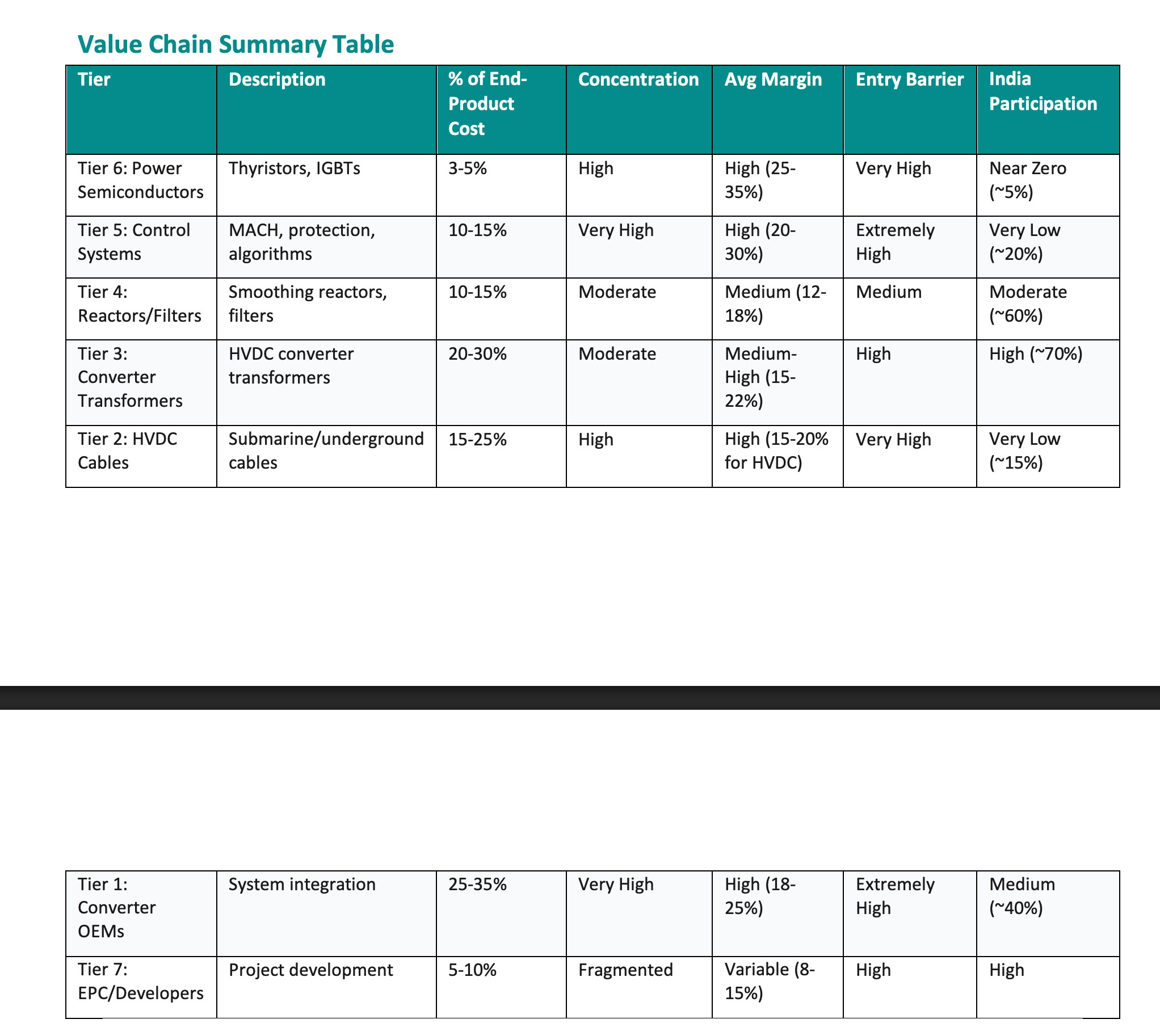
This is the entire value chain for HVDC. In this QP fits squarely in Tier 4 and so is about 10-15% of equipment for HVDC (1.9 lakh Cr is the est. HVDC opp till 2032).
Renewables

India has a 500 GW renewable target by 2030. Every solar park in remote areas without a strong grid would need STATCOMs (described later in this post) to ensure power quality at source at the point of interconnect. We have a lot of stranded/curtailed power as well (~ 40 GW) which is deployed but waiting for grid interconnect (specially in Rajasthan, Ladakh). The other important thing to understand is that renewables are generated in few solar/wind rich corridors but consumption is more spread out throughout the country. This means that for effectively using the produced power, we need strong evacuation and inter-state transmission. This is where HVDC is the only option to ferry power from say Rajasthan to UP. The current running HVDC projects are good examples of these

  1. Bhadla-Fatehpur 6GW at 800 kV over 950 km (Rajasthan’s largest solar zone to UP’s industrial belt) developed by Adani as Adani Green Corridor. EPC by Hitachi/BHEL. Tech is LCC

  2. Khavda-Nagpur 6GW at 800 kV over 1200 km (Gujarat’s massive solar park to Nagpur). PGCIL is the developer. EPC by Hitachi/BHEL is EPC again. Tech is LCC

  3. Khavda-South Olpad 2.5 GW at 500 kV over 630 km. PGCIL is the developer. GE Vernova is the EPC. Tech is VSC

Like this over 2028-2032, there is 15,432 ckm of new HVDC lines planned to transfer over 32GW of power between FY28-FY32 alone. So it would be fair to say there is multi-fold growth on the medium-term horizon because Rajasthan and Gujarat are going to continue adding a lot more renewable capacity and South zone will also develop surpluses.

AI Data Centers

AI usage has been rising exponentially since the advent of Claude code which has been an inflection point of sorts since about Opus 4.6 or so. AI usage is currently picking up on 3D modelling, game development, law, drug discovery, hardware design etc. What is currently being pursued by enthusiasts will eventually seep into enterprises which require training and realignment. This will keep inflecting every few months from here with the biggest unlock to come when robotics and AI are integrated together which is definitely on the 5-10 yr horizon.

This has led to the construction of several GWs of DCs, 10-15 GW in India alone by 2030 and about 120-140 GW in the US. All these DCs would need specialised power equipment to regulate power quality and to manage power. QP makes dry-type shunt reactors, BESS PCS that could find extensive use in data centers. DCs connected to the grid might use instrument transformers, filters/banks as well. GIS based instrument transformers with Hyosung also has a good opportunity in DCs

BESS

BESS is our country’s next massive foray, sort of similar to how we ventured into solar module assembly. India has an ambitious 74 GW target for BESS by 2032. Our value-add today in BESS though is very low with most of the battery modules being imported (what Acme, GPIL etc do or plan to do). BESS is needed because renewables are intermittent and if we manage to store then we can use stored solar power in the night as well. BESS would get integrated with the grid and also several data centers would have their own BESS to use as backup to their primary (grid/btm). QP makes PCS (power converter systems) that would convert the battery’s DC to AC to connect to the grid. It would involve a software component as well to ensure power quality and for interacting with the power semiconductors.

The same way HVDC helps spatially move power, BESS temporally helps move power. In a way, all these tailwinds are linked - HVDC/BESS/Renewables/DC

The Basics of Transmission

The Grid

I think its important to understand some of the basics of the grid before we get into the products. One of the best books on the subject is “The Grid”. At least read the summary to get the gist. Having a mental picture of how the grid has evolved over a period of time from having production close to consumption, in isolated grids, primarily used for lighting to where we are today would help. Also worth knowing some basics like - every electron that is powering an appliance at this moment was generated at the same moment - the grid inherently doesn’t store anything. Different sources of power and how they are generated - Thermal, nuclear, hydro, wind all involve a rotating generator and so inherently generate a/c (with Wind having higher variations in voltage due to wind speeds) vs solar which only generates d/c.

Reactive Power

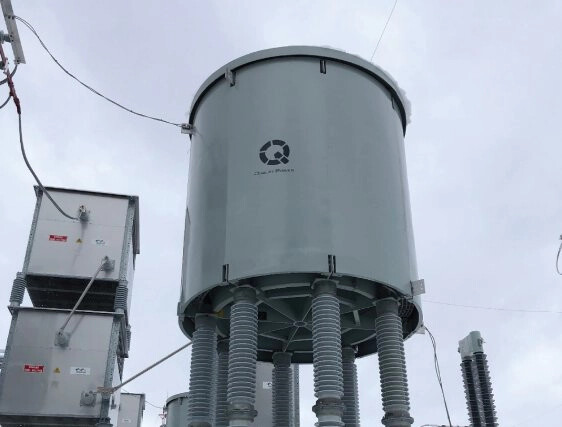
This is the crux of what QP does. It is important to understand Reactive Power in some depth before we proceed. Last year we had a massive blackout in Europe involving multiple countries due to issues with Reactive Power. To understand reactive power, we should have a firm grasp of inductance and capacitance you may have learnt in school. Long power lines tend to develop a capacitance and when lightly loaded tend to overcharge it (Ferranti effect) and when heavily loaded draw voltage down - grid operators must ensure Voltage and current stays stable and so need elements that can compensate for these and that’s where specialised components like reactors, capacitor banks, harmonic filters etc. come in. Incidentally, reactive power is measured as MVAr vs Active power measured in MW. MVAr is denoted usually as Q and I think that’s my most of QP’s equipment just carry Q as the logo like this (this is a Shunt reactor) - if it is, then its a nice touch.
Modern grids have to be capable of taking in variety of inputs sources of power, so require specialised equipment at the point of interconnect, esp for Solar and Wind (where QP equipment comes in) to ensure power quality. Solar and Wind especially doesn’t introduce reactive power as there is no spinning mass (though Wind is a/c generated, it is converted to DC to and then again to AC to regulate it, so behaves like power from an inverter for all intents and purposes). A spinning mass (of the turbine in a hydro/thermal/nuclear plant) maintains rotational momentum against spikes or drop in power and resists but a solar/wind has no way for it. Another thing is wheeling power over much longer distances than what the grid used to do - this also mean keeping previously isolated grids also in sync at 50 Hz (or 60 Hz) means there is a lot of reactors, filters required to do the job to maintain power quality.

I don’t think I have done a good job explaining any of this and suggest sitting with claude and ask questions until you grasp it, if interested. The TL; DR is modern grid requires a lot of QP’s equipment due to its unique challenges - to keep power phases synchronised across sources and transmission, to maintain reactive power, to maintain voltages in tight band and also to act as shock absorber to prevent blackouts like the Europe one last year.

Products

The key takeaway from this section is - though there are multiple products, most of them are at the core based on inductance and capacitance - mostly inductance. Inductance requries coils and so the Sangli expansion by 8x essentially means QP improves capacity for most of its products doing this as most are coil based. Its akin to a CDMO increasing reactor volume - it can make several molecules with it.

Reactors

Shunt Reactor - Used to prevent runaway voltage by regulating them down on lightly-loaded lines

Smoothing Reactor - Used on the DC side and smooths current ripple (remember the YT video above). QP product used on the Rihand-Dadri HVDC line

Series Reactor - Limiting fault current to protect switchgear

Filter Reactor - Used alongside a capacitor in Harmonic filters

Coupling Reactor - Used in FACTS systems in both SVC and STATCOM

Instrument Transformers

These step down the voltage down in substations to levels where relays and meters can read them. These are like sensors and so generally multiple ones are used. These are subsidiary Mehru’s speciality. Within this there is CT, VT and CVT but its enough to understand that they are used to measure voltage and current in HVAC substations and in HVDC converter stations

Line Traps & Line Tuners

Power lines are also used for communication (PLCC or power line carrier communication) - sort of similar to powerline adapters that you can use at home to use existing home wiring as ethernet cables to extend WiFi (super cool concept - do check out) primarily for protection and telemetry. But these signals need to be filtered out and this is where line traps and tuners come into play. Its used in HVDC stations as well as EHV substations

Capacitor Banks

These are used as standalone products to provide reactive power as well as with reactors to make harmonic filters and also in FACTS/SVC system

Harmonic Filters

Similar to how a guitar harmonics works (waves with exact multiples in frequency), power transmission lines also develop harmonics which can lead to blackouts (what caused the Europe outage). These are used to filter higher multiple frequencies which are undesirable. At the core its just a capacitor and inductor in series (maybe along with a resistor). Used in HVDC and FACTS/SVC projects and also in renewable projects at the point of interconnect

Converter-duty transformers

These are used in front of converter transformers in a HVDC substation and handle extreme amounts of stress before the conversion due to heavy harmonic heating.

Applications

HVDC Converter station

Of the 9 main product lines used in a HVDC converter station, QP has presence in 6 of them we have already seen above. The value of these could be 10-15% of HVDC equipment capex
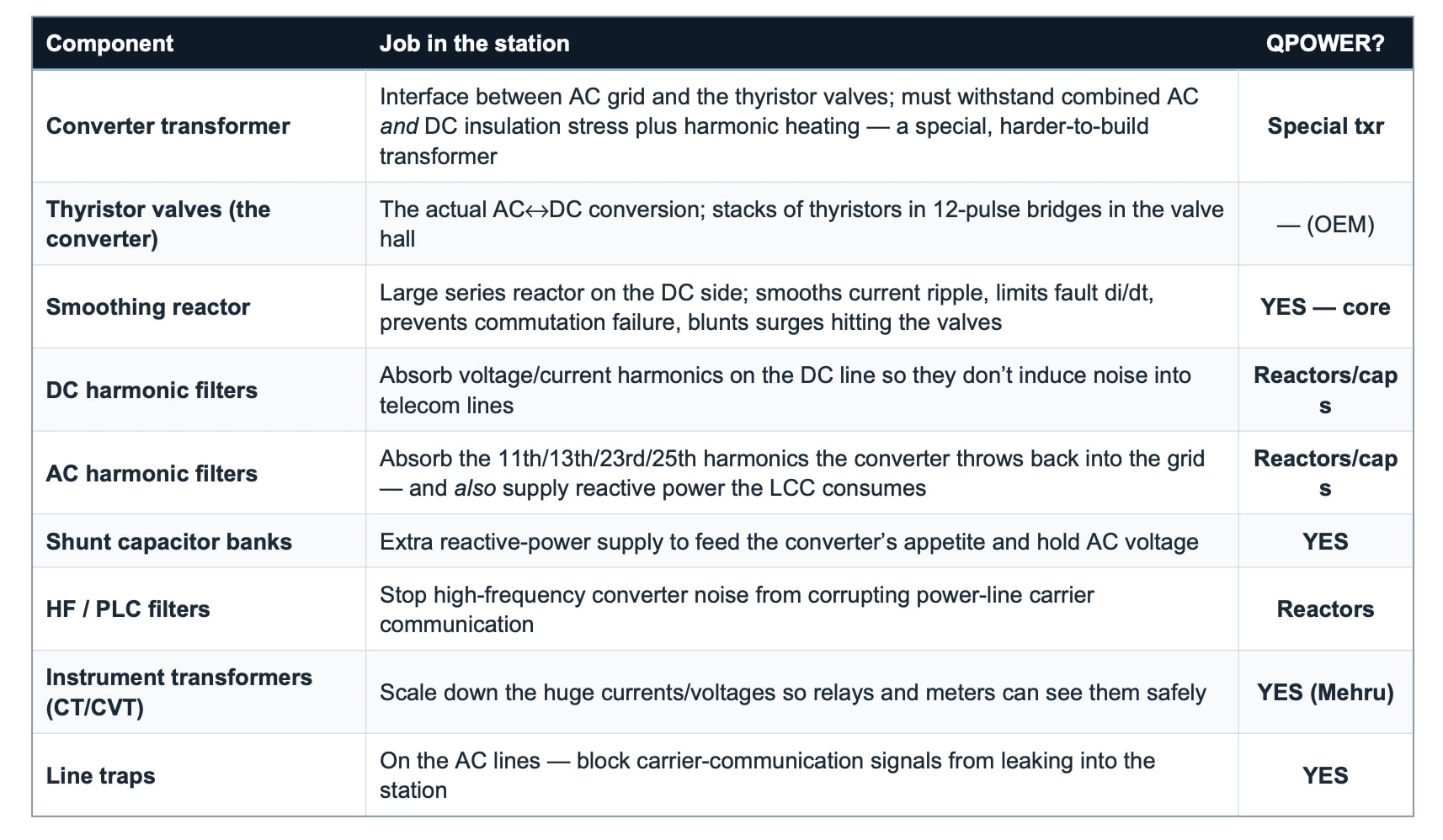
The above is for a LCC converter station. a VSC converter station as well uses some of these components (DC smoothing capacitor instead of smoothing reactor) but since switching and reactive power is controlled by IGBTs (LCC uses thyristors), the components from QP should be lesser. However, most of India’s HVDC projects (including the two big ones today) use LCC technology. It is worth keeping an eye on this though to see QP’s value contribution from VSC vs LCC tech

FACTS - Flexible AC Transmission Systems

This not a single product but a system of products that allow grid operators to control voltage, current and reactive power in realtime using power electronics. There are two types of FACTS devices - SVC (thyristor based) and STATCOM (IGBT based). QP has presence in both through Endoks, their Turkish subsidiary

Every GW of Solar/Wind will need a STATCOM device at point of interconnect to ensure power quality and this is increasingly mandated by grid operators. Endoks rides on Europe’s renewable tailwind. QP is able to source power electronics for cheap in Turkey than here in India and at higher volumes, they will do much better margins as well (same thing in BESS PCS as well)

BESS PCS

As I earlier mentioned, most of India’s value-add in BESS today is negligible. QP’s PCS though is high-value add system based on power electronics and software. Its a product developed by Endoks. Its a 1725 kW power converter system designed for BESS systems connected to grid. Europe and US will not allow Chinese players in software interconnection for BESS. This is where QP has an significant edge over Chinese competition and can carve out a niche for itself. While margins initially might be low on PCS at 10-12%, at higher volume power electronics cost drops significantly and can lead to 17-18% margins once business stabilises. They already have a 152 Cr order for this product.

Data Centers

The dry-type shunt reactor (eco reactor) is already proven with the Finland DC order and another from a hyperscaler for 48 Cr. Over time though, I do see them make inroads in DC BESS as well once the BESS PCS product is proven and accepted. The GIS instrument transformer as well might find use in DCs due to its compact size and design. It depends on how well Hyosung is able to push these products. Hyosung itself has a much firmer presence in DCs especially ni 800V DC based roadmap with Nvidia. I am hoping QP can tie-up for selling rest of its product pf as well through Hyosung

Subsidiaries and Strategy

The subsidiaries and what they do is captured well in this one slide
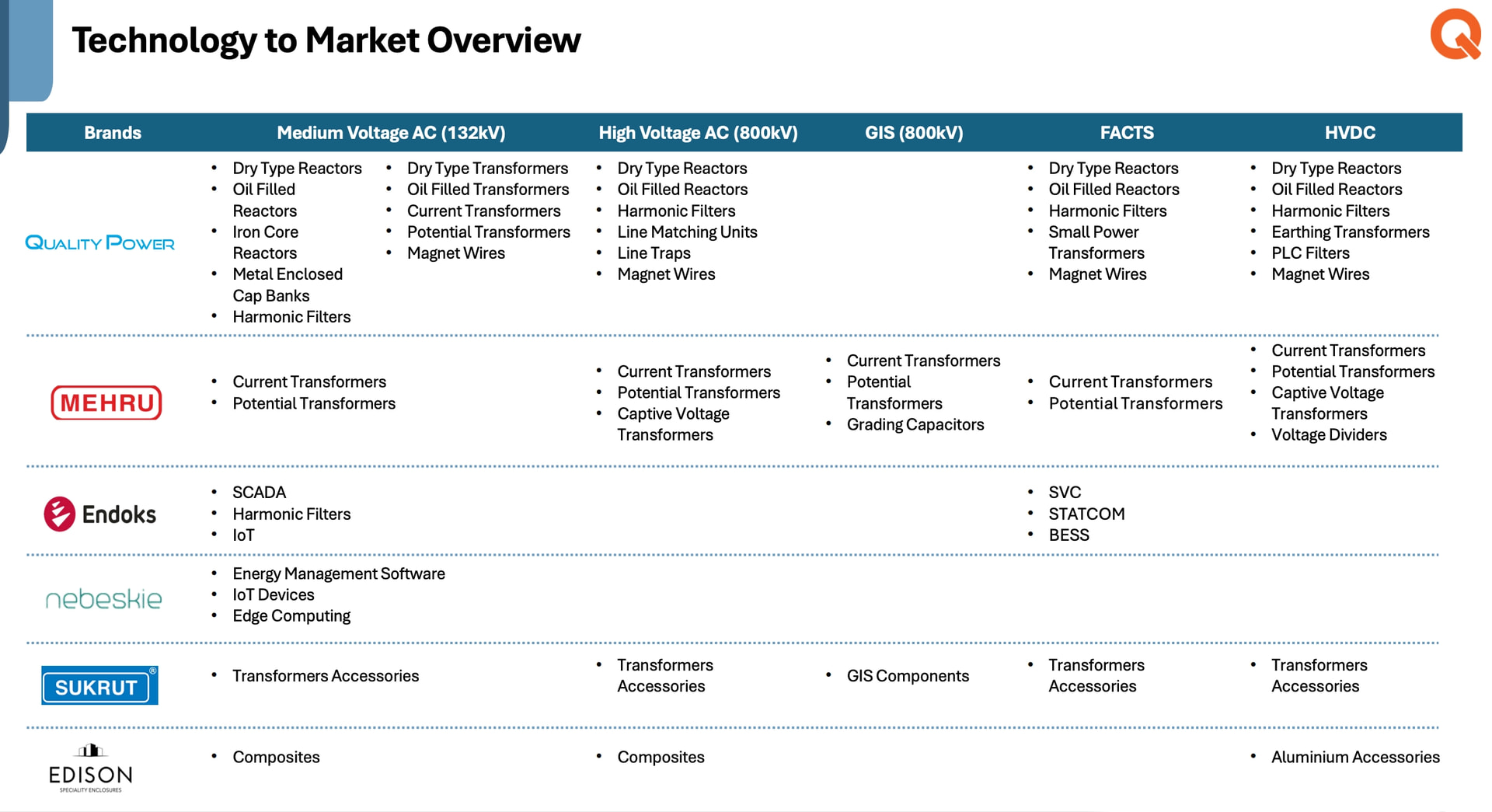
It is important to note though that none of these are wholly owned and most are ~50%
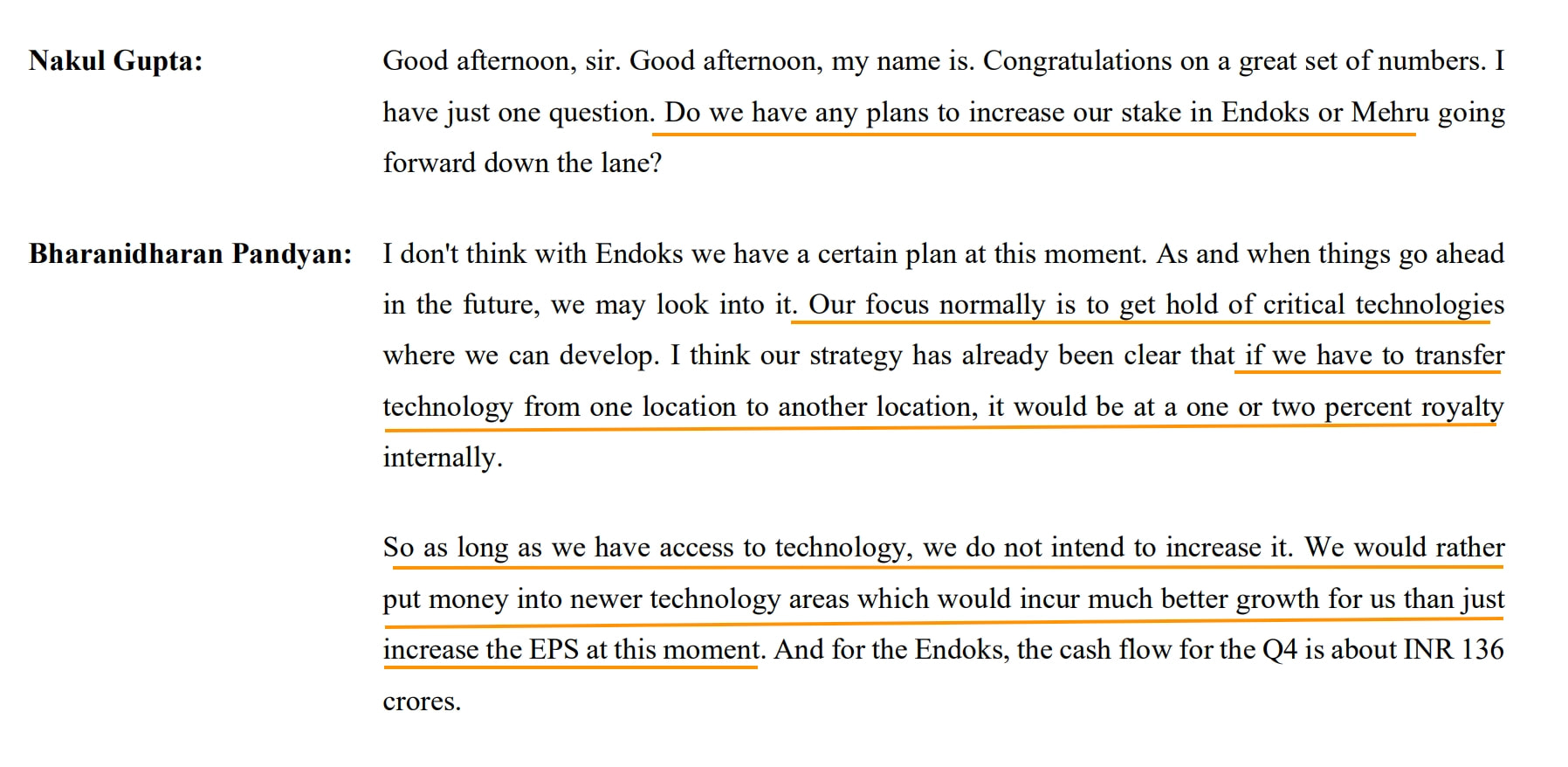
They have also recently acquired 100% of Winwin speciality insulators business for 315 Cr recently to handle capacity crunch in insulators worldwide. This has a capacity of 18000 MTPA (Modern Insulators with a capacity of 26000 MTPA is valued today at 2600 Cr mcap for reference)
They also recently acquired Sukrut Electric company from machinefabrik reinhausen (JV with Yash). Sukrut makes complementary products and QP should be able to integrate and sell their portfolio alongside theirs.

Thesis

It is clear that acquisitions are for tech and to build capabilities they otherwise dont have. To continue down this path in the public markets would essentially mean continuous dilution but the way to see this is that as long as dilution is happening at good valuation and is capability accretive (and not essentially EPS accretive as analysts usually like to see) with potential to add to overall moat, financed without stress on the balance sheet, its not essentially bad perhaps. It helps the company and shareholders a lot if the valuation of the company stays high if financing is done through a share swap.

Due to the minority share in all the subsidiary companies, valuing this company also is a pain as the profits adjusted for minority shareholding drop significantly and the company trades at 80+ P/E right now. The closest businesses trade 100+ (GE Vernova at 105 and Hitachi at 153 - but these are QP’s clients mostly - though QP makes competing products, they keep out of each others’ way by focusing on diff markets) so you can argue its par for the course but to have a margin of safety, it might be better to pay much less - maybe around 50 P/E which would mean a market cap of 6000 Cr.

The company has a order book of 1400 Cr -

  • QP - 520 Cr (HVDC, Coil products for PGCIL, 200 Cr for Israeli client over 4 yrs)

  • Endoks - 430 Cr (152 Cr BESS - expandable to 292 Cr. 197 Cr FACTS reorder)

  • Mehru - 450 Cr

Guidance for this year is 15-20% growth with a 50% growth in FY28.

The company can become a mini Hitachi Energy from India in the long run if they continue doing what they have done so far.

Risks

  • Delays in India HVDC capex

  • Any changes in Europe’s renewable targets

  • Data center capex commissioning slowdown

  • Sangli coil expansion capex completion on time

  • Acquisition led growth has historically been risky for Indian companies - BS risk must be watched

Disc: I have positions bought around 1250. It is expensive, so sized accordingly in case it corrects. I am not an investment advisor and just a novice and this is an expensive unproven stock with unknown promoter quality. Please do your own due diligence.

Sources:
Aside from AR, PPT, Concalls, found this nice primer on twitter. I dont know the original creator. Its probably claude but its a useful doc to refer to. This is what opened my eyes to the opportunity and Quality’s place in it.

IndustryPrimer-HVDC.pdf (847.7 KB)

P.S. I am very disappointed with my inability to do justice in this post and have probably rushed to finish it since I have been researching this stock over a long period of time (started in March)
109 Likes

Great effort @phreakv6. Not your most lucid writing but still useful nonetheless. You could cut down some industry product explaination and come to qpower bit quickly if you are thinking of rewriting.

Great writeup. Any view on the valuation and an entry point? The current valuation seems already stretched..

4 Likes

@phreakv6 Great insights on the Product …

Let me share some insights about the Promoter and the Management which got me interested into the counter .

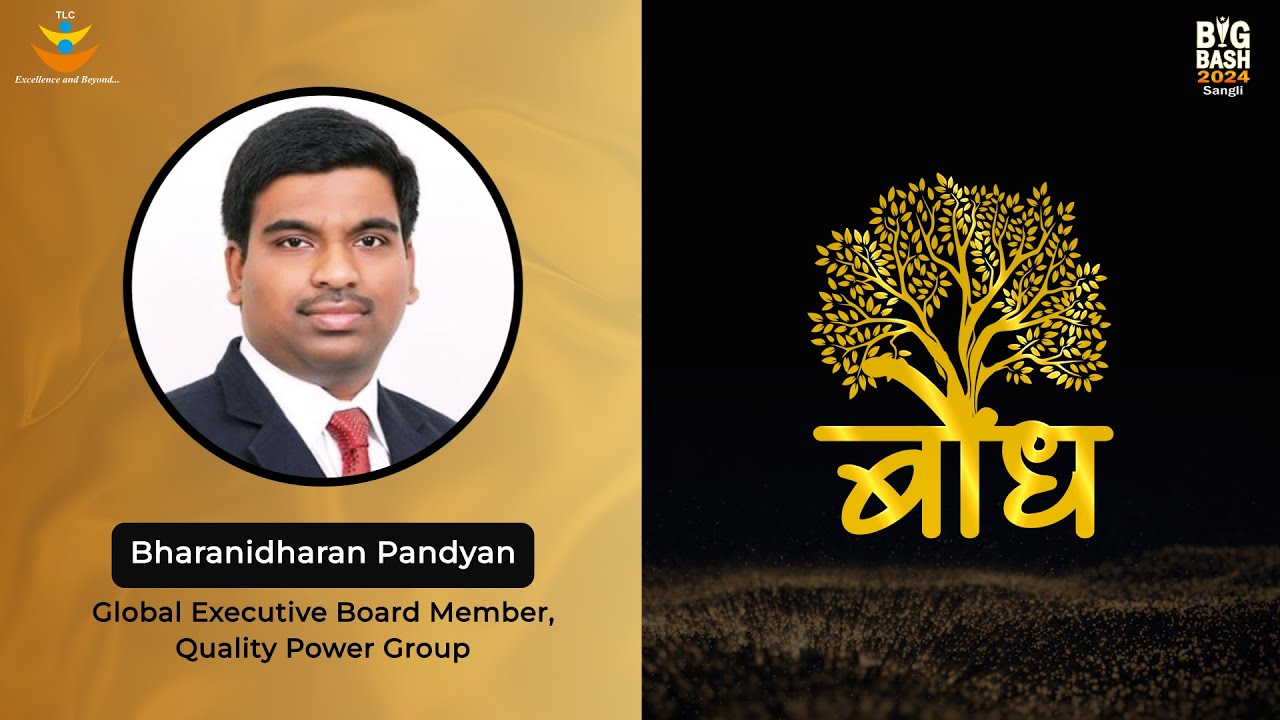
My thesis on the management was based purely on the fact of this one pre-ipo video which was provided in a Sangli Entrepreneur event which gave a very good insight on the promoter and his pedigree. Video in Marathi so Auto Translate would help for the non Marathi viewers

These kind of videos bring out genuine conversations which are devoid of any decked up speeches given to investors community and helps build a judgement on the promoters

While I last watched in June 2025 ( 1 year back ) below is some key summary points if my memory serves me right

-How he had taken a traditional power transformer business by this father which was merely 3crs to 300 crs over the last 20 odd years without a single round of external funding.
-How he focused on his first export order to Africa and realized that exports were much more profitable than domestic
-How his products were not accepted in Middle East inspite of being of high quality just because Indian products were thought to be inferior ( this triggered him to aquire a UK company way back in 2000’s itself and how that UK company helped him win contracts in Middle East ) . The same thesis lies with his Endoks aquisition as Turkey is close to USA as well as to EU markets
-How difficult is it to acquire certifications / approvals in each country due to the strict testing norms required by each country for HVDC equipment’s
-How his strategy has been to acquire different product capabilities in HVDC space to cross sell them different products from the QPower group
-How he has been able to successfully bid and win HongKong & China markets
-How he is competing with Hitachi and other players in some components and also at the same time being a supplier to them in some other markets

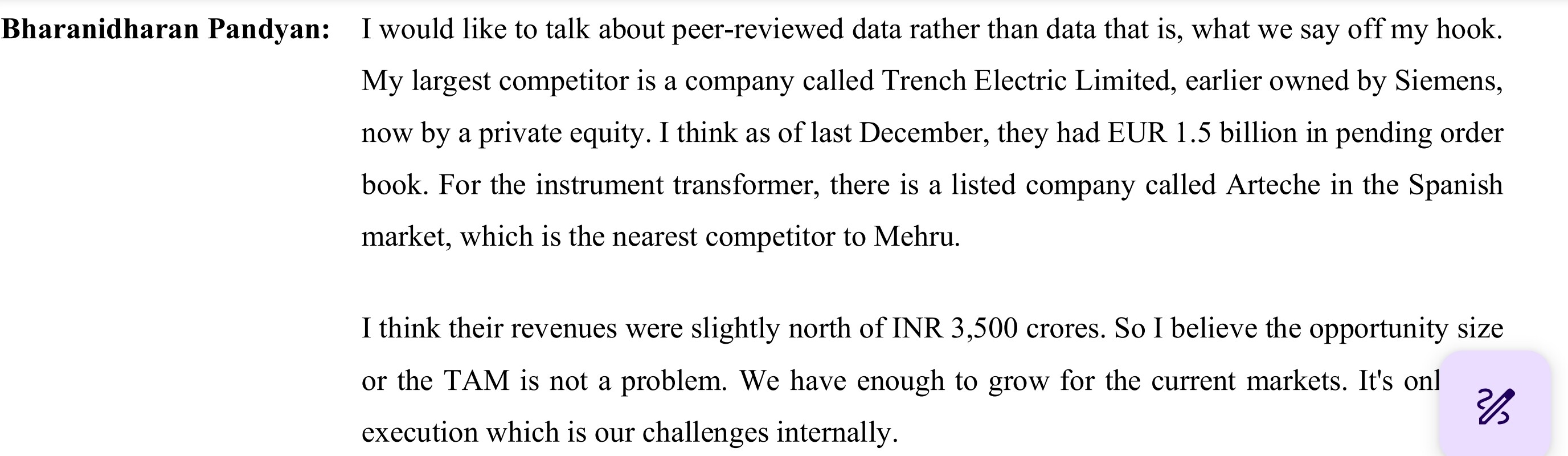
A more recent linkedin post of Bharanidharan Pandyan show how he approaches to build QPower as a company

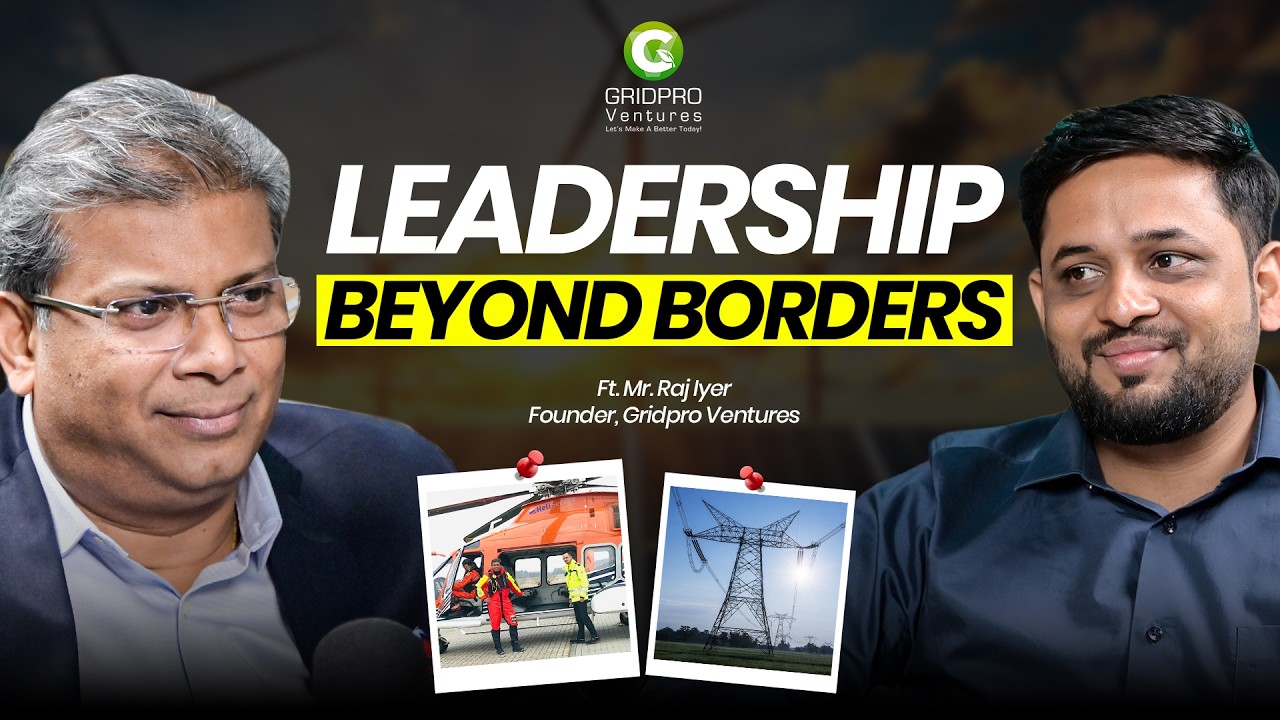
The promoter also has a star studded Board of Directors

  1. Mr. Rajendra Iyer https://www.linkedin.com/in/rajendra-iyer-25762110/ AKA the HVDC man of India

2.Mr. Shailesh Kumar Mishra https://www.linkedin.com/in/shailesh-mishra-01a33429a/

Ex ED Power Grid Corporation and SECI

Risks

  • Inorganic expansion is always difficult especially when cultures are different .

However , the promoter has done aquisitions in UK / Turkey and a few in India so he has some experience around it . In addition , he has a Doctorate in Strategy & M&A from SP Jain recently . I also believe he was part of a session at FLAME university ( if my memory serves me right ) so the promoter has been constantly trying to upskill his management skills over the last few years

-Cycle turning for the Power Sector

This cripples all the companies however this cycle seems more of a structural cycle with strong demand from Renewables + Data Centers .

Disc : Invested from lower levels below 500 with an average of 650 odd with a 7.5% of my PF ( Added recently after the Insulator business acquisition )

30 Likes

RED FLAG - Promoter ₹125 Cr Soft Loan Despite ₹858 Cr IPO Proceeds

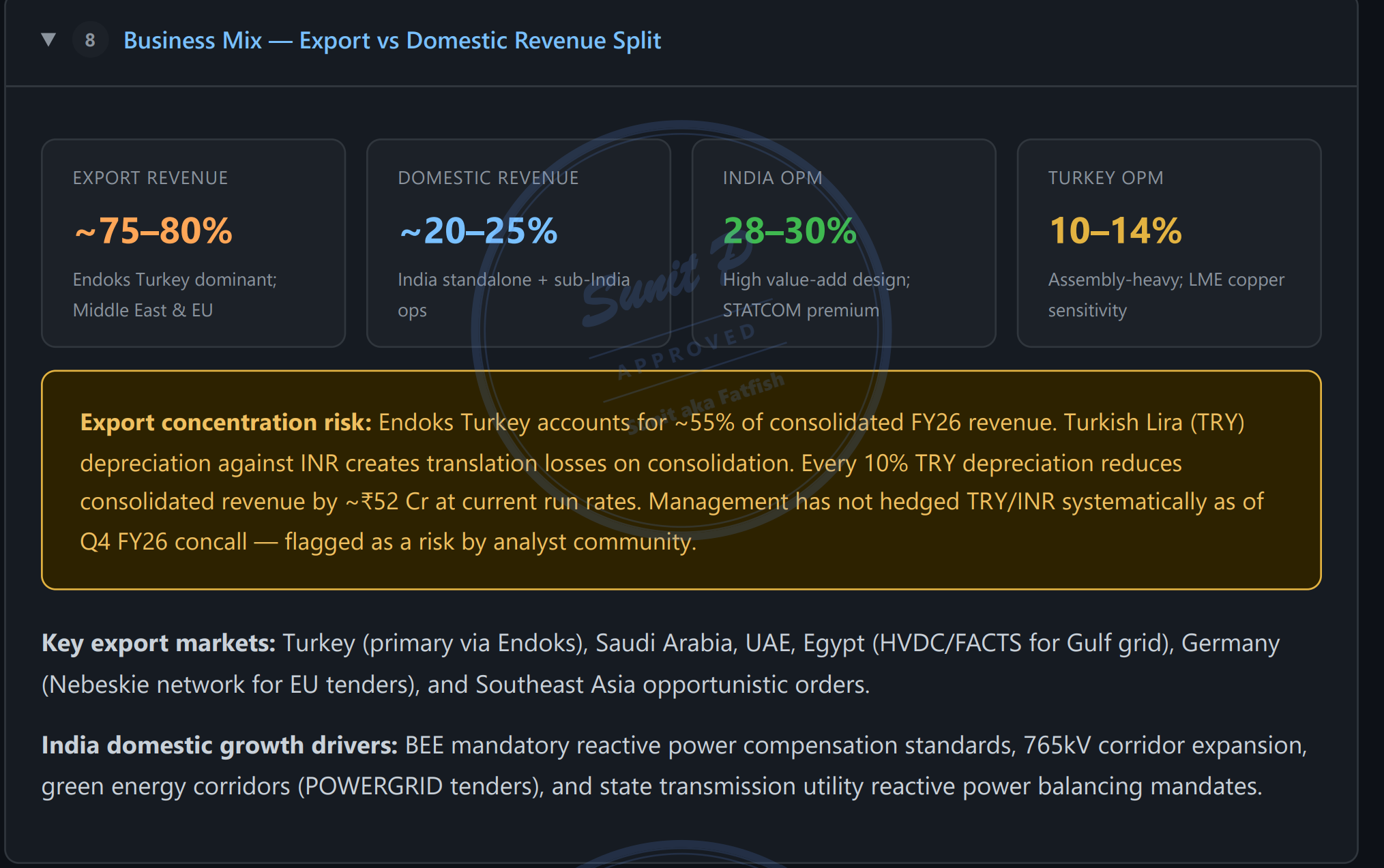
Short term Q1FY27 compression: LME has just started declining. But for Q Power price is already locked in early Q4FY26.

1 Like

@phreakv6 I came across this below Reddit post (posted 9 months ago) about the company. What’s your view?

Stock pumped on tijori finance, hni handles, social media turns out be a money laundering scheme. Quality Power - Stay away Forensic Financial and Operational Analysis of Quality Power Electrical Equipments Ltd. Executive Summary This report presents a critical forensic analysis of Quality Power Electrical Equipments Ltd. (QPEEL). While the company projects a narrative of high-tech manufacturing leadership and global expansion, a quantitative deconstruction of its financial data and strategic actions reveals a deeply troubled enterprise. Our findings point to a business model propped up by low-quality, non-operational income, a severe post-IPO working capital crisis, and a series of financial engineering maneuvers designed primarily for promoter enrichment rather than sustainable value creation.

The analysis identifies five core red flags that present a significant risk to investors:

The IPO as a Promoter Exit Vehicle: The February 2025 IPO was structured not for corporate growth but as a liquidity event for the promoter family. An Offer for Sale (OFS) constituted 74% of the issue, facilitating a ~₹634 crore cash-out for a promoter on shares acquired at a near-zero cost basis.

Systemic Reliance on Low-Quality “Other Income”: Nearly 50% of the company’s Profit Before Tax is consistently derived from non-operational “Other Income,” which management admits includes volatile forex and hedging gains from its Turkish subsidiary. The core manufacturing business appears fundamentally unprofitable.

Catastrophic Collapse of Working Capital Management: Post-IPO financials indicate a severe operational breakdown. Days Sales Outstanding (DSO) has ballooned to over 700 days, and Days Inventory Outstanding (DIO) has nearly quintupled. This signals either aggressive revenue recognition or a critical failure in cash collection and inventory management, leading to a severe liquidity crunch.

Pre-IPO Financial Engineering: The share base was artificially inflated by 48,100 times through a stock split and a 480:1 bonus issue just one month before the IPO. This maneuver created a large volume of low-cost shares perfectly positioned for the promoter’s massive OFS.

Post-IPO Capital Recycling for Promoter Benefit: Promoters are now extending a “soft credit line” to the company, effectively lending a fraction of the money they extracted via the IPO back to the business. This converts public shareholder equity into an interest-bearing private asset for the promoters while creating a new liability for the company.

Conclusion: QPEEL exhibits the classic hallmarks of a company engineered for a public listing to the primary benefit of its promoters. The underlying operational metrics are in a state of crisis, masked by opaque accounting and a forward-looking narrative that is not supported by current performance. The risk of significant capital impairment for public shareholders is exceptionally high.

Section 1: The IPO - A Study in Financial Engineering and Promoter Exit The structure and timing of the February 2025 Initial Public Offering reveal its primary strategic purpose.

1.1 The 48,100x Pre-IPO Share Expansion: In January 2024, one month before the IPO, the company executed two critical corporate actions:

Stock Split (Jan 3, 2024): Each share with a face value of ₹1,000 was split into 100 shares of ₹10 face value. This multiplied the share count by 100x.

Bonus Issue (Jan 13, 2024): A bonus of 480 shares was issued for every 1 share held. This multiplied the share count by a further 481x.

The combined mathematical effect was a 48,100-fold increase in the number of shares held by the promoters, transforming a small pre-split holding into a vast number of shares ready for a public offering. This is a textbook dilution technique to create a saleable float from a negligible capital base.

1.2 The Offer for Sale (OFS) Dominance: The IPO was a ~₹859 crore issue, structured as follows:

Fresh Issue: ~₹225 Crores (26%)

Offer for Sale: ~₹634 Crores (74%)

The vast majority of the capital raised went directly to the selling promoter, Chitra Pandyan. The prospectus confirms her weighted average cost of acquisition was ₹0.02 per share. At an issue price of ₹425 per share, this represents a staggering return of 21,249 times the initial investment. This structure fundamentally contradicts the narrative of raising capital for corporate growth.

1.3 The Alternative IPO Route (SEBI Regulation 6(2)): The prospectus explicitly states the IPO was conducted under SEBI ICDR Regulation 6(2). This regulation serves as an alternative path for companies that do not meet the standard eligibility criteria regarding net tangible assets, average operating profit, and net worth. Opting for this route is a tacit admission that the company’s historical financial track record was not strong enough for a conventional IPO.

Section 2: Deconstruction of Reported Profitability A key pillar of the company’s valuation rests on its reported profits. However, these profits are of exceptionally low quality.

2.1 The Core Profitability Gap: The company’s P&L is critically dependent on “Other Income” to show profitability.

Particulars (₹ Crores) FY 2022 FY 2023 FY 2024 FY 2025 (TTM) Profit Before Tax (PBT) 49 48 63 116 Less: Other Income 29 20 30 53 Core Operating PBT 20 28 33 63 Other Income as % of PBT 59.2% 41.7% 47.6% 45.7% Analysis: Consistently, between 40% and 60% of the company’s pre-tax profit is not generated from its core business of manufacturing and selling electrical equipment.

2.2 Management’s Admission on “Other Income”: During the Q4 FY25 earnings call, when questioned about the drop in margins and the nature of other income, management provided a critical admission:

“In Turkey, whatever the hedge call or whatever is the difference in dollar to Turkish Lira prices… all the money comes, accounted into the other income, which is not normally taken as an operational income… whatever is the difference of the exchange-linked Turkish lira is paid to us as other income or as an exchange bill. So, that is treated as other income that is nothing but an operational income due to our ongoing activities.”

This confirms that volatile foreign exchange gains and financial hedging gains, which are non-operational and unpredictable, are being systematically used to inflate the company’s bottom line. This practice severely compromises the quality and predictability of earnings.

Section 3: The Post-IPO Operational Collapse - A Working Capital Crisis Financial data from FY25 reveals a business in the grips of a severe working capital crisis.

Ratio Formula FY24 FY25 (est.) Observation Days Sales Outstanding (DSO) (Receivables / Revenue) × 365 96 days >780 days Catastrophic. Implies it takes over two years to collect cash on a sale, suggesting either aggressive revenue booking or a total failure of collections. Days Inventory Outstanding (DIO) (Inventory / COGS) × 365 42 days ~196 days Severe Deterioration. Inventory is sitting for over six months, burning cash and indicating a major disconnect between production and market demand. Cash Ratio Cash / Current Liabilities 0.29 ~0.13 Critical Liquidity Risk. Despite IPO funds, the company has only 13 paise of cash for every rupee of its immediate bills. Analysis: The velocity of the company’s operating cycle has ground to a halt.

Cash Conversion Cycle: The combination of an exploding DSO and DIO means the time taken to convert investments in inventory and sales back into cash has likely extended to over two years. This is an unsustainable model that consumes cash at an alarming rate.

Liquidity Post-IPO: To have a cash ratio of 0.13 after a fresh infusion of over ₹200 crores is a grave red flag. It indicates that the cash is either being consumed by a deeply unprofitable core operation, locked in unsaleable inventory and uncollectible receivables, or has been deployed elsewhere.

Section 4: Promoter Behaviour and Governance Concerns Post-listing actions continue to raise governance questions.

The Dividend Waiver Ploy: In the earnings call, management highlighted the promoters’ decision to waive a ~₹5 crore dividend to “conserve capital.” This is financially insignificant compared to the ~₹634 crore extracted in the IPO and serves as a public relations gesture.

Recycling Public Funds: The announcement of a ₹125 crore “soft credit line” from promoters is a sophisticated financial maneuver. It allows promoters to lend the public’s money (raised via the IPO) back to the company, creating an interest income stream for themselves while placing a new liability on the company’s books.

Suspicious Post-Listing Trading: Bulk deal data from February 2025, immediately after listing, shows massive, coordinated trades by entities with the surname “Kabra.” While not definitive proof, such concentrated activity by related-sounding parties post-listing is a common indicator of potential price stabilization efforts and warrants scrutiny.

Conclusion & Actionable Intelligence Quality Power Electrical Equipments Ltd. presents a compelling bearish case built on a foundation of poor-quality earnings, a post-IPO operational crisis, and governance actions skewed towards promoter benefit. The current financial trajectory is unsustainable and poses a significant risk to public shareholders.

Ten Key Follow-Up Questions for Management:

On Receivables: Can you provide an aging schedule for the ₹838 crore in trade receivables? What percentage is over 180 days past due, and what is your provision policy for these amounts?

On Revenue Recognition: For your large HVDC and FACTS projects, is revenue recognized based on project milestones or upon final delivery and cash collection? What is the average time lag between revenue recognition and cash receipt?

On Cash Burn: You raised over ₹220 crores in a fresh issue, yet your cash position relative to current liabilities has worsened. Please provide a detailed cash flow bridge explaining the use of these IPO proceeds to date.

On “Other Income”: Excluding all forex-related and hedging gains from the Turkish subsidiary, what was the standalone operating profit (EBIT) and margin for the consolidated entity in FY25?

On the Promoter Loan: What is the interest rate on the ₹125 crore promoter credit line? Why was this route chosen over utilizing the company’s own cash reserves or securing funds from independent financial institutions?

On Inventory: What specific product categories constitute the bulk of the ₹140 crore inventory, and what is your strategy to liquidate it without resorting to heavy discounts that would further erode margins?

On the IPO Route: Which specific clauses of SEBI’s Regulation 6(1)—net tangible assets, operating profit, or net worth—did the company fail to meet, necessitating the use of the alternative Regulation 6(2)?

On Capex vs. Working Capital: Given the severe stress on working capital, how can the company justify its aggressive nine-fold capex expansion plan? Where will the funding for the increased working capital to support this capex come from?

On Post-IPO Trading: Can you clarify the company’s relationship, if any, with the Kabra family entities that executed large-volume trades in your stock immediately following the IPO?

On Future Guidance: Your guidance of 17-18% blended margins is significantly below the historical standalone performance. Is this the new normal, and does it imply that all future inorganic growth will be value-destructive from a profitability standpoint?

7 Likes

@sameernics Thanks for detailed analysis. I do agree that such kind of manipulation by promoters, pumping price through hired PR firms and social media army is very much possible, especially in SME and micro cap companies.In limited liquidity, this is easy job for them.

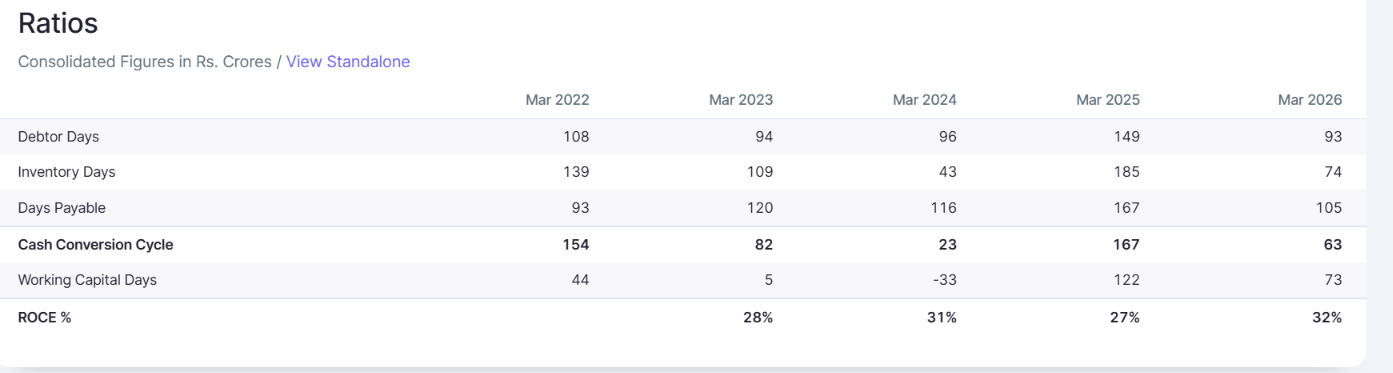
However, when I look at screener data - Year 2026 is very good year for the company especially on cash conversion and ROCE improvement . Am I missing something???….

1 Like

I am disappointed with how badly this forum has disintegrated making me question my reasoning for still hanging here when most people who started with me have smartly left. I still write because sometimes very productive people also contribute (like Dhruv’s post on Yash which carried lot more insights adding to what I started with). But many of the responses here add almost nothing to the original post (fair valuation of 6000 Cr is mentioned in my post and despite that there is a post asking what is fair valuation).

Worst, there is lot of unverified AI slop - a lot of the points are so basic, I am not even sure I should bother to reply. Brandolini’s law aka “bullshit asymmetry principle” states its easy to generate bullshit than it is refute it and the post #5 is a very good example of that. AI has made these things worse.

  • Split + 480:1 bonus doesn’t change ownership structure one bit. How is this financial engineering? This is common for almost every other IPO.
  • 75% OFS is a red flag? There are offerings with 100% OFS as well. Remember that the promoter holds 75% here still
  • There is a point claiming soft loan with “public money”. The money lent is private capital now from selling shares. How is this public money?
  • DSO and cash conversion - receivables days is ~3 months for the company which is normal. It is not “catastrophic” 780 days, nor is inventory days 196 - It is just 74 days which again is normal.
  • There is cash of ~250 Cr on the books. I dont know what liquidity crunch is being referred here.
  • The Turkey accounting is normal hyperinflation accounting. Please make an effort to understand it has zero cash impact
  • Suspicious post-ipo bulk deals - since when are bulk deals suspicious?

If you are using AI, at least pay 2k plan and use a decent model for analysing stocks.

Promoter quality is still an unknown to me - but this kind of AI generated red flags are of zero use to anybody. Please refrain from posting anything AI generated. Use AI to understand, assimilate and rewrite in your own words - that shows you at least made the effort to understand and stand behind what you write.

115 Likes

One of my frustrations with my thread starter was my inability to simplify “reactive power” the way i understood it because it is the crux of what the business is about. A nice analogy just stuck me

Think of reactive power components as a market maker in a stock. He helps smooth the price fluctuations when large trades land which would make the prices fluctuate a lot in an otherwise illiquid market. The market maker adds zero value, produces no goods - similarly reactors and capacitors don’t add any MW and do no work but are essential to absorb the fluctuations.

Reactive power components are isolated to the circuit - similar to how a market maker is required for each stock. Rating of reactive power will depend on the amount of fluctuation expected - just like large unpredictable orders need deeper liquidity, large variable loads will need a higher MVAr capacity

So as the overall size of power generation/consumption increases in the world and higher the unpredictability of generation and consumption (on a sub-second scale), higher would be the need for components that stabilise them.

61 Likes

Very nice analysis and thorough info! I would like to understand the the data center play with QP products. Do they already have tie ups with Hyosung? also, can you throw some light on who are Qps competitors both domestic and foreign, who have similar products?

Yes they have tie up with hyosung for gis, they are coming up with prototype in August-september 2026

They do not face Chinese competition in india, europe and us

7 Likes

Reactive power is sort of created by the load on the power generator, all the motors, ac’s, transformers running require a magnetic field and the reactive power helps in the above. High reactive powers are not good for many reasons, high curernt deawn, more heat losses due to the high current and voltage drops.We were always taught to maintain a PF of 0.8 and not go below it.PF is the ratio between real power in KW and apparent power in KVA, that is how efficiently electrical output power is converted to useful work and ideally the ratio should be 1.Capacitor banks and other equipment that Quality makes helps maintain the stabilty of the grid.Inductors cause the PF to drop(all motors cause inductive load) and capacitors help in icreasing PF,

These products have been there for some time since power generation and transmission problems have existed. Products that they make seem to be in existence for decades.. Iam sure there must be other manufacturers for these products. I believe for HVDC the technology is evolving and changing(believe Siemen’s SVC technology is the way forward). Just leaving the financials aside, are they doing anything unique to capture the transmission sector. Is it that the bigger players like Siemens, Hitachi are vacating some of the products to focus on niche products.Iam a mechanical engineer, but have some knowledge on electrical stuff. I may be wrong on the understanding of the product profile of Quality, but the demand could be so large that there are not enough players.

19 Likes

Please ignore the unverified comments, and kindly continue to post the detailed analysis. I read most of your threads

12 Likes

Yes these products have been around for a while but the cycle was not in favour which finished off a lot of weak businesses in the down cycle. The ones left are now making merry. That is one way to look at it. The other way is to see what is causing the cyclical upswing and how long it can last - this looks easily a 5-10 yr trend at least even from here based on the diff component tailwinds i mentioned in my initial post. One of the videos shared in post #4 specifically talks about this from about 34:20 (He is ex-GE/ex-ABB and now an ind. director for QP).

As for the PF, I looked it up and it seems CEA mandates grid power factor of 0.95 lagging to 0.95 leading. The 0.80 PF you are talking about seems to have been the case in the past. Also, this was specifically applicable to industrial power consumers from cement, steel, oil & gas (you can see arcelor mittal, jsw, aramco as customers) where they would have needed compensating equipment due to their induction motor heavy load (or they would be penalised when PF dipped below range). This was their traditional customer base I presume (The promoter mentions this in the video shared in post #4).

The current usecase though is different and is primarily from a renewable power producer standpoint. The tight 0.95 PF essentially mandates they do active management (STATCOM/SVC) and not use the older passive technology of capacitor banks and reactors alone. The other tailwind as I mentioned is the HVDC which again is a very old tech but there are only 3 survivors and after a lot of M&A action (involving Alstom becoming GE Vernova, and ABB Power products becoming hitachi) has left only 3 players with capable technology (Siemens the other).

QP appears to supply coil products to all these HVDC players (like the Rihand-Dadri HVDC line) and also for their STATCOM usage (Endoks Energy in Turkey for European markets). Europe is already predominantly renewable grid so this tech already has matured there. And qualifying to supply to Hitachi/GE is a long process and requires qualification which is where the moat comes in. Doesn’t mean QP is sole product supplier - there are others qualified in most of their categories but the products are themselves under supply crunch with long lead times presently.

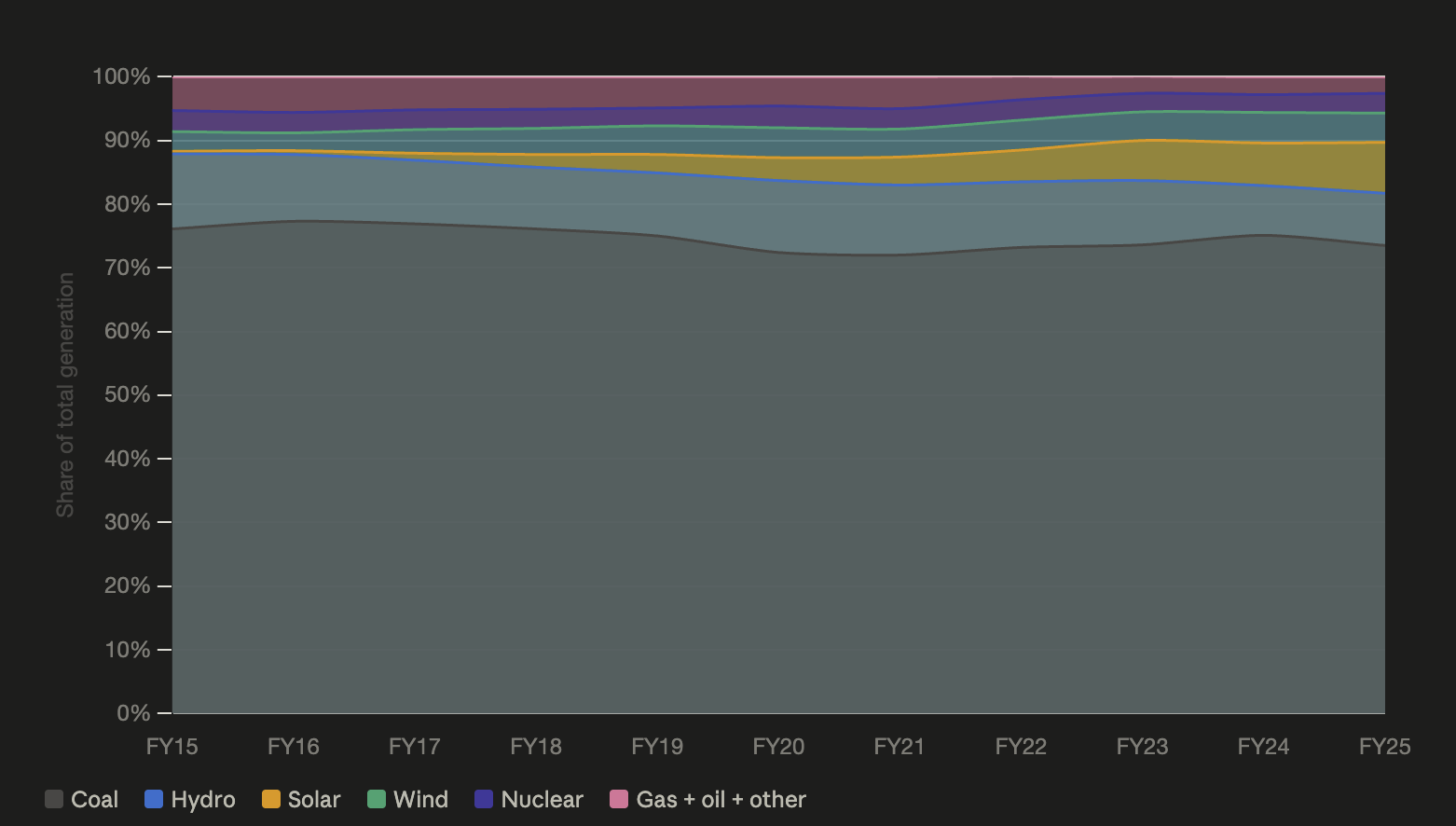
This is how our power mix currently is - you can see renewables expanding - higher renewable share directly drives demand for QPs products - be it HVDC, BESS, STATCOM/SVC, simple coil products

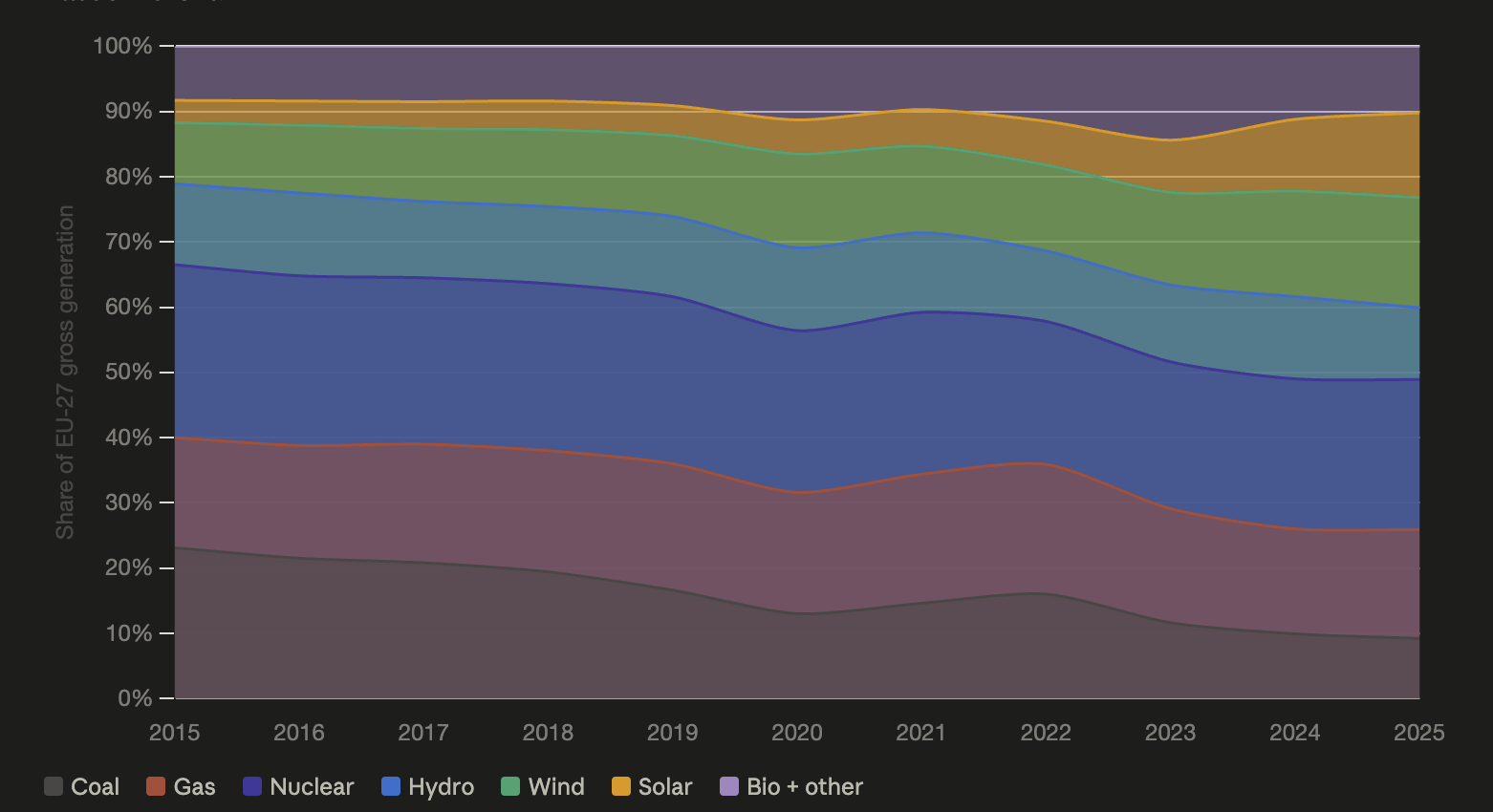
This is Europe’s power mix. We are where Europe was in 2015 (12% solar+wind).

Another exercise I did to evaluate how good the acquisitions have been. Listed chronologically

Endoks Energi, Turkey - 2011 - 51% in 7 people company for 1.62 Cr (mentioned in the video in post #4). Today Endoks has 468 Cr in revenue for FY26 with 109 Cr EBITDA (29% margin when not adjusting for hyperinflation). This is what riding on the European renewable tailwind (STATCOM/SVC) has done for the company. The main products did not even exist when the company was acquired. Now the next tailwind underway in Europe is BESS and with the PCS product, Endoks should continue its next phase of growth. Hoping for other acquisitions to be this good I think would be unfair considering how many things went right here - from paying low, investing in r&d, having a tailwind to capitalise etc.

S&S Transformers, Cochin - 2019 - 100% owned. Company used to manufacture transformers & components. Unsure of the value paid here. But the company acquired the cast resin/medium-voltage coil capability. I presume all transformers manufactured by QP were capability-wise acquired with this (STAP brand). So though the value paid is unknown, clearly the company got into transformers with this acquisition

EPEC, Bangalore - 2022 - 100% acquired and manufacturing of MV instrument transformers at Sangli under EPEC brand probably started after this. So this company gave them the instrument transformer capability albeit only for medium-voltage transmission. Unsure of what was paid for it

Toshiba P&M assets, Telangana, 2022 - This seems to have been an asset purchase. This is where they got the instrument transformer manufacturing capacity upto 400 kV

Nebeskie Labs, Chennai, 2022 - owns 25% currently (probably paid 1.5 Cr for this). This seems to have been a capability acquisition for edge computing and IoT solutions for real-time monitoring of substations. Company seems to have a revenue of ~1 Cr as of FY25 (up from 55 lakhs prev yr). FY26 AR will probably show where it was in FY26. Too small and good to be treated as an optionality

Mehru, Bhiwadi, 2025 - 51% for 120 Cr cash. Mehru today has 318 Cr revenue for FY26 and 47 Cr EBITDA (15% margin). FY24 revenue was 218 Cr with 10 Cr PAT. Price paid is ~24x PAT and ~1x P/S valn. roughly which is phenomenal. Acquired likely for instrument transformer capability upto 500 kV (EPEC gave them MV instrument transformer capability and Toshiba acq gave them manufacturing plant). Order book at Mehru is 450 Cr. This is already a phenomenal acquisition probably as good as Endoks Energi - both from a price paid as well as overall performance. There is a 45% capacity expansion as well and I think what was invested would likely be back this year itself. They get a strong footing in GIS/FACTS/HVDC/HV instrument transformers

Sukrut Electrical, 2025 - 50% for 10.2 Cr. Revenue I think is 25 Cr, so < 1x P/S. Again this company gives a lot of qualified products in transformer accessories and GIS components. Company has stopped losing money and going by the capability, regulatory edge (qualified products) and customer list to cross-sell to, this will most likely turn out to be a good investment. They have got the valuation right and the capabilities already justify the price paid.

Veeral Controls, Dec 2025, 76% for 15.2 Cr. Revenues FY23 - 8.57 Cr, FY24 - 2.94 Cr, FY25 - 4.19 Cr. So this is coming at almost 4x P/S. Its a 3 decade old business. But what’s interesting is what this company provides - They have Insulated Gate Bipolar Transistor (IGBT) and SCR based rectifiers - essentially power semiconductors used in green hydrogen, railways, heavy industry, nuclear and defence industries. It is still MV power electronics and not HV - so they can’t use these in HVDC. But the client base is extraordinary for its size (ABB/Hitachi, BARC, Indian
Railways, Indian Navy, DRDO, Tata Power, Tata Steel). Companies sees this as a synergistic with Endoks for power quality capabilities through dynamic compensation. I think this might turn out to be good too in the long run. Worst case, still fantastic capabilities

Winwin speciality insulators, 2026, 100% for 315 Cr. This is the most recent. The company has 18k MTPA insulator capability although currently not functional but once its made functional, its a near 5x value unlock (though it might take 2-3 yrs i think to do so). It also gives them 47.7 Cr SEZ land which alone should be worth the price paid.

This is what impressed me the most about the company. There is a definite method to the madness of acquisitions. As long as they keep the valuation discipline and execution capability to turnaround businesses (almost all of them are distressed assets of some sort), I think we might be good. This is my secondary bet here which I could not elaborate in the thread starter. Usually companies with a tailwind, a moat (regulatory in this case) and doing something unique (capability acquisitions in this case), there is a good chance of creating long-term shareholder value.

P.S. I just realised the post is a little too overoptimistic. The valuation is not cheap, as I have reiterated before. Ask yourself why the company is able to acquire businesses for so cheap while we are paying such expensive valn for it - it might be a rhetorical question but its worth asking anyway. Anything above 6000 Cr is expensive here. Since FY27 is supposed to have tepid growth, there are very good chances of getting a 20-30% correction here towards fair value. Just for clear disclosure - I own ~4-5% here. I will not scale up further at these valuations. If it falls further though while the execution plays out, I would double allocation or even triple it closer to FY28. I avoid looking at valuations when I am studying a business because my objective is not to have cheap as the gating filter. I want strong tailwinds as the first gating filter with everything else following that - because even the worst businesses make money when there are tailwinds and that generally protects the downside

67 Likes

While the company’s prospects appear promising, paying a price-to-earnings ratio of 80 and a PEG ratio of 3 is highly demanding. Purchasing even a fundamentally strong business at an excessive valuation rarely results in long-term wealth creation.

2 Likes

Iam always thankful to Mr.Bharani Manoharan for his contribution to this group, not only for his stock suggestions but also book suggestions. I have benefitted by hanging on to one of his initial suggestions, Apar Industries. I belive you have moved on, I did enough reserach on that and held on to it, giving me good returns. However mentally i could never buy any of his other suggestions like Wockhardt. Its a behavioural thing, not able to clearly see the future and sort of hung up on the valuations. I cannot still convince myself to buy something like Aeroflex, Sai Life sciences or Quality. Need your thoughts on how to go about buying expensive stuff like this, However i could buy Hitachi with confidence at 100+ P/E , because i knew they had blockbuster products that could not be replicated and the runway was long. I am still ready to take the plunge with Siemens at 97 P/E, but wary on Mtar,Quality, Sai or Aeroflex.How would you stagger the purchase or wait for a bad quarter to buy. Apar was reasonable priced at the time of suggestion, so there were no second thoughts at that time. I kept waiting for Sai to correct, but it has only become more expensive. Aeroflex and Mtar makes me giddy.

I would also request Electrical engineers to contribute as this energy transition, HVDC and transmission is going to be the happening sector for next few years. However we have to be mentally prepared for an AI crash, that could hurt the whole data centre business and along with it the energy business.

16 Likes

I am not sure about the authenticity of the information .

Lets get back to the history of WinWin Speciality Insulators.

W.S. Industries core business was Porcelain / Ceramic Insulator Core .

Refer the history of WS Industries which give an overview of the business

Seems that the 10x capacity expansion planned in 2008-2009 did not go to as per the plan and the debt blew up and they could not service the debts on time.

The final blow for any revival plans were hit by Cyclone Hudhud which stuck Vizag in Oct 2014 and since then the plant was completely out of for over 5 years .

This article from the Hindu on APSEZ from 2020 gives the details

The revival plan was approved by APSEZ with verbatim as below

“A. Rama Mohan Reddy discussed the possibility of its revival with a fresh investment of ₹100 crore of W.S Industries plant by a new company named Win Win Specialty Insulators Limited. The change of ownership has been approved by the unit approval committee of APSEZ.. The unit has also been given extension of approval for five years with the provision to review their performance on a yearly basis by the Board of Approval, the country’s highest body for SEZs.”

This info aligns with W.S. Industries planned divestment of their Ceramic Insulators business by the new management in 2020

W.S. Industries with the new management decided to go out of the Insulator business

Now lets understand the key architects of WinWin who have been reviving the operations of this sick unit over the last 5 years

  1. Aaditya Yalamarty : https://www.linkedin.com/in/yalamarty/

Based on his work experience : they have started the revival of the Plant in June 2018 itself

"Project “WS WINWIN” – Proposed acquisition of one of the World’s Most Modern & Youngest Electro-Ceramic production facility, capable of manufacturing Electro Ceramic Insulators up to 1200 kV Voltage Class amongst other products – built with technological inputs from American & European OEM / Manufacturing partners.

My Primary role as one of the core team members & CEO designate, is to plan & structure the Marketing, Procurement & Strategy directions, the unit will chart post acquisition. Being akin to a startup in a stealth mode, my role and sphere of operations is more fluidic in nature, covering most of the avenues & dawning various hats, as and when required, echoing the spheres of operations at Aster Private Limited."

  1. Vaishnavi Sahithy : https://www.linkedin.com/in/yvs/
  2. Aishwarya Yalamarty ( Related to Aaditya Yalamarty )
  1. Sridhar (Sreedhar) Gogula :

https://www.linkedin.com/in/sridhar-gogula-724a4518/

Now lets look at what WinWin Speciality Insulators present state

As per this post the Win Win Insulators has achieved over 1100% growth since Yalamarty’s bought the business around 2020 to 2022 period.

The interesting part was in just couple of years they had already restarted and were at the US trade exhibitions IEEE Power & Energy Society (PES) T&D Conference of 2024

Here is the list of products which they offer atleast this was updated in 2024

WIN WIN have recently been in the limelight winning quite a few awards.

AP MSME Growth Summit 2026. The video explains their products for Power & DC space

A couple more interviews / link of Aditya & the business

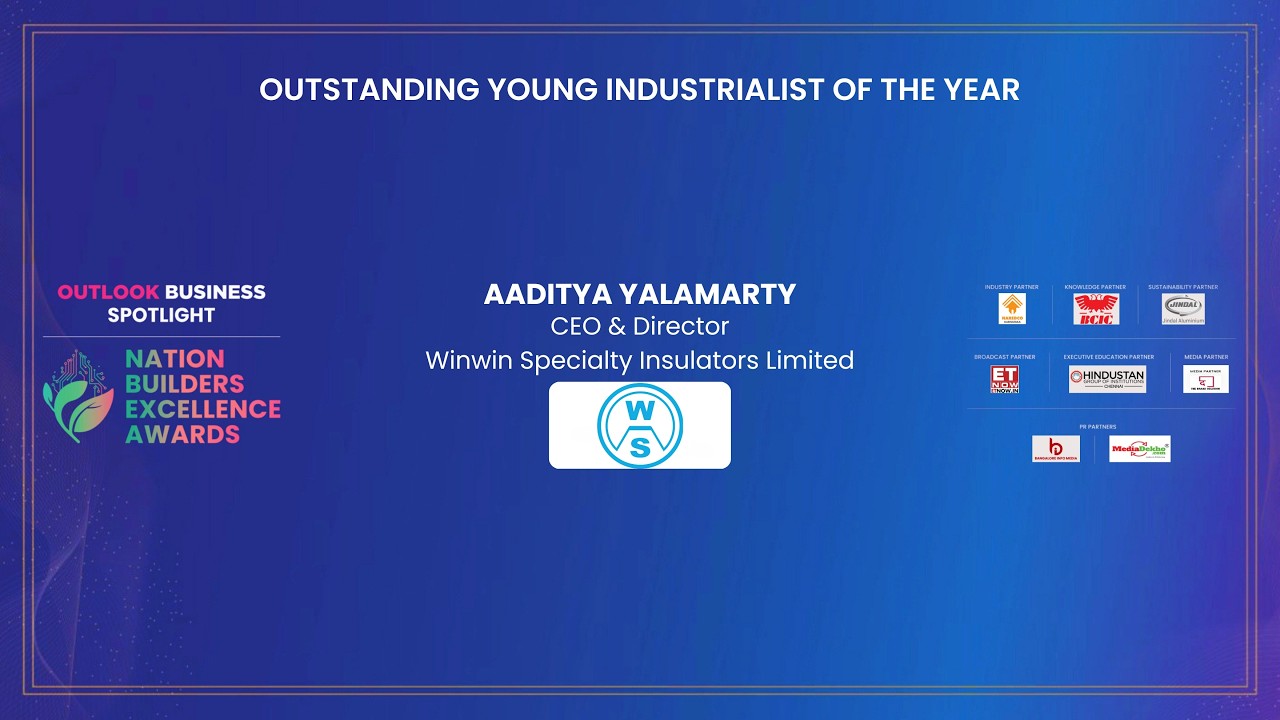
Outlook Nation Builders Excellence Awards 2026 - Outstanding Young Industrialist of the Year

Entrepreneur Media India Startup Awards 2026

Some more deep dive:

Why did Yelamarthy’s takeover the porcelain business from W.S. Industries ? Why A. Rama Mohan Reddy from APSEZ in 2020 mentioned in the Hindu , specifically talk about WinWin Speciality Insulators investing 100 crs & reviving the unit.

This 2012 TOI article shows the Yelamarthy’s business influence

On digging further Aditya father , Kamesh Yalamarthy was the MD of Sujana Towers https://www.linkedin.com/in/kamesh-yalamarty-46056738/ which was part of Sujana Group

And Sujana Group was promoted by YS Chowdhary who is a curent MLA from AP

So clearly Yalamarthy’s were into building Power Transmission Towers and HVDC space from quite sometime in the past and clearly knew the value of the W.S. Industries Insulator business.

W.S. Industries Chariman & founder V. Srinivasan death in July 2017 & the acquisition of the business by the new management who wanted to offload their insulator business was when Yalamarthy’s saw the opportunity and pounced on it in 2018 when they started Project “WS WINWIN” to aquire the asset and revive the plant.

Disclosure : Invested at lower levels and biased . The interpretations are purely based on my understanding of the sequence of events about Win Win Speciality Insulators

18 Likes

@Nabendu I am probably not getting what you meant to say out of the post? Its just me, apologies if it comes as questioning the post itself, i assure you it is not.

3 Likes

#QualityPower

On July 3 the company disclosed two separate customer wins on the same day. Its Turkey subsidiary Endoks won a Rs 41 crore order to supply grid stabilisation equipment to Japan.
Its India subsidiary Mehru won a Rs 16 crore order to supply high voltage transformers to Hitachi Energy India.

Japan’s grid is one of the hardest markets in the world for a foreign supplier.

Hitachi Energy in India takes six months to two years to audit a new supplier before the first order.

Positive developements

17 Likes

The Reverse DCF: What is the Market Assuming?

Let’s reverse-engineer the math to see exactly what financial performance is required to justify today’s INR 8,770 Crore Enterprise Value (assuming a 12% WACC and 4% terminal growth).

To mathematically justify today’s price, Quality Power must achieve:

  • Year 5 Free Cash Flow: ~INR 950 Crores.

  • Implied Year 5 PAT: Assuming a highly efficient 70% FCF conversion rate, this requires a Year 5 PAT of ~INR 1,357 Crores.

  • Implied Year 5 Revenue: Assuming an incredibly optimistic 18% PAT margin (far above their historical hardware averages), this requires Year 5 Revenue of ~INR 7,538 Crores.

The Reality Check: To hit INR 7,538 Crores in 5 years, Quality Power must grow its top line at a 50% CAGR for five straight years, while simultaneously expanding its PAT margins to 18%, all while absorbing the depreciation of a 9x capacity expansion.

Base Rate Probability: Near Zero. As seen in the Chinese supercycle, when massive capacity comes online, prices drop and margins compress. The market is pricing in hyper-growth and margin expansion simultaneously—a mathematical paradox in heavy manufacturing.

Disclosure: Currently on sidelines so biased

12 Likes