1. Positron Energy – Investment Case
Positron Energy is an energy sector company that specializes in natural gas distribution solutions, asset light gas aggregation, and technical and management advisory services for the oil and gas industry. The company was Incorporated in 2008 and operates pan-India; as of FY26, they served 70+ clients with a team of roughly 177 employees. The company’s main business and the source of 90% of their revenues is gas aggregation where the Company buys domestic gas or imported RLNG and resells it to industrial consumers and CGD distributors. In FY26 revenue grew 31% to ₹442.15 Cr, EBITDA grew 21.5% to ₹28.55 Cr, and cash rose 23% to ₹81 Cr while trade receivables fell 18%. Management has guided to 15,000 MMBTU/day in FY27, against ~11,000 MMBTU/day in FY26, backed by RLNG purchase contracts running to 2027 and 2035.
At ~₹173 a share (Market Cap of ~₹131 Cr), the whole company is valued at an Enterprise Value of ₹50 Cr, against ₹81 Cr of cash on the balance sheet. That is roughly 0.8–0.9x forward EV/EBITDA, against the 5x that brokers apply to the comparable gas trading segment of Gujarat Energy. The most likely answer is scale, and scale is what the FY27 and forward guidance addresses. On a 5x multiple the base case works out to ₹467–526 per share. The case rests on the volumes increasing while maintaining margins, which makes the next two to three quarters the ones to watch.
2. The Business
Positron Energy is a gas aggregator and reseller that buys domestic gas and RLNG on a long-term basis, through domestic allocation or spot on IGX, and subsequently sells the same to industrial consumers and CGD distributors with flexible tenures. The company does not have any captive pipelines; all gas is bought and sold through open access, and revenues are driven by the spread between the purchase price and the selling price.
The spread is earned rather than speculated on. Purchase pricing is largely formula-linked – to Henry Hub, JKM, WIM or crude, depending on the contract – and most sales contracts pass that formula through to the customer. Positron is not taking a view on gas prices; it is being paid for aggregation, credit and reliability. That matters when reading the margin, because it means spread compression comes from competition and demand, not from the company being caught on the wrong side of a price move.
Apart from gas aggregation, the company is also engaged in technical services and consultancy work – project management, engineering studies, operation and maintenance of city gas distribution networks, EPC for midstream and downstream gas infrastructure, regulatory approvals, feasibility studies, and pipeline design to PNGRB standards. As of FY26, the technical services division has executed more than 129 projects across gas consumption hubs and has laid 60+ pipelines and 1,700+ domestic connections. The consultancy work gives the company a critical competitive advantage, wherein engagement with industrial clients on their gas infrastructure needs leads to a long-term supply contract with the same, providing Positron with recurring revenues.
3. Competitive Position
It is important to make the case that Positron Energy is not just a simple gas trader. It possesses several competitive advantages that differentiate it from competitors-
First- Positron’s business model requires extremely minimal capital expenditure. There are no pipelines to construct, no CGD licences to apply for, and no infrastructure to maintain. The returns therefore come from how little capital the business ties up while generating a small but healthy margin. On an EBITDA margin of around 6.5%, the RoE for FY26 still comes out to 22.6% and RoCE to 30.5%, both on a near-zero debt balance sheet (D/E of 0.05x). There is almost no leverage to distort the earnings and no depreciating asset base to service, so the small capital employed is what does the work. Fixed costs barely move with volume, so each additional rupee of spread earned on incremental volumes translates to almost the same additional rupee of profit. FY26 shows what that allows in practice: the company lifted volumes from ~8,000 to ~11,000 MMBTU/day, and is guiding to 15,000, without adding capital or materially adding cost. Volume can be added quickly because there is nothing to build first. Most competitors sell natural gas as an ancillary business, whereas for Positron it is the core business and will always be the core business going forward.
The second edge is working capital management, which has allowed the company to fund long-dated supply contracts with its own cash flows. Even while recording 31% YoY revenue growth in FY26, trade receivables decreased by 18% YoY, and cash increased by 23% YoY to ₹81 Cr. As mentioned in the FY26 AGM, the cash is deployed as a guarantee for long-term contracts. That is what makes the third edge possible.
The third edge is the contract book itself. Positron’s function is to stand between RLNG sellers, who deal in cargo-scale volumes and want committed offtake, and industrial buyers, who individually cannot contract at that size. Aggregating that demand into a contractable block is the service, and it requires the balance sheet to sit in the middle and carry the commitment. Generic traders usually operate on a spot basis and hence do not have long-dated contracts, which exposes them to price risk on both the buy and the sell side. Positron has two long-dated RLNG purchase contracts, running to 2027 and 2035, which together average roughly 26,000 MMBTU/day across their full terms, and a sale contract covering calendar 2026. A thinly capitalised trader cannot commit to that.
The fourth edge is the customer base, and the technical services offering that holds it. Positron has deliberately gone after smaller industrial users and CGD distributors – customers who value flexible tenure and reliable supply more than the lowest headline price, and who the large OMCs serve poorly. Its relationships with those clients let it lock in medium and short-term supply contracts on the back of the technical services offering, which creates switching costs. The client cannot move to a cheaper RLNG or domestic gas supplier for want of infrastructure, and cannot easily move to another OMC either, since the OMC may not provide the technical services. This matters because most gas aggregators are large OMCs selling either to bigger industrial consumers, who can switch between OMCs on price, or to small distributors in smaller towns, who do not have much choice. Positron sits in between, and competes on flexibility and reliability rather than price. The advantage itself is difficult to quantify but extremely durable, and the management describes the company as a “drill-bit to burner-tip” business.
4. Volume Growth and the Contract Book
On a macro level, India’s gas consumption as a share of total energy needs currently stands at around 6%, against the government’s target of 15% by 2030, implying a need for doubling down on gas consumption over the next five to seven years. That is the demand backdrop against which the volume guidance should be read.
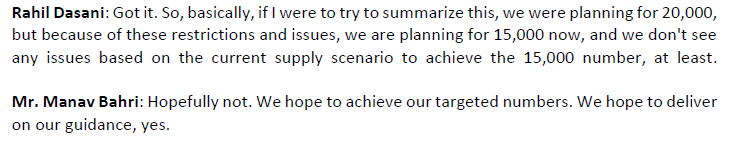
Volumes in FY26 increased from ~8,000 MMBTU/day in FY25 to ~11,000 MMBTU/day in FY26, aggregating 108 MMSCM over the year. The FY27E guidance for volumes comes at 15,000 MMBTU/day, implying 25–30% growth over FY26 (the earlier guidance was closer to 18,000-20,000 MMBTU, but due to the Gulf War, the company has revised it down based on the current supply that they are getting and passing on to customers).
The reason for optimism around volumes rests mainly on three contracts signed between August and October 2025:
- An RLNG purchase agreement signed in August 2025 for 3.635 million MMBtu (~92.7 MMSCM), running through March 2027.
- A long-term RLNG purchase contract signed in September 2025 for 60,991 Billion BTU (~1,555 MMSCM), effective until December 2035, with ramp-up potential toward higher daily rates.
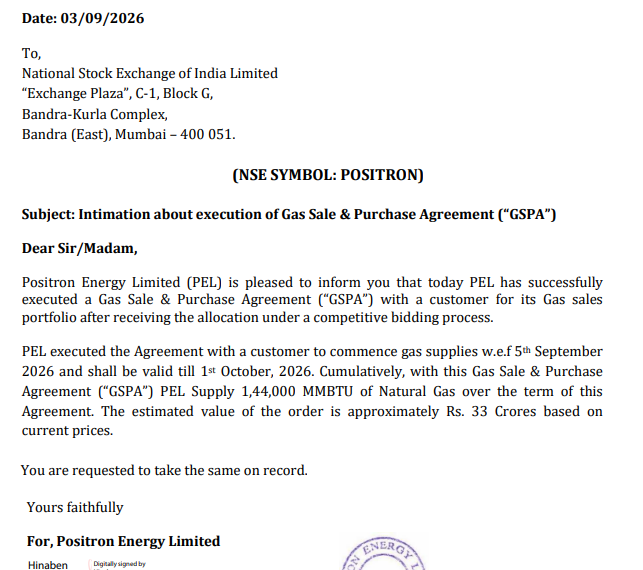
- A one-year gas sale and purchase agreement signed in October 2025, commencing 1 January 2026, for 3.285 TBTU (~85.4 MMSCM) of RLNG across calendar year 2026, with an indicated value of ~₹378 Cr.
| Contract | Type | Signed | Total Volume | Avg. MMBTU/day* | Expiry |
|---|---|---|---|---|---|
| RLNG Purchase Agreement | Purchase | Aug 2025 | 3.635 mn MMBtu | ~9,960 | Mar 2027 |
| RLNG Purchase Agreement | Purchase | Sep 2025 | 60,991 Bn BTU | ~16,161 | Dec 2035 |
| Gas GSPA (RLNG sale) | Sale | Oct 2025 | 3.285 TBTU | ~9,000 | Dec 2026 |
* Nominal daily equivalent, being the total contracted volume divided evenly across the contract term. The September 2025 contract averages ~16,161 MMBTU/day over 3,774 days but ramps up over time, so the two purchase agreements sum to ~26,000 MMBTU/day on a full-term average while the near-term contracted run-rate is 15,000–20,000 MMBTU/day.
The order book gives further visibility. As of 31 March 2026 it stood at ₹557.65 Cr, against ₹442 Cr of total revenues recorded in FY26. This includes one- to two-year execution contracts for gas aggregation and technical services contracts that can stretch up to three years. The FY27E revenue is therefore not just growth on the back of increased volumes, but also on the back of higher realisation prices. On an absolute basis, the near-term contracted run-rate on both the buy and the sell side already crosses 15,000–20,000 MMBTU/day, and the FY27E guidance of 15,000 MMBTU/day is an average, allowing for the ramp-up across the various contracts.
5. Financial Performance
For FY26 as a whole, revenue grew 31% YoY to ₹442.15 Cr, with EBITDA increasing 21.5% to ₹28.55 Cr and PAT rising to ₹20.04 Cr, or ₹26.37 per share. The half-yearly split shows the ramp clearly: H2 revenue stood at ₹285 Cr against ₹157 Cr in H1, with H2 EBITDA of ₹21 Cr and PAT of ₹15 Cr, implying an H2 EBITDA margin of 7.4% against 4.8% in H1, when the long term contracts were still being negotiated and signed. In fact, it’s important to point out that the margins being much lower in H1 was due to the fact that none of these long-term contracts were in place at that time.
As mentioned earlier the company is net cash on the balance sheet at ~₹81 Cr with a D/E of 0.05x. Returns on equity and capital are healthy at 22.6% and 30.5% respectively. While revenue rose 31%, trade receivables fell 18% YoY, indicating a materially improved cash conversion cycle.
| Particulars | FY26 | FY25 | YoY Change |
|---|---|---|---|
| Revenue from Operations | ₹442.15 Cr | ~₹337 Cr | +31% |
| EBITDA | ₹28.55 Cr | ~₹23.5 Cr | +21.5% |
| PAT | ₹20.04 Cr | ~₹17.8 Cr | +12–13% |
| EPS | ₹26.37 | — | — |
| EBITDA Margin | ~6.5% | ~7.0% | –50 bps |
| Cash & Equivalents | ~₹81 Cr | ~₹66 Cr | +23% |
| Debt / Equity | ~0.05x | — | — |
| Daily Gas Volumes | ~11,000 MMBTU/day | ~8,000 MMBTU/day | +38% |
The EBITDA margin of ~6.5% sits in the middle of management’s guided 4–10% range. That range is wide because spreads on spot purchases vary with gas market conditions; the long-term contracted volumes progressively compress that variance as they become a larger share of the total book.
6. Valuation
Current Market Snapshot
Late July / early August 2026:
| Metric | Value |
|---|---|
| Share price | ~₹169–177 |
| Shares outstanding | 7.60 million |
| Market capitalisation | ₹128–135 Cr |
| Cash & equivalents | ~₹81 Cr |
| Debt | Negligible |
| Enterprise value | ~₹48–55 Cr |
| Trailing P/E (FY26 PAT ₹20.04 Cr) | ~6.4–6.7x |
| Trailing EV/EBITDA (FY26 EBITDA ₹28.55 Cr) | ~1.7–1.9x |
Why EV/EBITDA?
Indian gas marketing and trading companies are valued on an EV/EBITDA basis, and brokerages consistently apply it to the pure trading segment of larger integrated companies. Gas marketing is volume- and spread-driven with minimal depreciation and little capitalisation on the balance sheet, so EBITDA is the proxy for cash generation.
The Benchmark: Gujarat Energy Trading Segment
Broker notes from Motilal Oswal, Prabhudas Lilladher and others in mid-2026 use a 5x EV/EBITDA multiple for the gas trading segment in their sum-of-the-parts valuation of the merged Gujarat Energy entity. In the same exercise the CGD business is carried at 12–13x, reflecting the regulated franchise nature of that activity. The comparison benchmark for Positron is the trading segment inside the Gujarat Energy eco-system, not the consolidated valuation, because the consolidated figure includes regulated CGD licensing and network assets with a different risk and reward profile. A 5x multiple for Positron therefore looks appropriate, on the back of a similar business profile and better growth and balance sheet metrics.
A discount to the 5x multiple would require a specific reason, and the most plausible one at the moment is the lack of scale. However, the FY27 volume guidance implies that the scale gap will soon close, and the multiple discount will be justified only if the volumes fail to materialise.
Why Positron Should Command at Least Parity with the 5x Trading Multiple
- Pure-play focus on aggregation, with no CGD capital intensity or regulatory overlay.
- Explicit long-term contracts on both the purchase and sale side, giving better volume visibility than a pure spot trader.
- Faster near-term volume growth, guided at 25–30%.
- High return ratios and asset-light business that can scale up very quickly if required.
- Superior balance sheet, with substantial net cash and effectively no debt.
Gas Pricing Backdrop
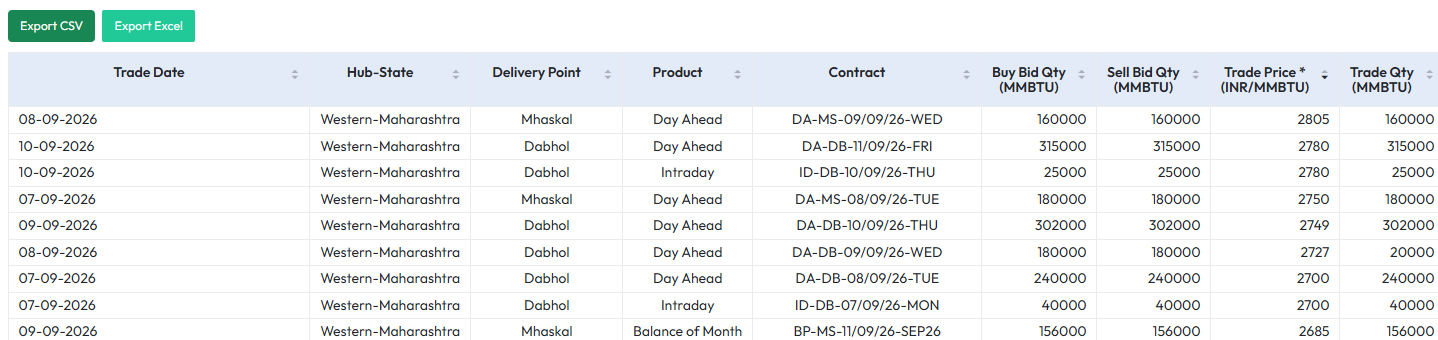
Due to the Gulf War of 2026, Indian Gas Exchange (IGX) prices have remained elevated through much of 2025–26. Recent levels have hovered in the ₹1,900–2,100/MMBTU range for key delivery points, significantly higher and close to double than the prices seen in earlier periods. Positron’s realized average in recent quarters has been a bit lower than pure spot, because of the long-term contract mix and customer pricing, but still supportive of margins. Management commentary on the latest call indicated comfort with mid-to-high teens pricing in ₹/MMBTU terms for planning purposes, while stressing the pass-through nature of most contracts. These are the levels behind the FY27 realized price assumption used in the valuation below.
FY27 Estimate
Management’s guidance of 15,000 MMBTU/day average implies annual volume of roughly 5.475 million MMBTU. At a blended realised price of ₹1,450–1,650/MMBTU – conservative against the recent spot levels noted above, allowing for contract mix and some moderation – that gives gas sales revenue of roughly ₹800–900 Cr, or ₹850–950 Cr including technical services. An EBITDA of ₹55–60 Cr on revenue of around ₹900 Cr implies a margin of 6.1–6.7%, broadly in line with the 6.5% delivered in FY26 and comfortably inside management’s guided 4–10% band. The growth in absolute EBITDA from FY26’s ₹28.55 Cr is therefore driven by volume and praice, not by assumed margin expansion.
Indicative Fair Value on FY27 Estimates
| Scenario | FY27E EBITDA | Multiple | Implied EV | Net Cash* | Equity Value | Value / Share | Upside |
|---|---|---|---|---|---|---|---|
| Conservative | ₹55–60 Cr | 4.0x | ₹220–240 Cr | ₹80–100 Cr | ₹300–340 Cr | ₹395–447 | ~2.3–2.6x |
| Base Case | ₹55–60 Cr | 5.0x | ₹275–300 Cr | ₹80–100 Cr | ₹355–400 Cr | ₹467–526 | ~2.7–3.0x |
| Growth Premium | ₹55–60 Cr | 6.0x | ₹330–360 Cr | ₹80–100 Cr | ₹410–460 Cr | ₹539–605 | ~3.1–3.5x |
* Remaining net cash after some cash generation over FY27, conservatively held at ₹80–100 Cr. Value per share on 7.60 million shares. Upside measured against a current price of ~₹173.
The base case points to an indicative fair value of ₹467–526 per share, using the 5x multiple that the market itself applies to comparable trading cash flows of Gujarat Energy. Even the more conservative 4x implies a substantial premium to the current price of ~₹173.
At the current enterprise value of ~₹50 Cr, the market is ascribing almost no value to growth and giving virtually no credit for the multi-year contracts already signed, despite the revenue and cash growth delivered in FY26. Forward EV/EBITDA on the base-case FY27 numbers works out at roughly 0.8–0.9x – a deep discount to the peer trading multiple of 5x.
7. Risks
Volumes – The company’s volumes are the critical risk factor. If the company achieves 15,000 MMBTU/day in FY27, the valuation gap can reduce quickly. If the volumes fail to accelerate, the bull case needs to be re-examined.
Supply disruption – Some of the company’s RLNG supply contracts were affected by the geopolitical tensions that erupted in West Asia in February 2026. Management commentary on the May 2026 earnings call suggested that alternate sources have been found, with modified pricing for some of the RLNG imports, and that the FY27 guidance of 15,000 MMBTU/day remains intact. In fact, the earlier guidance was for 20,000 MMBTU per day before the Gulf War started, so 15,000 MMBTU is the revised guidance after taking into account the impacts of the Gulf War on their supply contracts. Longer-dated disruption to RLNG supply would hit the growth trajectory, and the management commentary on that call flagged the risk of prolonged downtime on Qatari LNG.
Spreads – A sharp contraction in spreads, on the back of reduced industrial gas demand or a shift to CNG or LNG usage, would hit margins. While the long-dated purchase contracts mitigate some of this, demand destruction remains possible, with offtake customers shifting to spot purchases from other OMCs – a particular concern on the longer-dated sale contracts.
Counterparty and offtake – The value of a multi-year contract depends on the counterparty honouring it. This is most acute on the longer-tenure sales contracts.
Working capital – Higher volumes require more receivables and inventory financing, which will be a drag, though the net cash position provides a buffer.
Liquidity – The low free float and low average daily traded value make the stock extremely volatile, with large price movements possible in either direction.
8. Conclusion
Positron Energy is a simple company that primarily does one thing – gas aggregation. It is currently priced for no growth despite reporting healthy cash growth, driven by increased volumes on the back of long-dated purchase contracts. The FY26 results are clean, with no leverage on the balance sheet, and management has provided a clear volume growth target for FY27. The most comparable asset is the Gujarat Energy trading segment, valued at 5x EV/EBITDA in a broker sum-of-the-parts exercise, against which Positron trades below 1x forward EV/EBITDA.
If the volume growth materialises, a re-rating of the multiple is inevitable, and the gap between roughly 1x and 5x should narrow providing investors significant upside. Furthermore, the current valuations are very compelling and offer us a margin of safety which very few Indian stocks offer us at the moment. The next two to three quarters are critical for Positron to demonstrate that its volume growth is sustainable, and the actual volume trajectory, alongside the sustainability of spreads, remains the key monitorable.
Disclosure
The author holds long positions in Positron Energy Limited or related securities at the time of writing this note. All projections and estimates are illustrative and based on publicly available information, management commentary and reasonable assumptions; actual results may differ materially. Readers should conduct their own due diligence and consult a qualified financial adviser before making any investment decision.
Disclaimer
SME stocks carry higher risks due to their smaller size, limited operating history, and relaxed regulatory requirements. This analysis is for educational purposes only and should not be considered as investment advice. Always conduct your own research or consult with sebi registered financial advisors before making investment decisions.