
Investment Rationale :
Platinum Industries Limited presents a classic capacity-ahead-of-earnings setup. The company is India’s third-largest manufacturer of PVC stabilisers (the additives that make plastic pipes, wires and window frames possible), with a ~13% market share, the only listed pure-play in the category, and a domestic near-monopoly in the higher-value CPVC additives. Over the last two years, it has commissioned two capacity expansions that roughly double installed capacity: a new ₹71 crore plant at Palghar and a ₹67 crore greenfield plant in Egypt.
This new capacity has not yet contributed a meaningful rupee to reported profit. The Palghar plant is running at only ~30–35% utilisation, and Egypt has not yet started, so the costs of the expansion already sit in the P&L while the revenue does not, and the real earnings story begins as the plants fill through FY27 and FY28.
The entire ~₹138 crore expansion was funded out of IPO proceeds, with no debt and without the promoters selling a single share, so as utilisation climbs, the incremental profit flows to the shareholder rather than to a lender.
At the same time, a structural tailwind is building: a wave of new domestic CPVC resin capacity (Lubrizol-Grasim, Reliance, Meghmani) is set to widen the market for exactly the additives Platinum dominates.
Company Overview :
Platinum Industries is a speciality-chemicals manufacturer that makes the additive systems going into PVC and CPVC before they are processed into finished goods: heat stabilisers that prevent the plastic from degrading, lubricants that help the melt flow, and metallic stearates that act as release agents.
-
Listing & ownership: Incorporated in 2016, listed on the NSE and BSE in March 2024 (₹235 crore, 100% fresh issue). Promoter-run by Krishna Rana (Chairman & Managing Director) and Parul Rana (Director).
-
Product range: Lead-based, hybrid low-lead, and lead-free calcium-zinc / calcium-organic PVC stabilisers; CPVC compounds and one-pack additive systems; metallic soaps; PE and OPE wax lubricants; and a newer oleochemicals line.
-
Market position: India’s third-largest PVC-stabiliser maker (~13% share, CRISIL) and the only listed pure-play in the segment.
-
Customers & reach: Sells one step upstream of the pipe maker, to converters such as Supreme and Prince, from its Palghar facilities near Mumbai, exporting to 30+ countries (~15% of revenue).
Industry & Market :
India’s PVC additives market was ~120,000 TPA as of 2023, growing ~8% a year;
the CPVC additives market was ~160,000 TPA as of 2023, growing ~7–8%.
Two structural shifts define the opportunity:
-
The lead-free transition: Lead’s share of Indian PVC-stabiliser demand has fallen from ~76% (2016) to ~51% (2023), while calcium-based has risen from ~8% to ~34%, pushed by BIS lead-free pipe norms domestically and the EU’s restriction on lead in PVC articles (including imports). Lead-free calcium-zinc is Platinum’s higher-margin stronghold.
-
The CPVC shift: CPVC pipe requires ~25% additive by weight against 3–5% for ordinary PVC, so each tonne of CPVC pipe pulls five-to-eight times more additive. That makes CPVC a volume engine far larger than the size of the pipe market alone implies.
The segment is consolidated at the top, with two larger players ahead of Platinum and the balance fragmented across unorganised players:
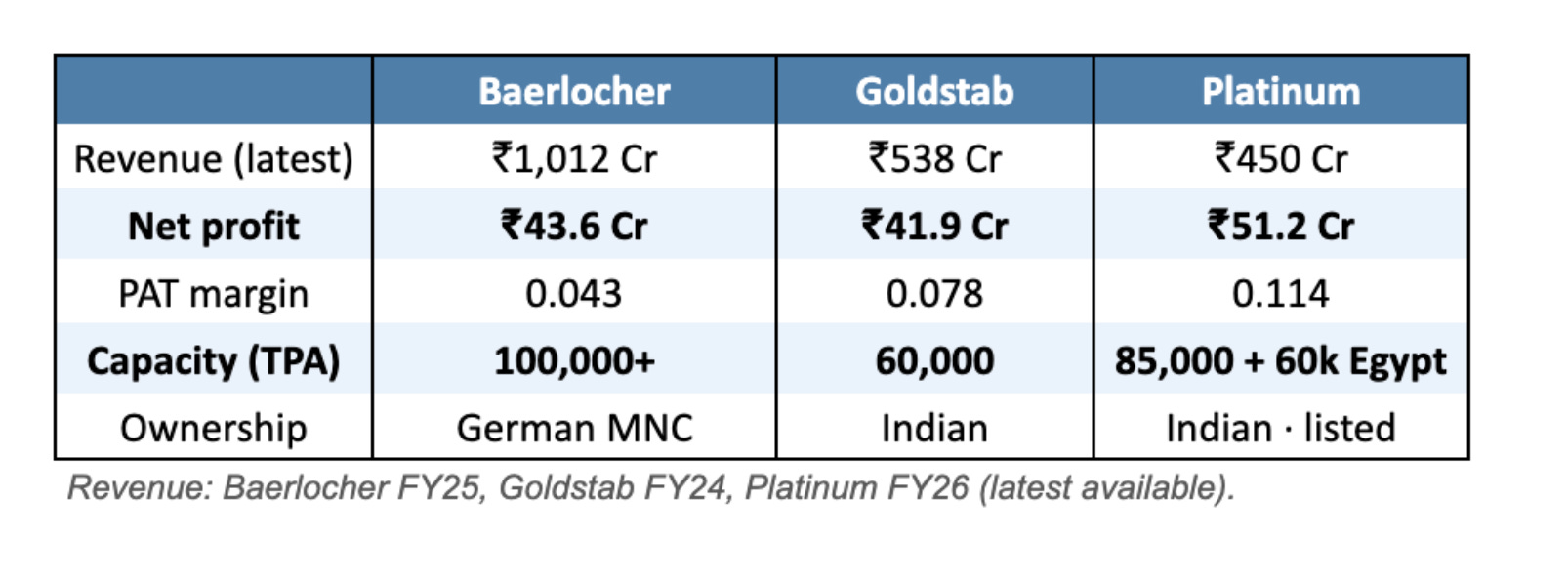
The point stands out at a glance: Platinum is the smallest of the three by revenue, yet earns the most profit, because it fishes in the higher-value lead-free and CPVC pools rather than commodity tonnage.
The Core Differentiator: The Chemistry Inside the Pipe
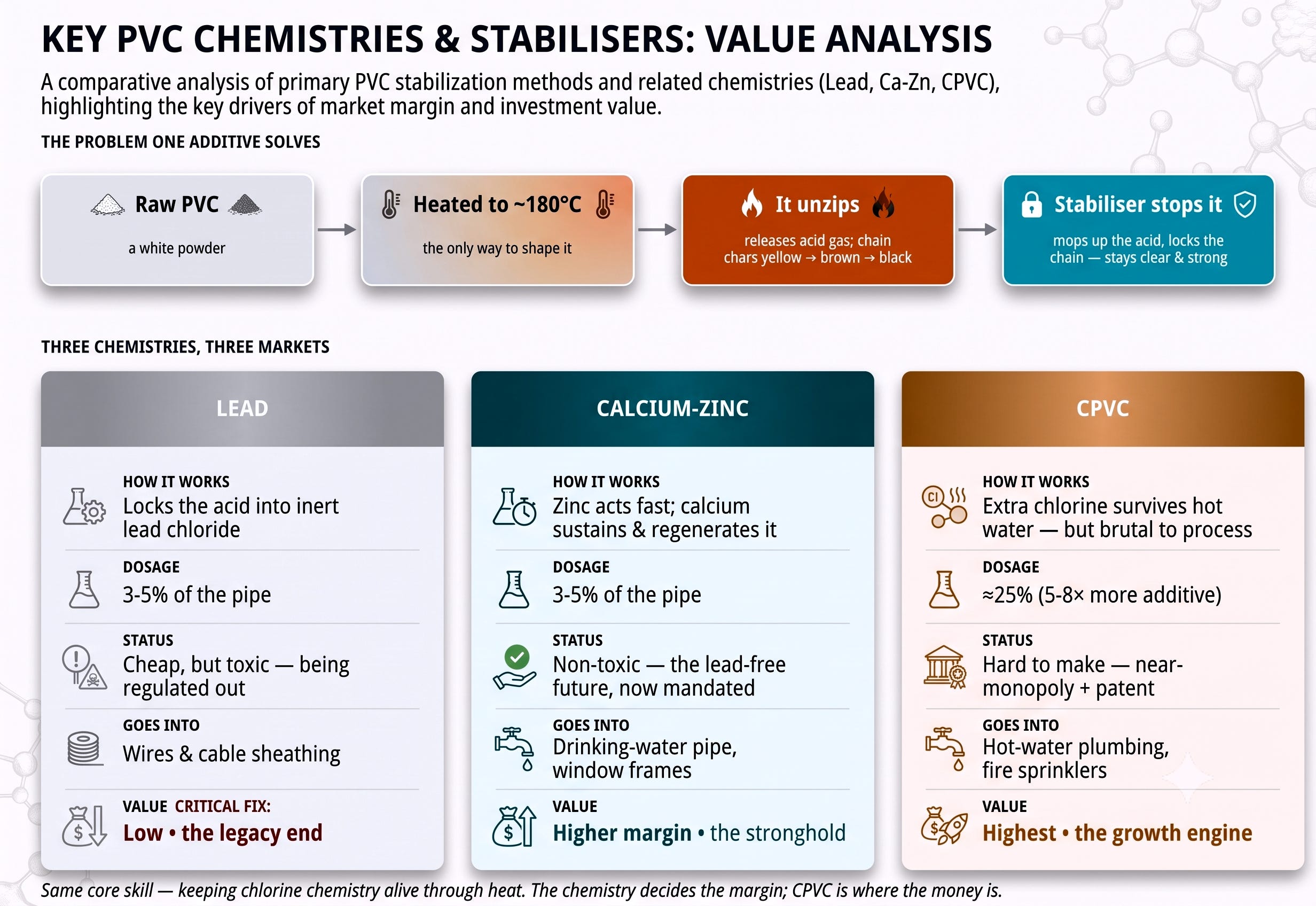
PVC cannot survive being turned into anything. It is a long chain of carbon atoms with a chlorine atom on every second one, and to shape it you must melt it at ~180°C. At that temperature, the chain begins to tear itself apart: a chlorine atom and a neighbouring hydrogen break away as hydrochloric acid gas, which weakens the next chlorine along the chain, which leaves too, and the reaction runs down the molecule like a zip being pulled open. The plastic turns yellow, then brown, then black, and the acid it throws off is itself a catalyst, so the longer it runs, the faster it runs.
Platinum’s core product, the heat stabiliser, stops exactly this: it mops up the acid gas and swaps the weak chlorine atoms for stable groups so the zip never starts. That is why the additive is only a few per cent of the pipe by weight, but the few per cent everything else depends on. How it does that job splits the business into three chemistries, and the split is the whole regulatory story:
-
Lead: Locks the acid into inert lead chloride. Cheap, effective, and an excellent electrical insulator, so its last stronghold is wire and cable sheathing. But lead is toxic and migrates out of the plastic, so it is being regulated out of anything touching water. The low-value, legacy end.
-
Calcium-zinc: Zinc acts fast and gives good early colour; calcium sustains and regenerates it. Balanced wrong, the zinc “burns” and blackens the batch, so getting it right is real formulation know-how. Non-toxic, so it goes into drinking-water pipes, window frames and food-contact plastic. Platinum’s higher-margin stronghold.
-
CPVC: Ordinary PVC with extra chlorine forced onto the backbone, so it survives hot water (the cream-coloured pipe behind your geyser, industrial lines, fire sprinklers). The same chlorine makes it brutal to process, run right up against its degradation temperature, so it needs ~25% additive to hold the line. Hard enough that Platinum faces almost no domestic competition and holds a multi-year patent. The highest-value product, and the growth engine.
Same core skill across all three (keeping chlorine chemistry alive through heat), three products, three markets. The chemistry decides the margin, and CPVC is where the money is.
Current Production Capacity
-
Palghar, Unit 2 (India): New 60,000 TPA plant (24,000 TPA lead-free PVC stabilisers, 24,000 TPA CPVC additives, 12,000 TPA lubricants), plus a separate 6,000 TPA metallic-stearate line (commissioning Sep/Oct 2026).
Fully operational from 21 May 2026; currently at ~30–35% utilisation.
Total India Operations capacity scales toward 85,000+ TPA at full ramp.
External Supporting Tailwinds
-
Domestic CPVC resin build-out. India historically imported CPVC as ready-made compound (resin plus additives pre-mixed), a closed system a standalone additive maker couldn’t enter. Lubrizol (with the Aditya Birla group), Reliance and Meghmani are now building large domestic CPVC resin plants. As that resin arrives, pipe makers shift to buying resin and the additive pack separately, and the additive pack is Platinum’s near-monopoly. The majors that look like new competition are, in this corner, building Platinum’s demand.
-
The lead-free regulatory shift. BIS lead-free pipe norms in India and the EU’s restriction on lead in PVC articles (including imports, effective November 2024) are forcing converters toward the calcium-zinc chemistry that is Platinum’s higher-margin stronghold.
-
Egypt’s location advantage. The Suez Canal zone gives duty-free access to the United States (via Qualified Industrial Zones) and free-trade access to South America, export routes an Indian plant cannot offer, alongside a freight advantage.
Financials :
-
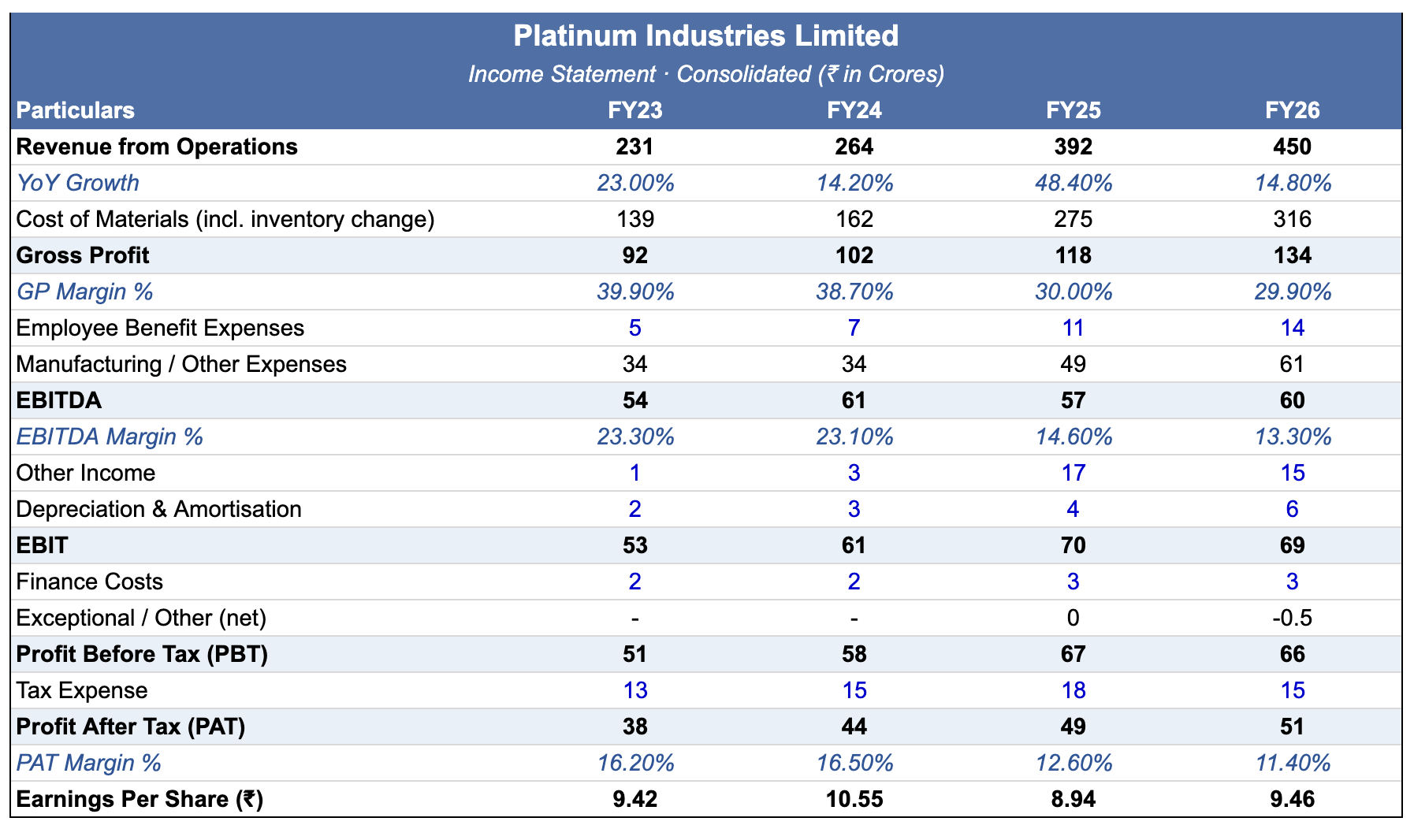
Revenue has grown from ₹188 crore (FY22) to ₹450 crore (FY26), a ~24% CAGR, driven primarily by volume and new product lines rather than price, with Q1 FY27 a transition quarter (consolidated revenue ₹109 crore) as the new plant ramps.
-
EBITDA margins compressed from a ~23% peak (FY23–24) to ~13% (FY26). This is largely mix, not structural decline: CPVC entered the book at deliberately low start-up margins (3–7%, now worked up to ~18% and targeting 20%+) while a soft quarter and freight disruption added pressure. Strip out CPVC and management indicates the lead-free gross margin is maintained.
-
Gross margin stepped down from ~39% (FY23) to ~30% (FY26), again a mix effect as lower-gross-margin CPVC became a larger share of revenue, not a collapse in product economics.
-
PAT has grown from ₹18 crore (FY22) to ₹51 crore (FY26), a ~30% CAGR. Note that FY26 PAT includes ~₹15 crore of treasury other income on idle IPO cash, which will fade as that cash converts into fixed assets, so headline PAT understates the operating recovery ahead.
-
The balance sheet is essentially debt-free. The entire ~₹138 crore expansion was funded from the ₹235 crore IPO (a 100% fresh issue, no promoter sell-down), with ~₹46 crore of proceeds still unutilised, so operating-profit growth as capacity fills flows straight to PAT with no finance-cost leakage.
-
Working capital has stretched as the business scales: debtor days from ~81 to ~101 and working-capital days from ~92 to ~149, with trade receivables and inventory both up sharply as the new plant is stocked and loaded.
-
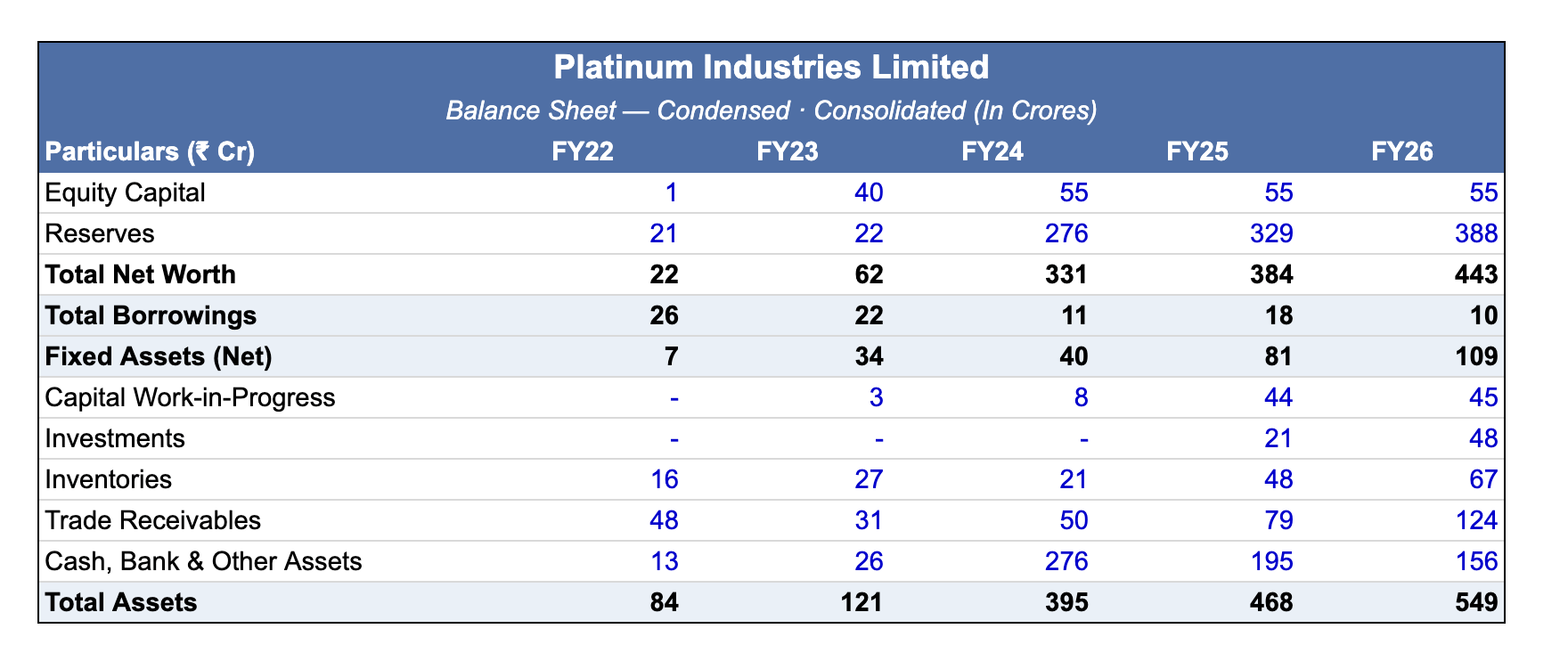
Equity-rich post-IPO. Net worth grew from ₹22 crore (FY22) to ₹443 crore (FY26), driven almost entirely by the ~₹235 crore raised at the March 2024 listing. Book value is roughly ₹81 per share.
-
Essentially debt-free. Total borrowings fell from ₹26 crore (FY22) to ₹10 crore (FY26), and most of that is lease liabilities; debt-to-equity is about 0.02x. This is why profit growth, as capacity fills flows to shareholders, not lenders.
-
Capex is visible in the assets. Fixed assets grew from ₹7 crore to ₹109 crore, with ~₹45 crore of CWIP still on the books (the Palghar and Egypt plants being built). IPO cash is being deployed into plants, not hoarded.
-
Working capital is the one pressure point. Receivables rose to ₹124 crore (debtor days 81 to 101) and inventories to ₹67 crore as the new plant is stocked; working-capital days stretched from ~92 to ~149. The number to watch as revenue scales.
Growth Strategy: Three Levers
-
Lever 1 (primary): Filling the new Palghar capacity. The ₹71 crore, 60,000 TPA plant runs at only ~30–35% today. Loading it toward full is the single largest near-term driver, and it comes through at high incremental margin on fixed costs already sitting in the P&L.
-
Lever 2: Commissioning Egypt. The 60,000 TPA export plant commissions by end-2026, bringing duty-free US access and FTA South America, and becomes a meaningful margin and geography contributor through FY28.
-
Lever 3: The widening CPVC market. As domestic resin capacity comes up, pipe makers shift to buying resin and additives separately, structurally expanding the addressable market for Platinum’s near-monopoly CPVC additive pack.
Underpinning all three, the zero-debt balance sheet ensures that EBITDA expansion translates into PAT and EPS growth broadly in line with the topline, rather than being absorbed by interest.
**
Projected Financials :**
-
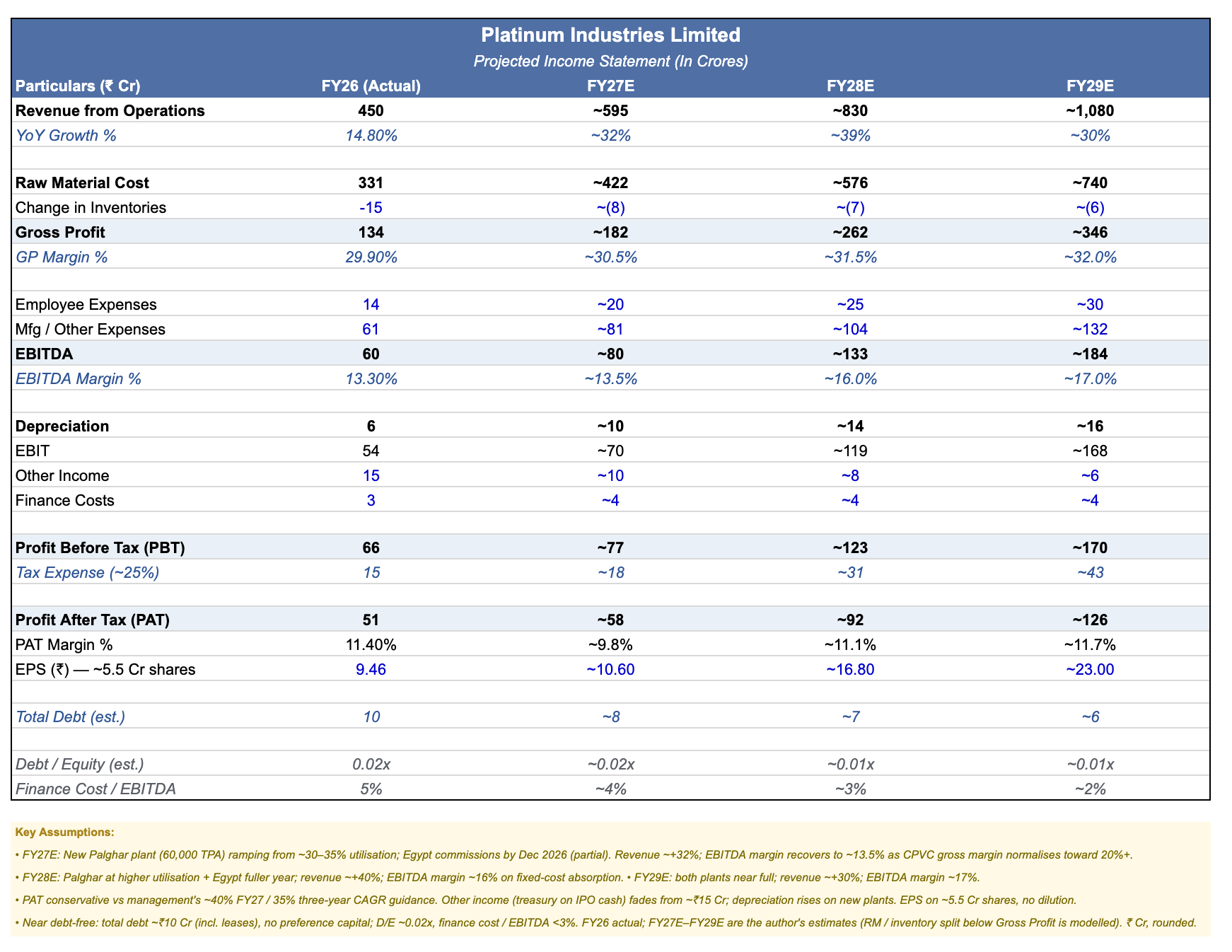
Revenue is expected to grow at a ~30–35% CAGR, from ₹450 crore (FY26) toward ~₹830 crore (FY28E), driven by utilisation of the new Palghar capacity and the Egypt ramp. This is a volume-led, not price-led, expansion.
-
EBITDA margins are expected to recover from ~13% to ~16% as CPVC gross margin normalises toward 20%+ and operating leverage absorbs the fixed cost base already in the P&L.
-
PAT is expected to grow from ₹51 crore to ~₹92 crore, with the inflexion in FY28. FY27 profit is held back by higher depreciation on the new plants and the fading of treasury other income, so revenue inflects roughly a year before profit does.
* Utilisation assumptions are deliberately conservative relative to management’s ~40% FY27 and 35% three-year CAGR guidance; margin recovery is assumed gradual rather than immediate.
Valuation and Upside :

Currently trading at ~22× trailing earnings (~12× FY28E) with a market capitalisation of ~₹1,125 crore, Platinum is simultaneously ramping a debt-free doubling of capacity, commissioning a duty-free export platform in Egypt, and compounding profits toward ~₹92 crore by FY28 as utilisation fills already-built, already-paid-for capacity. The return here comes from earnings delivery plus a modest re-rating rather than a cheap starting valuation. Given the visibility on utilisation-led growth, a structurally widening CPVC market, and a debt-free balance sheet, the business warrants a reasonable valuation band of 15×–25× FY28E earnings.
Key Risks :
-
Utilisation Risk: The entire case rests on the new capacity filling from ~30–35%. If end demand for pipes stays soft for a prolonged period, the payoff is pushed out rather than cancelled.
-
Margin-Recovery Risk: If CPVC’s structurally lower margins permanently dilute a once lead-free-heavy mix, EBITDA may not recover toward 15–16%. The CPVC gross margin trajectory (currently ~18%, targeting 20%+) is the single line to watch each quarter.
-
Execution / Timeline Risk: Management guides big and tends to deliver late. The Egypt plant has grown from 30,000 to 60,000 TPA and slipped from FY25 to December 2026, and the stearates line slipped a quarter. The built capacity and clean balance sheet are real; the schedule is the variable.
-
Competitive Intensity: The #1 player, Baerlocher (100,000+ TPA, ~₹1,012 crore revenue), is investing all its new capacity in the calcium-based segment Platinum wants to grow, and could compete down the margin edge over time.
-
Working-Capital Stress: Rising debtor days (81 to 101) and working-capital days (92 to 149) tax cash conversion as the business scales and extends credit to larger converters.
-
Raw-Material / Freight / FX Risk: Raw materials are ~72% of revenue and substantially imported. During disrupted shipping, Platinum cannot fully pass through freight and input-cost spikes, as seen in Q1 FY27.
Disclaimer :
I currently hold shares of the company discussed in this post and therefore my views may be biased.
This write-up is prepared solely for educational and discussion purposes on the ValuePickr forum. It does not constitute investment advice, a recommendation, or an offer to buy or sell any securities under the regulations of the Securities and Exchange Board of India (SEBI).
The information and analysis presented are based on publicly available sources and my personal interpretation, which may be incomplete, inaccurate, or subject to change. I may be completely wrong in my assessment.
I may buy or sell shares of the mentioned company without prior notice. Readers are strongly encouraged to conduct their own independent research (DYOR) and, where necessary, consult a SEBI-registered investment advisor before making any investment decisions.