
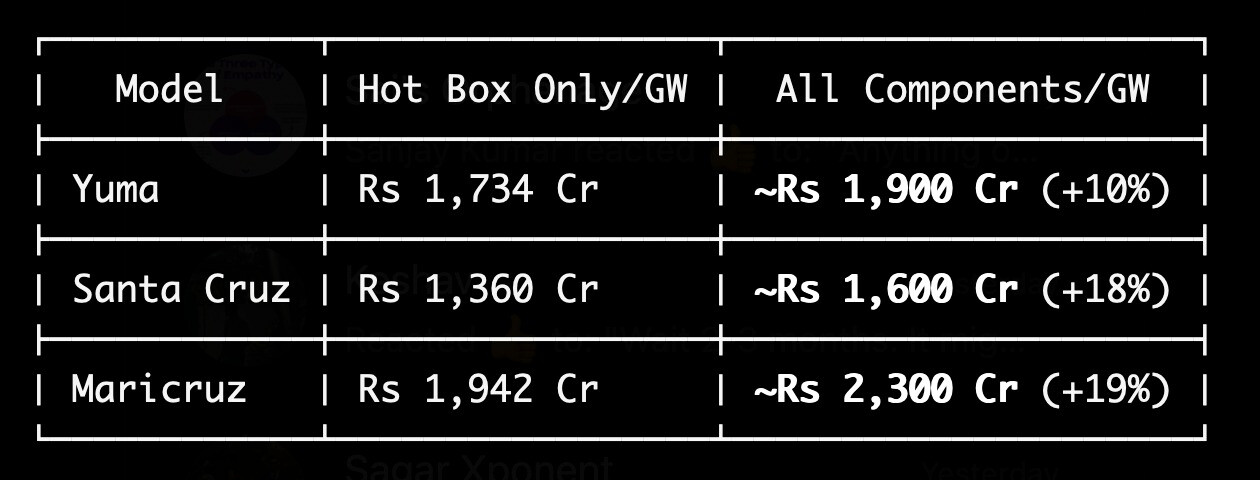
This is a follow-up to my last post, specific to Aeroflex but with also one correction on Mtar. On Mtar, I think my estimate per hotbox is wrong. I re-worked it based on export data and this is what I found - My earlier estimates were only ~1000Cr/GW which is incorrect. Its much higher, esp for the latest Maricruz model hotboxes that they are shipping recently.
Moving on to Aeroflex - there is a great piece on semianalysis on data center cooling that came out last week which I think is essential piece to understand the importance of cooling systems in data centers. In addition, I did some research on the lay of the land as well as Aeroflex’s capabilities in DC liquid cooling. The crux of it
- Every watt of electricity consumed by the chip is converted to one watt of heat and needs to be dealt with. So 1 GW DC would need proportionately more cooling than a 100 MW DC
- Cooling is the second-largest capital expense after electrical systems. Without cooling, both life and performance of GPUs will reduce (thermal throttling)
- DC effectiveness is measures using PUE (Power Usage Effectiveness). It is simply Total Facility Power / IT Equipment Power (1.0 means zero energy wasted). 1.5 is industry avg. Microsoft/AWS report 1.15-1.22. Google/Meta have custom solutions that give them ~1.10
- In the past (2000-2015) we had 5-10 kW per rack which went up to 10-20 kW per rack between 2015-2023 for hyperscalers like Google/Microsoft for cloud compute (mostly cpu workloads for web applications). Now we are talking 120 kW for a Nvidia GB200 NVL72 rack for AI workloads. 120 kW/rack cannot be evacuated using fans - it needs liquid cooling
- Vertiv co-developed the standard for cooling for GB200 NVL72 platform with Nvidia and this will be most ubiquitous design gaining market share going forward for all Nvidia Blackwell based chips. Aeroflex is exclusive partner for Vertiv in India for 5 years and Vertiv is also building a supply-chain in India for export markets as per recent call
- Nvidia Rubin and Rubin Ultra platforms which will hit the markets in 2-3 years time after Blackwell have energy density of 600kW/rack. So liquid cooling is going to be the future. Currently liquid cooling is a small part of the market but it can be 60-70% of the market going forward
The basics of how liquid cooling works is - there is a loop of water flow that carries heat away from the chip and another loop of water/air that carries that heat out to the environment. Strangely, the loop that carries heat from the rack is the secondary loop (I was initially confused by this) while the one that carries it outside the building is the primary loop. When I saw Aeroflex was in secondary loop, I assumed they do building level cooling but that’s not true since they are in SFN (Secondary loop). This is roughly what happens
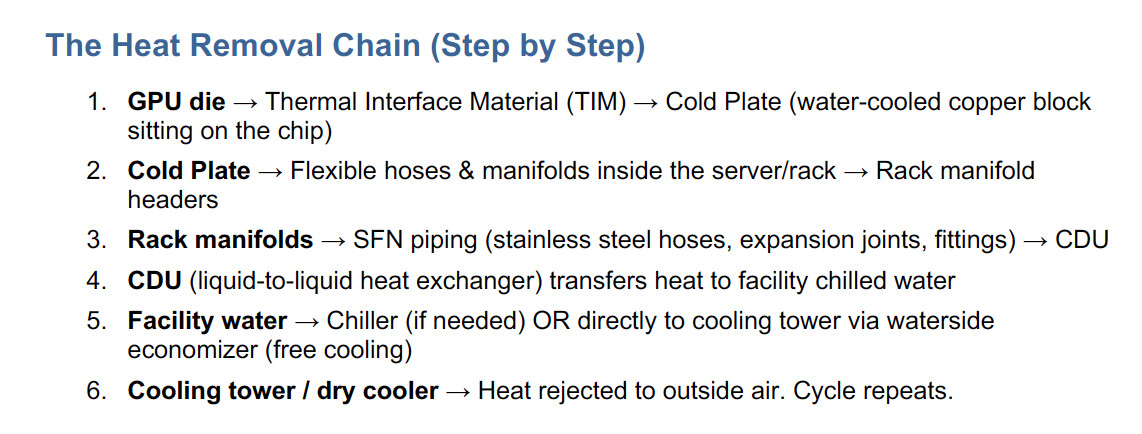
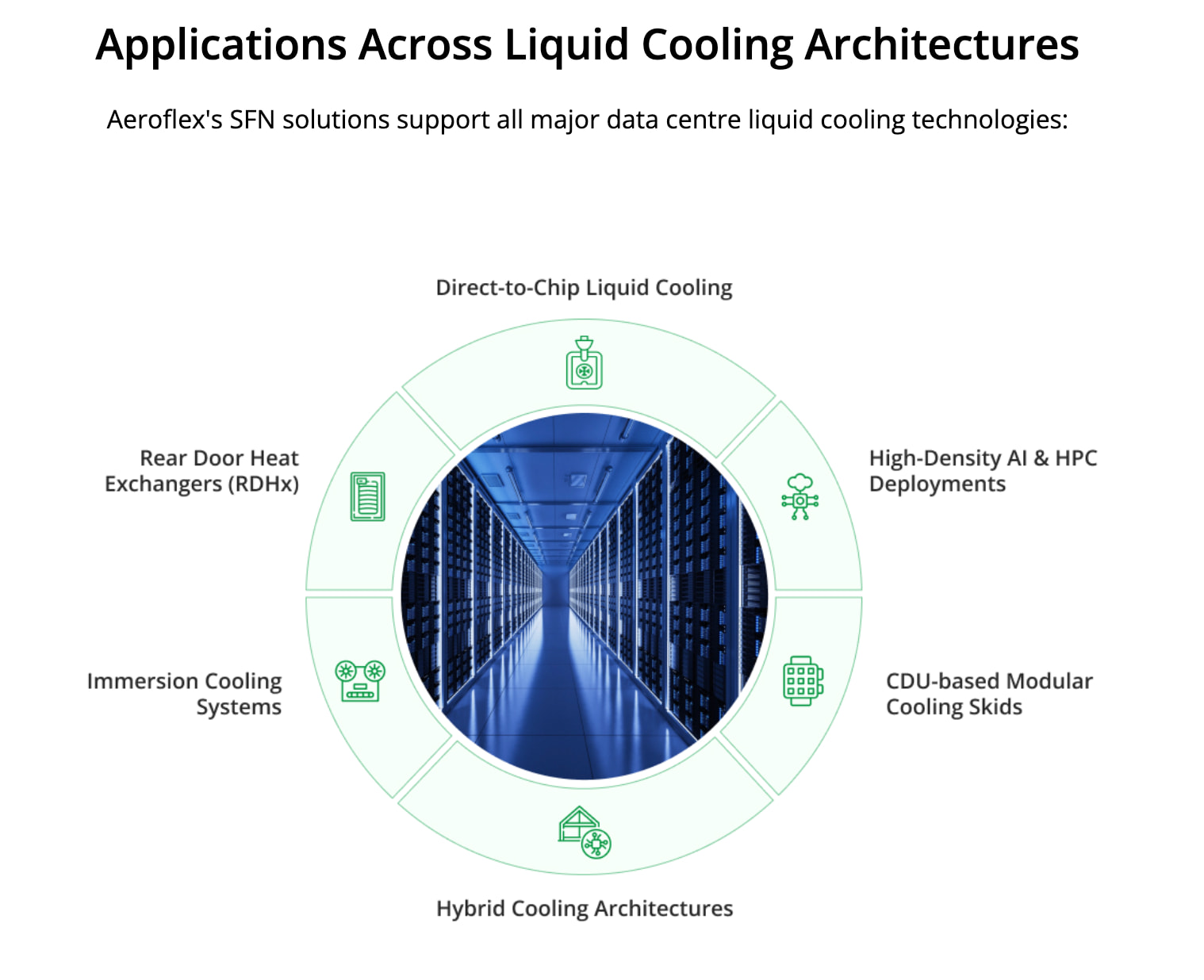
Where does Aeroflex figure in this? They are present in all different types of heat removal from the rack (check the semianalysis piece to understand RDHx, immersion cooling etc.). The one above I described is basically Direct-to-Chip liquid cooling which is what Vertiv-Nvidia GB200 spec is for Blackwell.
This is also from Aeroflex DC Liquid cooling page. In this again the primary loop vs secondary loop (being in the data hall and removing heat from rack) is clearly explained in the diagram
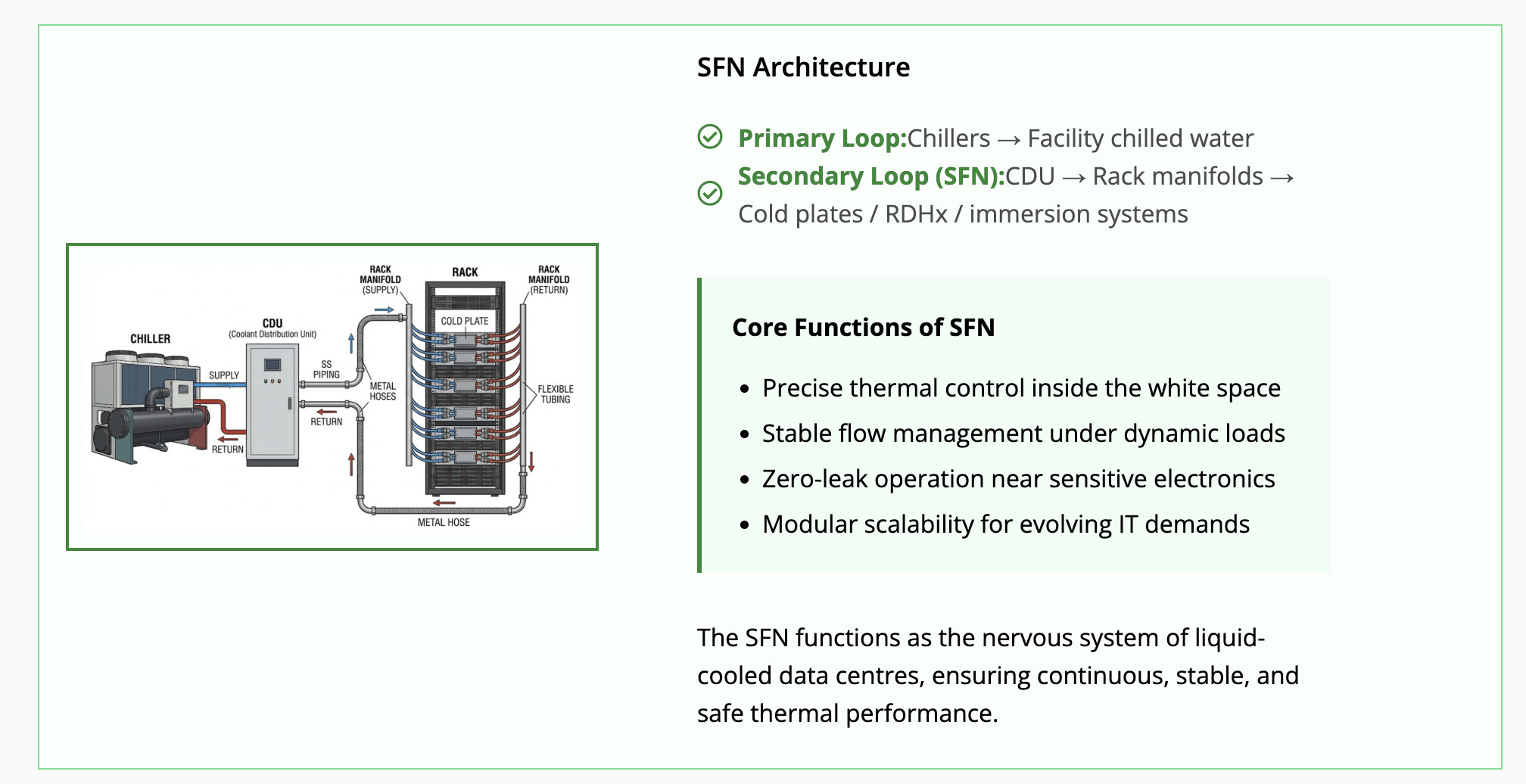
So Aeroflex provides Stainless steel flow systems for CDU skid piping, Rack manifold headers, High-flow trunk lines and metal hoses for Rack-level manifold connections, Modular skid interconnections etc. and also Metal bellows/expansion joints and precision fittings like quick release couplings, ferrule fittings etc. (interestingly the semianalysis piece talks about how even simple stuff like quick disconnects are in short supply currently).
Competition for Aeroflex is mostly international - companies like Parker Hannefin, Penflex, Swagelok (these 3 are the biggest). Aeroflex might have cost advantage being an Indian player to compete in export markets.
Indian DC capex announced so far
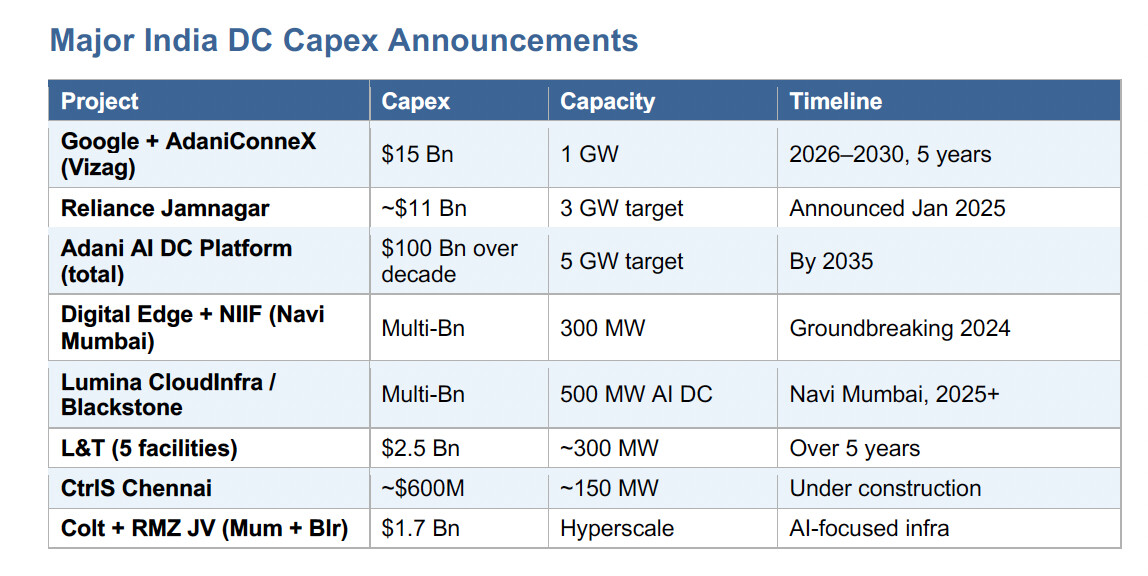
There is very good chance for Aeroflex to make it big considering we are currently at ~1.2 GW of DC capacity (mostly for CPU workloads, so mostly air-cooled) to ~5-8 GW by 2030 and most of the incremental capacity being for AI workloads - within that most would use Nvidia Blackwell chips and thus would use GB200 and Nvidia-Vertiv’s liquid cooling design.
Disc: Invested, have recent transactions