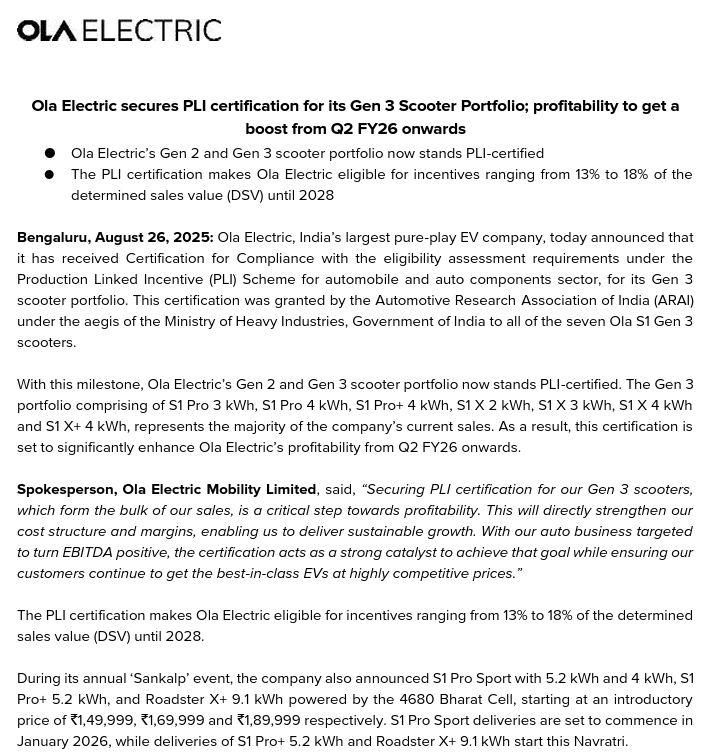
How is it PAT positive? Is it just calculating Sales - COGS.
Screener shows even operating profit is negative.
How is it PAT positive? Is it just calculating Sales - COGS.
Screener shows even operating profit is negative.
Bhavish mentioned PLI during the Gigafactory tour
Looking back at the clip, it’s nice to hear ‘let’s see’ and ‘hopeful’ kind of balanced vocabulary, even so close to a favourable result, or the government clearing them at a fast pace.
Disclosures: same as earlier, Invested.
I did some research from customer’s perspective. If we look at the some of the views (& reviews) and how people preceive Ola, they are laregly mixed. Users do want to consider Ola but they are hesitant:
One thing in these threads I observed is the build quality issues that people are concerned about. Perhaps because of design issues? or cheaper material? In any case, it shouldn’t be too difficult to address.
In a very recent thread (dated 21st Aug) where a user sought views as he wants to buy a new vehicle, Ola’s name didn’t turn up:
My take, competition is cut-throat, brand name (?) or PR or first mover advantage alone won’t work. Focus should be on delivering value to the customer, whether it’s by way of durability, tech, or service.
Disc.: Not invested.
Ola usually does only online marketing. The competition of Ola too has same service issues but not publicised in social media as much. A simple X search will prove my point. People take extra effort to write negative reviews. Nobody writes positive reviews until prompted. So, Ola would do well to first improve parts availability and service(which will also improve automatically with time as Gen 3 comes into play and private people also start servicing EVs) and secondly to prompt people to write positive reviews. In personal interactions, I have found that most people are satisfied with their vehicles. Small service issues will remain, and do remain with even legacy brands in 2 and 4 wheelers both.
Guys like River & Ather are silently investing in building Reliability, R&D & Customer Service.
They will likely be the survivors IMO, unlike Ola who screwed over all their initial customers & made Use and throw type vehicles
This is simply not true. You can visit any bajaj chetak showroom and its quite smooth. There are no large number of chetaks outside the showroom waitimg for parts to arrive. While there are service issues with other brands none are as serious as ola. Ola has only two main advantages so far: first mover and lower price. The first mover advantage is now gone for scooters. They may create it again with bikes and that is interesting to me.
Disc: I own chetak, ICE scooter and bike. Tracking ola share with no position.
I am not denying Bajaj has issues. I am simply saying none of the other brands are as serious as ola which was justified earlier when they were top seller but not anymore. I have visited multiple bajaj service centers in past two years during my ownership of chetak and confirmed this first hand. This has negative impact on brand image when one is new to auto industry.
Yes, Ola has service issues, there’s no denying that.
But these are not structural problems; they can be fixed.
As investors, we can only hope that after putting in the hard work of building a gigafactory, the company will also dedicate focus to the relatively easier task of fixing service.
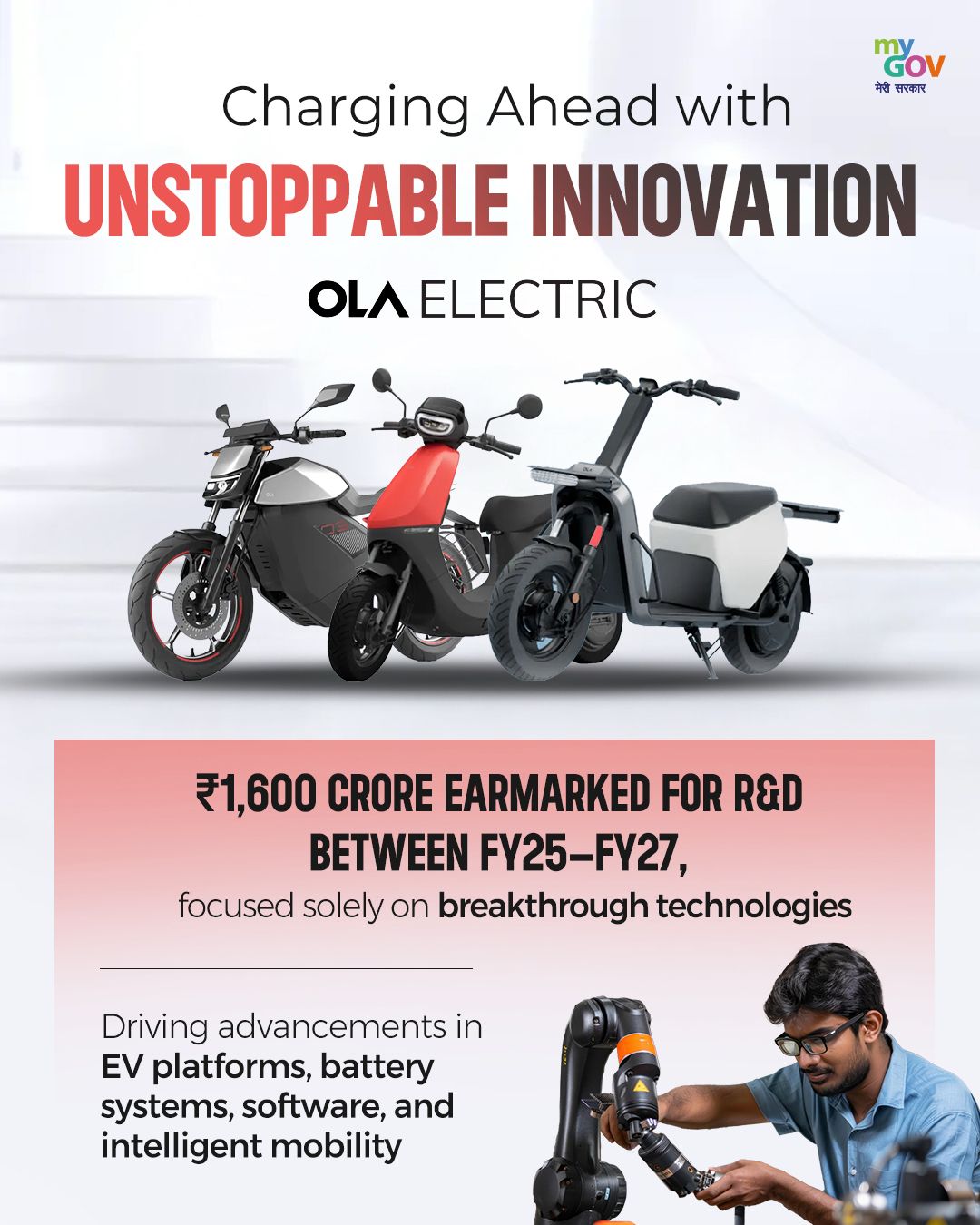
I don’t think the figure is correct. They don’t have 1600 crores for R and D. That would be total investment including R and D.
I think we must take into account the products already in the market. We cannot ignore those. Among two wheelers, motorcycles are a far bigger opportunity than scooters and Ola has products in the segment which are already selling in some numbers.
Thus, the analysis should be run with entire 2w category, even if with a smaller percentage of market share. Maybe 12-15% for entire market would be reasonable. That should put the revenue 10 years hence around $12-15 billion. Lets not do 3 wheelers as of now. But we must take into account the battery business, which I think will be spun off by then and scaled to at least 20 GWh.
Secondly, the margins will be unclear as of now. Nobody knows the unit economics of EV 2ws as of now. Not in India, not anywhere. 15% is a good approximation, but could be 10 or 20. We just won’t know until the supply chains are fixed and reliable. This is an understated risk. Ola has tried to derisk its motors but what of batteries? No idea. Much will depend on our China relations.
I hope the current price comes to 27 though. I would be happy to double my position.
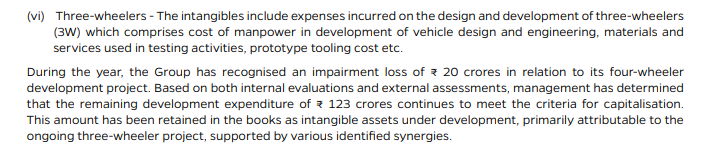
I have been reading the annual report of Ola. The 3-wheeler Raahi seems to be under development although they have said nothing about it publicly.
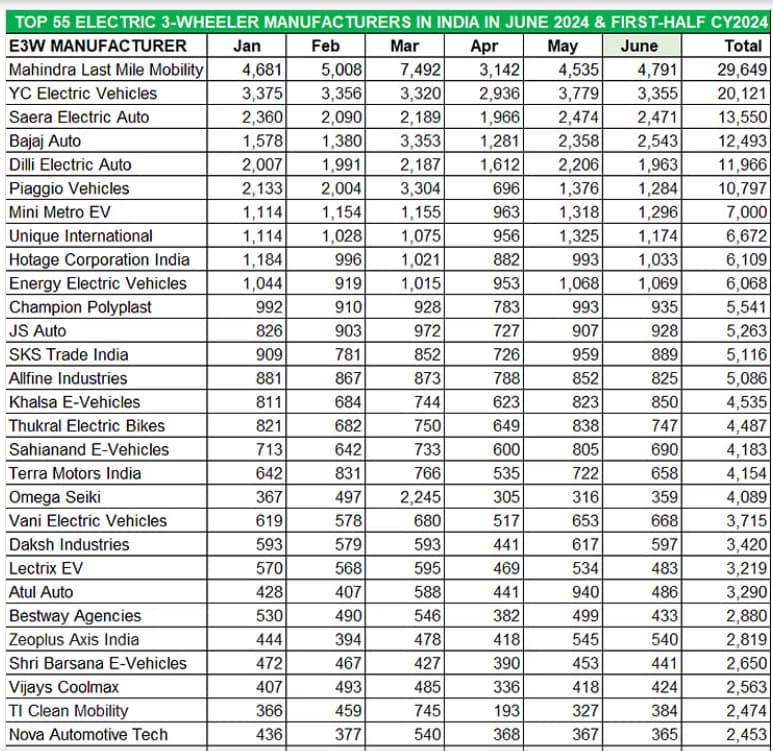
As a non-expert, my guess is that this will take perhaps another 100 crores and maybe another year, so by end of FY26, we might have a product ready to launch. 3 wheelers is the most penetrated category by EVs with more than 50% sales in EV. This is due to various govts banning sale of ICE 3 wheelers in states. This will continue to rise and has very good scope for Ola if they deliver an acceptable product.
Dated : Oct - 2024. Somehow I missed it.
3W Video - https://youtube.com/shorts/o3eV-VhtyQQ?si=5bvqa4xMtRrkCvAg
I believe most 3W and LCVs will eventually ride on the Gen-4 platform, with cell integration being the real key.
Given the intense competition in this space, product differentiation is critical to gaining scale. Ola’s edge has always been its vertically integrated model that enables aggressive pricing. If they can pair that with superior range at a lower cost, it has the potential to be a category-topper.
Thanks. I have seen this video last year too. LCVs are not in development though. Ola wrote off 20 crores on that account.
I don’t see any car for at least 5 years. They have too much on their hands in 2w and then 3w.
Ather’s Tarun Mehta Vs Ola’s Bhavish Aggarwal:
One is playing short term game other is playing long term game.
One is auto company other is a mobility platform.
Ather follows low risk low reward strategy, Ola follows high risk high reward strategy.
This is fundamental difference between the two companies.
Article is Under Paywall, so sharing here -
Ather Energy Ltd considers investing in new technology and brand a better option than spending on developing battery cells and components in-house, according to its co-founder, as a supply chain already exists for many of the parts in India.
“Assembly, manufacturing, ultimately, after a certain point, is only so much valuable. It’s a very last step optimization," Tarun Mehta, also the chief executive at Ather, told Mint in an interview. “The much richer optimization is in IP (intellectual property) and brand today. So we will always put our money there."
Mehta, also the chief executive of the Bengaluru-based electric scooter maker, said, “We are big believers, contrary to some of our peers in the industry, that the real money will be made or lost on your fundamental product architecture. And that’s down to how much engineering you do, how much money you put in there, how much attention you put in there."
The question of building everything in-house has raged in the automobile industry after China curbed the supply of rare-earth magnets, a key component in motors. Makers of both fossil fuel-powered engines and EVs flagged concerns and have drawn up plans to build alternatives or their own supply chains. However, tensions between India and China have started easing, offering hope to India’s automotive sector that, according to government estimates, was valued at $240 billion in 2024. The country’s EV market, Grand View Research estimates, is worth $8.4 billion.
“Given what has happened in the real-world situation, vertical integration wouldn’t have solved it (rare-earth problem)," Mehta said. “If you had to produce rare earth motors in-house, you would still have needed rare earth from China. And if you want to produce ferrite motors, there are suppliers who build ferrite motors. You don’t need to be vertically integrated to use ferrite motors."
Mehta’s view contrasts with that of Bhavish Aggarwal, chairperson at Ather’s cross-town peer Ola Electric. Aggarwal wants to make everything in-house, from ferrite motors to lithium-ion cells. While a supplier ecosystem exists for many of the components, India has not made progress on lithium-ion cells, with only Ola Electric’s gigafactory producing such cells.
Mehta, however, doubts whether investing in cells would be good for the company’s financial health, as the business is known to have poor margins.
“Companies at the scale of 3 to 4 lakh electric scooters in a year, at that scale of cell production have rarely ever been profitable," he said. “A lot of cell production is a tricky piece. You see gross margin improvement. But your cost of production is so high that your Ebitda impact comes out much worse."
Ebitda–earnings before interest, tax, depreciation and amortization–is a measure of the operating profitability of a company.
However, during Ola Electric’s annual event on 15 August, Aggarwal said that indigenously produced cells will help the company reduce the cost of procuring the key component and also offer lower prices for consumers.
“At a consolidated level, it is cheaper for us to manufacture our own cells than procure from outside at the 5 GWh level,” Aggarwal said during the company’s earnings call on 14 July.
Aggarwal also stressed that his strategy of vertical integration is different from how traditional auto businesses work.
“Our strategy in this business has been to build more manufacturing vertical integration, do more in-house technology development and build a direct-to-customer channel for customer engagement with the brand directly," Aggarwal said. “And on all these three, we believe we keep compounding our competitive advantage as incumbents only continue building traditional auto business models. And that competitive advantage can be seen in the balance of volumes and profitability that are now able to deliver."
Instead of investing in factories, Ather believes it has the right partners in China. However, it continues to look outside to diversify its supply chain and hedge its bets on multiple partners.
“You want to de-risk your cells. You want to hedge by using multiple technologies in parallel, which can only happen if you work with multiple partners of those technologies in parallel," Ather’s CEO said. “In-housing cells lock you onto a technology. And that technology has raw materials which will anyway have external dependence on."
Both companies’ approaches have their own risks and advantages, and the choice will depend on factors including capital and market position, said experts.
“Players with very deep pockets and a long investment horizon may justify vertical integration, while others may benefit from leveraging global ecosystems," said Harshvardhan Sharma, group head at Nomura Research Institute. “Companies competing on price and scale may need integration. Those competing on experience and agility may prioritise partnerships."
According to Sharma, EV players globally adopt hybrid models like Tesla integrating cells selectively, while still working closely with Panasonic, CATL or LG. Chinese original equipment makers like BYD develop components in-house and also source from outside suppliers.
Maybe an over-stretch, but it looks like Apple vs Lava’s approach to me: Mobiles also have availability of nearly all the components: OS, silicon, sensors but still Apple and now Google/Samsung are taking the hard route of vertical integration
Lets see how this Pans out!
Motilal Oswal ELSS find took a small position in Ola Electric around 54-55. Before that Helios had taken position in July. I think many more may have taken in August and we shall know in a few days.
DII showing conviction in the capital allocation strategy and confidence in turnaround of Ola is good.