NRB Bearings - EV and exports to drive growth?

NRB bearings is a company working on those invisible tiny bearings which make things move. If someone wants to understand about bearings then below video series is the best I found: https://www.youtube.com/watch?v=91_VaGiU1Is
Interestingly, the world is going crazy with precision engineering due to demand from sectors like aerospace and defence. NRB is essentially into precision engineering and market leader in needle bearings. NRB had a great promoter few decades back (Trilochan Sahney). He had two children Harshbeena and Devesh. Not much is known about Devesh (and irrelevant for this discussion) but Harshbeena on the other hand used to be in limelight. She may not have technical qualification for a company like NRB but started from the floor shop and worked her way to the top management (not necessary due to merit). She is widely credited with opening the first R&D center of NRB in the year 2000. Even today R&D is a rare occurrence in Indian corporates and many are being punished severely for it. At the time, NRB had marquee clients like Maruti, Bajaj Auto, Yamaha, Hero Honda, M&M, Renault, Volvo, General Motors, Electrolux, GKN. In 2007, they were clocking 300 cr in revenue with great growth. In fact, Harshbeena gave a revenue target of 1 billion dollars (4500 cr inr at the time) to be achieved in 2020. Fast forward to 2026, they are nowhere near this target with current revenue of 1335 cr. So what happened? NRB was hit by global recession, sibling rivalry, death of promoter, covid and factory fire. Their major revenue comes from auto which is a cyclical industry. Suffice to say, targets of more than 2 years are hawa-hawai baate in my opinion.

After being hit with all these problems and losing 16 years in the process, the dark clouds finally lifted when siblings came to an agreement in 2024. Harshbeena would control the crown jewel ‘NRB Bearings Ltd’ while her brother will get the industrial business and a large sum of money as one time compensation. She took huge loans by pledging all her equity and paid the compensation. What she got in return was complete autonomy over the business. Nothing stands in her way now and on top this she will be motivated by the huge pledge to work harder than ever. At least thats the narrative!

Below is the brief of commentary in q4 fy26 concall:

Harshbeena handles nearly all questions and her technical knowledge is quite good. numbers are at ATH, revenue is 372 cr with ebitda at 74 cr (~19% margin) and pat of 146 cr. They have been impacted by gas shortage meaning q1fy27 numbers may not be that good. blended utlilization is around 85% while brownfield capex is underway and will finish by q1fy28 in piecemeal. They are entering into industrial friction solutions in segments such as construction equipment, off highway, industrial gearboxes, switchgears, and power generation. They have also also entered into aerospace.

Aerospace is a very difficult sector to enter into as it demands nothing but perfection. A small failure in some component of an airplane is enough to take down everyone on board. And humans always had extreme reactions to flight crashes. Tens of thousands may perish on roads but a single plane crash sends massive shockwaves all around the world instantly. NRB always had the capability to cater this industry and they claim 100s of RFQ from aerospace division. After all their clients are the likes of bmw, mercedes, audi, volvo. What they did not have was AS 9100 certification which is a must to enter this sector. So they acquired a small company called ‘mahant toolroom’ which is already a supplier to HAL with an order book of 50 cr. This essentially saves the company few years to acquire the certification organically. I believe this is the reason why market has pushed the stock to ATH valuation.

NRB is a market leader in needle bearings for auto industry with over 60% market share. They also claim to be EV transition proof meaning ICE-age ending will have no impact on their business. It is important to note that they are not making any engine components but more into transmission.

Risks: I believe there are several key risks to this business. First is promoter pledge which they are reducing fast by selling stake and restructuring loan. Pledge stands at roughly 77% right now. Another risk is cyclicality of auto industry. Currently we are in auto boom cycle which is not a good starting place to bet on auto related stocks.
One subjective opinion on promoter is she comes off a bit too much sometimes to me. But so far in my research she came as a competent leader. One can also consider her age (66) as a risk. Succession triggered nasty rivalry and company suffered in the past.
If auto cycle risk plays out the market cap can easily slash by 50% from current levels. They must scale fast into other divisions as sooner or later this risk will play out.

Disc: invested at recent levels with small position and looking to build more. I was going through Bharani’s threads and something he said on capabilities hit me hard. Market is not rewarding companies on basis of what they are doing but rather what they can do (future earnings and growth visibility). Those companies which can handle mission critical components are far likely to do better than others. I think NRB fits the case of a company with hidden capabilities in its balance sheet. Even with all the issues of past they are a market leader in the part of precision engineering they do. Its not easy to acquire such competence.
I must share another bias I have. I believe we are in a bull market since April 2026. I look at charts and most stocks had run up in April (gadhe-ghode sab bhag gaye). Then we had some issues in May and many either fell or remained flat. But some refused to fall and rather continue to climb up in May as well. NRB is one such stock. Though it maybe a bull trap but I decided to pull the trigger with a small position. Rest markets will decide in the end, bhav bhagwan che
4 Likes

Please double check the age of the MD. I wonder what their management bench looks like. Do they cultivate leaders from within the company?

It seems mahant toolroom order book is 70 cr now. No more stake sale will be done. Claimed total order book of 2600 cr till 2031 in-line with guidance.

Disc: invested and added more recently

2 Likes

Pledge is almost gone only ~12% remaining. Promoter pared with significant chunk of stake (~4.5%) but good thing is strong hands absorbed it.

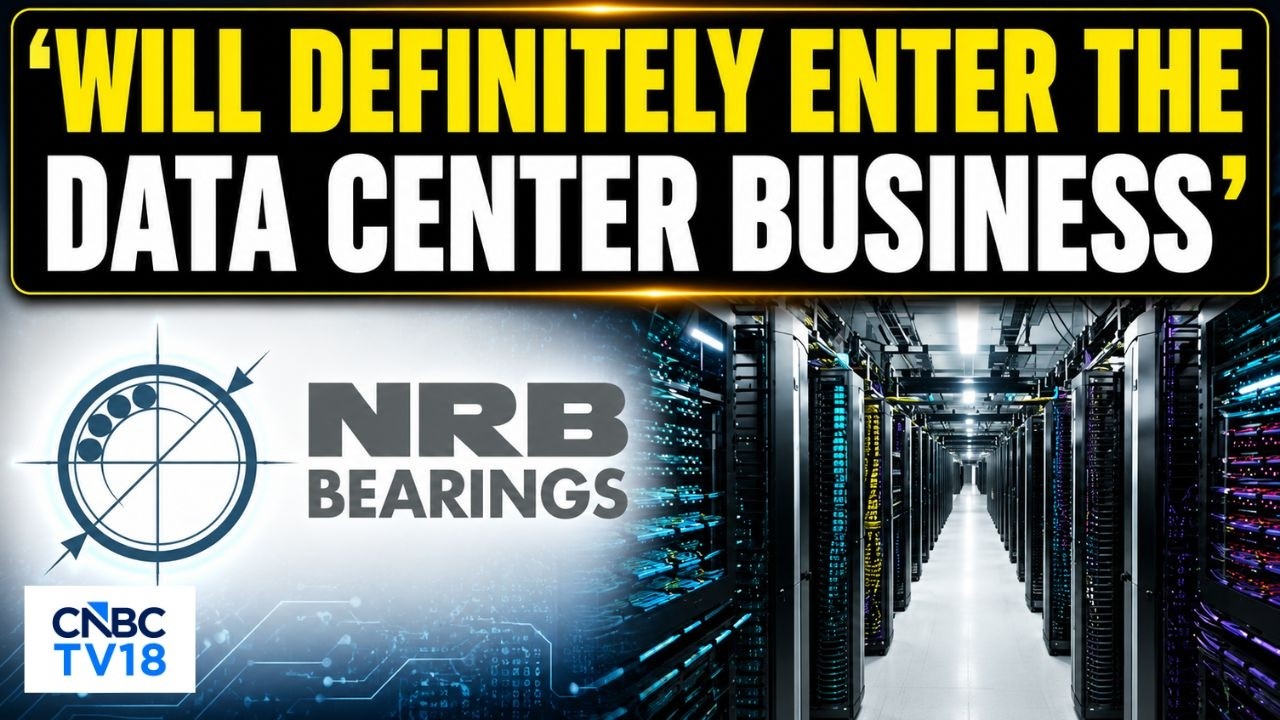
Surprisingly, they have started building narrative by including buzzwords like aerospace, data center and make in usa. Take it with pinch of salt. I am wondering if current price is good to average up or not. Happy to hear opinions.

108adab8-3a18-4349-909f-5439844f58a9.pdf (665.3 KB)

2 Likes

Yes. The management is very very conservative, guiding to a turnover of 2500 cr in the next 5 years, which works out to be 13.5% cagr.

1 Like

The most unique thing about NRB is the focus on Research and Development (R&D) capabilities which will start bearing fruits in the years to come.

1. R&D Infrastructure & Evolution

  • Dual Government-Recognized Facilities: NRB operates two distinct government-recognized advanced R&D hubs driving future mobility applications.

  • Thane Hub (2000): Commissioned and received official government recognition as a path-breaking core R&D laboratory.

  • Waluj Hub (2016): Set up as a second specialized R&D center explicitly tasked with handling lightweighting and sustainable product design paradigms.

  • Turbhe Expansion (2020): NRB inaugurated an expanded 35,000 sq. ft. premier R&D center, diagnostic testing facility, and automated robotic laboratory in Turbhe, Navi Mumbai.

  • Engineering Scale: The total structural network spans over 36,000 sq. ft. and leverages the cognitive expertise of more than 70+ specialized development engineers globally.

2. Core Strategic Moat: “Black Box” Co-Design

  • Platform-Tier Blueprints: NRB bypasses traditional reverse-engineering loops through its “Black Box” design capabilities. R&D engineers sit directly on the drawing boards of global original equipment manufacturers (OEMs) and Tier-1 systems integrators to brainstorm future platforms 3 to 5 years before commercial vehicle launch.

  • Application Data Integration: Custom friction solutions are engineered using application-specific physical metrics provided directly by global clients. This embeds NRB’s designs contractually into the lifecycle of premium vehicle transmissions, steering structures, and electric e-drives, making them nearly impossible to substitute out.

  • Friction & NVH Abatement: Core testing focuses on maximizing fuel economics via absolute friction elimination, improving bearing yield tolerances, and eliminating Noise, Vibration, and Harshness (NVH) profiles across high-RPM configurations.

3. Key Product Innovations & Technical Breakthroughs

NRB’s R&D framework has driven recent breakthroughs across automotive, electric propulsion, and heavy industrial domains:

  • EV Ceramic Insulation Bearings: Engineered specialized hybrid bearings integrated with high-durability ceramic balls and custom ceramic-coated outer rings. These solutions neutralize internal electric discharge damage, reduce rotating inertia, and sustain low friction margins under intense high-voltage EV motor thermal limits.

  • Third-Gen Lightweight Coatings: The team is currently validating a proprietary, high-speed lightweight insulating coating to defend EV powertrains against high-frequency shaft voltages.

  • Fuel-Saving Big End Bearings: Achieved a breakthrough by demonstrating a 40% physical friction drop inside big end bearings. This advanced modification generates a measurable 3% fuel economy boost across traditional combustion engines and hybrid automated transmissions.

  • Micro-Controller Bearing Diagnostics: Successful prototyping of bearings embedded with microcontroller diagnostic capabilities, facilitating live, predictive condition monitoring for end vehicle operators.

  • Automated Design Automation: R&D automated its entire one-way clutch design system (covering both drawn cup and solid race architecture models) using custom-developed proprietary modelling software, drastically compressing turnaround times on customer RFQs.

4. Financial Commitments & Methodologies

  • Capital Allocation Strategy: During the 2025-26 fiscal year, NRB allocated ₹21.29cr across revenue and capital accounts exclusively to support Research and Development operations.

  • Process Innovation for Sustainable Development (PISD): The group structures its innovation spaces as non-cubicle, non-hierarchical collaborative zones designed to maximize lateral thinking.

  • Virtual CAE Simulation Controls: R&D utilizes advanced virtual testing mechanisms driven by in-house Computer-Aided Engineering (CAE) algorithms. This allows the group to predict and map material tool performance prior to launching expensive mass manufacturing, ensuring that newly deployed lines operate on a “First Time Right” baseline.

  • Rapid 3D Prototyping: Employs advanced 3D printing methodologies to safely produce, alter, and validate custom prototype options under highly competitive timelines.

  • Academia-Industry Ecosystems: Active pipelines are managed with elite institutional bodies, including sponsoring racing car engineering formats at IIT Bombay for nine consecutive years, alongside sourcing engineering trainees from the Indo-German Tool Room and Ashoka University.

Speaking on the Q2 FY26 Earnings Call regarding growth into robotics and next-generation mobility, Managing Director Harshbeena Zaveri stated:

“Sunrise industries like robotics, automation, drones, we even are serving humanoid and robots themselves. That is a different kind of mobility, even though it falls in the industrial segment… We are expanding into sensor bearings and smart motion systems.”

A few years away Optionality:

NRB Bearings Limited has identified robotics, automation, and service robots as key “sunrise industries” and strategic pillars for its long-term growth roadmap. The company is actively positioning itself to capitalise on these sectors through a multi-pronged approach involving capital investment, R&D, and internal operational expertise.

Strategic Plans and Future Venture

  • Targeting Sunrise Industries: As part of an ambitious growth strategy to achieve a revenue of ₹2,500+ crore by FY31, NRB Bearings is aggressively diversifying beyond its traditional automotive friction solutions. Robotics and service robots have been explicitly highlighted as core target segments for this expansion.

  • CAPEX Commitment: The company has unveiled a ₹500 crore capital expenditure plan spanning five years, specifically designed to fuel expansion into high-growth, high-entry barrier industrial segments, including robotics, automation, and drones.

Capabilities and Existing Optionality

NRB Bearings is leveraging several internal strengths to enter the robotics space:

  • Leveraging In-House Automation: The company currently utilizes over 70 in-house robots within its own manufacturing facilities. This practical operational experience provides the company with deep “hands-on” knowledge of robotic systems, which it is now leveraging to develop products for the robotics and automation market.

  • R&D Infrastructure: The company has significantly invested in its R&D infrastructure to support this transition. For instance, its expanded 35,000 sq. ft. R&D center in Turbhe, Navi Mumbai, includes a dedicated robotic laboratory focused on testing and benchmarking next-generation mobility and industrial motion solutions.

  • Precision Engineering Expertise: NRB’s core competency lies in complex, high-precision friction solutions rather than high-volume commodities. The precision-engineered needle and cylindrical roller bearings that the company produces are essential for the smooth, high-speed, and low-friction motion required in robotic joints and actuators.

NRB Bearings is not merely observing the robotics market; it is actively transitioning from being a user of robotic technology to a supplier of precision-engineered components designed for the robotics and automation industry.

3 Likes

AGM speech

1 Like

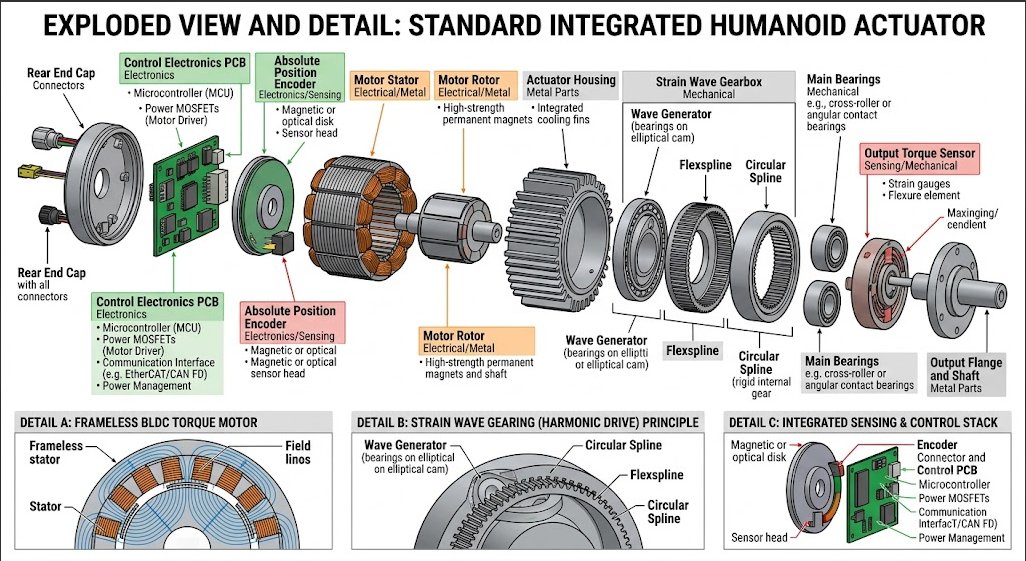
Came across this tweet regarding Actuators:

Integrated Actuator modules

Humanoid robots rely heavily on integrated actuator modules at every joint. Because these robots must balance their own weight, carry payloads, and fit within human proportions, their actuators can’t just be standard industrial motors.

They must pack immense torque, precise sensing, and power electronics into an incredibly small, lightweight package.

The Internal Components

To save space and weight, modern humanoids use frameless designs — meaning the motor, gearbox, and electronics are all pressed directly into a single shared housing rather than being bolted together as separate parts.

1. Mechanical & Metal Parts

Gear Reducer: Typically a strain wave gear (often known by the brand name Harmonic Drive). It converts the high-speed, low-torque spinning of the motor into low-speed, massive-torque output.

Bearings: Cross-roller bearings are used to support both axial (push/pull) and radial (side-to-side) loads simultaneously, allowing the joint to bear the robot’s weight without bending.

Housing / Casing: Machined from aerospace-grade aluminium alloys or titanium. The metal acts as a structural frame and a crucial heat sink to pull heat away from the electronics.

2. Electrical Parts

Frameless Torque Motor: Usually a Permanent Magnet Synchronous Motor (PMSM) or Brushless DC (BLDC) motor.

Stator (Stationary): Tightly wound copper coils that create alternating electromagnetic fields.

Rotor (Spinning): A metal ring lined with powerful rare-earth neodymium magnets.

3. Electronic Parts

Motor Controller (Driver PCB): The “brain” of the joint. It uses smart power stages (often featuring advanced Gallium Nitride or GaN transistors) to switch currents at high frequencies, driving the motor with extreme precision.

Position Encoders: High-resolution absolute optical or magnetic sensors that track the exact angle of the joint (often down to fractions of a degree) so the robot always knows exactly how its limb is bent.

Torque Sensors: Strain gauges built into the output shaft that measure how much physical force the joint is applying or resisting. This is what allows a robot to handle fragile items or dynamically balance when pushed.

Which Companies Make Them?

The supply chain for humanoid actuators is split into two main camps: component specialists who sell parts to roboticists, and well-funded humanoid companies who engineer their own actuators entirely in-house.

Component Specialists- Harmonic Drive, Maxon, Kollmorgen, Moog, Celera Motion

In-House Humanoid Builders - Tesla, Boston Dynamics, Figure AI, Apptronik

Yesterday one of the companies in India (Sona BLW) made an Announcement that they will make actuators and the other components.

Then I had discussion with an AI Agent:

Does NRB have the capability to manufacture any of the components in this value chain?

Yes, absolutely. NRB Bearings Ltd. is well-positioned to supply 60% to 70% of the mechanical, structural, and precision components that make up an integrated humanoid robot actuator module.

While NRB does not manufacture semiconductor chips or copper motor windings, its specialized capabilities in precision friction reduction, aerospace machining, custom batch engineering, and joint-venture assets match the exact mechanical requirements of humanoid joint actuators.

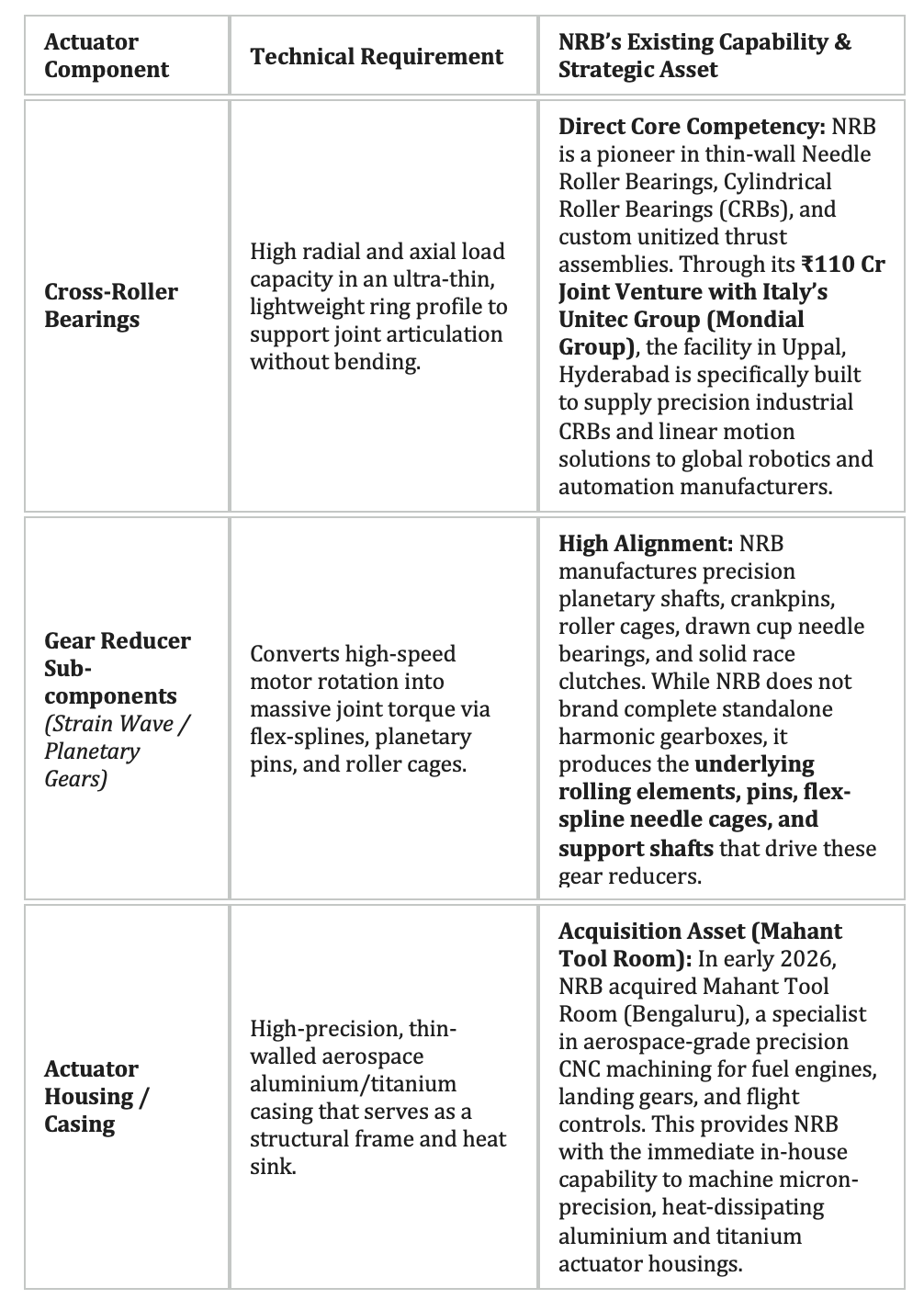
Below is a component-by-component breakdown of where NRB fits into the humanoid actuator value chain:

1. Mechanical & Metal Parts (NRB’s Core Fit)

2. Electrical Sub-components (Peripheral & Structural Fit)

  • Frameless Motor Rotors & Shafts: NRB does not wind copper coils for motor stators or manufacture neodymium magnets. However, it produces high-precision rotor support shafts, customized sleeves, and ultra-low friction motor bearings engineered for high-RPM, high-temperature electric brushless DC (BLDC) motor shafts.

3. Electronic & Sensing Integration (R&D Pipeline)

  • Position & Torque Sensing (Sensor Bearings): Traditional bearings simply rotate; humanoid joints require integrated angular and torque feedback.

  • NRB’s “Smart Motion” R&D: In its technical roadmap, NRB’s 35,000 sq. ft. R&D center in Turbhe is developing Sensor Bearings and Smart Motion Systems. NRB has prototyped bearings integrated with microcontrollers and condition-monitoring diagnostics, allowing the bearing itself to feed position and load data back to the central robot controller.

Strategic Levers Positioning NRB for Humanoid Supply Chains

  1. Mass Customization DNA: Standard bearing giants manufacture millions of identical ball bearings on fixed continuous lines. Humanoid actuators require small, highly customized batch runs. NRB’s core manufacturing model relies on “Mass Customization,” allowing it to rapidly tool up and produce high-value, low-volume batch components at competitive costs.

  2. Explicit Management Intent: Speaking on the Q2 FY26 Earnings Call regarding growth into robotics and next-generation mobility, Managing Director Harshbeena Zaveri stated:

“Sunrise industries like robotics, automation, drones, we even are serving humanoid and robots themselves. That is a different kind of mobility, even though it falls in the industrial segment… We are expanding into sensor bearings and smart motion systems.”

  1. The Unitec JV (Mondial Group): Italy’s Mondial/Unitec Group—NRB’s 75/25 JV partner—already supplies motion-technology solutions and application-specific bearings to European robotics and automation leaders.

Summary

If a humanoid robotics manufacturer seeks an integrated joint actuator partner, NRB can supply the precision cross-roller joint bearings, the planetary/strain wave gear rollers and shafts, the high-precision aerospace housing, and the sensor-integrated motion ring. The company can handle everything except the raw magnetic rotor materials, copper stator coils, and PCB power transistors.

1 Like

A realistic Timeline for NRB Bearings Ltd. to enter, sample, and scale its presence in the humanoid robot integrated actuator value chain:

Phase 1: Capacity & Capability Foundations (Late 2025 – Mid 2026) [COMPLETED]

  • Aerospace Machining & AS9100D Certification: On July 17, 2026, NRB completed the acquisition of Mahant Tool Room (Bengaluru) and secured the AS9100D Aerospace & Defense certification. This provides immediate capability to machine micron-precision, heat-dissipating aluminium and titanium actuator housings.

  • Joint Venture Execution: Established a 75/25 JV (NRB Unitec) with Italy’s Mondial/Unitec Group to localize precision industrial cylindrical bearings and linear motion systems in Uppal, Hyderabad.

  • Smart Motion R&D: NRB’s Turbhe R&D center prototyped sensor-embedded bearings with built-in microcontroller diagnostics for live load and angular tracking.

Phase 2: Facility Setup & Prototype Sampling (Late 2026 – Mid 2027) [12 – 18 MONTHS]

  • Plant Commissioning: Long-lead machinery imports for the ₹110 Crore Hyderabad JV facility and brownfield expansions at Jalna/Chikalthana arrive between late 2026 and early 2027. Commercial operations for industrial-grade precision bearings stabilize within a 15 to 18-month window.

  • Actuator Sub-component Sampling: NRB tools up its “Mass Customization” batch lines to submit prototype samples to industrial automation and robotics OEMs:

    • Thin-wall Cross-Roller Bearings for joint articulation.

    • Planetary shafts, rollers, and cages for strain-wave/harmonic gear reducers.

    • Machined Actuator Housings via Mahant Tool Room.

Phase 3: OEM Qualification & Low-Volume Production (2027 – 2028) [24 – 36 MONTHS]

  • Validation Window: In high-precision robotics, component qualification and “Black Box” co-design testing typically require 12 to 24 months of joint validation.

  • Global Industry Adoption: The global humanoid robotics industry transitions from pilot factory testing (2025–2026) to low-volume mass production (tens of thousands of units) between 2027 and 2028.

  • Initial Supply Contracts: NRB begins commercial supply of custom cross-roller bearings, actuator casings, and gear reducer sub-assemblies to Tier-1 system integrators and robotics builders.

Phase 4: High-Volume Commercial Scale-Up (2028 – 2031)

        [2026: Foundation]  ──► AS9100D Certified & Unitec JV Plant Built

        [2027: Sampling]     ──► Actuator Housings & Cross-Roller Prototyping

        [2028: Commercial] ──► Qualification & Initial Robotics Supply

        [2031: Scaling]    ──► Part of ₹2,500+ Cr Non-Auto Growth Blueprint
  • Mass Production Horizon: Industry forecasts project global humanoid shipments to scale rapidly toward 2030–2031 (targeting 100,000+ units globally).

  • Revenue Realization: NRB’s target of reaching ₹2,500+ Crores in consolidated revenue by 2031 relies on non-automotive sectors (industrial, aerospace, defense, and robotics) expanding to account for 20% to 25% of group turnover.

  • Integrated Smart Actuators: Commercial deployment of NRB’s full “Smart Motion” sensor bearings directly into production-grade humanoid joint modules.

Summary

NRB is currently in Phase 1 (Infrastructure & Capability Ready). Initial prototype sampling will occur over the next 12 to 18 months (by mid-2027), with meaningful revenue contributions from robotics and advanced automation materializing between 2028 and 2031.

----------------------------------------------------------------------------------------------------------------

Disclaimer

This report is generated strictly from publicly available financial information and corporate transcripts with the analytical assistance of an AI Agent. This document does not constitute formal financial or investment advice, nor does it represent a buy, sell, or hold recommendation.

----------------------------------------------------------------------------------------------------------------

3 Likes