From a 1992 experiment in electronic trading to one of the world’s most important market infrastructures, the National Stock Exchange is preparing to enter public markets. The investment case is not merely about trading volumes. It is about whether India’s financialisation story can continue to compound and how much of that compounding NSE can capture.
There are businesses that sell products, businesses that provide services, and then there are businesses that become part of the infrastructure through which an economy functions.
The National Stock Exchange of India belongs to the third category.
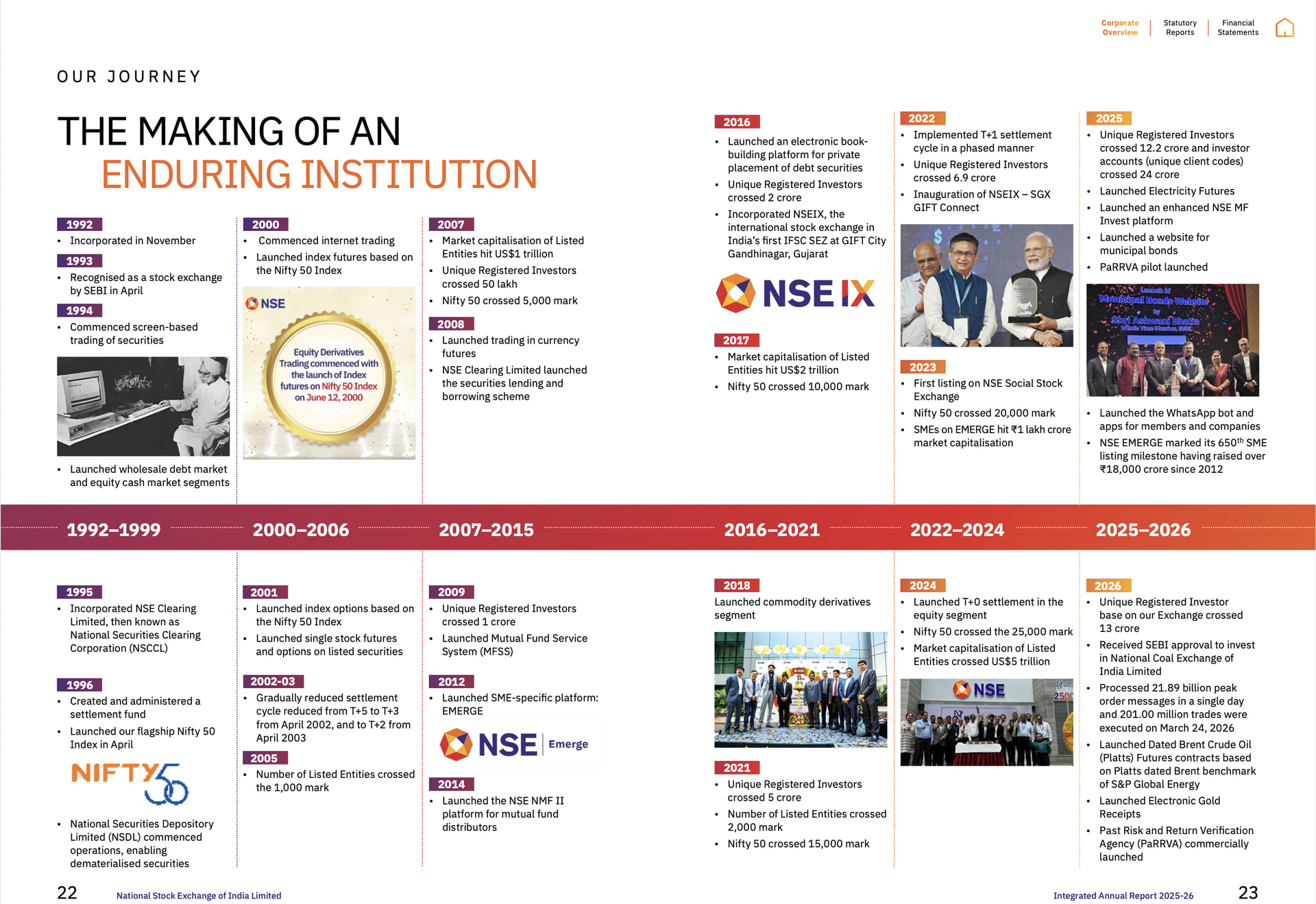
Established in 1992 and beginning operations in 1994, NSE was created at a time when India’s capital markets were undergoing a fundamental transformation. It introduced screen-based electronic trading and nationwide access to securities markets, helping replace a fragmented, broker-centric market structure with a technology-led national marketplace.
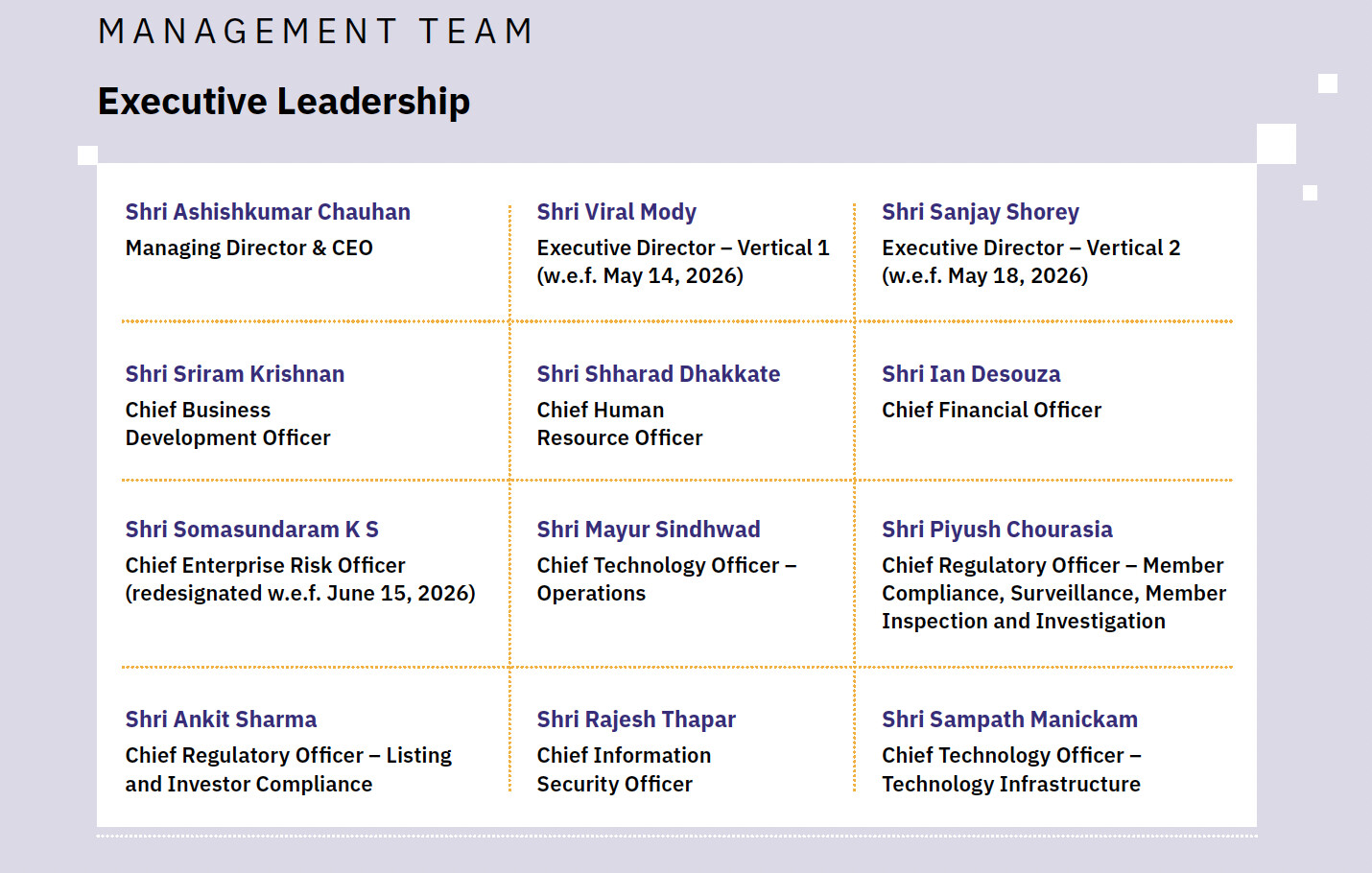
Management:
More than three decades later, the scale is difficult to ignore.
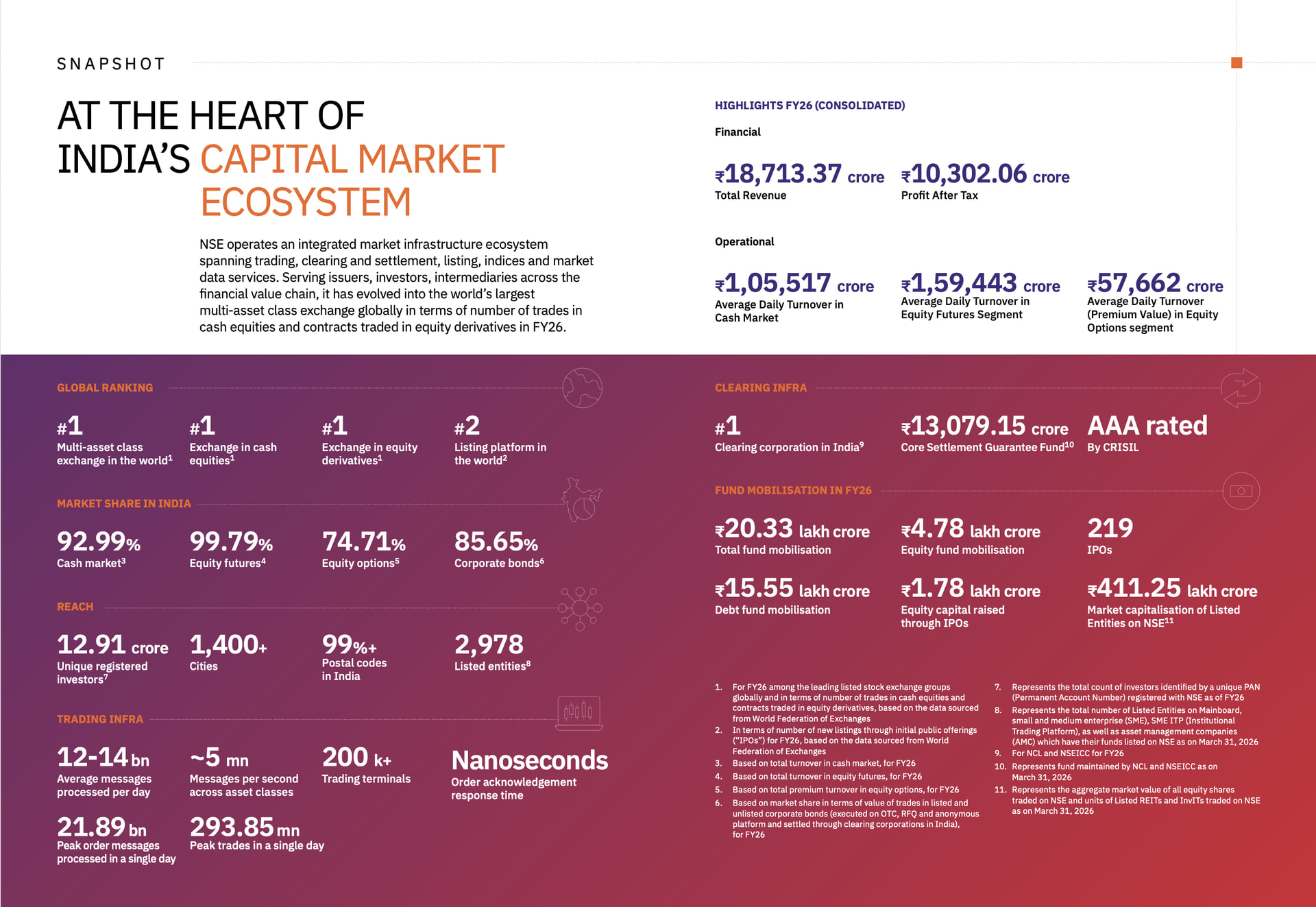
As of March 31, 2026, NSE had 12.91 crore unique registered investors, 2,978 listed entities and more than ₹411 lakh crore of market capitalisation represented on its platform. During FY26, it facilitated ₹20.33 lakh crore of fund mobilisation. Its average daily turnover was ₹1.06 lakh crore in the cash market, ₹1.59 lakh crore in equity futures and ₹57,662 crore in equity options premium turnover.
The Exchange describes itself as serving “a billion dreams”. That is corporate language. But beneath the slogan sits a more consequential proposition:
India is still early in its transition from a savings economy to an investment economy. NSE sits directly in the middle of that transition. The question for investors is therefore not simply whether NSE is a good exchange. It is whether NSE can remain the principal financial toll road through which India’s growing pool of savings, capital and risk management needs will travel.
History:
Capital Market Eco System
Product Landscape
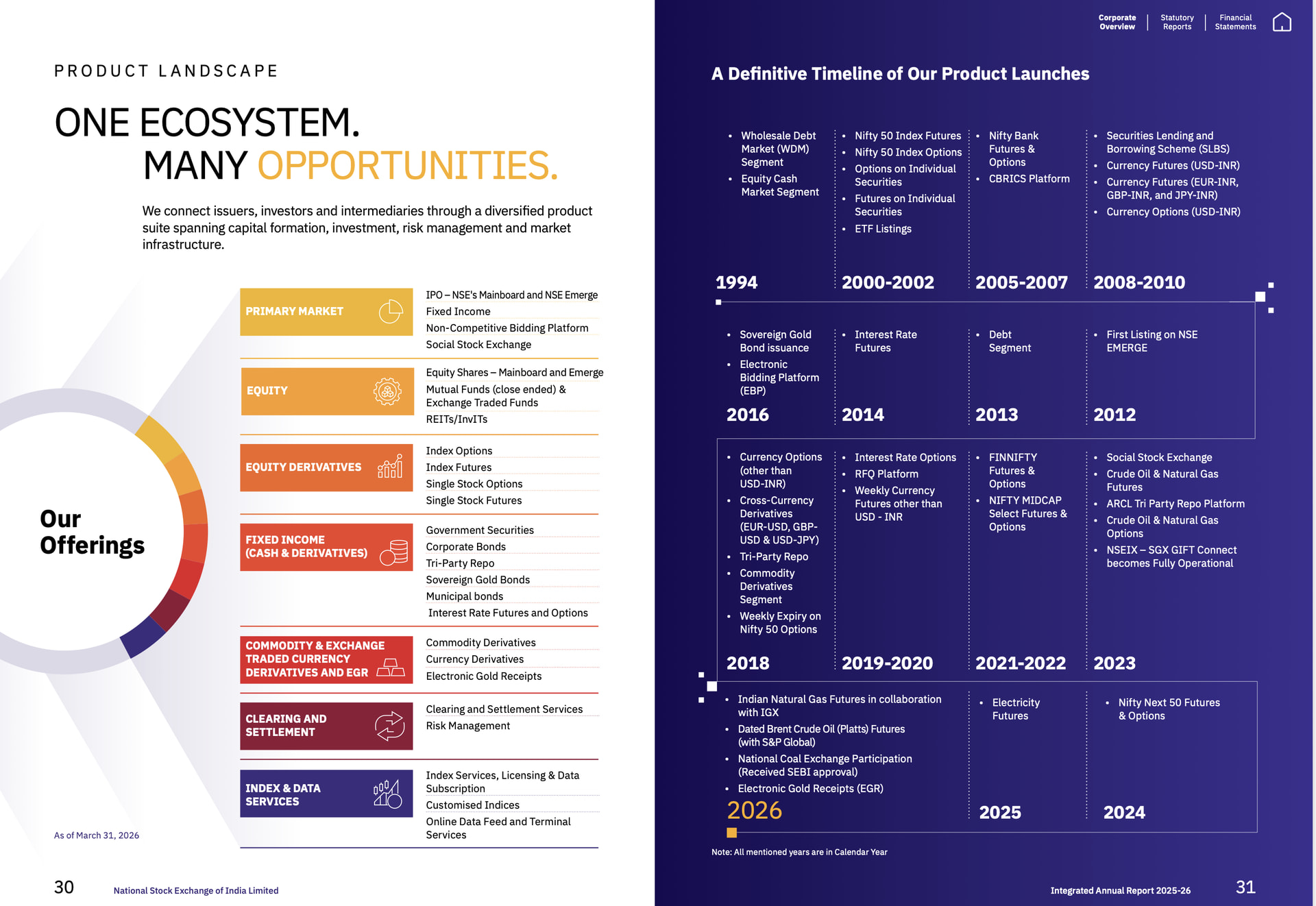
Structural Tail Winds for growth
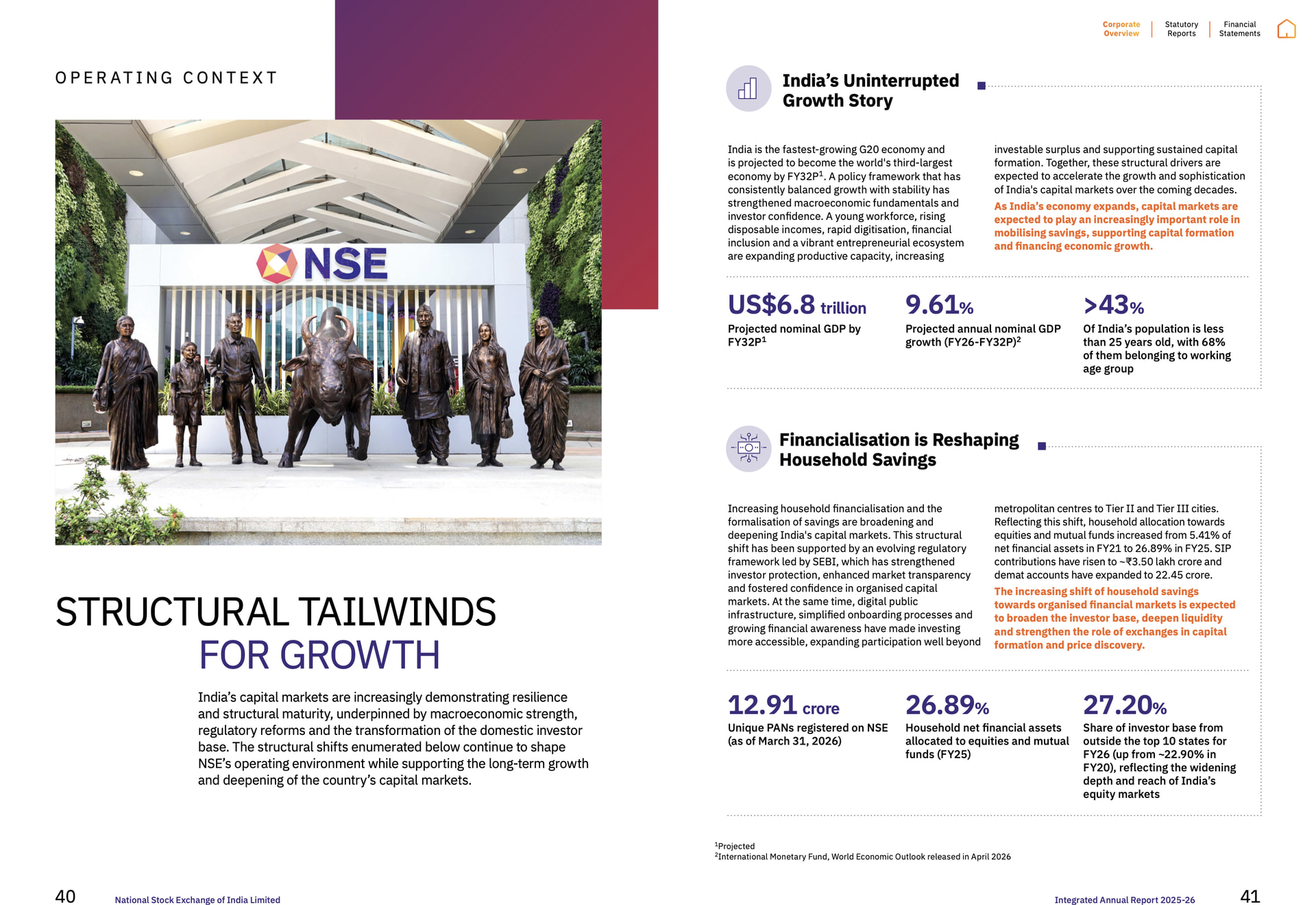
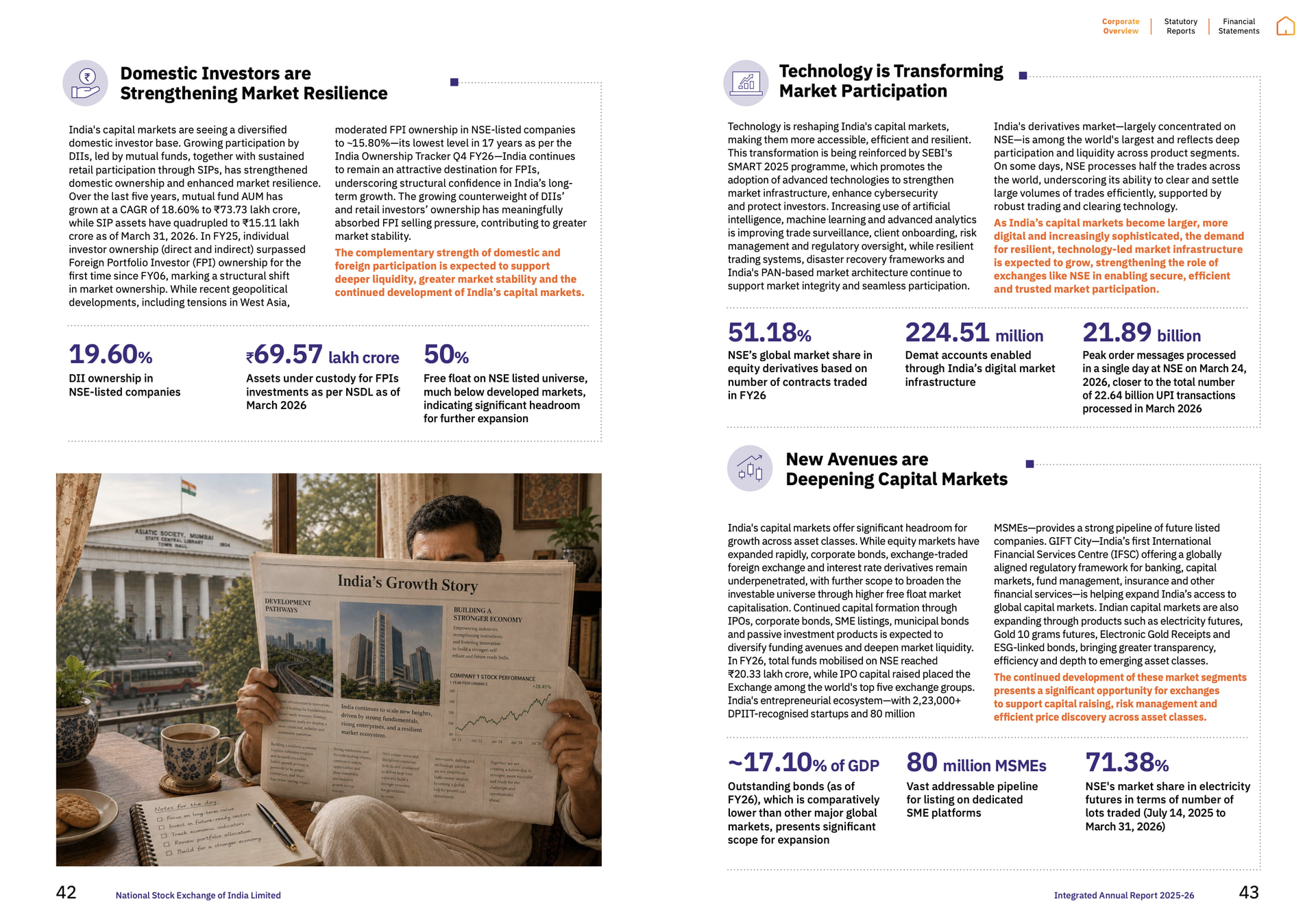
Above screenshots are extracted from the 34th annual report Link
Important Growth Drivers
The core long-term driver is the continued inancialisation of Indian household savings and expansion of capital-market participation. NSE’s annual report highlights 22.45 crore demat accounts, 12.91 crore unique investors on NSE and a significant increase in household allocation to equities and mutual funds. Other potential growth avenues include increasing derivatives and cash-market participation, IPOs and primary-market fund raising, corporate bonds, ETFs and index products, data and index licensing, GIFT City/global participation, and newer products such as electricity futures and gold futures. The large young population and relatively low penetration of securities-market products provide a potentially long runway, although the pace of monetisation will depend on participation, regulation and market activity.
Comparison with other exchanges:

Positives & Negatives of NSE
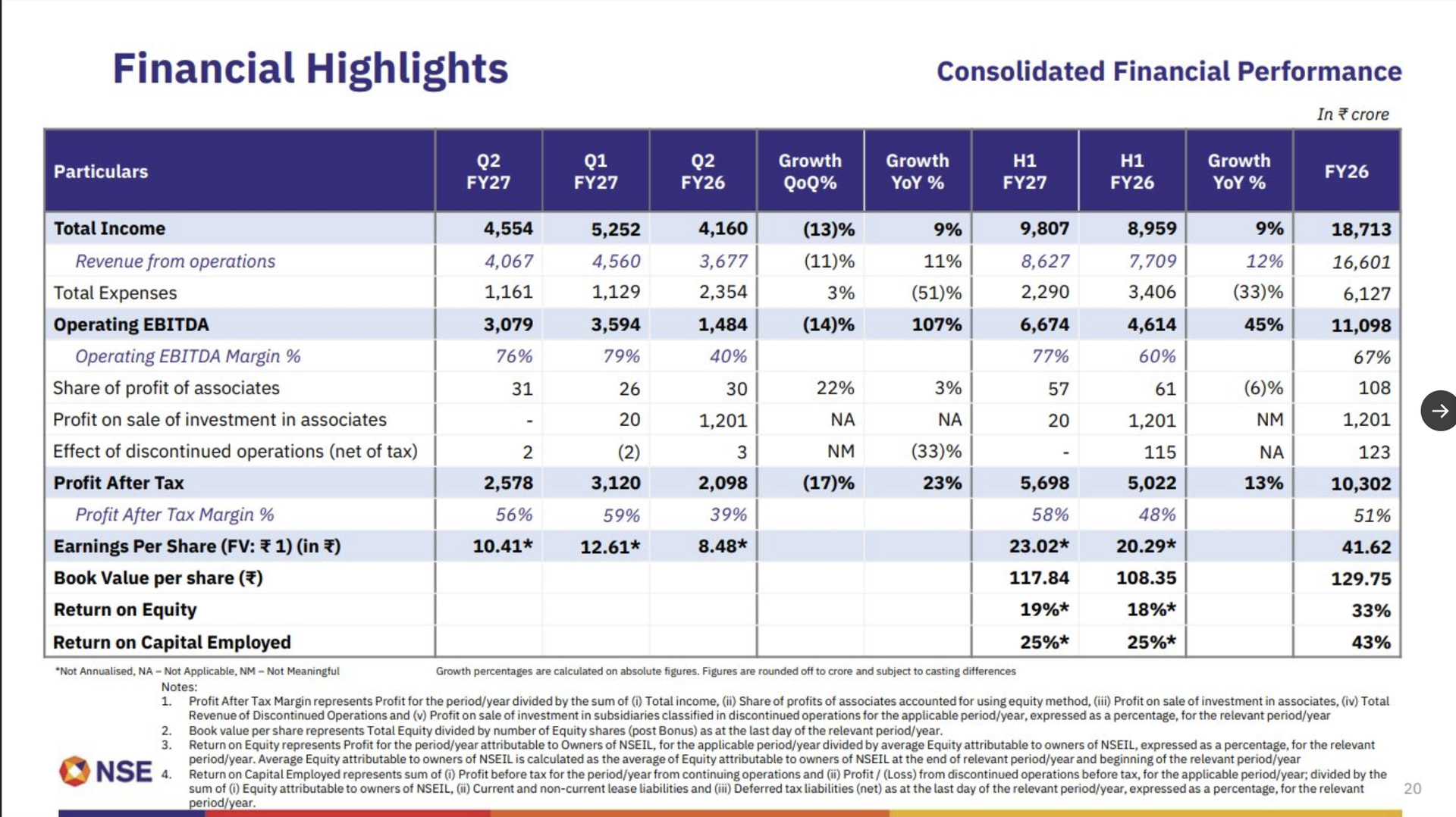
The key positives are NSE’s very strong market position, liquidity/network effects, highly scalable technology platform, broad product ecosystem and capital-light economics. In FY26, transaction charges accounted for around 79% of operating revenue, while the business generated a 66.85% consolidated operating EBITDA margin. NSE also has significant opportunities to monetise indices, data, listings and technology infrastructure beyond trading. The key negatives are the concentration of revenue in transaction charges and particularly equity options, exposure to changes in market volumes, regulatory intervention in derivatives, and the substantial ongoing investment required in technology, cybersecurity and infrastructure. FY26 itself demonstrated this cyclicality, with revenue and PAT declining from FY25 levels.
Immediate Triggers / Catalysts
NSE IPO and subsequent listing, which will provide a public-market valuation for India’s largest exchange and increase visibility and access for investors. Beyond the IPO, potential catalysts include recovery or continued growth in cash and derivatives volumes, expansion of the investor base, growth in IPO and debt-market activity, increasing monetisation of market data and indices, new product launches, GIFT City initiatives and further development of India’s capital-market infrastructure. The introduction of products such as electricity futures and gold futures illustrates NSE’s ability to expand into new market segments, although their eventual financial contribution remains to be demonstrated.
Great investors generally view the stock exchange itself as a phenomenal business to own due to its massive competitive moats, high profit margins, and recurring transaction-based revenue.
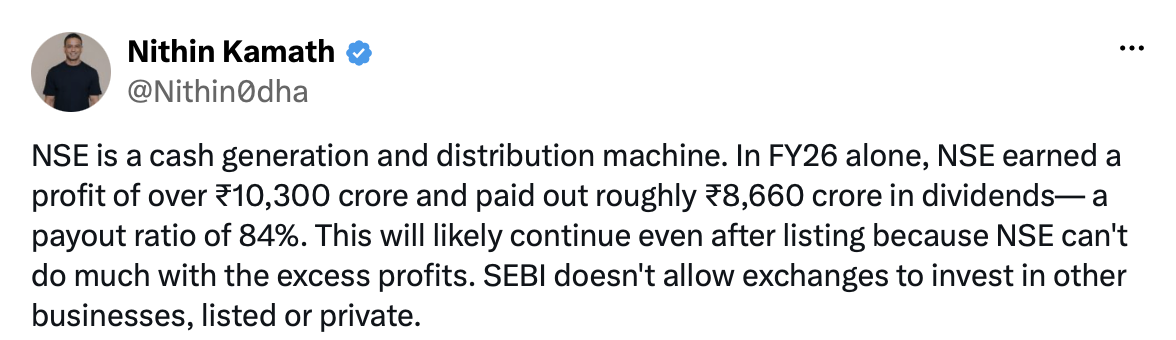
Nikhil Kamath of Zeroda said the below Link
Instead of looking at a stock exchange merely as a place to trade, legendary investors analyze it through the lens of a corporate entity (such as the Intercontinental Exchange, ICE, or Nasdaq).
The Ultimate Network Effect Moat
Warren Buffett and Charlie Munger frequently praised businesses that enjoy “tollbooth” characteristics, and stock exchanges are the ultimate example.
- Liquidity Begets Liquidity: Buyers want to go where the sellers are, and sellers want to go where the buyers are. This creates a powerful network effect that makes it nearly impossible for a new competitor to steal market share.
- Tollbooth Model: Every time a share is bought or sold, the exchange collects a tiny fraction of a cent. Like a toll bridge, they profit from the volume of traffic regardless of whether the stock market goes up or down.
High Pricing Power and Capital Efficiency
Quality-focused investors like Terry Smith or Nick Train often look for capital-light models with high returns on capital, a hallmark of modern electronic exchanges.
- Low Capital Reinvestment: Once the electronic trading infrastructure is built, adding more transaction volume costs almost nothing. This leads to exceptionally high operating margins (often exceeding 40–50%).
- Data Monetisation: Modern exchanges no longer just rely on trading fees. They have transformed into data and analytics monopolies. Companies must pay them massive recurring fees just to see real-time price feeds, indexes, and market data.
The Main Investment Risks
While great investors love the business model, they also note a few inherent structural risks:
- Valuation Risk: Because everyone knows exchanges are incredible businesses, they rarely trade at a cheap price. Investors often have to pay a steep valuation premium to own them.
- Regulatory Interventions: Exchanges operate at the heart of global financial systems. Changes in government regulations regarding trading fees, market structures, or data privacy can instantly impact profitability.
- Cyclical Volumes: While they make money in both bull and bear markets, a prolonged period of low market volatility or declining retail participation can temporarily suppress trading volumes and earnings.
Given that the IPO is already done, do you guys think NSE will compound in the coming 10 years?
Disclosure:
Invested at IPO stage and continuous monthly SIP planned for 3 years.