Re-cap of 15-years direct stock investing journey - Part 2
Second Innings: 2014 to 2020
A new innings began, I started investing in well-known groups (quality), easy to understand businesses at SIP mode and kept reasonable return expectation
- I filled the portfolio with Tata’s (tata global beverages, tata coffee), Birlas (AB Nuvo, Grasim), Mahindra’s (Mahindra Holidays), Bajaj (Bajaj Finserv, Bajaj Electricals), Britannia, and many more from such trusted groups/largecaps/MNCs (Blue Dart, Cadila Health – Zydus group, Apollo Hospitals etc.
- Most of these were easy to understand businesses
- Diversified the portfolio to 25-30 stocks.
- All these stocks were added in SIP mode on monthly basis
- Realistic expectations of 10-12% returns
2014: Kinder markets, kinder outcome
Modi wave turned the things around as portfolio did well post transition in 2013.
Top bets
- Bajaj Electricals (8%): It was mainly a turnaround bet; company was reporting losses due to its Engineering projects division. Its other businesses (consumer durable and lighting) were profitable and doing well. Given it was Bajaj and we used its products I thought of betting on its turnaround. It did well with 56% returns in the year.
- Bajaj Finserv (8%): Rationale shared here: My portfolio updates and investment journey - #6 by joinjp2003. Stock gave 22% returns, in hindsight this was just a beginning.
- Tata Global (7%) : Main reason to buy Tata Global was its JV with Starbucks. I had followed Starbucks in US market and it did really well so I thought of playing it through Tata Global in India. It was a painful large position as stock did not do well during my holding period (12-18 months).
- Yes Bank (6%) : An opportunistic bet as Fed tantrum (to end QE) in 2013 led all the banks to fall by 30-50% in short period of time. Yes Bank had also fallen from 100 to 50 so I bought to play a rebound. It was growing at high rates 40%+ with NPAs largely under control. It really worked well as it was up 41%.
- Britannia (6%) : it was the only FMCG available below 30PE vs. all other 50+. I was consuming Britannia biscuits, and Britannia’s product basket was wide. It also had leading market share in biscuits category.
- PVR (6%): I noted many youngsters watching movies in theatres now. Me and my wife also started going for movies often. This investment was simply a reflection of what I saw and experienced firsthand and asking where are the crowds?. That led me to buy the stock.
- Cadila Health (Zydus Lifesciences) (6%) : Whole pharma sector was doing well during this time. However, Cadila had not done anything from 2011 to 2103, so absence of run up in the stock and reasonable valuations enticed me. Slowly I built position as I improved my understanding. I had no courage to understand other pharma companies and this complex sector. One key factor which I liked was that Cadila had launched one drug (Lipaglyn) which was first time in India and cost wise it was cheapest. So, I thought company is good in innovation/R&D so loaded up in 2014 and 2015.
Portfolio composition in mid-2014:
|
H1-2013 |
2014 |
| Top 5 positions |
100% |
35% |
| Top 10 positions |
100% |
62% |
| Total #stocks |
1 |
30 |
Portfolio as of mid-2014 (BFSI* – 32%) (estimated returns +20%)
*BFSI: Banking, financial services and insurance
| Name |
Sector |
Industry |
% return till 12/06/2014 |
Current port mix |
| BAJAJELEC |
Consumer durables |
Cyclical |
56% |
8% |
| BAJAJ FINSER |
Insurance |
Semi-cyclical |
22% |
8% |
| TATA GLOBAL |
Food & bev |
Defensive |
7% |
7% |
| YESBANK LTD |
Banking |
Cyclical |
41% |
6% |
| BRITANIA IN |
Food & bev |
Defensive |
3% |
6% |
| PVR LTD |
Media |
Semi-cyclical |
5% |
6% |
| CADILA HEALT |
Pharma |
Defensive |
15% |
6% |
| IDFC LTD. |
Banking |
Cyclical |
20% |
5% |
| MAX INDIA |
Insurance |
Semi-cyclical |
45% |
5% |
| ZEELEARN |
Education |
Defensive |
20% |
5% |
| TREE HOUSE |
Education |
Defensive |
33% |
4% |
| CARE RATING |
Services |
Cyclical |
24% |
4% |
| MCX LTD |
Services |
Defensive |
5% |
4% |
| NMDC LTD |
Mining |
Cyclical |
20% |
4% |
| OBEROI REAL |
Real estate |
Cyclical |
17% |
4% |
| COAL INDIA |
Coal |
Semi-cyclical |
37% |
3% |
| TATA COFFEE |
Food & bev |
Defensive |
-2% |
3% |
| PETRONET LNG |
Gas distribution |
Defensive |
18% |
3% |
| ZYDUSWELL |
FMCG |
Defensive |
9% |
3% |
| GUJ PETRONE |
Gas distribution |
Defensive |
24% |
2% |
| INDRA PRSGAS |
Gas distribution |
Defensive |
17% |
1% |
| MHRIL |
Leisure |
Semi-cyclical |
17% |
1% |
| Others |
|
|
|
4% |
2015: Validation by performance
The new approach was getting validated with good returns in the last 18-24 months. Gradually, I reduced the number of stocks in my portfolio from 30 to 20, reflecting build-up of some confidence.
Portfolio continued to do well with big winners in 2015 being Dish TV, Britannia, Cadila Healthcare (now Zydus Lifesciences) and Bajaj Finserv.
Bajaj Finserv rationale is shared earlier in valuepickr thread: My portfolio updates and investment journey - #6 by joinjp2003
Top bets
Disht TV (11%)
I bought Dish TV to play DTH (direct to home) theme in India as government mandated to have full mandatory Cable TV Digitization by 2017/2018. Dish TV was a key listed player with leading market share.
Netflix story – As Netflix was getting hugely popular in USA, I had to come up with a reasoning why it will not work in India. So my reasons were:
-
Subscription plan for Netlflix was INR 500 per month vs, DTH player subscription plan starting from 200 per month.
-
For Netflix high speed broadband is required which needed additional 800-1000 rs per month. So total cost for Netflix streaming would be 1300-1500 per month vs. cable TV below 500 for all channels.
-
Rural markets can’t have broadband.
These reasons looked legit at least on cost and infrastructure basis. However, where we stand today as of 2025/26:
- Subscription plan for Netflix is now 300 per month in line or below vs. DTH players.
- Broadband bandwidth is abundant and per GB cost would have come down by 50-80% since then
- Entertainment bucket widened from just traditional TV channels – both Rural and Urban markets now enjoy data on mobile phone so they watch Netflix on phone and also there is somewhat increased broadband penetration.
Investor returns: Netflix used to trade at USD5 per share in 2105, now at 90+ (18x in 12 years) and Dish used to trade at 50-55 now at 4 (90% fall). Value migration and disruption?
Off course Dish had its own corporate gov challenges, but similar story played out in some other DTH/broadband players like Den Networks, Hathway Cable, Sun TV (not decimated but not even created).
I have shared this story to show how “we under-estimate the change”. Also its worth noting that disruption in business may happen later but destruction in share price will be faster.
MCX (10%)
MCX was the second largest holding with 10% allocation. Key rationale was that it could grow its revenue by 10x without any additional investments. Also, it was coming out of sharp decline in 2013 owing to NSEL default crisis. Market share of 90%+ meant government can’t afford it to fail (based on my banking experience of too big to fail or systemic importance logic). Also hedging activities were under-penetrated in India vs. globe.
Onmobile (9%)
I re-entered Onmobile after booking huge losses in 2011-13. By this time company had fallen to 30-40 rs from high of 100 in 2011. Promoter was buying stake through open offer, and it did some buyback. Company had cash of about 40% of market cap. I thought of buying it again with hope of turnaround and cash cushion. I don’t think company ever turned around but I made decent gains of 37%.
Portfolio composition in early 2015
|
H1-2013 |
2014 |
2015 |
| Top 5 positions |
100% |
35% |
48% |
| Top 10 positions |
100% |
62% |
80% |
| Total #stocks |
1 |
30 |
20 |
Portfolio in early 2015 (BFSI – 43%) (estimated returns +29%)
| Name |
Returns |
Portfolio mix |
| DISHTV |
41% |
11% |
| MCX |
11% |
10% |
| CADILAHC |
31% |
10% |
| ONMOBILE |
37% |
9% |
| BAJAJFINSV |
53% |
8% |
| CARERATING |
11% |
7% |
| ZEELEARN |
10% |
7% |
| YESBANK |
47% |
6% |
| ICICIBANK |
-4% |
6% |
| FEDERALBNK |
-1% |
6% |
| PVR |
4% |
5% |
| BRITANNIA |
153% |
5% |
| TREEHOUSE |
21% |
4% |
| MHRIL |
-14% |
3% |
| PFS |
-3% |
1% |
| APOLLOHOSP |
3% |
1% |
| ICRA |
0% |
0% |
| IPCALAB |
0% |
0% |
| NAUKRI |
1% |
0% |
2016: Interruption
During H1 of the year, I had to exit many financial stocks like Bajaj Finserv in 2016 due to compliance reasons.
Aditya Birla Nuvo : Luckily, I was able to invest in Aditya Birla Nuvo as it was classified in miscellaneous sector category. AB Nuvo was available at 75% holding discount to its investments. My main thesis was that its financial subsidiary (AB Capital) is a priced asset which market was not be valuing much. Owing to compliance related selling in other stocks, I concentrated quite a bit on stock as it continued to go up. Stock doubled within one year as it announced demerger of financial services business. Until 2016, this was my biggest win in terms of absolute amount that too in a short time (<12 months). This was also a luck as such corporate actions within such short time is difficult to get.
In H2 of 2016, I was able to re-invest in financial stocks. However, I sold couple of companies as I found something fishy about them. Just capturing them here for reference:
- Tree House :
- Company never shared any plan how they will use 200 crore cash on balance sheet
- On one side promoter was buying shares on other side it was pledging shares
- Yes Bank :
- In September 2016, Yes Bank announced a QIP and pulled it for a technical reason. I was not satisfied with reason given by then CEO - Rana Kapoor. So, I decided to sell.
- Already UBS was alleging lower NPAs reported by the bank vs. its exposure to kind of groups it had.
- Yes Bank was growing its loan book 2-3x of system level growth and was reporting very low NPAs when whole system was reporting higher NPAs with steady loan growth.
I do not have portfolio data for this year.
FY18 – Influence of investment gurus
Investment philosophy
Broadly during this time period, I was influenced by Raamdeo Agarwal sir’s QGLP framework and Peter Lynch’s “buy what you know”. I also liked Ramesh Damani’s philosophy of – when you find something good, “back up the truck” (recently got to know it was Charlie Munger’s quoter).
Peter Lynch said buy what you know. I took it to next level “buy what you see”. Hence, I bought Borosil as I could see it a lot in Big Bazaar (India’s leading retail chain during that time), I could see many of Aditya Birla’s Fashion brands in malls as well as I could see MacDonands (Westlife). These also fit well in QGLP framework.
This was a year when many of my colleagues and friends started talking about stocks. After 2006 may be this was the period when I heard so many people talking about stocks. They were like did you see X, that one has gone up 3 times, did you see Y that has gone up 5 times. Unfortunately, I had no multibaggers, portfolio was positive (+7%) but not much.
A note of small win: I moved to my new house in April 2017. My equity portfolio exceeded the home loan principal amount by almost 30% by March 2018. An extreme focus on savings helped a lot as returns were moderate.
Big wins and top bets
Bajaj Finserv (21%) continued to play anchor role with 21% allocation and decent returns.
Note: Bajaj Finserv’s returns in the table look low as I had to sell Bajaj Finserv in early 2016 owing to compliance. I re-entered the stock in second half of 2016.
Care Ratings (15%) was second largest bet (not a big win yet). Coming from a credit-rating background, I understood the business well. It is a highly sticky, asset-light business with near-zero incremental investment requirements. At that time, India’s corporate bond market was still under-developed, offering significant long-term potential, especially with the government/RBI actively working to deepen bond markets. Care’s dividend yield and valuations were attractive compared with MNC peers such as ICRA and CRISIL.
ICICI Prudential Life Insurance (14%)
Somehow, I could envision that life insurance industry will grow in 15-18% range for a decade and PAT growth could be 20-22%. Taking a leaf from how US and some European companies became giants over the years. I believed if you own an Insurance company then your retirement shall be taken care of. I have not been able to fully understand this bias/bullishness yet.
Edelweiss Financial Services (10%): Amit Jeswani, a passionate fund manager, of Stallion talked about Edelweiss. Then I researched it and found it cheap at 13x PE and 2x P/B while earnings growth was 30-40%. Cherry on top was its ARC business where upside was supposed to be very high.
Westlife Foodworld (10%)
MacDonalds was strongest brand in QSR after Domino’s. Company was growing steadily and was improving margins. I was attracted by opening up of McCafe, which was adjacency to its burger business. I thought this will driven revenue and margins. A QGLP and Peter Lynch (buy what you know) bet.
Borosil (10%)
I heard from friend Borosil ka hai kuch nahi hoga (it Borosil nothing will happen) “in context of putting glass bowl in oven”.
Then I saw Borosil displayed in many stores/hypermarkets, my company gifted us Borosil tiffins. Hence, there was enough evidence of increased use and trust on these products. I started researching (read annual report), found some related party issues. However, over the years management addressed them and son of the promoter started changing lot of things in the company. From trader they became manufacturers, they increased product basket to opalware through acquisition of “Larah”. As company gained market share and revenues, I increased my bet.
Special mention - Hindustan Foods
This was a year when Hindustan Foods entered my portfolio – rationale already available in thread here: My portfolio updates and investment journey - #3 by joinjp2003
As I also wanted to be around my circle of competence – BFSI sector accounted for 69% of my portfolio.
Portfolio composition
Portfolio was highly concentrated with 10 stocks. Top 5 accounted for 70% of portfolio. BFSI sector accounted for 69% of my portfolio.
|
H1-2013 |
2014 |
2015 |
FY18* |
| Top 5 positions |
100% |
35% |
48% |
70% |
| Top 10 positions |
100% |
62% |
80% |
100% |
| Total #stocks |
1 |
30 |
20 |
10 |
*FY18 means period from 1st April 2017 to 31st March 2018
Portfolio as of March 2018 (FY18) (BFSI – 69%) (XIRR +7%)
| Asset Name |
Overall Gain % |
Portfolio mix |
| Bajaj Finserv |
32.72% |
21% |
| CARE Ratings |
-16.77% |
15% |
| ICICI Prudential Life Insurance Company |
-3.70% |
14% |
| Edelweiss Financial Services |
70.84% |
10% |
| Westlife Foodworld |
39.59% |
10% |
| Borosil |
24.71% |
10% |
| Aditya Birla Fashion and Retail |
0.02% |
9% |
| Aditya Birla Capital |
-16.89% |
7% |
| Hindustan Foods |
4.55% |
2% |
| BSE Ltd |
-4.53% |
2% |
FY19 – Calmness in a year of chaos
This was first year when I noted portfolio names were pretty much same as last year. Only weights changed due to performance of individual stocks.
This was my year. All my friends and colleagues vowed never to touch small caps again. Thanks to Bajaj Finserv at 21% allocation portfolio was in positive territory.
Big Wins: Bajaj Finserv, Westlife Foodworld, Aditya Birla Fashion, and Hindustan Foods did well in a carnage like environment. On absolute basis these stocks ran up 30-40% during the year.
While Care Ratings (down 20%) which I was holding from 3 years with 9 to 15% allocation was a drag on portfolio. Edelweiss (-17%) and BSE (-19%) also caused a drag on portfolio.
I was most bullish on Aditya Birla Capital. I believe on cost basis this must have been my largest bet till date (March 2019).
Portfolio composition
Portfolio continued to reflect my circle of competence – BFSI allocation at 64% and high concentration in 10 stocks. Top 5 stocks accounted for 62% of portfolio with Bajaj Finserv being largest bet at 21%.
|
H1-2013 |
2014 |
2015 |
FY18 |
FY19* |
| Top 5 positions |
100% |
35% |
48% |
70% |
62% |
| Top 10 positions |
100% |
62% |
80% |
100% |
100% |
| Total #stocks |
1 |
30 |
20 |
10 |
10 |
*FY19 means period from 1st April 2018 to 31st March 2019
Portfolio as of March 2019 (FY19) (BFSI – 64%) (XIRR +7%)
| Asset Name |
Overall Gain % |
Portfolio mix |
| Bajaj Finserv |
80.59% |
21% |
| Aditya Birla Capital |
-17.14% |
12% |
| Westlife Foodworld |
87.00% |
10% |
| Aditya Birla Fashion and Retail |
46.10% |
10% |
| ICICI Prudential Life Insurance Company |
-13.20% |
9% |
| CARE Ratings |
-31.86% |
9% |
| Hindustan Foods |
22.27% |
9% |
| Borosil |
26.40% |
7% |
| Edelweiss Financial Services |
41.83% |
6% |
| BSE Ltd |
-10.43% |
6% |
FY20 – COVID lows
In 2013, I had targeted to achieve a milestone amount by end of 2020. When 2020 arrived, milestone was just 8% away, however by March 2020 it went 45% away due to COVID fall.
This was the time when you don’t want to open your demat account. If anyone says she lost 50% in BSE, please do believe in that. In my portfolio, BSE was down 50%, AB Capital was down 63%, Bajaj finance was down 46%.
Hindustan foods saved some grace with 50% returns during the year with highest allocation in portfolio at 14%.
Reaction to crash : My 90% of net worth was in equity, and net worth declined by 40-50% within 30-40 days. I stood through correction; I did not sell anything.
No need to applause the courage, I was frozen. Such frantic fall did not give much time to think. For example, one of my largest holdings, Bajaj Finserv, fell 50% in 30 odd trading days (20 Feb price of 971 and 450 on 3 April 2020). Everything else was also falling like a rock.
Distraction helped? Question on whether we will survive COVID also kept focus away from portfolio, hence inaction.
Only stock I added during this fall was Oracle Financial Services mainly driven by 12 PE and high dividend yield (4-6%).
Special mentions
Life Insurance companies – HDFC Life, ICICI Pru Life, SBI Life
I was very bullish on Insurance due to structural growth expected driven by increased penetration. It was about 30% of my portfolio. Also, this sector aligned with QGLP framework. I owned HDFC Life, ICICI Prudential Life, and SBI Life. This also kept my BFSI exposure high at 56% of portfolio.
Dixon Technology
This was the year when Dixon Tech made entry into the portfolio. Simple logic to buy Dixon was that it had economies of scale advantage in TVs and few other consumer electronics owing to leading market share and it was available at 40x PE vs. all other listed brand companies were above 50x. I bought it with 15% return expectations. That time mobile manufacturing and PLI story had not taken off.
Account for covid lows
As the portfolio values are taken as of March 2020 (COVID lows) portfolio shows huge pain (down 29%). Anyone who would have seen single digit returns for two years in a row (FY18 and FY19) and then 29% negative returns in third year (2019/20) he would have been scarred for life and/or would have left the stock markets. I just hang in there that too with almost 90% of net worth in equity.
Portfolio composition
|
H1-2013 |
2014 |
2015 |
FY18 |
FY19 |
FY20* |
| Top 5 positions |
100% |
35% |
48% |
70% |
62% |
51% |
| Top 10 positions |
100% |
62% |
80% |
100% |
100% |
78% |
| Total #stocks |
1 |
30 |
20 |
10 |
10 |
19 |
*FY20 means period from 1st April 2019 to 31st March 2020
Portfolio as of March 2020 (FY20) (BFSI – 56%) (XIRR - negative 29%)
| Asset Name |
Overall Gain % |
Portfolio mix |
| Hindustan Foods |
71.70% |
14% |
| HDFC Life Insurance Company |
-2.36% |
11% |
| ICICI Prudential Life Insurance Company |
-11.85% |
11% |
| Bajaj Finserv |
-9.94% |
9% |
| Aditya Birla Capital |
-63.28% |
6% |
| Oracle Financial Services Software |
-10.62% |
6% |
| Westlife Foodworld |
37.22% |
6% |
| Dixon Technologies (India) |
4.11% |
5% |
| Multi Commodity Exchange of India |
12.33% |
5% |
| BSE Ltd |
-50.00% |
5% |
| SBI Life Insurance Company |
-35.39% |
4% |
| HDFC Bank |
-30.22% |
3% |
| Bajaj Finance |
-46.40% |
3% |
| Gujarat State Petronet |
-17.94% |
3% |
| Titan Company |
-19.19% |
3% |
| Grasim Industries |
-39.65% |
2% |
| IFB Industries |
-59.21% |
2% |
| Borosil |
NM |
2% |
| RPSG Ventures |
-58.55% |
1% |
Third innings: 9M2020 to 2023
Earlier I mentioned that “In 2013, I had targeted to achieve a milestone amount by end of 2020. When 2020 arrived, the milestone amount was just 8% away, however by March 2020 it was 45% away due to COVID fall”.
Nevertheless, by the end of December 2020 I had overshot the milestone by 35%. In hindsight, felt the “power of staying invested” and understood why people say inaction/a smaller number of decisions is good. Despite a 40-50% fall in portfolio from peak, I did not sell anything, however I also did not add any real incremental money until my portfolio made a new high in July 2020.
In hindsight I call this year as a year of beginning of third innings. My first innings from 2010 to H12013 was just a stupid start with narrow focus on valuations or beaten down stocks. While second Innings from H2-2013 to H1-2020 was about focus on quality, low expectations, being in circle of competence.
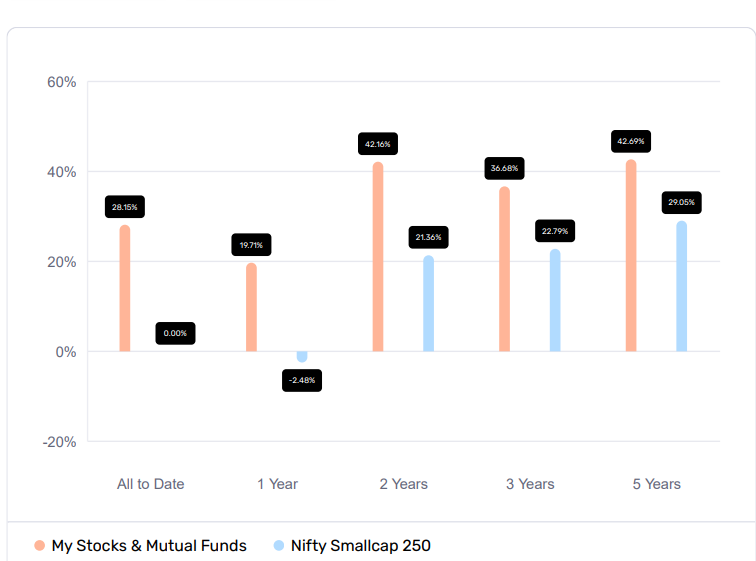
Broad outcome of First innings was huge losses. Second Innings: was a negative 9% CAGR (April 2017 to March 2020), off course it is distorted a bit by COIVD low. Even if I exclude COVID pain period, XIRR was muted at +12.4% (April 2017 to Jan 2020), though in line with my realistic expectations I set earlier.