
Unless it is just colocation (which is just renting space with cooling and power),
Even this needs network engineers, hardware engineers etc.
It is different world altogether. Please check E2E networks. they have similar model.
Not saying it is undo-able. But there are potent execution risks.
1 Like
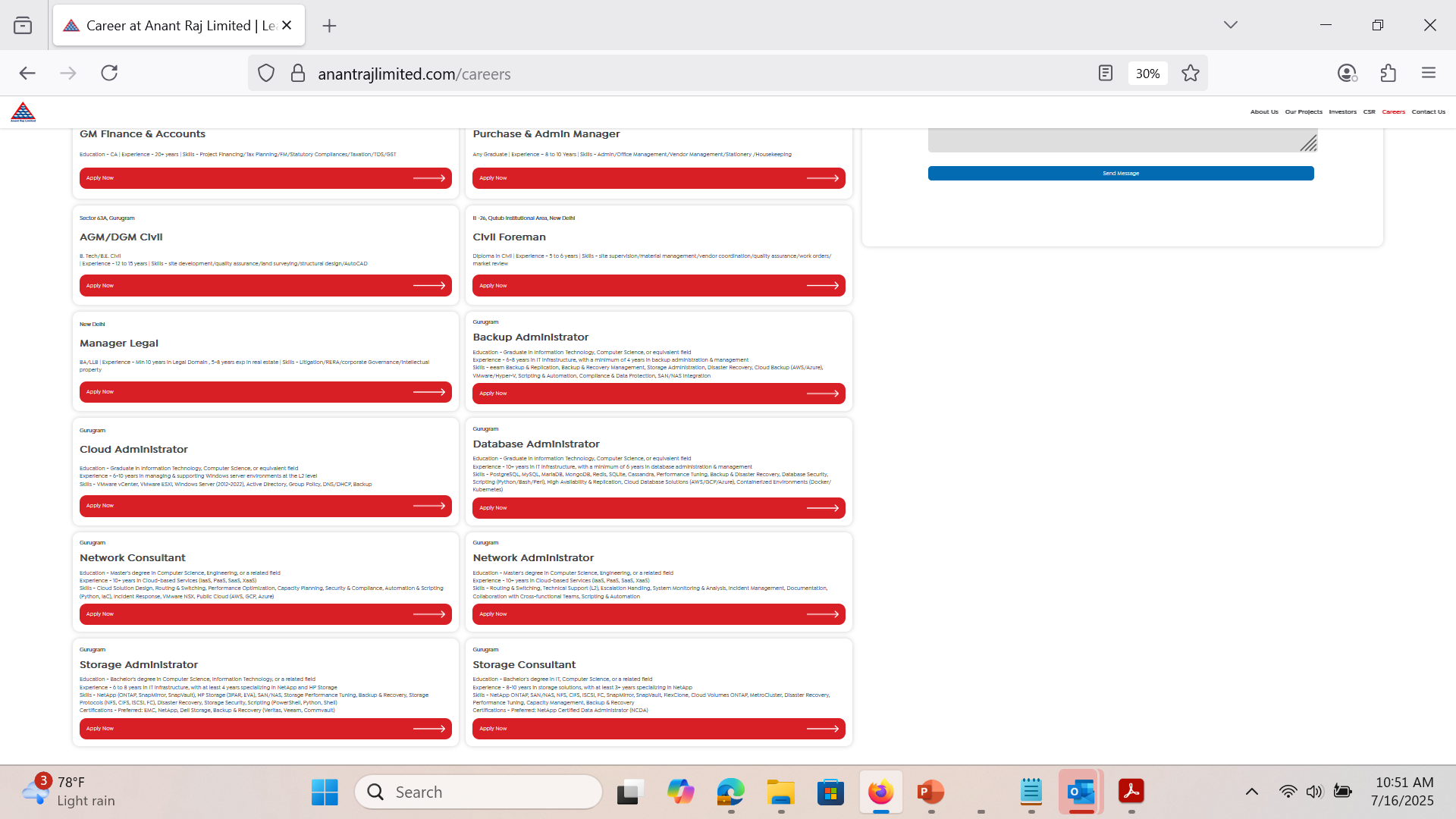
They are hiring for these roles. But Glassdoor employee satisfaction is pathetic 2.7
With that kind of work environment, you can not retain tech talent.
1 Like
Yes you are correct. You definately need to treat software engineers with great care for the service they offer resides in their minds which needs to be kept happy and content. Thats what sunil gupta talked in the yt video above. The earlier management realises this the better. maybe they already know and are working on it. Need to have that faith else we cant invest in almost any company
Thanks to everyone for this rich and thought-provoking discussion.
I went through the entire thread, and I must say — it’s one of the most informative community-level breakdowns I’ve come across regarding Anant Raj and Yotta’s pivot towards AI cloud infrastructure. The level of skepticism, caution, and thoughtful counterpoints brought out by each of you is exactly why ValuePickr remains such a valuable forum for investors.
A special appreciation to @Arj_Patel — your effort to dig into con call transcripts, derive rough back-of-the-envelope calculations (EBITDA per MW, capex payback assumptions, etc.), and compare with peers is commendable. Doing all this before even taking a position reflects the right temperament — deep due diligence before capital allocation. Thanks to nav_1996 also for valuable insights
Key takeaways from the discussion:
- Business Model Shift: Yotta’s move from colocation to AI cloud (Infra-as-a-Service) with high-revenue potential (up to $21M per MW/year in Shakti Cloud vs <$1M in Hyperscaler colocation) is exciting, but also capital-intensive and execution-heavy.
- Capex & Talent Concerns: ₹100 Cr/MW upfront capex sounds aggressive. But it’s also not just about hardware — they will need to build a robust tech workforce and support infrastructure, which is clearly a pain point given Glassdoor reviews and hiring challenges.
- Execution Risk: As @nav_1996 rightly pointed out, infra-as-a-service still needs strong backend teams — network engineers, hardware specialists, etc. Transitioning to full-fledged PaaS/SaaS will be an even steeper climb.
- Communication Gaps: The absence of regular concalls and clarity from management continues to be a red flag. Greater transparency would help retail investors build conviction.
Let’s continue tracking how they execute on this vision — particularly their ability to:
- Attract & retain top engineering talent
- Secure GPU supply chains in a cost-effective manner
- Scale AI cloud customers without overextending capital
Once again, grateful to the contributors here — particularly @Arj_Patel and @nav_1996 — for setting the bar high for community-driven diligence.
1 Like
Bit of learning about AI Cloud (Infra-as-a-Service or IaaS)
That refers to the delivery of high-performance AI-ready computing infrastructure—like servers, GPUs, storage, and networking—as a service, usually via the cloud. It enables enterprises, startups, and research teams to run AI workloads without owning or managing physical hardware.
 What does it include?
When we say “AI Cloud – IaaS”, we are essentially talking about:
| Component | Description |
|---|---|
 AI-Optimized Hardware AI-Optimized Hardware |
Servers powered by GPUs (like NVIDIA A100 or H100) designed to train and run large AI models |
 Networking Networking |
High-speed, low-latency networks to connect storage and compute across data centers |
 Storage Storage |
High-throughput SSDs, object storage systems optimized for training datasets |
 Security & Compliance Security & Compliance |
Encryption, access control, and regulatory certifications for data security |
 Colocation Environment Colocation Environment |
Physical space (rack, power, cooling) for client-owned or leased machines |
 Who uses AI IaaS?
- AI Startups & Researchers: Need powerful infra for LLM training, computer vision, NLP.
- Enterprise AI Teams: Building fraud detection, predictive analytics, or AI-powered apps.
- Government & Healthcare: For secure, large-scale AI modeling (e.g., genomic analysis).
 Why is this model growing?
- Avoids upfront capex – No need to buy ₹100+ Cr worth of GPUs and infra.
- Pay-as-you-go – Clients only pay for what they use.
- Scalable & Flexible – Easily scale up to hundreds of GPUs for training jobs.
- Rapid deployment – Companies can go live in days, not months.
 Indian Examples
- Yotta: India’s first hyperscale AI cloud (Shakti Cloud), with H100 GPUs.
- Anant Raj/Yotta Infra tie-ins: Infra partners building data centers tailored for GPU workloads.
2 Likes
Absolutely agree with your perspective—thanks for bringing in that clarity.
As mentioned in the con-call, Anant Raj’s current model is Infra-as-a-Service (IaaS)—focused on setting up data center infrastructure (space, power, cooling, networking, GPU/CPU hardware) and offering it to hyperscalers or enterprise clients who’ll layer their own software stack.
So yes, it doesn’t need a deep tech talent bench today, unlike a cloud-native or SaaS/PaaS provider.
Comparing Anant Raj vs. Yotta:
- Yotta is definitely ahead on the tech stack integration + AI infra bundling. They’ve already built:
- Cloud platforms (Shakti Cloud)
- AI infra with H100 clusters
- A strong engineering team led by Sunil Gupta
Your point on Sunil’s vision is spot on—he’s building a next-gen digital infra company, not just a DC landlord.
 What Anant Raj Needs to Get Right:
- Land & Capex → Asset Moat: They own land in core NCR, so cost is lower. This gives margin cushion in early IaaS phase.
- Client Ramp-up: If they can attract key anchor tenants (like CSC, or cloud players), the IaaS model can generate strong cash flows.
- Scaling into PaaS/SaaS: Over the next 3–5 years, if they plan to go beyond IaaS:
- They must invest in tech talent (DevOps, Cloud, Security)
- Build partnerships or JVs with cloud/AI SaaS platforms
- Take cues from how Yotta is building India’s AI stack
 Final Thought:
Yotta is setting a benchmark. If Anant Raj can deliver profitable IaaS in the near term, and evolve carefully into higher-margin PaaS/SaaS layers while controlling costs—then this could be a hidden AI infra story emerging from a real estate DNA.
Let’s track how this thesis evolves over next few quarters.
1 Like
 Key Difference: Yotta vs Anant Raj Today
| Feature | Yotta | Anant Raj (Ashok Cloud) |
|---|---|---|
| GPU-based AI Cloud | Yes (NVIDIA H100s) |
 No public indication yet No public indication yet |
| AI Talent & Dev Tools | Built in-house |
No evidence yet |
| Infra-as-a-Service (IaaS) | |
|
| Software Stack (PaaS/SaaS) | Planned |
Not yet |
Ashok Leyland MD&A : Long-Term Investor Summary (FY2024–25 Annual Report)
 Macro & Industry Outlook (India + CV Sector)
- India’s GDP projected to grow at 6.5% in FY26 driven by manufacturing strength, infra spending, and high urban consumption.
- Inflation outlook is improving; food inflation stabilizing, commodity prices projected to moderate.
- Global demand is expected to weaken due to tariff wars and slowing trade, but India stands resilient.
- CV industry outlook is strong with:
- M&HCV trucks and buses (Heavy Commercial) show strong demand , especially with infrastructure and mining rebound
- LCVs (Light Commercial Vehicles) are stable but facing pressure from e3W cannibalization and tight rural liquidity
- Government infra push, GST-led freight demand, and urban construction are key structural tailwinds
- Commodity costs easing YoY (better margins)
- Risks: tariffs, global trade tensions, elections, crude oil volatility, and 3W * cannibalization
 Business Performance Summary
- Sales: ₹38,753 Cr in FY25 (1% YoY growth); Net profit: ₹3,303 Cr (26% growth)
- Highest-ever PBT: ₹4,348 Cr | EBITDA margin: 12.7%
- EPS: ₹11.25 (vs ₹8.92 last year)
- Export volume up 29% YoY (focus on SAARC, Africa, ASEAN)
- Spare parts and engines segment growing at double-digit CAGR
- Power Solutions and Defence Vehicles adding diversification and stable margins
 Segment-Level Trends
1. M&HCV Trucks
- Strong performance due to infra-led demand
- Key launches: Cement Star, AVTR tipper & hauler, BOSS Electric
- Shift toward higher tonnage trucks and MAVs
- Margin-accretive segment
2. M&HCV Buses
- 18.3% growth YoY – driven by STU demand and school/office transport
- Major models: Oyster Vmax, Lynx Max, Viking full AC bus
3. LCV
- 2.4% volume degrowth, but new launches like BADA DOST i3/i4 expanded addressable market
- Company is now #2 in LCV (2-4T) segment
- Targeting 70–80% product coverage in LCV within a few years
4. Exports
- Volume surged to 15,255 units, up 28.7%
- Strong revival in Bangladesh, Sri Lanka, Middle East, and Africa
 Manufacturing & Cost Optimization
-
Investments in:
- Greenfield Lucknow plant
- EV, Hydrogen, CNG, Fuel Cell tech (R&D focus)
- Digital manufacturing, AI-powered solutions, and Saathi (worker upgrade)
-
Successfully improved operating efficiency
- Material cost down 1.6%
- Staff cost up only due to incentives and bonus
- Finance cost down 13%
-
R&D spend & futuristic tech included: ₹924 Cr capex
 EV, Alt Fuels & Future Technologies
- EVs: through Switch Mobility – 1,028 e-buses, EBITDA breakeven achieved in FY25. Switch is building capacity in GCC & India.
- LCV EV: 8 models launched, 1795 Switch EV units delivered
- Fuel Cell, CNG, LNG, Hydrogen ICE (H2ICE), Battery Electric Vehicles (BEVs) in development. These are aligned to the next wave of emission norms and electric mobility megatrend.
- Focus on 35% market share in EVs in India by leveraging:
- Tied-up AI solutions (Auto Expo)
- Partnerships (Reliance for H2ICE trucks)
- OHM (eMaaS): 650+ buses in operation, adding 1700+ more by FY26
 Financial Strength & Ratios
- RoNW: 27.8% (vs 22.6%)
- Net profit margin: 8.2% (vs 7.0%)
- EBITDA margin: 12.7% (vs 12.0%)
- Current Ratio: 1.08
- Cash Flow from Ops: ₹7,819 Cr
- Debt-free on net basis (Net debt/equity: 0.01)
 Risk & Controls
- Risks from inflation, elections, commodity price spikes, geopolitical disruptions
- Proactive risk management systems (COSO, ISO 31000:2018)
- Strong internal controls, whistle-blower mechanism, and regular audits
 Human Resources & Digitization
- 9,695 employees
- Strong investment in:
- Training (17 Driver Institutes)
- Tech platforms (Ashok LeyKart, AI-powered CRM). Leykart app + parts retail network expanded to 734 stores – consistent double-digit growth in aftermarket revenue.
- Expansion of Uptime Solution Centre , AI/ML for predictive maintenance, customer insights.
- Focus on connected vehicle tech , remote diagnostics, digital manufacturing.
- Digitized after-market operations and warranty system
- Dealer & customer satisfaction programs showing improvement
 Infrastructure & CV Industry Growth Triggers
- Dedicated Freight Corridors (WDFC & EDFC), multimodal parks, road & rail infra projects expected to boost M&HCV demand.
- Capex-to-GDP expected to rise to 4.3% from 4.1% over next two years – directly positive for CVs.
- M&HCV buses expected to continue double-digit growth; LCVs will benefit from rural revival and consumption.
- Rail logistics, GST consolidation and fuel cost savings favour formalized freight operators – a tailwind for branded CV players.
 Key Growth Vectors for Long-Term Investors
| Theme | Strategic Focus |
|---|---|
| EV & Hydrogen | BEV, H2ICE, Fuel Cell – Active R&D + exports; Switch Mobility EBITDA breakeven |
| Infra Boom | CV demand tailwind from roads, railways, logistics parks |
| Aftermarket | ₹3,000+ Cr revenue with growing footprint, margin accretive |
| Digital & Uptime | Focus on predictive analytics, AI-driven fleet uptime |
| Exports | Penetration in SAARC, GCC, Africa, ASEAN – double-digit growth |
| Product Launches | New LCVs (BADA Dost), CNG/LNG HCVs, 55T AVTR, electric buses |
Final Investor Take
Ashok Leyland is not just a cyclical play on Indian infrastructure. It is:
- Building sustainable, high-margin recurring business (aftermarket, digital uptime).
- Expanding international footprint meaningfully.
- Investing in clean-tech and future-ready platforms (Hydrogen, EV).
- Maintaining strong operating leverage, improving working capital.
It is executing on a long-term transformation plan while delivering all-time-high PAT and steady ROCE. Strong balance sheet, +₹11,500 Cr equity base, and strategic R&D bets reinforce that this is a structurally stronger, value-accretive story.
1 Like
What Are Dedicated Freight Corridors (DFCs)?
DFCs are specialized railway tracks built exclusively for freight (goods) transport — not for passengers. They are designed to:
- Handle heavy cargo loads
- Allow high-speed goods movement (up to 100 km/h)
- Decongest the existing passenger lines
- Lower the logistics cost across India
 Types of DFCs in India (Main Ones):
1. WDFC – Western Dedicated Freight Corridor
- Route: Dadri (Uttar Pradesh) to Jawaharlal Nehru Port (Navi Mumbai)
- Length: ~1,500 km
- States Covered: UP, Haryana, Rajasthan, Gujarat, Maharashtra
- Cargo Focus: Industrial goods, fertilizers, cement, containers, etc.
- Strategic Importance:
- Connects Delhi–Mumbai Industrial Corridor (DMIC)
- Reduces delivery time drastically
2. EDFC – Eastern Dedicated Freight Corridor
- Route: Ludhiana (Punjab) to Dankuni (West Bengal)
- Length: ~1,800 km
- States Covered: Punjab, Haryana, UP, Bihar, Jharkhand, West Bengal
- Cargo Focus: Coal, steel, iron ore, food grains (from the mineral belt)
- Strategic Importance:
- Supports thermal power plants and steel industries
Why Does It Matter for Ashok Leyland?
Ashok Leyland’s trucks primarily operate in road freight. But with DFCs:
- Logistics chains are evolving into “hub-and-spoke” models, where:
- Rail handles long-distance cargo (via DFCs)
- Trucks handle last-mile delivery
- This increases demand for medium and heavy commercial vehicles (MHCVs) for port, factory, and warehouse linkages.
- Leyland benefits indirectly from increased freight movement, supply chain expansion, and national infrastructure growth.
 Investor Takeaway
- DFCs are a game-changer for Indian logistics — enabling faster, cheaper, and more predictable freight movement.
- It aligns with India’s ambition to lower logistics costs from ~14% to 8–10% of GDP.
- Companies like Ashok Leyland, logistics providers, cement, steel, and port companies are key indirect beneficiaries.
- Over time, this improves vehicle utilization, demand for haulage trucks, and overall freight efficiency — positively impacting Leyland’s growth.
1 Like
 Background: What’s Changing in Indian Freight?
India’s logistics is transforming because of three key trends:
1. Rail Logistics (DFC Rollout)
- Long-distance freight is shifting to rail (more efficient for bulk cargo).
- Trucks are now focusing on first-mile and last-mile delivery.
2. GST Consolidation
- Earlier, companies had multiple warehouses in every state (due to state taxes).
- Post-GST: Fewer, centralized hubs → longer haul routes → need for larger, more efficient trucks.
3. Fuel Cost Optimization
- Fleet owners want more fuel-efficient vehicles to reduce running costs.
- High diesel prices push demand for modern BS6 trucks with better mileage.
How This Benefits Ashok Leyland
| Trend | Impact on Freight Operators | Benefit to Leyland |
|---|---|---|
| Rail + DFCs | Rail handles bulk freight; trucks needed for short hauls and port connectivity | Boost in demand for Intermediate & Heavy Commercial Vehicles (I&HCVs) |
| GST Warehousing Reform | Longer hub-to-hub trips; higher tonnage requirements | More sales of multi-axle and long-haul trucks |
| Fuel Savings Focus | Preference for branded, efficient, reliable trucks | Leyland’s modular AVTR platform & BS6 techgives edge |
| Formalization | Small/unorganized operators lose out | Big fleet operators buy from trusted OEMs like Leyland |
| Digital Logistics Growth | Increased demand for telematics, servicing, AMC | Leyland benefits from connected vehicle offerings |
Investor Takeaway
- These macro trends are favourable tailwinds for players like Ashok Leyland.
- Branded OEMs will capture higher market share as fleet buyers shift toward **TCO (Total Cost of Ownership)**efficiency.
- Leyland’s AVTR platform, i-Alert (connected vehicles), and focus on aftermarket services position it well in this evolving ecosystem.
- Expect higher volume growth, better margins, and premium product mix over the next few years.
2 Likes
Thank you for very detailed study and sharing it here. Much beneficial.
- How do you think Ashok Leylands current valuation comparing it to whatever you think is right valuation?
- Within EV wars where do u think AL will find a place ? With EV buses , Olectra, Ashok Leyland, Tata and JBM competing.
- 3W ev cannibalisation - does AL have a ev product in this space ?
- EV trucks - whats your analysis? Who are the players and who may win? Will EV penetrate this segment. Olectra did not do any meaniful production recently after doing few many quarters back ?
- why do you like Ashok Leyland comparing to other auto vehicle manufacturers
Disc: invested in Ashok Leyland (2.5% of pf), JBM auto 2.5% pf and olectra 1% of pf mainly looking at Ev bus space.
1 Like
Wouldn’t putting in a random mutual fund have been better? Almost all reputed mutual funds have given better than 22% returns over last 5 years. Had it been a smallcap fund, I reckon the CAGR would have been in 30s over last 5 years.
1 Like
Appreciate the perspective  and you’re absolutely right — many smallcap mutual funds have posted stellar ~30% CAGR over the past 5 years. But I’d like to clarify a few things about my personal journey and strategy:
 1. Stock Returns vs Portfolio CAGR: Many of the individual stocks I hold have delivered CAGRs well above 100% from their respective entry points. However, my portfolio CAGR reflects averaging up and scaling 1300x from a very small base over the last few years. That naturally drags down the overall percentage — especially when significant capital gets deployed at higher levels.
2. Strategy Choice: My approach blends multi-cap investing with a strong tilt toward smallcaps (~60%), often with concentrated conviction bets. I don’t just chase returns — I pursue businesses I deeply understand and can stick with through cycles.
3. Long-Term View: With business fundamentals of many holdings improving, I’m quite confident that CAGR will spike significantly in coming years — especially with compounding at scale kicking in.
4. The Intangible Edge: Above all, the learning curve and insight gained through deep research, thesis building, and conviction holding — something I wouldn’t have picked up by just being in mutual funds — has been invaluable. For me, that learning itself is a huge alpha.
In the end, there’s no one right way — MFs are great for many, but my path is tailored for where I want to go. Appreciate the comment, and happy to exchange thoughts further! 
1 Like
Thanks for the clarification. In that case isn’t XIRR a better metric than CAGR?
As for the process, sure if you like it, nothing like that. I would however request to use less AI in drafting. Natural language is quicker to process and also concise.
1 Like
Really appreciate the honest suggestion on using less AI in drafting. Totally agree that natural tone is quicker and more human, and I do plan to shift more to that once I get some breathing space.
At the moment, since I work full-time, I rely a bit on AI mainly to save time — but I always make sure the insights, numbers, and opinions are fully my own. That said, I also believe AI doesn’t give meaningful output unless we interact with it deeply — by teaching, correcting, and questioning it frequently. It’s a tool, and its quality depends on how well we use it.
Also, on the XIRR part — the 26% I mentioned is actually XIRR, not CAGR. You’re right that XIRR is the better metric when external cash flows happen at different times.
For example, I’ve been investing in Ashok Leyland for 5 years. The stock is up nearly 390% over that period, but since I scaled my position gradually [now holding 16,000 shares at an avg. price of ₹75 (cost adjusted for recent bonus shares)], my XIRR comes to 26.38%.
That said, you’re also right — in casual conversation, many of us tend to refer to XIRR as “CAGR,” even if it’s technically not. Thanks again for raising that. Love this kind of constructive dialogue!
2 Likes
Hi James, Thank you so much for your thoughtful and detailed questions — I truly appreciate the depth you bring to this discussion.
I haven’t ignored your comment at all. Due to some current work commitments, I’ll need a few more days to draft a comprehensive response to each of your points. Hope that’s okay, and looking forward to continuing this conversation soon.
1 Like
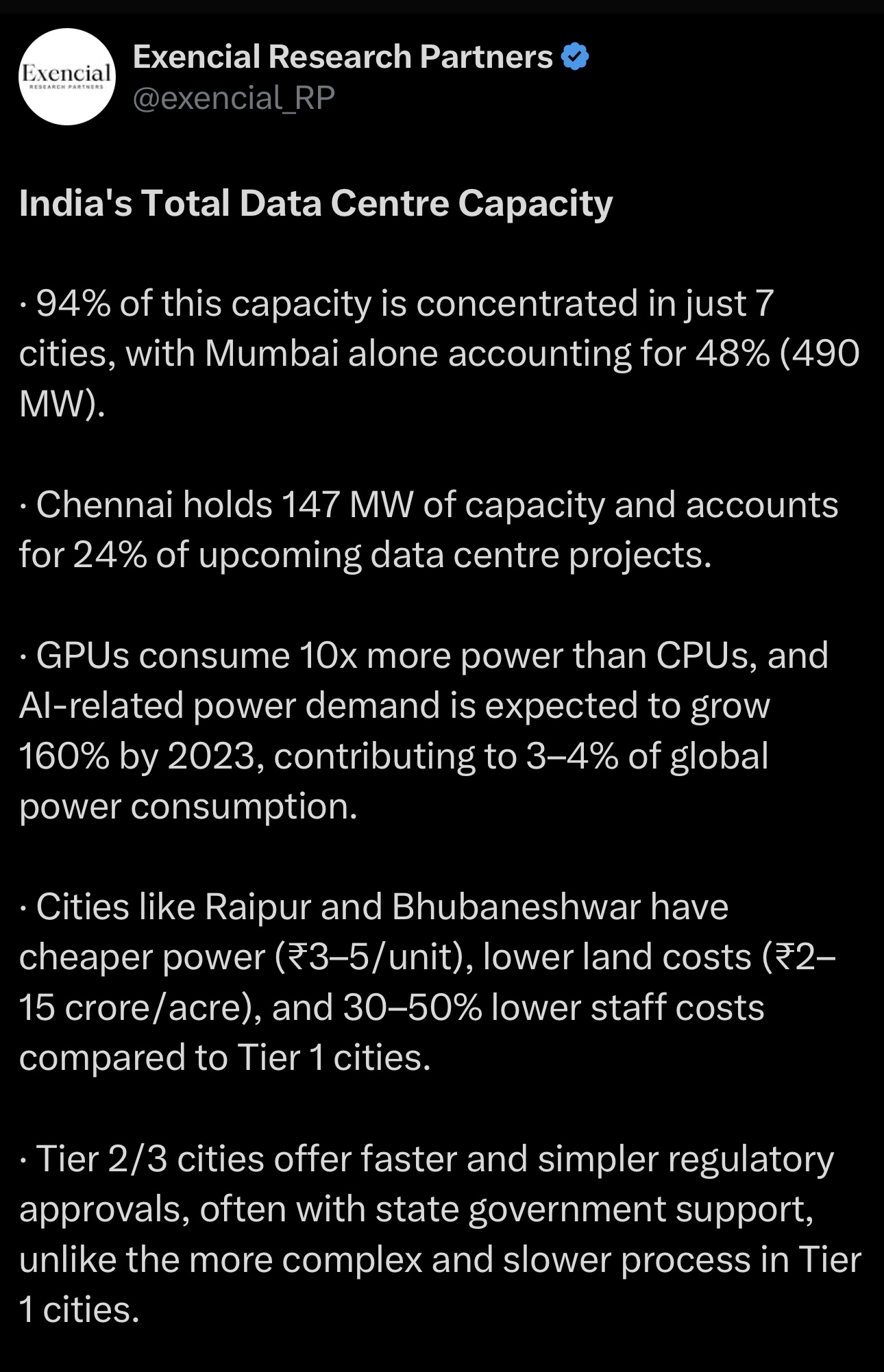
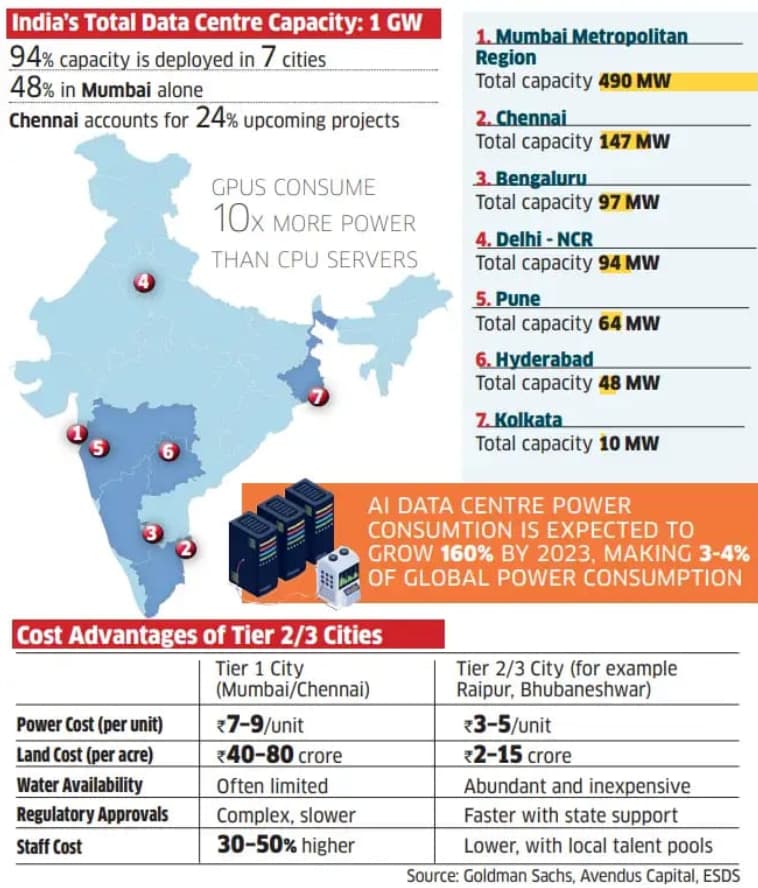
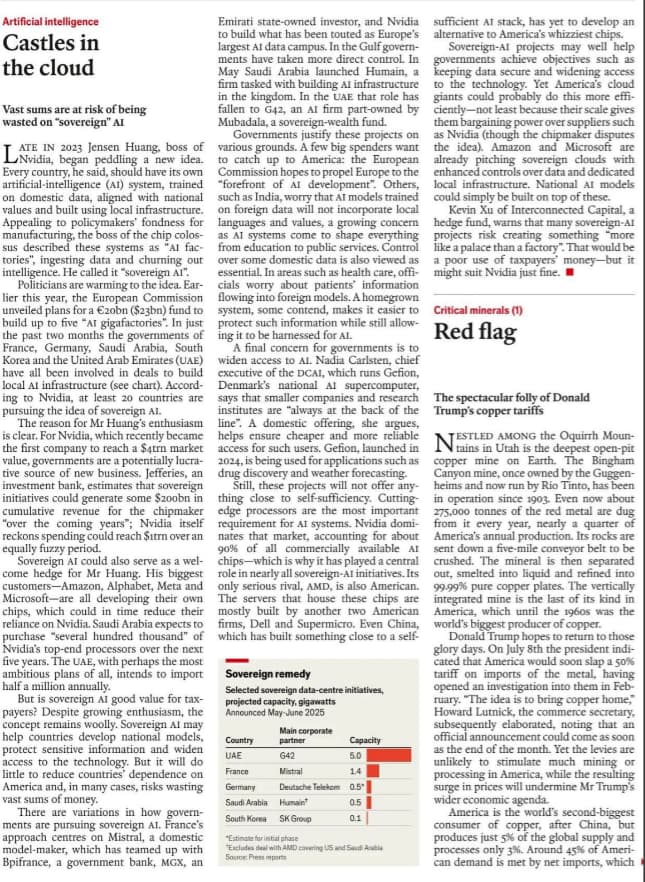
What about Techo electric, they also have plan to invest upto 1B USD in Data Centres. Apart from land bank, Anantraj doesn’t know anything about data centere and cloud business.
3 Likes
There’s not much to know about in a data center business, its just iaas. They just set up the hardware and others use it. Kind of like the internet/computer cafes of the past or whatever they were called. Basically where we go to use a computer and pay a fee. The main risk arises from competition and overall capacity increasing beyond the demand and everyone starts undercutting. This is for the colocation/hyperscaler business, its pretty simple. Based on industry reports, we dont expect the supply to exceed demand for the next 4-5 years.
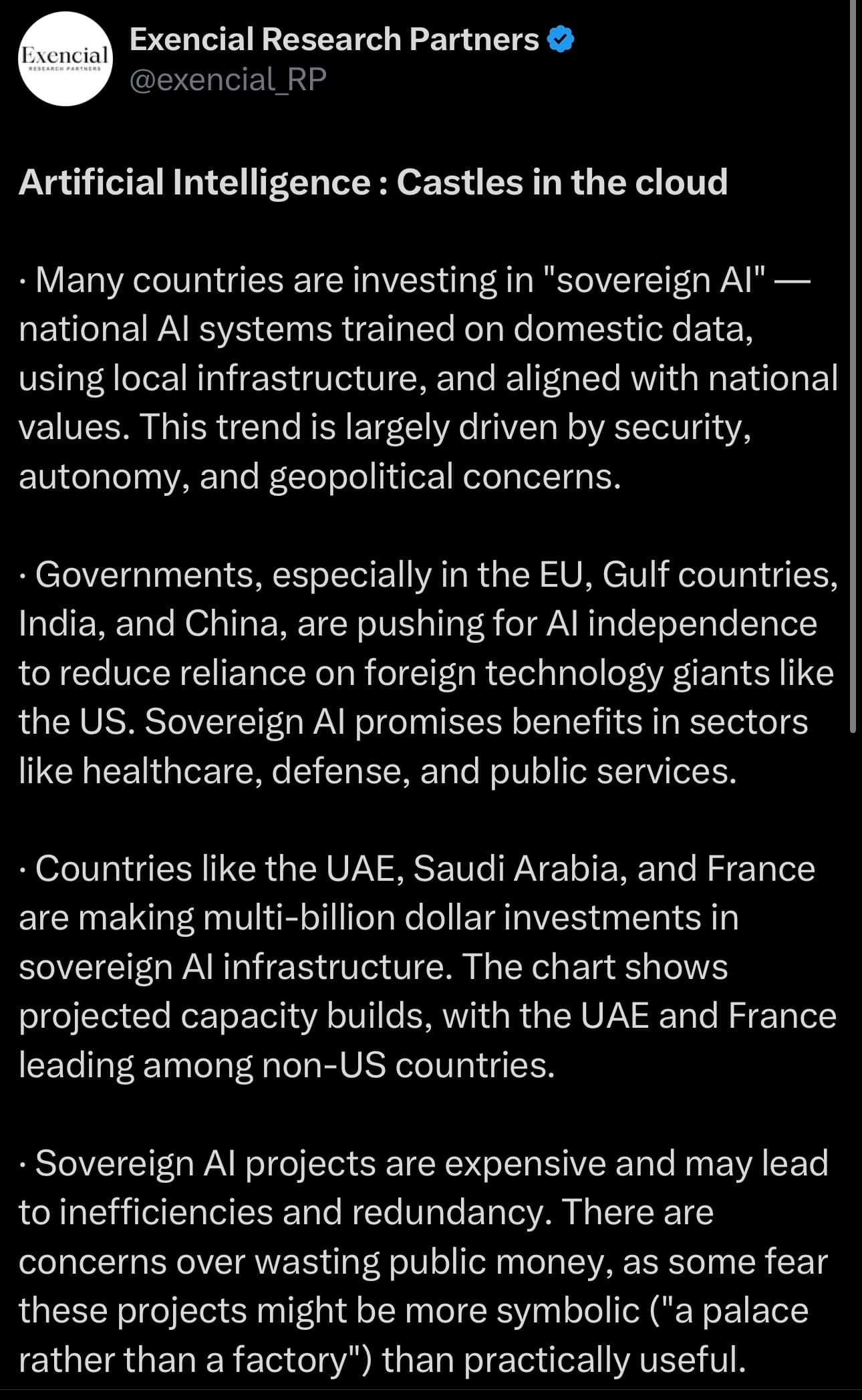
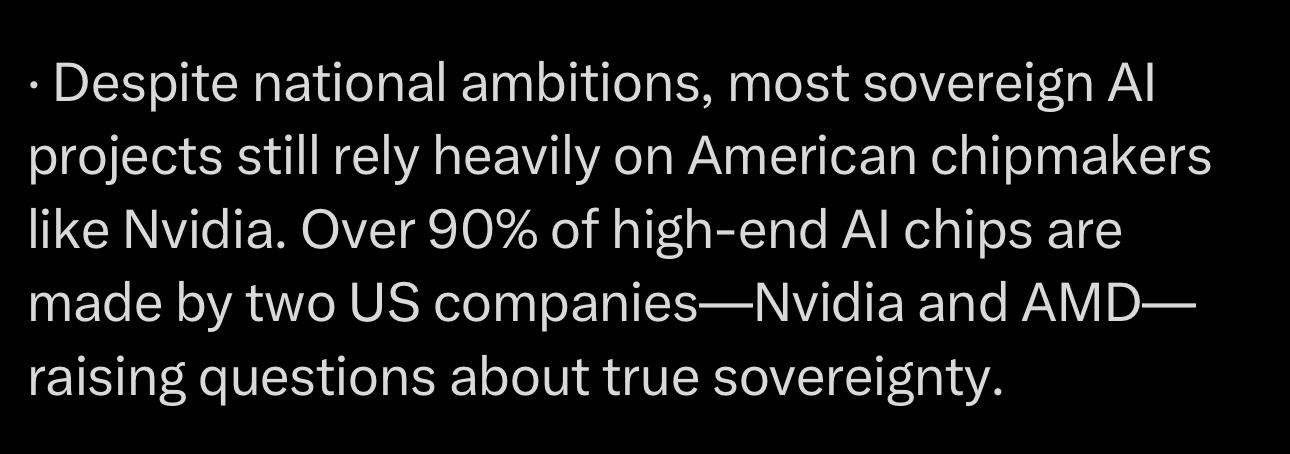
The main challenge is in the cloud business where they aspire to provide paas and saas. Thats tricky for a non software company. However, they are receiving technical know how from the government and have partnered with a french datacenter company named orange which is an established player. So will have to see how the management executes it. As per the above industry outlook shared by jacob, its clear that the government wants domestic AI capabilities, currently we are reliant on nvidia gpus and i dont think thats going to change for the forseeable future but we can become self sustained in other aspects. so there is enough tailwind. All depends upon execution now.
1 Like
My Thoughts on IEX’s 20% (24 July 2025; 10.53am IST) Drop After Market Coupling Approval
I wasn’t surprised by today’s fall in IEX. I hold ~10% of my concentrates portfolio in IEX and have been tracking the market coupling discussion for years. Regulatory overhang isn’t new. Every time the topic resurfaces, we’ve seen knee-jerk reactions. This time was no different — but the long-term story, in my view, remains largely intact.
Let me explain why I continue to hold with conviction 
What Happened?
On July 23, 2025, CERC finally approved Phase-I Market Coupling for the Day Ahead Market (DAM) starting Jan 2026.
In simple terms, this means:
•Price discovery will be centralized, not done individually by IEX, PXIL, or HPX.
•The best aggregate bid/offer across exchanges will determine a single national clearing price.
•This aims to ensure transparency, lower spreads, and a level playing field for new exchanges.
Why Did IEX Fall?
Because:
•IEX loses exclusive price-setting power in DAM.
•Volume share might get redistributed.
•Transaction charges may drop due to competition.
•Immediate sentiment turned cautious.
But that’s just the short-term reaction. The real question is:
⸻
Will Market Coupling Truly Work in India?
Possibly, but not without hurdles:
- Government and CERC are committed to implement it — timeline is now official.
- Grid-India has been made the 4th Market Coupling Operator (MCO), adding oversight.
But…
India’s power market is complex, with multiple state discoms, legacy contracts, and uneven infrastructure.
-Market coupling pilots (TAM, RTM) are still to be tested.
-Globally too, such transitions are gradual — the EU took years.
-And despite new exchanges, none could threaten IEX’s dominance till now.
Why I Still Hold IEX
Penetration is still low: Only ~6–7% of India’s electricity is traded on exchanges. Developed markets like Europe trade 40–70% of power on exchanges. Even if India moves to 20% penetration by 2035, the opportunity is massive.
Strong ecosystem moat:
• IEX is embedded in workflows of major buyers/sellers.
•Its user interface, reliability, and scale are unmatched.
•Competing exchanges haven’t shown any real innovation in years.
Growth Optionalities Beyond DAM:
•IGX (Gas exchange) is IEX’s subsidiary and fits perfectly into India’s gas-based economy vision.
•IEX is building products in green energy trading, carbon credits, and capacity markets — which will outlive the DAM narrative.
•Transaction charges may fall, but volumes and new product monetization can offset it.
Regulation is not always bad:
Sometimes, a more transparent and competitive ecosystem expands the market and benefits the most efficient player.
IEX has the tech, trust, and early-mover advantage.
My View:
This is not the end of IEX — this is the beginning of a new chapter.
CERC’s order may change the way pricing is done, but it does not eliminate the need for strong, liquid, and trusted platforms. And in that race, IEX is still miles ahead.
Let the dust settle. Let the narrative shift back to structural growth.
Until then, I’ll hold tight. I’ve seen worse corrections on better businesses.
And for those asking — no, I haven’t sold a single share and will continue accumulating below 150 levels.
3 Likes