
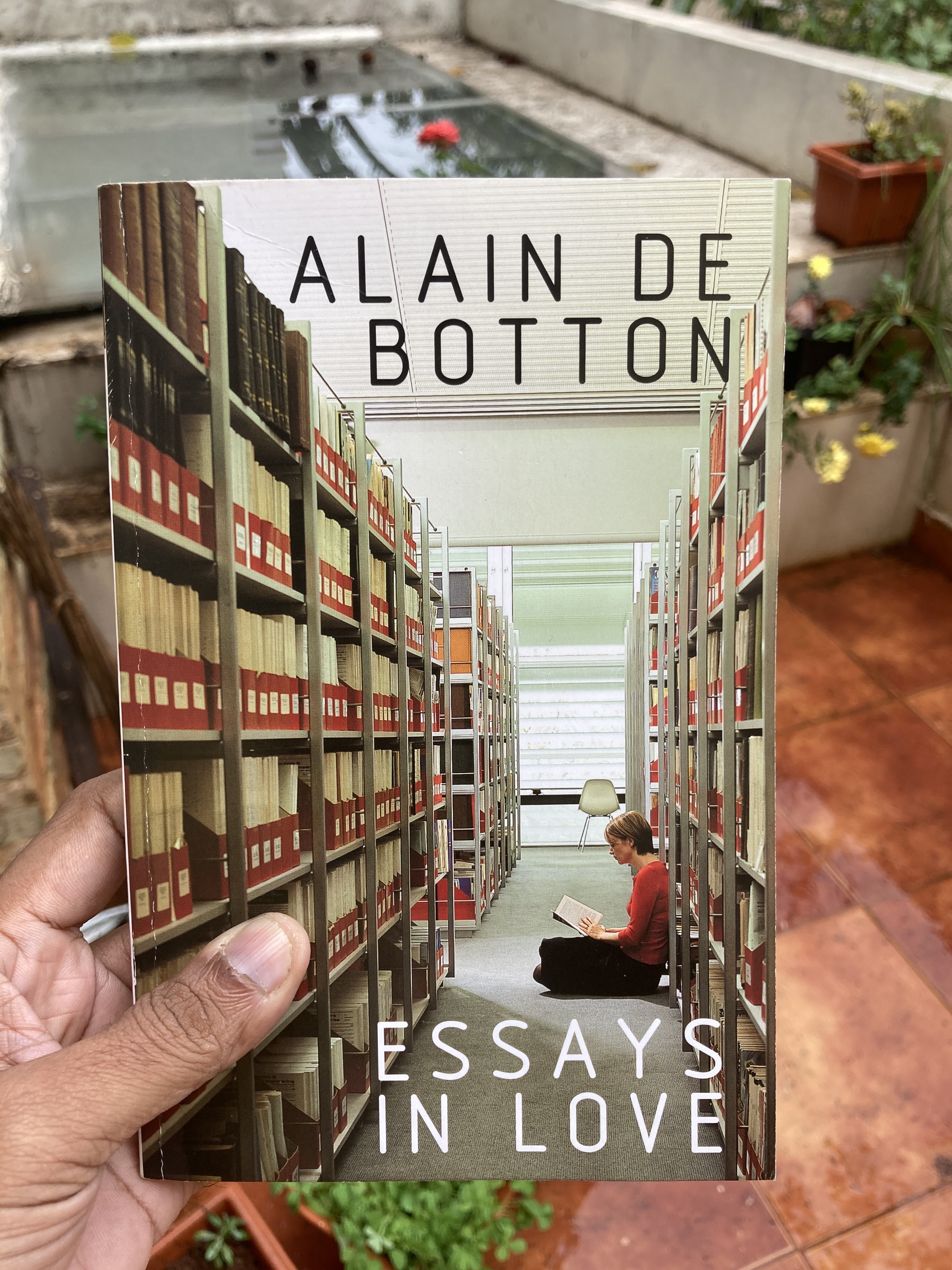
Essays in Love, Alain de Botton, 1993 - The loving wife inserted this into the reading list around our anniversary. You certainly can’t learn to love from a book, the same way you can’t learn to swim or drive from a book. But love is one of the most abused and misunderstood words in the lexicon, as it means so many things to so many people. Each and everyone of us certainly has some misguided notion on the word. This book is part fiction, part philosophy, part humour, large parts stream-of-consciousness narrative in the form of essays, interrupted by fiction in the form of recollections.
The style is sophisticated, with generous references of love from classics, from Flaubert’s Mme Bovary, Baudelaire, Proust and his characters very English, reserved, dignified and self-deprecating (that I use humour and honour despite the spell-check should show where my sensibilities are). The book is packed with insights, with a fundamental, physiological, psychological, paradoxical look on love. The chapter on “Marxism” was an absolute favorite, where the writing distinguishes the feeling accompanying that of “loving another” vs “being loved” and how conflicting and at odds they can sometimes be (‘If s/he is so wonderful, how could she love someone like me?’). If one is not convinced of ones own “lovability”, affection can feel like being bestowed an honour for a feat one has no connection with. Desire can only thrive on the impossibility of mutuality (Many a Woody Allen film on this) is the gloomy Western traditional thought. Author quotes Montaigne (like I said, abundant sophistication) - ‘In love there is a frantic desire for what flees us’.
What I loved is the ability of the author to relate diverse things like characters from literature, ideas (like Communism/Capitalism, Authoritarianism), art, philosophy (generous on Wittgenstein, Kant and Hume) and write insightful yet entertaining prose with so many ideas like ‘One can talk problems into existence’ for eg. or ‘Some people would never have fallen in love if they have never heard of love’ (that it is society, rather than authentic urges that motivate us in priding ourselves of romantic love) or that Western cultures are “individual centered” while Chinese culture is “situation centered” and so concentrates on groups or that man sees water, palm trees and shade in the desert (mirage) not because he has evidence of belief but he has a need for it. There’s just too much to love in this, maybe because I found in it a voice for a lot of my existing beliefs. It is hilarious and profound and highly recommended. 10/10