
Modern Insulators Ltd: Keeping the Current in Line

Company Overview Modern Insulators Limited (MIL), established in 1982 in technical collaboration with Siemens AG, Germany, is India’s largest manufacturer and exporter of porcelain insulators. The company operates primarily in the high-voltage electrical equipment space, serving national and regional utilities, Indian Railways, global original equipment manufacturers (OEMs), and EPC contractors across more than 50 countries. The company’s long-standing technical pedigree is anchored by its initial joint-sector promotion alongside the Rajasthan State Industrial Corporation (RSICO) and technical partnership with Siemens AG. MIL features a highly reputed client base with low concentration risk, supplying major industry players such as the Tata Group, Siemens AG, and Hitachi Energy India Limited

Business Segments The company operates through two primary segments. The Insulators Division forms the core business, generating approximately 89% of total revenue, and specializes in Extra High Voltage (EHV) porcelain insulators ranging from 132KV to 765KV, including solid core post, hollow, long rod, and railway insulators. The Terry Towels Division, based in Gujarat, accounts for approximately 11% of revenue and manufactures terry towel products, which has recently shown a turnaround from historical operating losses to achieve positive operating margins.
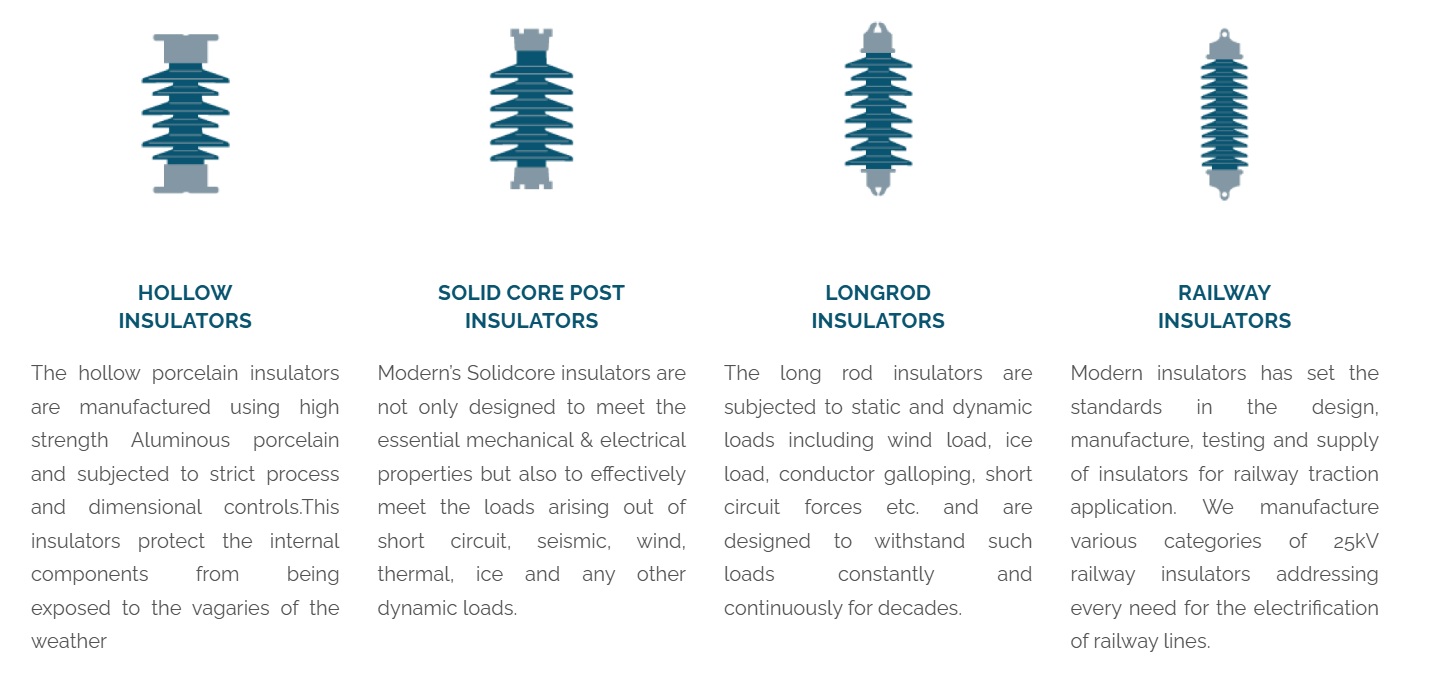
We were the first company to introduce porcelain Long rod insulators in India – a superior alternative to disc insulators with an unbeatable pollution performance. MIL also introduced an exclusive aluminous body for porcelain insulators- proven for its improved mechanical and electrical strength.

Modern Insulators’ manufacturing plant is situated in Abu Road, Rajasthan and has a currently installed capacity of 26,000 metric tonnes per annum and exports account to about 30% of its annual turnover.

Modern has the most sophisticated manufacturing plant with machinery imported from Germany along with the required testing and inspection facilities and an in-house R&D setup recognized by the Government of India for development of new products & process improvements.

From their site About Us – Modern Insulators Limited**

Key Corporate Developments** MIL is undergoing significant corporate restructuring. The company demerged its yarn division into a new entity, Modern Polytex Limited (MPL), with a record date of October 31, 2025, to function as a pure-play electrical equipment manufacturer. Additionally, MIL is pursuing a long-pending amalgamation with Modern Denim Limited (MDL), for which it has advanced unsecured loans of ₹57.6 crores to settle MDL’s institutional debts. On January 22, 2026, the National Company Law Tribunal (NCLT) disposed of the merger petition, granting MIL the liberty to re-approach after fulfilling specific procedural compliances.

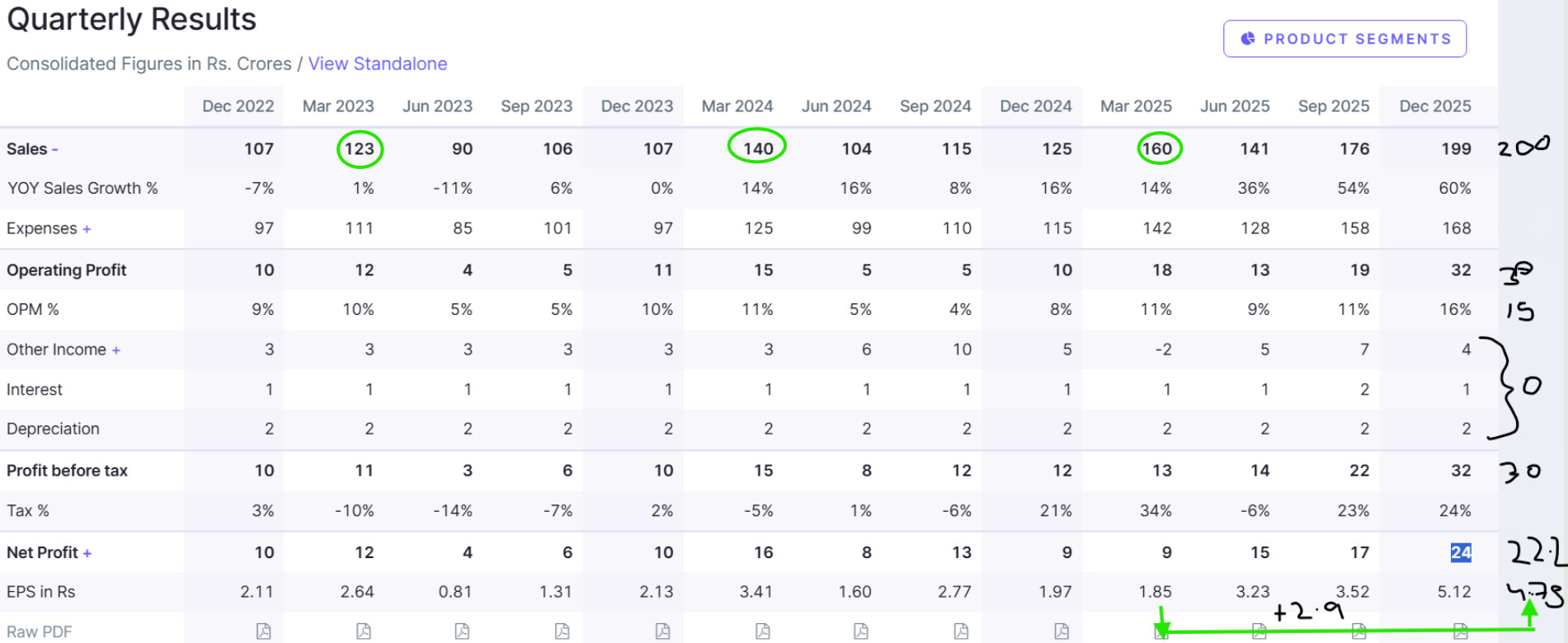
Financial & Operational Performance For the financial year ending March 2025, consolidated revenue from operations grew to ₹503.27 crores from ₹443.30 crores in FY24. Consolidated Profit After Tax (PAT) improved to ₹38.58 crores from ₹36.04 crores over the same period. While absolute EBITDA increased to ₹47.03 crores in FY25, the EBITDA margin experienced a slight contraction to 9.51% from 10.13% due to a higher cost of goods sold. However, recent Q3 FY26 results show exceptional momentum, with standalone revenue surging 60.1% year-over-year to ₹199.46 crores and EBITDA margins expanding sharply to 17.78%. The company maintains a comfortable net leverage ratio of 0.43x.

Segment Highlights / Key Business Verticals The Insulators Division is the primary growth engine, achieving a turnover of ₹417.34 crores in FY25, up from ₹385.45 crores in FY24. This vertical benefits from strong export demand, with international sales reaching ₹192 crores, driven by approvals from overseas utilities and new orders for specialized products like RTV-coated porcelain long rod insulators. The Terry Towels Division also demonstrated growth, with revenue rising to ₹56.87 crores in FY25 from ₹46.25 crores in the previous year, achieving an operating margin of 2.8%.

Capacity Expansion & Capex Plans The company has an installed manufacturing capacity of 24,000 metric tonnes per annum (MTPA) for insulators in Rajasthan and 2,400 MTPA for terry towels in Gujarat. MIL does not plan to undertake any debt-funded capital expenditure on a standalone basis in the near-to-medium term. However, on a consolidated basis, its subsidiary, Modern Composites Private Limited, has availed a term loan of ₹7.65 crores to fund plant and machinery investments.

Order Book / Recent Orders / Contracts As of September 2024, MIL reported a robust short-term order book of ₹192.4 crores scheduled for immediate execution over the subsequent three months. The company has successfully secured frame contracts with European utilities and won significant orders from a major Gulf utility for RTV-coated insulators, highlighting its competitive positioning in international markets.

Growth Drivers & Future Outlook Management anticipates sustained revenue growth fueled by India’s transition to a power-surplus nation, extensive integration of renewable energy, and massive government capex in transmission infrastructure. Global grid modernization and the replacement of aging infrastructure act as strong tailwinds for the export business. The company expects EBITDA margins to improve in the medium term by shifting its product mix toward higher-value, high-margin EHV insulators and incorporating price escalation clauses in contracts to mitigate raw material volatility.

Subsidiaries & Strategic Initiatives MIL has established a wholly-owned subsidiary, Modern Composites Private Limited, to manufacture composite insulators, which reported an initial stage loss of ₹93.77 lakhs in FY25. To diversify into EPC contracting, the company formed several joint ventures, including Shriji Designs - MIL (JV) for railway EPC tenders, which successfully turned profitable in FY25 with a net profit of ₹31.92 lakhs. Additional JVs, such as SEC-MIL and Akhandlamani-MIL, have been formed to bid for power distribution and railway contracts, with MIL executing the projects and paying commission fees to partners.

Financial Position & Funding The company’s financial position is stable, characterized by adequate liquidity and strong cash generation. Operating cash flows improved to ₹45.6 crores in FY25, supported by favorable working capital changes. The standalone entity is virtually debt-free regarding term loans, and credit metrics remain comfortable with a gross interest coverage of 10.96x. The promoter group maintains a 60.18% holding with zero pledged shares.

Risks / Red Flags A primary red flag is the statutory auditor’s qualified opinion regarding the non-provisioning of taxation and interest liabilities. The company has not provisioned an estimated ₹19.15 crores for FY25 (cumulative ₹118.44 crores) in anticipation of tax benefits from the pending Modern Denim amalgamation. Furthermore, the business suffers from an inherently elongated net working capital cycle, peaking at around 199 to 210 days, primarily due to long inventory holding requirements for imported raw materials like clay. The extended delay in the amalgamation process with the loss-making Modern Denim Limited also remains a key rating constraint.

Management Commentary / Qualitative Insights Management projects a highly confident tone regarding the macro-environment, citing a “virtuous cycle” of domestic energy demand and international orders. They emphasize a strategic pivot towards high-end technological products, such as HVDC insulators and semi-conducting glazes, to protect market share against intense global competition. Despite regulatory delays, the board remains committed to executing the Modern Denim merger to unlock administrative synergies and tax breaks.
3 Likes

I got interested in the scrip after its spectacular run-up in the past few months. The company does not do concalls, neither does it release investor PPTs, so I really had to scour the internet to find valuable information. In a few T&D company concalls, I did find some very useful industry-related information, sharing below.


INSULATOR DEMAND-SUPPLY ANALYSIS- CONCALL EXCERPTS (Sources: Q2/Q3 FY26 Concalls & PPTs | Aug 2025 – Feb 2026)


1. DEMAND

The insulator segment is witnessing rapid growth driven by India’s electrification push and a transmission capex boom. At Olectra, management noted: “insulators division, again, the margins we have concentrated on exports. So, exports are giving healthy margins” and confirmed that “compared to last year, we did about ₹180 crores top line, this year, we are expecting about ₹300 crores top line” with “15-20% growth year-on-year is what we are targeting” and an order book of “about ₹300 crores surplus as of now.” (Olectra Greentech_Concall_Q3FY26_February 03, 2026)

On the broader demand environment, Quality Power’s management stated: “The high-voltage electrical equipment industry continues to experience strong sustained demand across global markets, driven by the energy transition, renewable energy integration, and grid modernisation. These structural tailwinds are creating a multi-year opportunity cycle.” (Quality Power Electrical Equipments_Concall_Q2FY26_August 08, 2025)

The transmission boom is also creating demand for specialised, higher-voltage insulators. Advait’s management confirmed: “the new transmission lines are coming up in India are basically for the higher voltages, maybe around 765 KV, 800 KV and that too into HVDC.” (Advait Energy Transitions_Concall_Q3FY26_February 12, 2026)


2. SUPPLY CONSTRAINTS

The supply side is severely stretched. Quality Power’s management described the situation plainly: “The insulators are still a cause of concern if you look at something like Modern Insulators you see their stock touching upper circuit every day. It just indicates that how big is the shortage in this part of the world. The Chinese insulators are again are not available for some of the critical projects in India. So again for the Indian projects and some projects in the US and Europe you are stuck to Indian vendors.” They further added: “We do import some insulators now from China paying a larger price than what Indian counterparts do.” (Quality Power Electrical Equipments_Concall_Q3FY26_February 05, 2026)

On the global supply picture, the same management had earlier flagged: “insulators and bushings remain tight in global supply” and described porcelain insulators specifically as a “huge problem” , noting that “The Chinese are actually more expensive when you compare the freight, import duties and everything. It is just availability at this moment. We simply pass it on to the customer.” (Quality Power Electrical Equipments_Concall_Q2FY26_August 08, 2025)

As a direct consequence of the shortage, Quality Power has been forced to stockpile: “something like insulators, some long-lead cables, where we see suddenly a huge spike in deliveries, we are right now storing it, like stocking it from global sources, Indian sources, whatever capacity we have, because that determines our sales in the next two quarters.” They also noted: “once the demand supply in the inventory side or in the supply chain side improves I think we would reduce our inventory levels.” (Quality Power Electrical Equipments_Concall_Q3FY26_February 05, 2026)

The lead time situation has become extreme. HEC Infra’s management confirmed: “porcelain insulators, any components that you want to buy, it takes more than 12 months currently for high voltage projects or maybe even in some cases, somewhere around 14 to 16 months as well. So, if we can basically cater to some of these demands as well, then we are thinking it along those lines where people are basically willing to pay a certain premium for expedited deliveries in these components.” (HEC Infra Projects_Concall_Q1FY26_August 18, 2025)


3. NEW CAPACITY / SUPPLY RESPONSE

To combat the supply shortage and capture the new investment cycle, domestic companies are attempting to expand. Advait Energy’s management stated: “our company to be specific here is looking forward to put up the assembly operations of the glass insulators time ahead, along with some specialized composite post insulators to be required for transmission line towers 220 KV and above. That is in the plan.” They added context on their legacy in the segment: “this company, Advait, is today standing on the foundation made by the insulators because our company used to have 30%, 40% of the total revenue coming from the insulators. We have supplied composite, glass and porcelain from our sources and our collaborators in Russia and China over the years.” (Advait Energy Transitions_Concall_Q3FY26_February 12, 2026)

MMP Industries is making a more structured entry. Their Q3 FY26 PPT confirmed: “Foraying into manufacturing of Composite Insulators through its 100% wholly owned subsidiary, MMP Electricals Private Limited” with a “total planned capacity of 10,00,000 units (to be completed in two phases) of different product mix for the electrical distribution and transmission sector.” On current status: “Phase I investment of ₹17–18 Cr completed; production of distribution insulators commenced, and obtained vendor registration for distribution line insulators in Maharashtra, Gujarat, Chhattisgarh and Himachal Pradesh. Phase II (upto 765 kV) capex of ₹15–20 Cr is on track for Q4FY26 completion, with full capacity ramp-up expected in Q1FY27.” During Q3 FY26, “132 KV transmission insulators were supplied, making the Company eligible for PGCIL registration, expected in early Q1FY27.” The company positioned this strategically: “Composite Insulators: A high-margin segment set to improve overall profitability.” (MMP Industries_ConcallPPT_Q3FY26_February 2026)

HEC Infra is also evaluating backward integration, with management noting: “it is more about getting the deliveries done in time” and that the rationale is not margin-driven but supply-security driven “it is not going to be a backward integration to drive profits.” (HEC Infra Projects_Concall_Q1FY26_August 18, 2025)


4. MARGINS

On the margin front, Olectra’s management explained: “margins have improved, but we continue to strive to improve margins. Consistently, we are seeing growth and I think margins will stabilize around these levels. Again, it depends on the mix between domestic and export” with the EBIT margin having moved from “earlier 26% which has increased to 32%-33%.” However, they tempered expectations: “the expectation is that the market will give margin between 25% to 30% region” and cautioned that “between last quarter and this quarter, our margins will remain between the two quarters. It is not expected that it will go further.” (Olectra Greentech_Concall_Q3FY26_February 03, 2026)


OVERALL TAKEAWAY

As Advait’s management put it: “there is a dearth of few transmission products… One of them is, insulators for the new upcoming transmission lines” and the supply response, while beginning, is still quarters away from catching up with what is clearly a structural, multi-year demand upcycle. (Advait Energy Transitions_Concall_Q3FY26_February 12, 2026)

7 Likes

Key ratios-

Valuations (as of May 3, 2026 | TTM)
PE: 25.5 | Mcap/Sales: 2.4 | EV/EBITDA: 17.4 | Debt/Equity: 0.07 | ROCE: 8.90% | ROE: 7.26% | OPM: 12% TTM

Although the price has quite run up and margin of safety is less, for the coming couple of years it has visible topline growth. Other companies in their concalls are saying lead times for insulators are 12 to 24 months, which points to a multi-year demand cycle. Additionally, there is visible margin expansion on the cards from shifting to higher margin products. Q3 had 16% OPM and management has indicated this will improve further.
I did some back of the envelope calculation and the stock is still trading at a decent valuation, at a forward PE of roughly 20x for Q4 FY26, if we get similar results as Q3 in Q4.
The PE will also fall as Q4 results come in, due to low base effect and improved margins. I would like to wait for Q4 results to make full year estimates as we will get more clarity on the sustainable margin trajectory of the company.

Not invested, Long view (LLM used for formatting)

1 Like

3 Likes

from SOIC recent tweet

On April 20, the President of USA signed the Presidential Determination 2026-10, a Defense Production Act (DPA) Section 303 determination for grid infrastructure, equipment, and supply-chain capacity.

Thereby, officially classifying conductors, transmission lines, transformers, substations, high voltage lines & capacitors & CRGO core used in transformers as items which are essential to national defence. The current waiting for distribution transformers in USA has gone to 13 months vs the historical average of 3 months & for power transformers the lead time is 42 months vs the historical average of 15 months.

This trend is visible financially in order book of GE Vernova, Eaton, Bloom energy & the GRID ETF. For EATON the order book increased by 16% YOY in Q4 results. Primarily driven by Data centre and demand for other electrical goods. For GE Vernova the Quarterly order book increased by 71% YOY, & back logs for GAS turbines has gone to 100 GW.

India’s power demand hit a record high of 256.1 GW on April 25, 2026, driven by intense early summer heatwaves and economic growth. This peak demand surpassed the 250 GW record from May 2024, with expectations to reach 270 GW+ soon. The grid successfully met this surge using increased coal-fired generation and solar energy. Increased cooling needs (air conditioners) during April-June are the primary drivers for surging power usage.

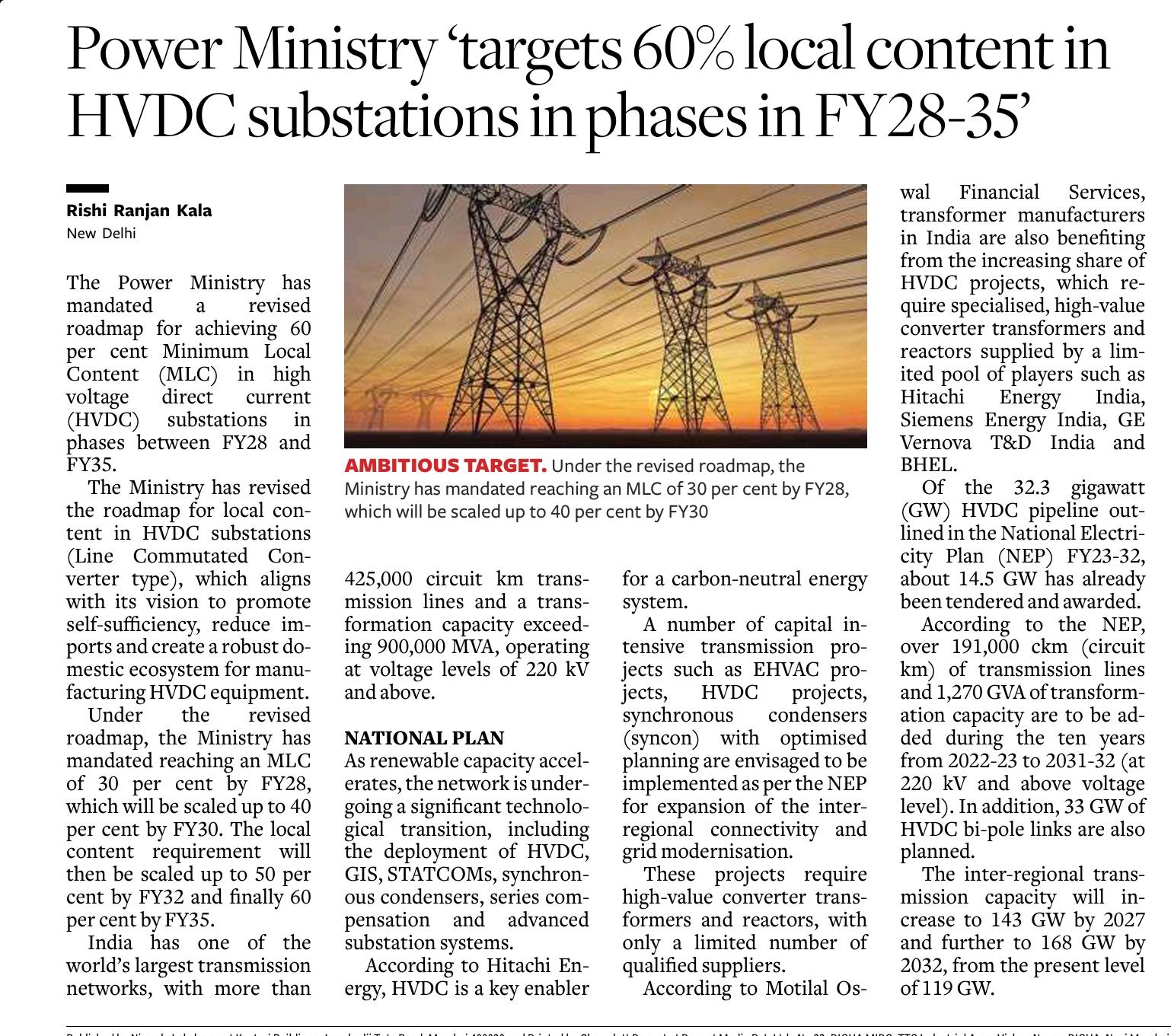
Giving priority to ‘Make in India,’ the Ministry clarified that by March 31, 2028, up to 30% local products must be used in the establishment of substations.

Subsequently, this local usage should be increased by 10% every two years, reaching 60% by March 31, 2035.

Under the revised norms, the government has replaced the earlier uniform requirement of 60 per cent local content with a gradual increase over time for engineering, procurement and construction (EPC)/turnkey projects

1 Like

Thanks a lot for initiating this thread for insulators in general and MIL in particular. But one thing I would like to know is why MIL has not gone for expansion when others like MMP, and Hindustan Insulator have gone ahead?

Even I dont know that, is there way to contact the management?
If the demand is real and the management is good, they should announce after upcoming board meeting, Q4 results in past 4 years have come on 28th-30th May.

1 Like

Really in depth analysis. During other Insulator company analysis, I couldn’t find mention of Hindusthan Insulators, have you come across it?

A new credit report has been published by CRISIL
Modern Insulators Limited 'Crisil A- / Stable / Crisil A2+ ’ assigned to Bank Debt

The company is expected to record revenue growth of 14-15% over the medium term, supported by healthy high realisation export order book coupled with healthy domestic demand. Moreover, the wholly owned subsidiary–Modern Composite Pvt Ltd (MCPL) - is expected to record its first full year of operations in fiscal 2027, which will further support overall revenue growth.

CAPEX

The company incurred Rs 15 crore towards expansion capex during fiscal 2026 and was completely funded through internal cash accrual. Further, during fiscal 2027, the company plans to increase the capacity through addition of one more kiln along with automation of processes and purchase of research and development (R&D) equipment. The entire capex is expected at ~Rs 30-40 crore for fiscal 2027, which is planned to be funded through internal cash accrual.

Recent & Planned Capex (from Latest Documents)

Period Capex Amount Details / Funding Source Quote
FY26 (Apr’25-Mar’26) ₹15 Cr Expansion capex (unspecified; likely insulators/RTV coating). Fully internal accrual-funded. “The company incurred Rs 15 crore towards expansion capex during fiscal 2026 and was completely funded through internal cash accrual.” Credit Rating Report (05 May 2026)
FY27 (Apr’26-Mar’27) ₹30–40 Cr +1 kiln, process automation, R&D equipment for capacity increase. Internal accrual-funded. “The entire capex is expected at ~Rs 30-40 crore for fiscal 2027… funded through internal cash accrual. …no major debt-funded capex is planned.” Credit Rating Report (05 May 2026)
FY25 Actual ₹6.5 Cr (standalone)₹18.7 Cr (consolidated) PPE additions (plant/machinery ₹14 Cr consolidated); CWIP ₹1.3 Cr. Includes RTV coating machine. FY25 Annual Report (Cash Flows/Note 2 PPE)

Margins

Operating margin remains susceptible to volatility in raw material and fuel costs, particularly in the backdrop of geopolitical disruptions such as trade restrictions (including US tariff actions) and conflicts in energy-sensitive regions such as West Asia. Such events can lead to sharp fluctuations in commodity prices and energy costs, directly impacting the company’s cost base, given the high proportion of these inputs in overall cost of sales. Additionally, supply chain disruptions and freight cost escalation during such periods can further compress margins, especially where contracts are fixed price in nature. However, the company partially mitigates this risk through price pass-through mechanisms in supply contracts, which allow for periodic revisions linked to input cost movements. The increasing share of export revenue and value-added products also supports better pricing power and margin resilience. Further, the company adopts proactive procurement strategies, diversified sourcing, and inventory planning to manage cost volatility.

Some research regarding raw material, LLM used for formatting-

MIL manufactures porcelain insulators (89% revenue), relying on imported clays (e.g., ball clay from UK) and other inputs like alumina for high-strength ceramics. Credit ratings note elongated inventory (141 days FY25) due to “large stock of imported raw material (clay from the UK)”, long production/inspection cycles, and price escalation clauses in contracts to “insulate margins from fluctuations in raw material prices”. FY25 EBITDA margins dipped to 9.51% (FY24: 10.13%) from “higher cost of goods sold”, but expected to improve with high-margin products.

Compiled from NALCO circulars (alumina), market reports (others). User’s figures (e.g., alumina USD 310–330/MT) align with 2025–26 lows; ball clay USD 600/MT plausible for premium UK CIF imports.

Raw Material Primary Source Pricing Trend (USD/MT, 2024–2026) Key Notes/Source
Calcined Alumina NALCO (Domestic) 2024: ~$400 (Jun) 2025: Peak $612 (Feb) → $380–420 (Aug–Nov) 2026: ~$370 (Apr) Volatile; peaked early 2025, softened later. Ex-works INR: ₹33.8k–52.4k. NALCO circulars. User’s 310–330 matches late lows.
Ball Clay UK/China (Import) China: $120–220 (2024–26) UK: $200–500 (2024–26) High freight/inventory; niche pricing (grade-dependent). USD 600 premium UK CIF. Trade reports.
Caustic Soda Domestic (RMB Proxy) 2024–25: $350–575 (spot) 2025–26: Softening (~$350–450) Downward post-2024 peaks; energy-linked. RMB 3,125 (~$430 USD) aligns mid-range. IMARC reports.
Energy (Power/Fuel) Grid/Coal Coal: Stable/soft 2025 Power: State-mixed (+TOD volatility) FY25 fuel +45.5%; key pressure. Coal India/Govt data
1 Like


Interesting take

Hindusthan Insulators & Industries Ltd

Part of Hindusthan group, it is a capex-heavy model which relies on kiln-based production at Mandideep (MP) facility (installed dispatchable capacity ~16,500 MT, 100% utilization). Operations are scalable through phased kiln expansions (e.g., +7,900 MT by Jun 2026; +2,900 MT by Dec 2026, total ~19,500 MT), funded internally from FD/MF proceeds post-HSCL divestment. Previously diversified into conductors (discontinued Q4FY23, Khurda plant sold) and speciality chemicals via 58.5% subsidiary HSCL (epoxy resins; fully divested Aug 2025).

Recent Structural Changes / Capex / Events

  • HSCL Sale (Aug’25): 58.5% stake to DCM Shriram (~₹219 Cr proceeds; ₹46.3 Cr exceptional loss booked Q2FY26). Escrow ₹39.8 Cr held (tax ₹29 Cr, GIDC ₹10.7 Cr). Improves focus/liquidity.

  • Capex: ₹94 Cr kiln addition (Nov’25; +7,900 MT by Jun’26); ₹210 Cr further (Feb’26; total +10,800 MT by Dec’26). Capex heavy phase (~₹300 Cr FY26).

  • Conductor Discontinuation: Khurda plant sold FY25 (₹37.5 Cr exceptional gain).

  • Debt Reduction: Gearing down to 0.3x (FY25); ratings withdrawn post-NOC (low exposure).

Good flags?

  • Investment Properties: Fair value ₹670 Cr (Bangalore ₹360 Cr, Faridabad ₹287 Cr, etc.; rental ~₹5 Cr / ~3% yield). Not fully reflected in mcap (₹783 Cr) or book (~₹220 Cr).

  • HSCL Proceeds: ~₹219 Cr cash (net of escrow/loss); FDs/MFs for capex.

  • Land Banks: Multiple sites (MP/Assam/Haryana); freed post-conductor sale.

Yellow flag?

  • Personnel Churn: Promoter death (Sep’24); MD resignation (Jul’24); CFO resignations (Feb’25, May’23); CS retirement (Jan’26); President-Finance resignation/withdrawal (Nov’25). New CFO Shailendra Jhalani.

  • Past Losses: PAT losses FY22-25; weak coverage (ROCE 1.3x FY25).

  • Debt History: Peak gearing 1.0x (FY25 cons); interest ₹12.5 Cr FY25. Now low but stretched liquidity noted.

  • Ratings Non-Coop: Brickwork BB-/Negative (Sep’25); CARE withdrawn (Jan’26).

  • Legal/Claims: HSCL escrow/tax disputes; no major ongoing cases disclosed.

  • Governance: Promoter 75%; clean audits but no dividends (losses); IEPF transfers.

3 Likes

Financials of Promoter’s Group company.

1 Like

we buy BPI insulators from them , they are quoting astronomical price, other similar companies are ICE and ABI who makes these porcelain insultors being used in substations, but n the last few monts share price has shot up quite a bit, otherwise they are a kind of monopoly in BPI whose quality is better than others.. focussed company as well

6 Likes

Yes the prices have increased a lot! Can you expand the full name of ICE and ABI.

I think it’s IEC not ICE which stands for Insulators & Electricals (aka Hindusthan Insulators) and ABI stands for Aditya Birla Insulators.

Together these 3 companies owns ~75% nameplate capacity in the country. (AI research)

And almost ~90% of >400kV capacity, and 100% of 1200kV capacity. (AI research)

These 3 players together HAVE NOT added any capacity in last 10 years.

Now all of them are showing signs of adding new capacities.

Note :-

BHEL also makes porcelain insulators, not much data is available, I found somewhere capacity is only 6000MT. So above data doesn’t account for BHEL.

4 Likes

As per my reading, This is the whole thesis on porcelain insulators.

The industry spent two decades losing share to polymers, which led to consolidation and kept new capacity from coming online. For obvious reasons, no one invests in fresh capacity in a structurally declining business. That equation is now starting to flip. Polymer has already taken most of the share it was likely to take in the segments where it clearly has an edge, i.e. sub-230kV lines, urban installations, polluted coastal zones, etc. But in extra-high-voltage and ultra-high-voltage applications, porcelain still holds a dominant position.

The reason is simple. It has a proven track record (~99.5% survival after 30 years in field studies), mature ANSI and IEC standards, and utilities still default to it for substation bus support, station posts, and high-voltage switchgear, where reliability is non-negotiable.

One critical and often overlooked part of this is transformer bushings. At EHV ratings like 400kV, 765kV, and above, transformer bushings have traditionally relied on porcelain as the outer housing, with an oil-impregnated paper (OIP) condenser core inside.

The porcelain envelope provides the dielectric strength, mechanical rigidity, and long-term thermal stability that EHV transformers require, and it is still what utilities specify by default in tender documents.

Composite housings are gaining ground in HVDC converter bushings and heavily polluted environments, but the bulk of EHV AC power transformer bushings, which is where most substation capex actually goes, still defaults to porcelain. Every new EHV transformer going into a substation is effectively a porcelain bushing order.

This matters because India is still in the early stages of its HVDC and EHV build-out. India’s HVDC bipole capacity is expected to roughly double from ~33.5 GW today to 66 GW by 2032, with a 32.3 GW project pipeline, of which only 14.5 GW has been awarded so far. HVDC and EHV projects are substation-heavy, and within those substations, AC switchyards, station posts, bus support insulators, and transformer bushings remain the key long-term demand drivers for porcelain. Layer that on top of the broader ₹9 trillion (~$110 B) T&D capex cycle running through 2032, and demand visibility starts looking unusually strong.

Now combine that demand with a decade of supply-side underinvestment, an already consolidated industry, no meaningful greenfield capacity additions, and long qualification cycles for high-voltage products, and you have the setup for a classic capital goods cycle.

Disclaimer: I’m not an expert on this topic. This is simply my attempt to piece together information from various sources, and some of it may be incorrect or outdated. Please do your own research and arrive at your own conclusions. I can, and likely will, change my opinion as new facts emerge.

4 Likes

yes it is IEC, typo.. IEC insulators in 765 KV are failing, buyes are now going to ABI and Modern. Modern charges exhorbitantly as their quality is better, ABI has problem with delivery timeline. Bushings is also one important component in substation(Transformers) but i think few other make as well. But their costs also have increased especially with LPG crises.

2 Likes

Yeah, IEC has struggled with efficiency. The rejection rate at its current installed kiln is relatively high, around 18%, though the newer kilns coming online is going to operate with a much lower rejection rate.

ABI and Modern remain the industry leaders.

It still remains to be seen whether IEC can successfully execute its large capex plan.

1 Like

Hindusthan Insulators & Industries Ltd got suspended from trading