
Mitsu Chem Plast Limited is a 35-year-old Maharashtra-based plastic moulding company that has quietly evolved from a simple blow-moulding packaging manufacturer into a company with a genuine value-added play in hospital furniture parts. Founded in 1990, it listed on BSE SME in 2016 and migrated to the BSE Main Board in May 2020.
At its core, Mitsu runs three manufacturing units in Maharashtra — two at Tarapur (Boisar, Palghar) and one large unit at Khalapur (Raigad) — with a combined installed capacity of 29,000+ MT per annum. It operates 51 blow molding machines and 18 injection molding machines.
Its product mix spans three verticals:
-
Industrial Packaging (Containers): HDPE drums, jerry cans, carboys, bottles, pails — 100ml to 250L. This is the majority (~84%) of current revenue.
-
Hospital Furniture Parts (Furnastra brand): Head/foot bows, side railings, mattress platforms, over-bed tables, bedside lockers, rescue boards — sold to hospital bed manufacturers both in India and globally. Currently ~15% of revenue but the strategic growth vector.
-
Custom Molding / Infrastructure: Automotive fuel tanks, bus/stadium seats, baby car seat shells, auto filters, pharma-related injection-molded items.
The company’s customers include Godrej, BASF, Tata, Aditya Birla (Grasim), 3M, Cipla, Emcure, Mylan, Castrol, Thermax, Parle, and Galaxy Surfactants — a genuinely blue-chip list of ~500+ buyers, of which 30+ are Fortune 500 India companies.
Why I’m Starting This Thread
The Furnastra brand story, the 144% export growth in FY25, and what appears to be an inflection in profitability trajectory in recent quarters.
The stock is near its IPO price after a long journey through a bonus issue and rights issue. However, the margin compression over the past three years and an ambitious but currently vague ₹1,000 Cr revenue target by FY28 (from ~₹333 Cr in FY25) raise legitimate questions.
I’ll lay out what I find interesting and where I have unresolved concerns. Happy for the community to push back or add color.
The Bull Case
1. Furnastra — A Niche Brand with Real Traction
The most interesting part of this business is the hospital furniture parts vertical, now rebranded under the Furnastra label. Mitsu claims to be India’s largest manufacturer of plastic hospital furniture parts by design range, and from what I can see in the product catalog — it’s hard to dispute that. They make everything from simple side railings to full mattress platforms and CPR-emergency-patented head bows.
The numbers are encouraging despite being small: management disclosed in the Q2 FY26 concall that hospital furniture revenue grew 32% HoH in H1 FY26, and 28% YoY over the prior two full years (FY23-24 and FY24-25). Given that the category is coming off a small base and is inherently lumpy (hospitals buy once when they build, not on a recurring cycle), this kind of growth shows genuine market penetration.
What gives me more confidence is the export angle. Mitsu now exports to 17 countries including Saudi Arabia, UK, UAE, Germany, France, USA, Canada, and Japan — nearly all through Furnastra. Their participation in major global med-tech trade fairs (Arab Health in Dubai, MEDICA in Düsseldorf, Hospitalar in Brazil, IMDEC in Malaysia, WHX in Miami) is aggressive for a ~₹150 Cr market-cap company. Export revenues grew 144% in FY25, albeit from a small base.
The global healthcare infrastructure build-out (Saudi Arabia’s Vision 2030 with $65B earmarked for healthcare, UAE’s medical tourism push, Europe’s aging population) creates a large addressable market for a quality, cost-competitive Indian manufacturer. Mitsu claims it is already approved by several global OEMs and is converting more pipeline orders.
Key watch: The management acknowledged in concall that from lead generation to revenue, it takes ~12 months because these are custom-designed technical products. So the trade fair investments of 2024-25 should start showing up meaningfully in revenues by FY26-27.
2. Blue-Chip Customer Base = Compliance-Grade Quality
This is easy to miss but important. HDPE containers supplied to Cipla, Emcure, BASF, 3M, and Aditya Birla need to clear stringent supplier audits. Mitsu has ISO 9001:2015 (QMS), ISO 13485:2016 (Medical Device Quality), ISO 14001:2015 (EMS), ISO 45001:2018 (OHSMS), ISO 22000:2018 (Food Safety), PESO Certification, CE Marking, UN Certification, and TFS (Together for Sustainability) Bronze medal.
This certification stack is a meaningful competitive moat for a sub-₹500 Cr revenue company. It is expensive to build and takes years, effectively raising barriers for new entrants targeting the same customer base.
3. Financial Trajectory Is Inflecting
Revenue has grown from ₹178 Cr (FY21) to ₹333 Cr (FY25) — a CAGR of ~17% over four years. More recently:
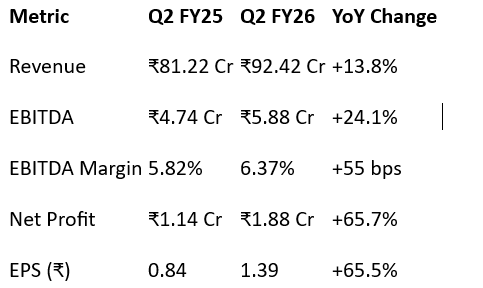
For H1 FY26: Revenue ₹177.96 Cr (+9.95% YoY), EBITDA ₹10.89 Cr (+14%), Net Profit ₹3.20 Cr (+43.7%). The margin trajectory is clearly improving after the FY22-FY25 compression.
4. Balance Sheet Cleanup Happening
Long-term borrowings have fallen sharply — from ₹37.64 Cr (FY23) to ₹24.69 Cr (FY24) to just ₹8 Cr (Sept’25). This is a significant debt reduction even as net worth has grown to ₹96.98 Cr. Debt-to-equity has improved from 1.23x (FY23) to 0.71x (FY25). Operating cash flow was positive at ₹15.16 Cr in FY25 after a weak ₹9.35 Cr in FY24.
5. PCR Capability — First Mover Advantage
Mitsu claims to be one of the first blow moulders in India to have established a full Post-Consumer Resin (PCR) facility, covering all product sizes from 100 ml to 250L. As sustainability mandates tighten (EPR regulations, global procurement requirements), this positions them well for future business from chemical companies, who are the primary early adopters of PCR packaging.
The Bear Case and Open Questions
1. Margin Compression — Structural, Not Cyclical?
This is the elephant in the room. EBITDA margins have collapsed from ~12.95% (FY21 — pandemic-era anomaly) to 7.01% (FY25).
The management’s explanation in the Q2 FY26 concall was vague — citing polymer price pressures and higher power costs in Maharashtra vs. competitors in Daman/Silvassa/Gujarat. However, an analyst on the call pushed back hard: competitors in the same geography and same segments (containers for pharma/chemical companies) are doing 12-15% EBITDA margins. The management could not provide a satisfying answer.
My read: The mix skew toward commodity containers (84% of revenue) at thin margins is the drag. The Furnastra business carries ~15% margins while containers are 3-8%. Until Furnastra becomes a much larger revenue share, blended margins will stay depressed. This is a chicken-and-egg problem — you need revenue to scale Furnastra, but margins only improve when Furnastra scales.
2. The ₹1,000 Cr Target — Math Doesn’t Add Up Yet
Management has repeatedly guided for ₹1,000 Cr in revenue by FY28. As of H1 FY26 annualized, they’re at ~₹356 Cr. To reach ₹1,000 Cr in 2.5 years requires a ~3x jump. Current capacity is 28,000 MT; no major capex announcement has been made.
When asked directly in the Q2 concall whether this requires M&A, the MD said “we will announce very soon.” This is a red flag for me — a target that size without a clear roadmap or capex plan announced is more promotional than operational at this stage. The market will start demanding specifics in the next 2-3 quarters.
3. Raw Material Risk — 90% HDPE Dependence
HDPE constitutes ~90% of raw material consumption. HDPE prices are driven by crude oil, ethylene crackers, and global import dynamics. With increased polymer imports (especially from China/Middle East flooding India), there is a margin opportunity if buying leverage improves — but also pricing disruption risk for Mitsu’s sales realizations. Pricing with customers is mostly monthly (formula-linked), so the pass-through works, but it does create revenue volatility.
4. Maharashtra Location Disadvantage
The MD candidly acknowledged this in the concall — power tariffs in Maharashtra are structurally higher than Daman, Silvassa, and Gujarat. For a power-intensive process like blow molding, this is a persistent 100-150 bps margin disadvantage versus peers. The company does not have a clear plan to address this other than efficiency initiatives.
5. Working Capital Intensity Has Worsened
Trade receivables have ballooned from ₹29 Cr (FY21) to ₹63.48 Cr (FY25) while revenues grew ~2x. Debtor days have stretched from ~59 days to ~70 days. Short-term borrowings remain elevated at ₹57.53 Cr. The net operating cycle is ~59 days (FY25), slightly improved from FY24’s ~66 days but still elevated. This working capital intensity limits free cash flow generation even when PAT is rising.
6. Furniture Segment Is Lumpy and Non-Recurring (Domestically)
Management themselves acknowledged a key limitation: hospital furniture is an infrastructure product. Once a hospital buys and installs beds, there’s no recurring domestic demand — you need new hospitals to build. This means domestic furniture revenue is highly project-dependent. The export market is what gives it durability. Until international repeat orders kick in at scale, the domestic hospital furniture opportunity has a natural ceiling.
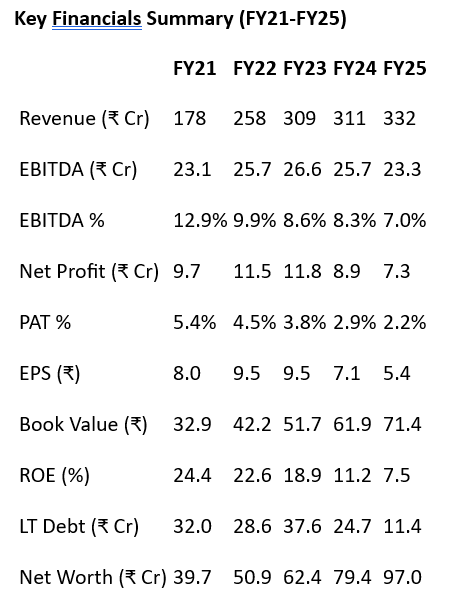
H1 FY26 (latest): Revenue ₹178 Cr, EBITDA ₹10.89 Cr (6.1%), PAT ₹3.20 Cr
Valuation
At CMP of ~₹102 and market cap of ~₹138 Cr:
-
P/B: ~1.5x book (FY25 book value ₹71.4/share)
-
EV/EBITDA (FY25): With ~₹69 Cr in total debt (LT + ST) and ~₹0 cash, EV ≈ ₹210 Cr; EBITDA ₹29 Cr → ~7x
This is not expensive for a company with blue-chip customers, improving margins, strong export traction, and a proprietary brand in hospital furniture. But the margin trajectory and the ₹1,000 Cr aspiration need credibility before any meaningful rerating.
What I’m Watching
-
Furnastra revenue breakout — If hospital furniture crosses ₹80 Cr on an annualized basis (vs ~₹38 Cr in FY25), that’s a signal the export push is working
-
Capex announcement — Any plant, capacity, or M&A announcement tied to the ₹1,000 Cr target will be the key trigger. Company did announce a Unit-4 plan recently.
-
EBITDA margin trajectory — Can it reach 12-14% margin with better product mix and operating leverage?
-
HDPE price environment — Lower crude = lower HDPE input cost = potential margin upside
-
Working capital improvement — Debtor days and short-term borrowings need to moderate
Promoter & Shareholding
Promoter group (Dedhia family) holds 67.77% as of September 2025. The promoters are actively involved — Chairman Jagdish Dedhia oversees production, MD Sanjay Dedhia handles marketing and development, and MD & CFO Manish Dedhia runs finance.
Bottom Line
Mitsu Chem Plast is a well-run, founder-led plastic moulding company with genuine differentiation in hospital furniture parts and a credible sustainability story. The stock is near book value after a multi-year margin compression that appears to be bottoming out. The Furnastra brand and export expansion are real and meaningful — but small relative to the commodity packaging business that dominates today.
The key question isn’t whether the business is good — it clearly is, for its size. The question is whether the ₹1,000 Cr vision has a concrete plan, and whether Furnastra can grow fast enough to shift the margin mix before investor patience runs out.
I’m tracking, not yet adding. Would love thoughts on:
-
Anyone who has visited the Tarapur/Khalapur plants?
-
Any insight into how their pricing compares to Time Technoplast or Mold-Tek in the container segment?
-
Views on the hospital bed market — who are the main OEM customers globally for plastic bed parts?