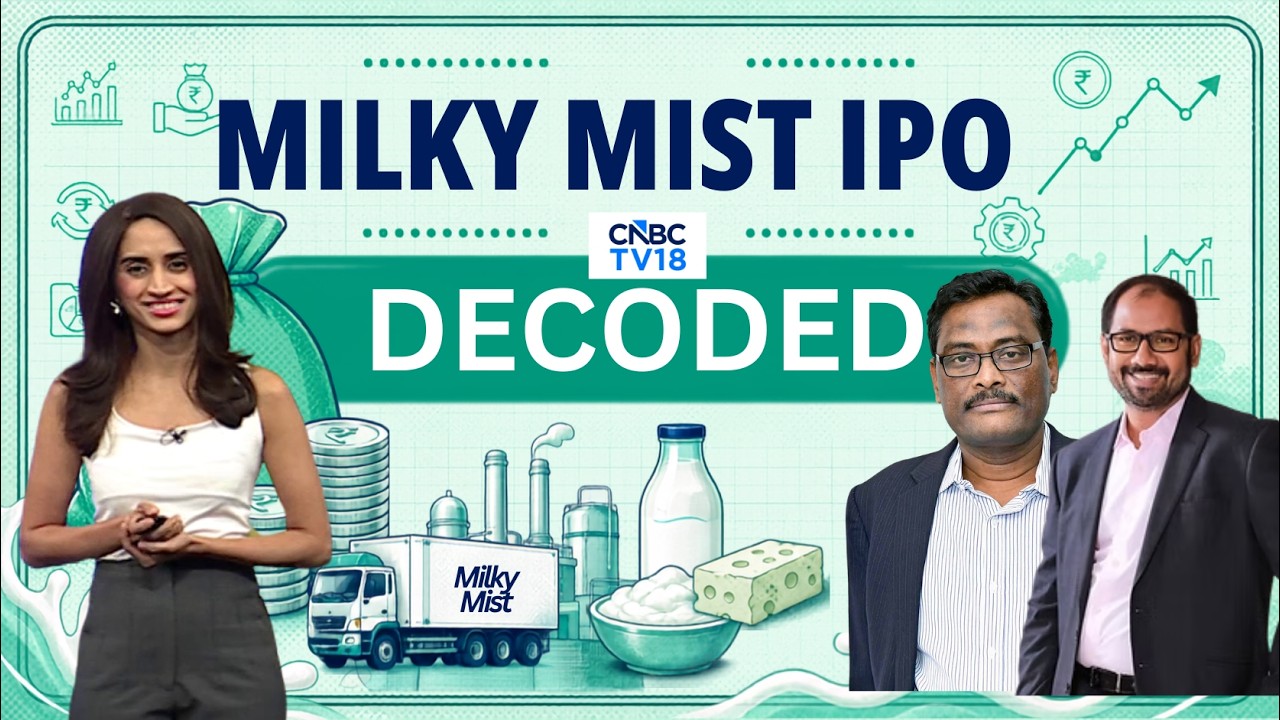
Company: Milky Mist Dairy Food Ltd
Sector: Dairy/FMCG
Basic Details: IPO Mechanics
| Parameter | Detail |
|---|---|
| Issue Size | ₹1,553 Cr total |
| Fresh Issue | ₹1,428 Cr (92% of issue) |
| OFS | ₹125 Cr (only 8%, promoters not aggressively exiting) |
| Price Band | ₹133–₹140 per share |
| Post-IPO Market Cap | ₹10,778 Cr (at ₹140 upper band) |
| Listing | August 18, 2026 (BSE + NSE) |
| GMP Today | ₹23–₹25 (indicating ₹163–165 grey market price = 16–17% premium) |
| QIB / HNI / Retail | 50% / 15% / 35% |
Financial Highlights: Snapshot of last three-year story
| Metric | FY24 | FY25 | FY26 | CAGR |
|---|---|---|---|---|
| Total Revenue (₹ Cr) | 1,826 | 2,355 | 3,145 | 31.3% |
| Revenue Growth YoY | — | +29% | +34% | Accelerating |
| EBITDA (₹ Cr) | 215 | 310 | 435 | 42% |
| EBITDA Margin | 11.8% | 13.2% | 13.9% | Expanding |
| PAT (₹ Cr) | 19.44 | 46.07 | 127.01 | >6x in 2 years |
| PAT Margin | 1.06% | 1.96% | 4.05% | Improving |
| ROE | — | 15.11% | 32.12% | Explosive |
| Net Debt | ₹1,600+ Cr | — | — | High |
| D/E Ratio | — | — | 3.61x | Concerning |
Business Description
Milky Mist is a 30-year-old, Erode (Tamil Nadu)-based dairy company that made one strategic choice two decades ago and has compounded it relentlessly: never sell liquid milk. Everything it makes is Value-Added Dairy Products (VADPs), i.e. paneer, cheese, curd, butter, ghee, yogurt, ice cream, UHT dairy, frozen foods, chocolates, and ready-to-cook/ready-to-eat products.
Milky Mist held approximately 19% market share by value in India’s organised packaged paneer market in FY26, along with roughly 12% share in the organised packaged cheese market in South India and about 5% nationally among private players in that category.
Product mix (FY26 revenue breakdown): Paneer 29.52%, Cheese 17.36%, Curd 15.75%: these 3 categories together make up 62.63% of total revenue. Ice cream contributes 5.86%, with ghee, butter, RTE/RTC, chocolates, and others making up the remaining 31.51%.
The supply chain moat/concentration: Automated manufacturing and a direct milk procurement network connecting over 67,000 farmers. This farmer-direct procurement (94%+ from Tamil Nadu) gives Milky Mist consistent raw material quality and cost predictability, the same model that made Amul untouchable in its era.
Geography: 69% of revenue from South India. Remaining 31% from a national expansion that is still early-stage. Exports to 15+ countries including Singapore, USA, Australia, and Middle East markets.
Leadership: Sathishkumar T (CMD, Founder) and Anitha S (promoters). Dr. K Rathnam (CEO), Biswajit Mishra (CFO). Promoter shareholding moves from 93% pre-issue to approximately 79.52% post-issue. Founder-led, very high promoter skin in the game.
Use of Proceeds (Fresh Issue ₹1,428 Cr): Repaying certain debt, capital expenditure for expanding and modernising the Perundurai manufacturing facility, investment in 25,000 ice cream freezers, 20,000 visi-coolers, and 10,000 chocolate coolers across FY26–FY28, and general corporate purposes.
Investment Thesis
The headline numbers are impressive: Revenue compounding at 31.3% CAGR, PAT growing 6x+ in two years, EBITDA margins expanding 200 bps, and ROE improving dramatically to 32% in FY26. This is not a typical dairy company trajectory!
Positives:
Always track the pace of growth, not just the growth.
Revenue: ACCELERATING, 29% in FY25 to 34% in FY26.
PAT: EXPLOSIVELY ACCELERATING; from ₹19 Cr (FY24) → ₹46 Cr (FY25) → ₹127 Cr (FY26). The PAT compounding is outrunning revenue by a wide margin, suggesting genuine operating leverage as fixed costs (depreciation ₹136 Cr, employee costs ₹145 Cr) are being spread over a rapidly growing revenue base.
Finance costs rose from ₹72 Cr (FY24) to ₹86 Cr (FY25), driven by higher borrowings for expansion. Depreciation rose from ₹107 Cr to ₹136 Cr. The leverage and capex investments of FY24–FY25 are now showing operating leverage in FY26. PAT grew 176% on 34% revenue growth; this divergence is positive, driven by:
- Interest costs partially retiring post-IPO (IPO proceeds partially for debt repayment)
- Fixed cost base now supporting a much higher revenue base
- Improved product mix (more cheese, more curd — higher margin than paneer alone)
Concerns:
₹1,671.85 crore in total borrowings with a debt-to-equity ratio of 3.61. At 3.61x D/E, the company’s interest burden is significant. PAT of ₹127 Cr on ₹86 Cr+ interest cost means the PAT is highly sensitive to interest rate changes. Post-IPO debt repayment from ₹1,428 Cr fresh issue is the most critical de-risking event for this story.
VADP manufacturers carry inherent WC risks; milk procurement is daily cash, but finished product (paneer, cheese) cycles are short. However, institutional B2B customers (hotel chains, restaurant aggregators, retail chains) create receivable risk.
The company’s raw material supply is deeply rooted in Tamil Nadu, with over 94% of raw milk procurement happening in that region. A single-state procurement model concentrates raw material risk. Any disease outbreak, drought, etc in Tamil Nadu could disrupt the entire supply chain.
No specific debtor days deterioration flagged in available data, but the concentration risk in sourcing warrants monitoring post-listing through quarterly balance sheets.
The Debt Problem- The Most Important Risk
The company’s ₹1,671.85 crore borrowing and debt-to-equity ratio of 3.61 remain important considerations.
At 3.61x D/E on ₹127 Cr PAT:
Interest coverage (EBITDA/Interest) = ₹435 Cr ÷ ₹150 Cr est. interest = 2.9x thin!
Net Debt/EBITDA = ₹1,672 Cr ÷ ₹435 Cr = 3.84x high for a Dairy company
Finance costs FY24: ₹72 Cr | FY25: ₹86 Cr (stated by company)
Post-IPO scenario (best case): ₹1,428 Cr fresh issue → most goes to debt repayment → net debt falls to ~₹400–600 Cr → Net Debt/EBITDA drops to 1.0–1.5x → interest cost falls ₹100 Cr → PAT jumps to ₹200–225 Cr in FY27E even with moderate revenue growth → ROE stays elevated → this is the bull case and it is entirely achievable if proceeds are deployed as stated.
The IPO is essentially a balance sheet repair event disguised as a growth story. Both are real, but the debt cleanup is the more immediate financial catalyst.
Valuation
| Metric | Milky Mist (IPO Price) | My view |
|---|---|---|
| P/E (FY26 PAT ₹127 Cr) | 84x | Expensive on trailing basis |
| P/E (FY27E PAT ₹200–225 Cr) | 48–54x | Reasonable if debt cleanup delivers |
| EV/EBITDA (FY26) | 26x (EV = ₹10,778 Cr + ₹1,672 Cr – cash) | Above listed peers but VADP premium justified |
| P/Sales | 3.4x | Reasonable for branded FMCG-like dairy |
| Post-IPO Mkt Cap | ₹10,778 Cr | Between Dodla and Hatsun in size |
At first glance, 84x P/E looks absurd for a dairy company. But the correct lens is FY27E PAT post-debt cleanup. If interest costs fall ₹80–100 Cr post-IPO proceeds deployment, FY27E PAT of ₹200–225 Cr implies a forward P/E of 48–54x. For a business growing revenue at 30%+ with 19% market share in organised paneer and expanding nationally, 48–54x forward P/E is justifiable
Growth Catalysts
69% of revenue from South India means 31% from a national expansion that is still early. North India (UP, Delhi, Haryana, Punjab) is the largest paneer consuming market in India and Milky Mist barely operates there. The entire North India expansion is an incremental growth vector on top of an already-profitable South India base.
Red Flags to Watch
1. 69% South India revenue AND 94% Tamil Nadu milk procurement is a double concentration risk.
2. At ₹140 upper band and 85x trailing P/E, the IPO is pricing in: debt cleanup execution, continued 30%+ revenue CAGR, margin expansion to 5%+ PAT margin, and North India expansion success. If any one of these delays by a quarter, post-listing P/E compression is rapid. The GMP of ₹23–25 (indicating ₹163–165 listing) implies the market is already pricing in short-term optimism; entry at listing price ₹163-165 pushes P/E to 100x, leaving essentially zero margin of safety.
3. The entire FY27 earnings upgrade thesis rests on IPO proceeds going to debt repayment. If management diverts proceeds to capacity expansion instead (the Perundurai facility modernisation + cooler procurement are also in the use-of-proceeds list), debt reduction is partial, and interest savings don’t fully materialise. Sequencing of proceeds deployment matters enormously; watch Q2 FY27 balance sheet for net debt levels.
Bear Case- 3 Risks
1. Amul is entering Milky Mist’s core Southern markets. GCMMF has expanded distribution across India aggressively. In every category Milky Mist sells; paneer, butter, cheese, ghee; Amul is the incumbent brand with national distribution. The competitive question is: can Milky Mist’s regional freshness/quality advantage (shorter supply chain, Tamil Nadu dairy tradition) outcompete Amul’s brand + distribution + pricing in South India? **Currently yes in paneer but cheese and butter are harder to defend against Amul’s brand equity.
2. Valuation Is Unforgiving at 85x P/E.** If revenue growth decelerates from 34% to 18–20% (plausible if South India saturates and North India ramp-up takes longer), PAT growth drops proportionally. At 20% revenue growth + unchanged margins, FY27E PAT = ₹150 Cr. At 50x P/E = ₹7,500 Cr market cap vs ₹10,778 Cr listing cap- 30% downside from listing even if the business grows. This is the base case bear scenario if multiple compression happens.
3. Dairy Sector-Wide Margin Squeeze Is Active Right Now. Four companies, four record top lines, and in every single case, profitability moved in the opposite direction of revenue. Heritage Foods’ net profit fell 38% Y-o-Y, even as revenue grew 18%. Dodla Dairy’s profit dropped 35% on 19% revenue growth. Hatsun’s EBITDA margin contracted from 14.3% to 11.3% in a single year. The entire listed dairy sector is experiencing a structural margin warning, i.e rising milk procurement prices, packaging costs, and logistics inflation. Milky Mist’s FY26 numbers look spectacular partly because it benefited from a favourable input cost environment in FY26. If milk procurement prices rise in FY27 (as ICICI Securities warned for CY26), Milky Mist’s margin expansion stalls or reverses.
Disclosure: Subscribed to IPO
Disclaimer
Recent IPO stocks carry higher risks due to their smaller size and limited operating history. This analysis is for educational purposes only and should not be considered investment advice. Always conduct your own research or consult with SEBI-registered financial advisors before making investment decisions.
 Net Interest Cost (After AHIDF Subvention)
 Total Finance Cost Breakdown (FY2025)
 The AHIDF subvention is available for a maximum of 8 years (including a 2-year moratorium on principal repayment) from the date of first disbursement. Since the first subvention was received in FY2024, this benefit is expected to continue until approximately FY2031–32
 Key Observations