
Lemon Tree Hotels: Planning to add 30% inventory by FY25 (asset-light). Retail demand has picked up strongly & corporate demand is picking up as business events as well as flights are improving. Higher occupancy & better pricing would improve performance. Company has guided for EBITDA margins of 50% in FY23, compared to about 48% in H1FY23.
2 Likes
Hotel - On a strong wicket - HSIE-202301271523464011426.pdf (2.2 MB)
Hotel sector Hdfc securities institutional research report enclosed
1 Like
G20 ,MICE,weddings,lower expenses cost control
hotels in a upcycle as per the hdfc report enclosed
Two hotels in two states bring on board more than 100 rooms
New Delhi, June 2, 2023: Lemon Tree Hotels Limited announced the opening of
two of its latest hotels ~Lemon Tree Hotel, Agra, and Lemon Tree Hotel, Bhopal.
With these two launches, the company makes its debut in both the cities and
also adds more than 100 rooms to its inventory.
The Company has signed a License Agreement for a 48-room property in Mashobra, Shimla, Himachal Pradesh under the Company’s brand “Lemon Tree Hotel”.
1 Like
Lemon Tree has signed license agreements for two new properties in Junagadh, Gujarat, and Chitwan, Nepal under the brand Lemon Tree Hotel and Lemon Tree Resort, respectively. Lemon Tree Hotel in Junagadh is expected to be operational by FY25, and Tigerland Safari – A Lemon Tree Resort in Chitwan, Nepal is expected to be operational in FY24 itself.
I also expect Lemon Tree to do record business this holiday season due to the continuous capacity expansion it has been doing recently, out of which many hotels are already operational. This surety is coming after I personally experienced a shortage of rooms in all premium hotels across India which are early signs of how happening all tourist spots are going to be.
Lemon Tree has opened doors to India’s largest hotel in Mumbai, Hotel Aurika which consists of 660 rooms and suites. This move is sure to add a lot to the top line as they had multiple wedding and corporate bookings even before they opened the hotel
1 Like
As it was mentioned in concall, last quarter company did not increase price, focused on occupancy. Upcoming two quarters I believe they will increase price due to events and short supply with already increased occupancy rate. Looks disposable income is rapidly rising and people are spending on higher ticket spending such as occupying branded hotels, travel, buying luxury goods.
Disclosure: Invested
2 Likes
Lemon Tree in expansion spree across the country through franchise & non-franchise model: -
Mussoorie.pdf (605.5 KB)
Meerut.pdf (761.9 KB)
Kundapura.pdf (688.0 KB)
Hubli.pdf (308.9 KB)
Hissar.pdf (435.8 KB)
Gujarat.pdf (598.9 KB)
Dapoli.pdf (590.3 KB)
Bihar.pdf (449.3 KB)
Corporate amalgamantion as indicated above: -
Amalgamation.pdf (494.1 KB)
Fine performance from Lemon Tree.


Key points: -
Per mgmt, all India hotel occupancy stands at around 65% likely to increase to 70+ in the next 2 years with significant benefit likely for Lemon Tree.
Lemon Tree to focus more on retail customers than corporate
25% growth in 9M YOY seen on mgmt fees, which now contributes to ~13% of the revenue
The decrease in EBITDA margin Y-o-Y mainly due to planned increase in payroll and
renovation expenses and some impact of Aurika which is yet to stabalize
1.5 million loyalty members; 30%+ repeat customers
2 Likes
Lemon Tree Hotels has opened a new franchised resort in Somnath, Gujarat, marking its seventh property in the state. The resort offers 52 rooms, a restaurant, and recreational facilities.
1 Like
Would it make sense if we extrapolate Q1-24 results with above generalized % ?
Q1-24 results:
- Income-268Cr
- PAT-20 cr.
https://www.bseindia.com/xml-data/corpfiling/AttachLive/3b48c58f-3ad0-4bbc-ba5a-9e1c1695b508.pdf
https://x.com/bastionresearch/status/1834939028023763386?t=yeYgfA_RhN54bpvxRiEuNg&s=19
Very interesting
2 Likes

Lemon Tree Hotels announced execution of HOA for a new property in Gujarat
Hotel is expected to start its operations in FY 2029
This Hotel will feature 92 well-appointed rooms, a restaurant, a meeting room, a swimming pool, a spa and other public areas.
Lemon Tree | Financial Results

Lemon Tree | Management Interview
- Highest-ever revenue, EBITDA & net profit
- Q4FY25 will be strong & the momentum will continue in FY26 as well.
- Management added that company will be debt free in next 3-4 years.
Watch here

Can anybody post the complete article here. Thanks
Lemon Tree Hotels may list its subsidiary Fleur Hotels next year in an effort to become a debt-free company.
According to a source, Fleur Hotels’ listing would be completed sometime next year.
Lemon Tree has a consolidated debt of ₹1,760 crore as of December 2024, with its standalone debt being ₹300 crore, Kapil Sharma, chief financial officer (CFO), told analysts at the company’s earnings’ call during Q3 of FY25.
Patanjali Keswani, chairman and managing director, Lemon Tree Hotels, said during the earnings’ call that the company would be debt free in three years.
“I can say with certainty that it will happen in the next 1.5-2 years. If that happens, automatically we go debt free,” said Keswani.
He had also stated that Lemon Tree will continue to be a significant shareholder of Fleur Hotels.
“We think it will have a really solid listing because we think its earnings before interest, taxes, depreciation, and amortisation (Ebitda) will be $100 million when it lists,” Keswani stated in the earnings’ call.
Additionally, Lemon Tree Hotels — with 112 operational hotels as of Q3FY25 — currently has no immediate plans to add any new brand to its hotel company. It has 88 hotels in its pipeline.
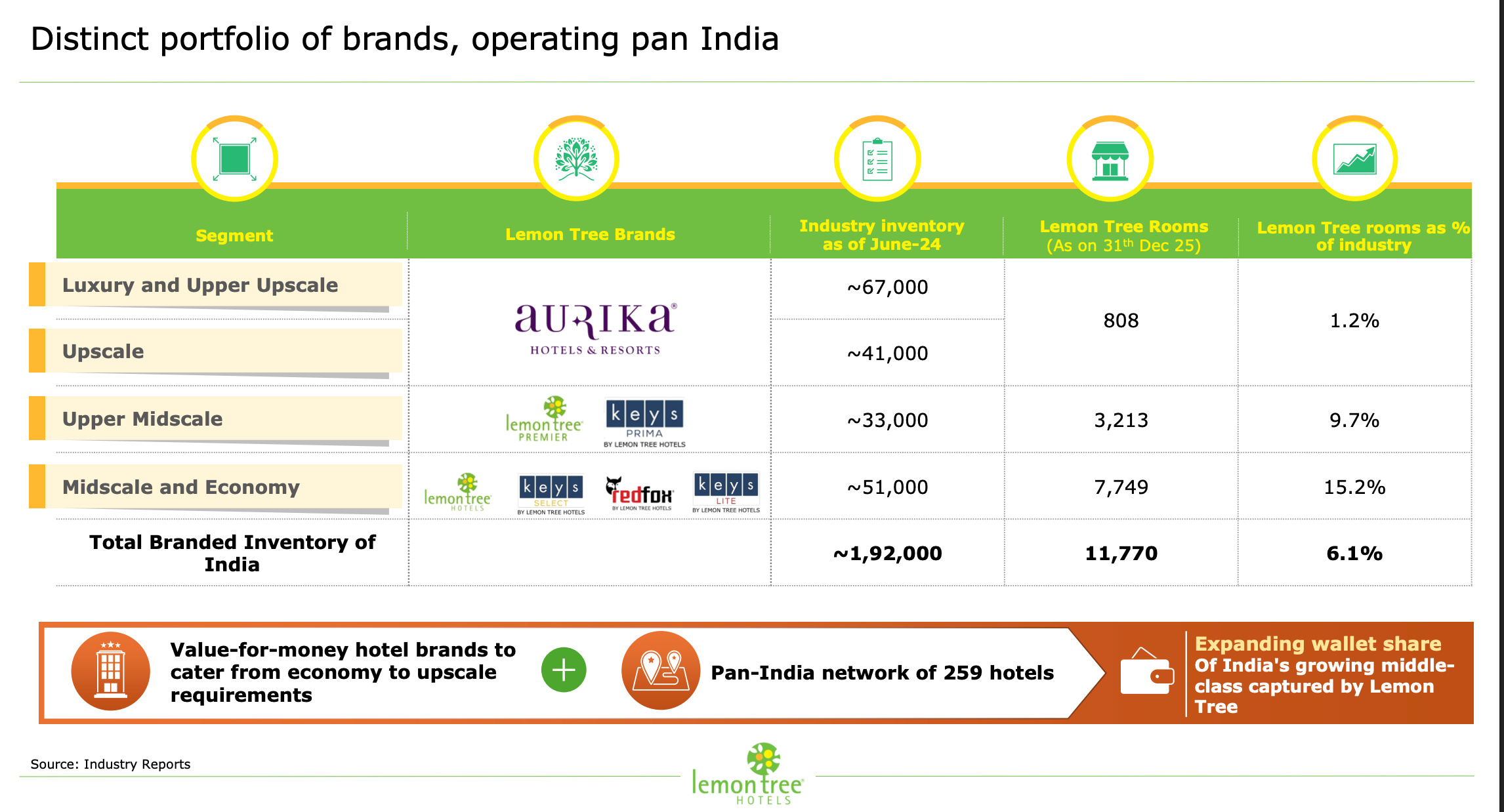
“Lemon Tree is already running seven brands (Aurika Hotels and Resorts, Lemon Tree Premier, Lemon Tree Hotels, Red Fox by Lemon Tree Hotels, Keys Prima by Lemon Tree Hotels, Keys Select by Lemon Tree Hotels, and Keys Lite by Lemon Tree Hotels), and all segments are between a three-star and an upper, upscale segment,” the source added.
Corporate travellers generate most of the demand for the hotel, with 75 per cent of the company’s revenue coming from this travel segment. Leisure travellers contribute about 25-30 per cent of the revenue, the source further said.
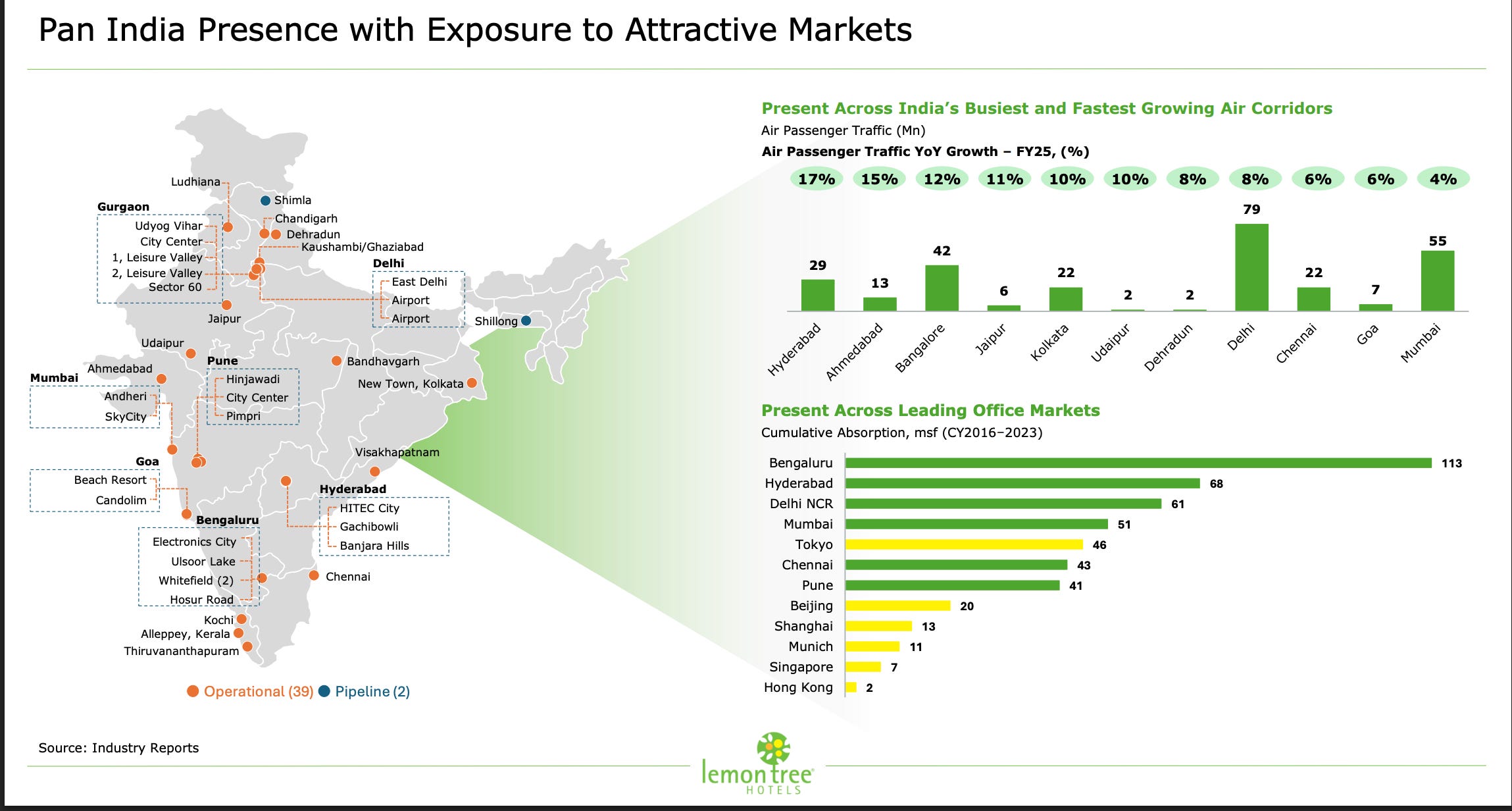
Lemon Tree has a vast presence in India with 40 per cent of the company’s portfolio in Tier-II and Tier-III cities. The company expanded internationally with hotels opening in Dubai in December 2019, Bhutan in February 2020 and Nepal in April 2024.
The company currently has two operating hotels in Nepal and is slated to add another four. It also has two operating hotels in Bhutan and is in the process of adding another two. It is open to scouting more opportunities internationally.
3 Likes
Lemon Tree’s Q2: The Real Story Behind the Margin Dip !
Earnings Flash: Lemon Tree’s Q2 FY26 – Three Signals Lighting the Path Forward
Dear Value Curators,
In a market chasing headlines, Peter Lynch taught us to hunt the quiet compounders. Lemon Tree Hotels (LTH) is a classic example. With Q2 FY26 results out, the market saw a mixed bag.
We see three critical signals.
The consensus view (first-level thinking) is fixated on the temporary margin dip. But as Howard Marks would say, we must look deeper. The real story isn’t just what happened, but why , and what it means for the next two years .
Here’s the world-class investor’s decode.
1. Signal 1: The “On-the-Ground” Demand is Real
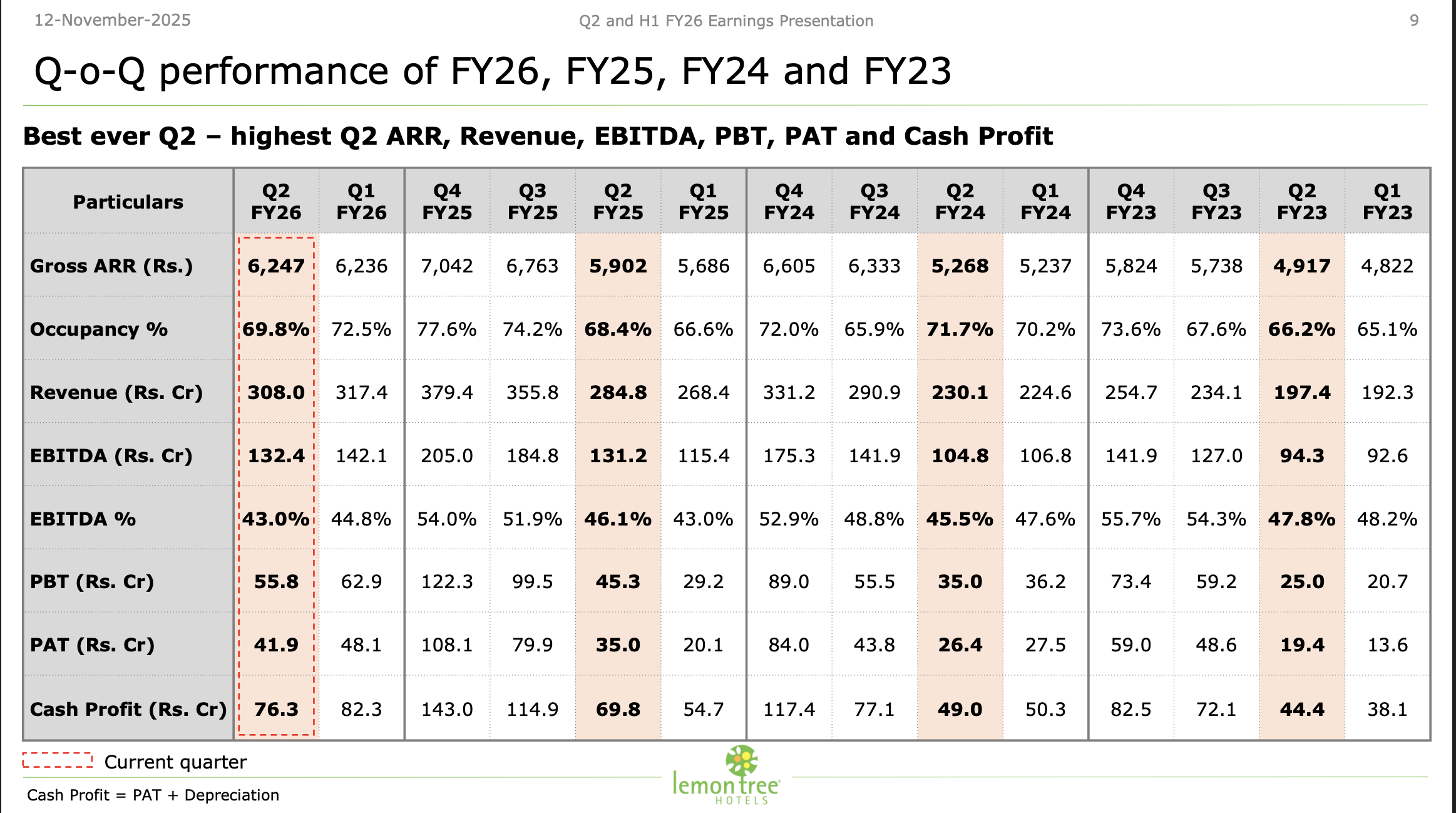
The numbers: Revenue hit ₹308 Cr (+8% YoY), a record for a seasonally weak quarter.
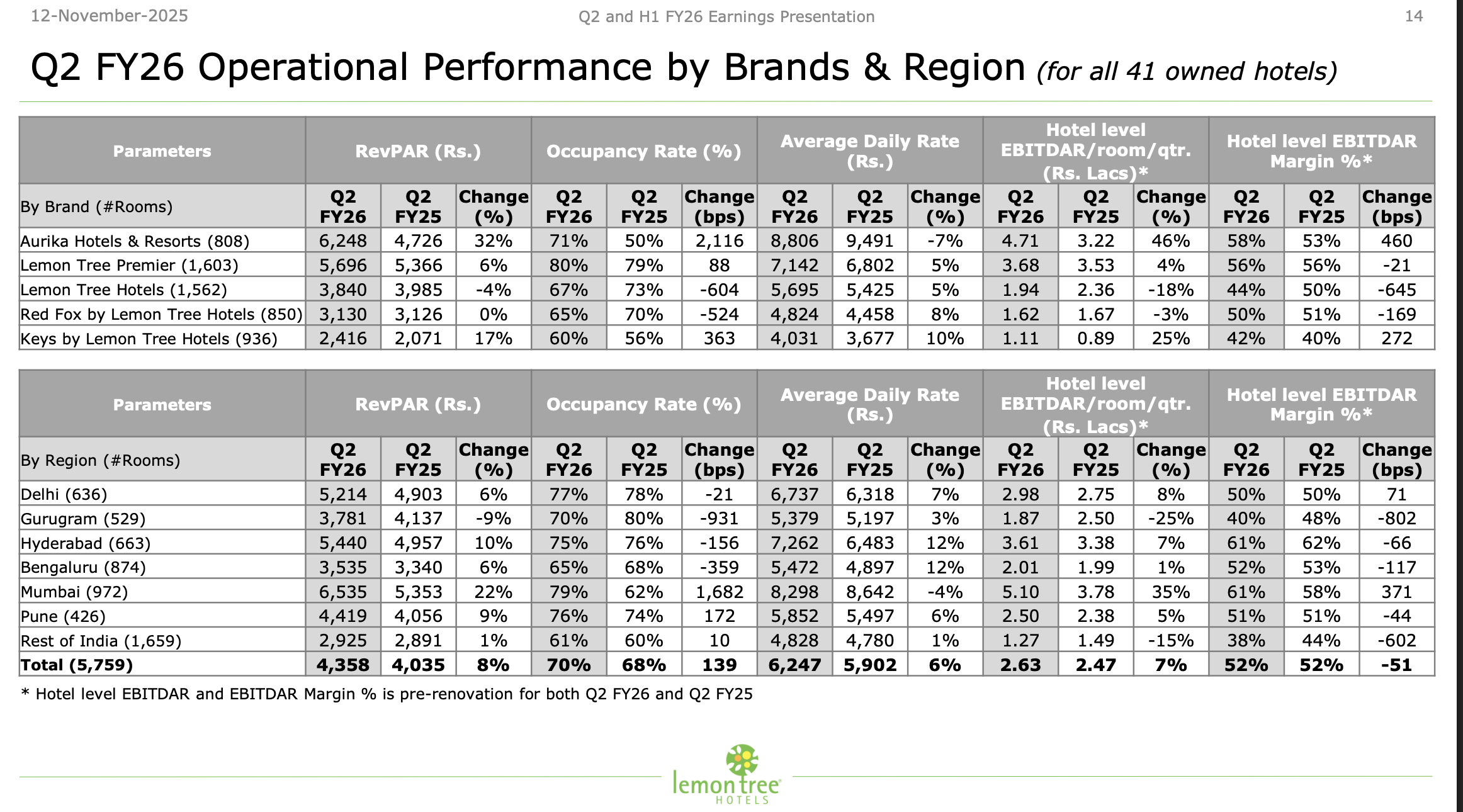
- The Lynch “Scuttlebutt”: Forget the headline number. The real proof is in the pricing power. LTH raised Average Room Rates (ARR) by 6% to ₹6,247 and increased occupancy by 139 bps to 69.8%. Raising prices while filling more rooms, even during the monsoon “downpour,” is on-the-ground proof that the brand is strong. This isn’t just cyclical recovery; it’s tangible, sticky demand.
2. Signal 2: The Margin Dip (A Second-Level Analysis)
This is where the entire thesis rests.
Net EBITDA margin dipped 306 bps to 43%. PAT, however, was up 20% to ₹42 Cr.
- First-Level Thinking (The Consensus): “Margins are down because of ₹130 Cr in renovation/tech capex. Management says this is temporary and will normalize by FY28. It’s a non-event.”
- Second-Level Thinking (Our View): This is the central risk to the entire bull case. The consensus assumes this spending will automatically lead to higher ARRs. The real question isn’t if the spending stops; it’s what is the return on that spend?
- What if the customer doesn’t value a “Keys Prima” over a “Keys Select” and refuses to pay the 15% premium?
- The risk is that this isn’t a temporary margin dip but a permanent impairment of capital on a failed premiumization strategy. This is what we must watch like a hawk.
- The Munger Capital Allocation Test: Management is making two big capital bets.
- Paying down debt (costing 7.72%).
- Renovations (targeting a 13%+ ROCE).At the stock’s high valuation (see below), they are implicitly stating that reinvesting cash into the business at 13% ROCE is a better use of capital than an aggressive share buyback. This is the bet we are underwriting as shareholders.
3. Signal 3: The Moat is Deepening
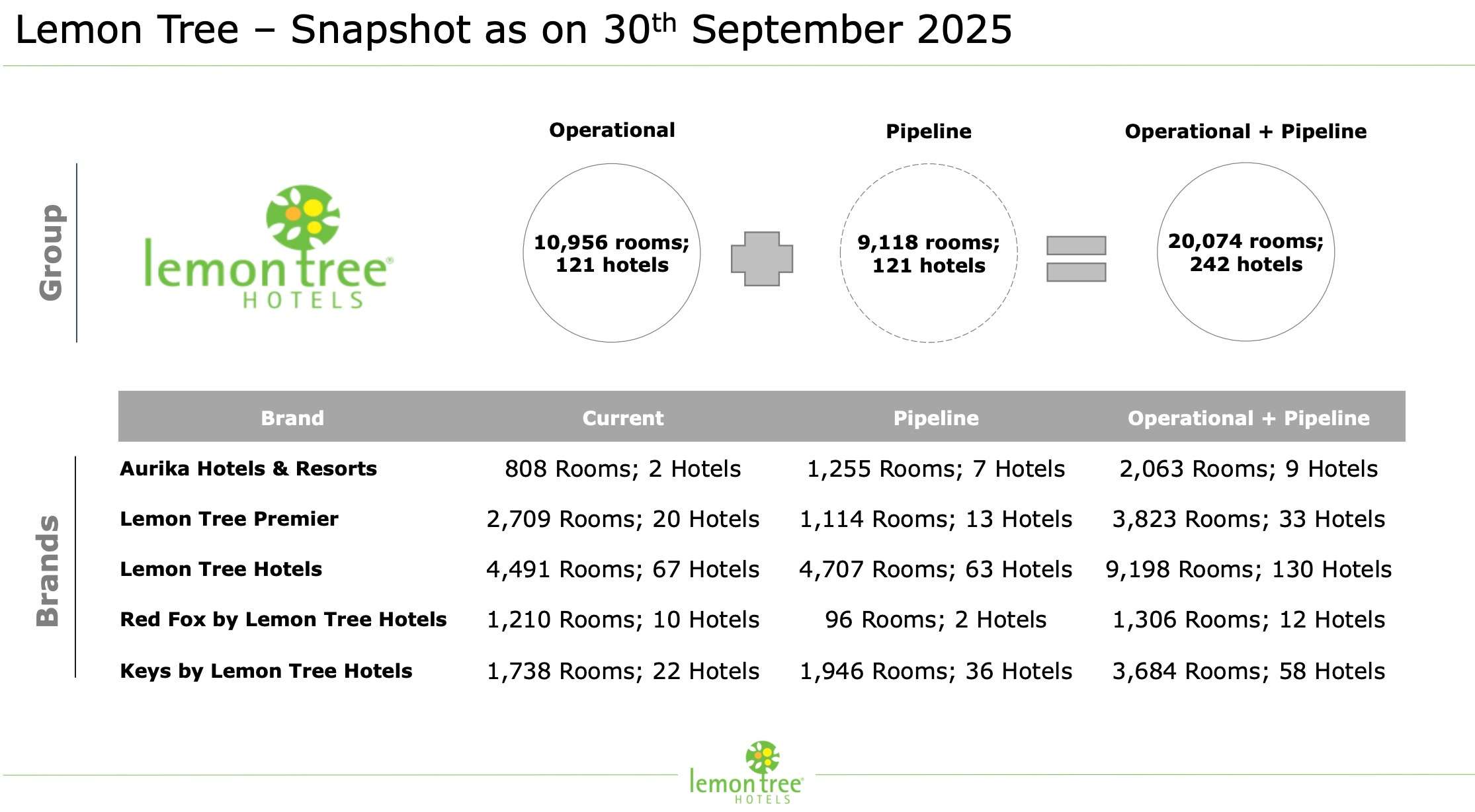
LTH signed 15 new contracts (+1,138 rooms) and operationalized 5. The pipeline is now a massive 121 hotels (9,118 rooms) , which will almost double the company’s current room inventory.
The crown jewel is the 500+ room Aurika won in Nehru Place, Delhi. This is a classic Buffett-style “moat” asset: a scarce, high-return property in a prime location that is impossible to replicate. This single asset provides a long-term anchor for high-margin, premium growth.
The Real Price Tag: EV/EBITDA – The Cap-Heavy Lens
The market’s lazy number is the 53.6x P/E. We ignore that.
Why? P/E gets distorted by depreciation in cap-heavy businesses like hotels—an accountant’s guess that masks true operational strength.
A world-class investor focuses on cash generation, adjusted for debt. Enter EV/EBITDA: It captures the full enterprise cost (market cap + net debt) against core earnings before non-cash hits.
Current EV: Market Cap ₹11,794 Cr + Net Debt ₹1,610 Cr = ₹13,404 Cr
TTM EBITDA: ₹659 Cr
EV/EBITDA: 20.3x
This is our true price tag. It’s fair for a 13% ROCE compounder with strong tailwinds, but the renovation bet must deliver to justify it. Ideal range for Indian hotels: 18-25x forward—below 18x screams buy; above 25x, wait for dips
The Thesis:
The bet on Lemon Tree isn’t on a simple travel boom. It’s a bet that management’s current capex spend will generate returns well above its cost of capital, proving the “second-level” skeptics wrong.
What are your thoughts? Do you believe this renovation bet will pay off, or is it a value trap? Reply and let’s discuss.
Stay curious,
Uday Chandak
7 Likes
Anyone tracking lemon hotel they gave announced demerger
2 Likes
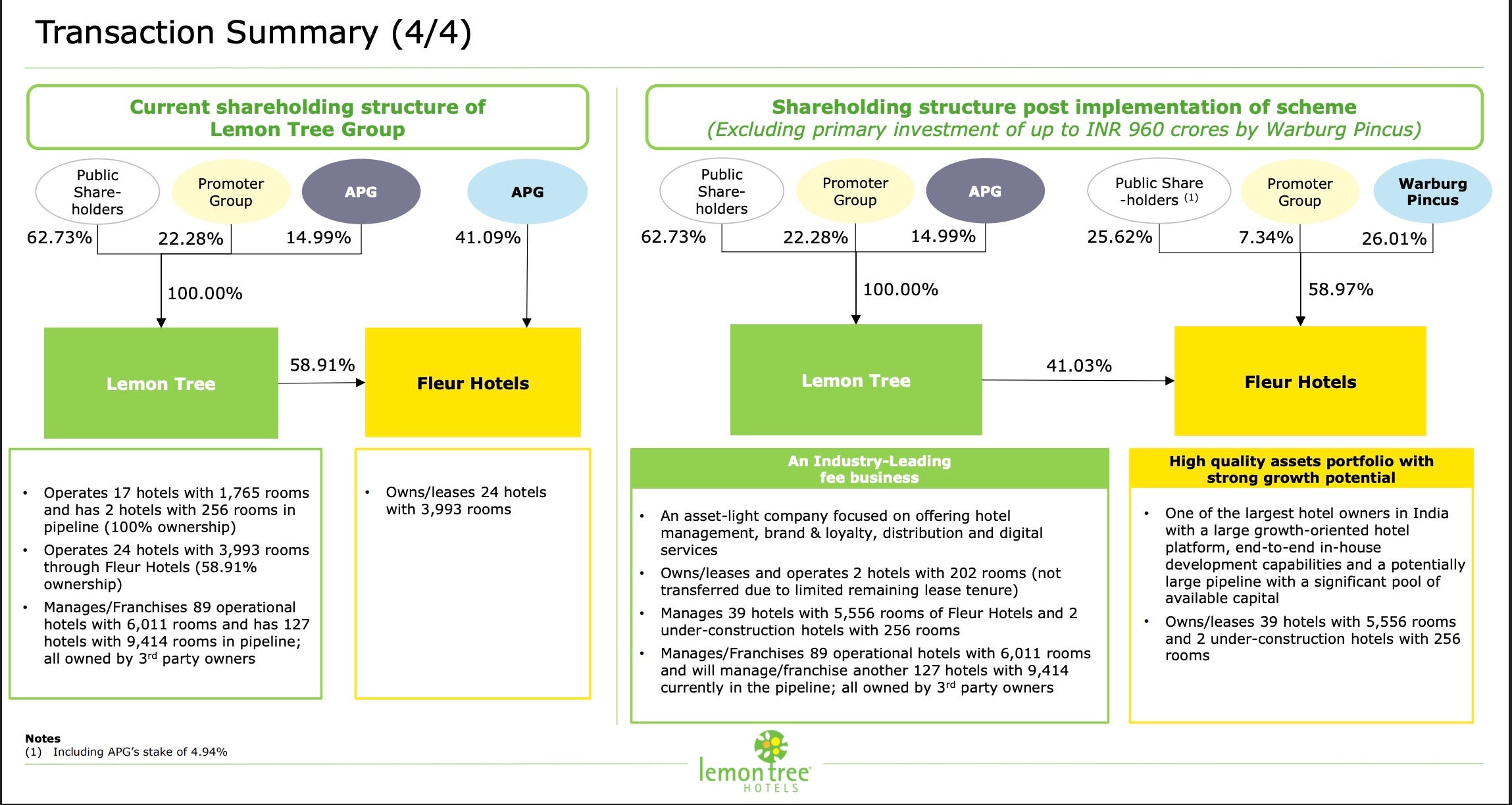
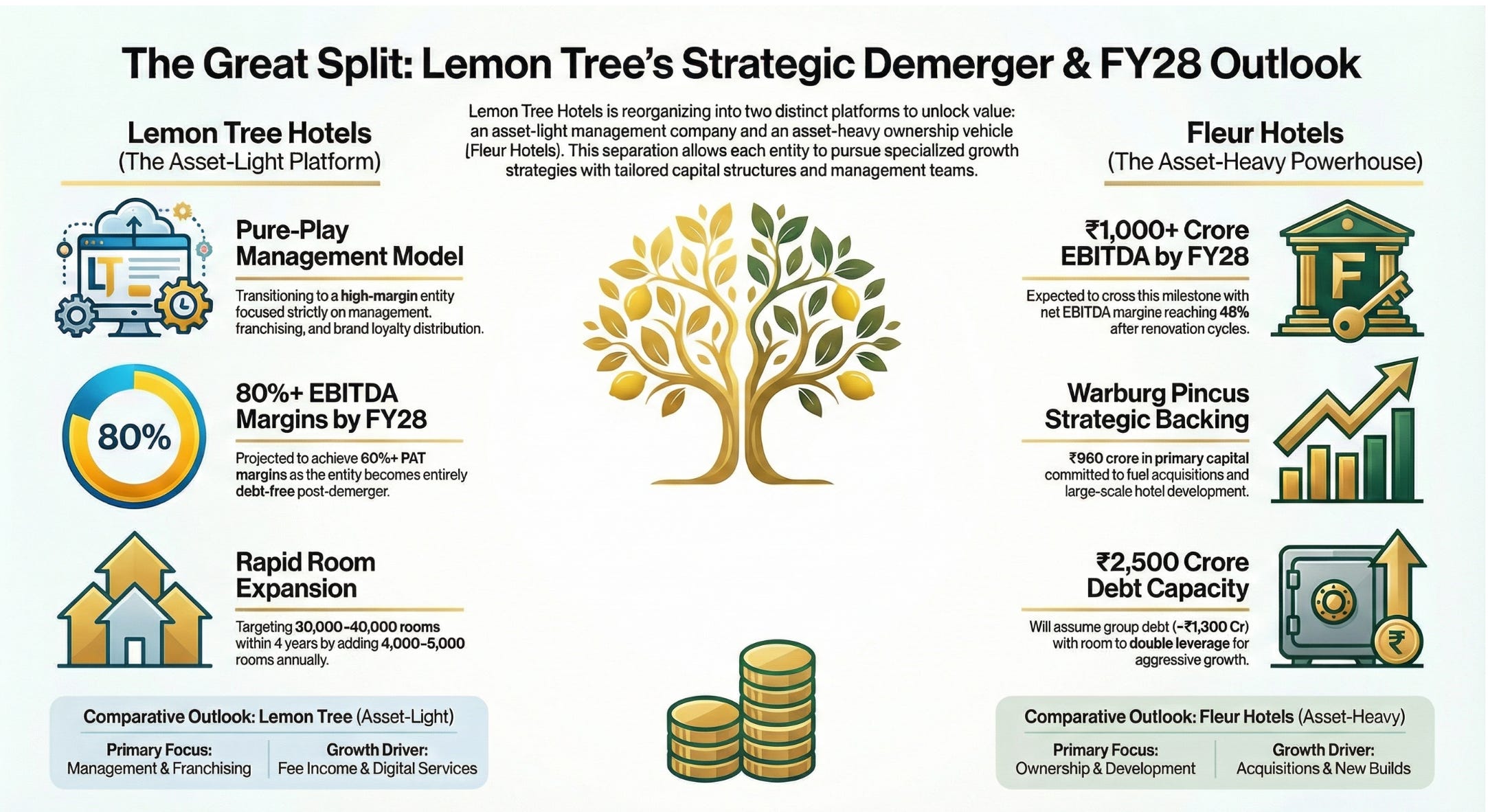
asset heavy fluer and asset light lemon tree demerger is the plan with warburg pincus fund infusion in asset heavy fluer hotels. managment told earlier value unlock .will see. waiting for some solid brokerage report analysis
1 Like
Title: The Theory of Counter-Positioning: The Structural Case for Lemon Tree Hotels**
Subtitle: How a contrarian bet on “inefficiency” and “heavy assets” created an economic moat that competitors are mathematically paralyzed to copy.
Snapshot: The Investment Thesis
In this deep dive, we reverse-engineer Lemon Tree Hotels using Hamilton Helmer’s ‘Counter-Positioning’ framework. We analyze how a contrarian bet on heavy assets and inclusive hiring has created a moat that giants like Marriott are mathematically paralyzed to copy—and how the upcoming demerger is the catalyst that finally unlocks this hidden value
I. The Mental Model: The Paralysis of the Incumbent
In his strategy masterwork 7 Powers, Hamilton Helmer defines Counter-Positioning as the rarest and most potent form of competitive advantage. It occurs when a challenger adopts a business model that incumbents could technically copy, but won’t, because doing so would destroy their existing unit economics.
It is not merely about being better. It is about being toxic to replicate.
The Classic Example: Vanguard vs. Wall Street. Big banks could have launched low-fee index funds in the 80s. They didn’t. Why? Because offering a 0.1% fee product would have cannibalized their lucrative 2% active management fees. They were paralyzed by their own profit model, leaving the door wide open for Vanguard to eat the world.
The Thesis: Lemon Tree Hotels (LTH) has effectively counter-positioned the entire Indian hospitality sector.
For twenty years, the industry consensus (Marriott, IHCL, Hyatt) has optimized for two specific variables:
-
Labor Efficiency: Hiring fungible, English-speaking staff (high churn, high competition).
-
Capital Efficiency: The “Asset-Light” model (managing hotels, not owning them).
Lemon Tree optimized for the inverse:
-
Social Inclusion: Hiring the “unhireable” (Speech and Hearing Impaired/EWS).
-
Asset Ownership: Building a fortress of owned rooms on owned land.
For decades, the market punished Lemon Tree for these choices, viewing them as “inefficiencies” that dragged down Return on Equity (ROE).
But the game has flipped. In the post-2024 economic environment—defined by sticky wage inflation and skyrocketing replacement costs—these “inefficiencies” have calcified into structural moats. The incumbents are now trapped. To replicate Lemon Tree’s cost structure today, a competitor would have to wreck their own margins and pivot their entire corporate culture.
They are mathematically paralyzed. And Lemon Tree is about to cash in.
The First Moat: Shorting the Wage Spiral
Forget “social responsibility.” This is labor arbitrage.
The biggest risk in Indian hospitality today is the “Wage Spiral.” Competitors are bleeding cash, bidding up salaries by 30-40% to poach staff who quit every 9 months. Lemon Tree opted out of this war. They built a “Missionary Workforce” (ODI staff) that the “Mercenary Market” cannot access.
The Efficiency Gap: Why LTH Wins on Unit Economics
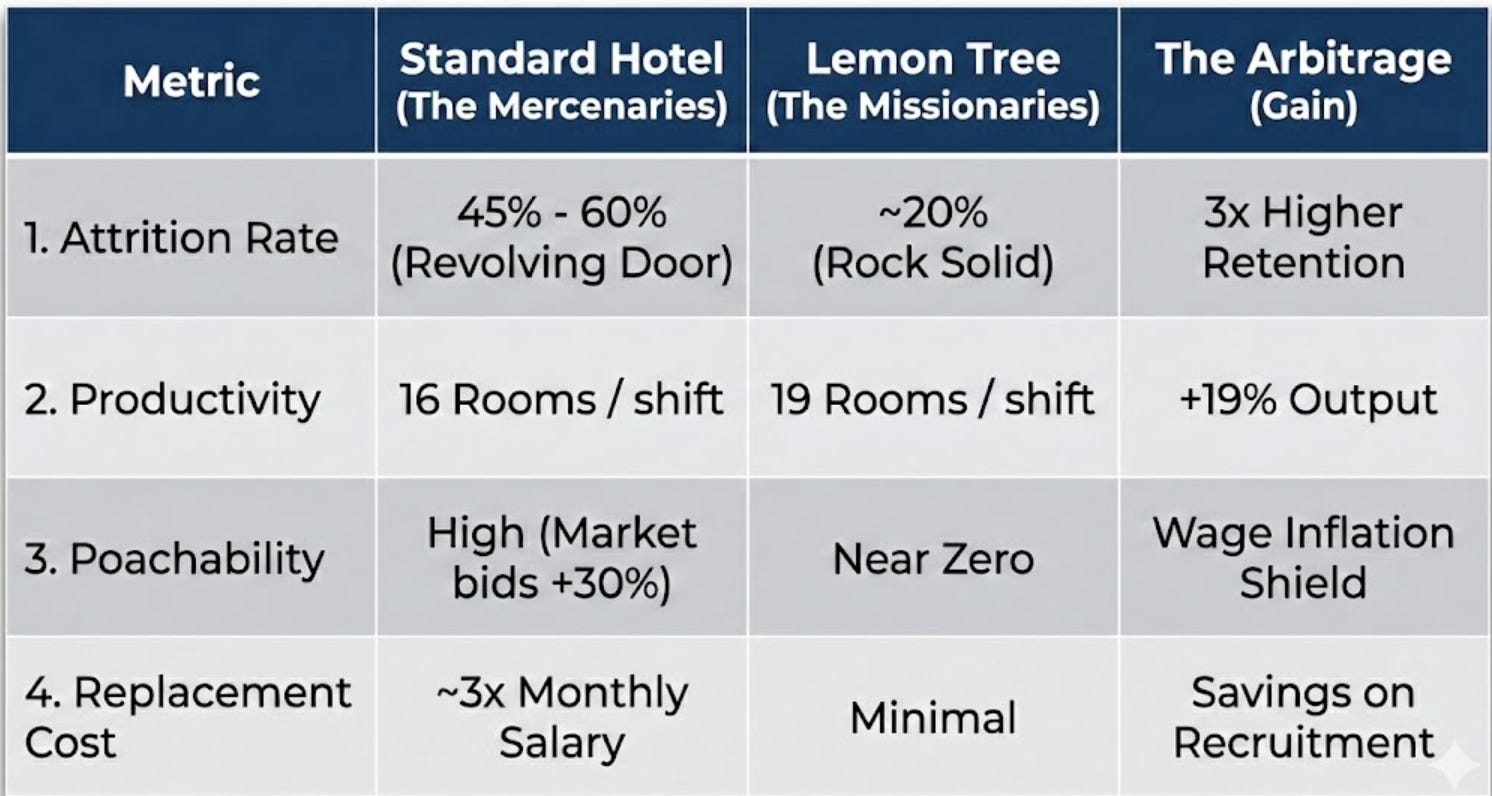
Source: Harvard Business School Case Study & BBC
The “Focus Premium” Why the higher output? The data is counter-intuitive but clear. Staff with hearing or speech impairments are not distracted by hallway gossip, phone notifications, or office politics. They possess superior visual focus.
The Result: Lemon Tree extracts 19% more revenue-generating activity for the exact same salary cost. This isn’t charity; it is superior human capital allocation.
The Second Moat: The Inflation Fortress (Assets & Growth)
For a decade, “Asset Light” was religion. Lemon Tree defied it, choosing to own ~60% of its inventory. In 2026, this “heavy” balance sheet has morphed into a lethal weapon: The “Pac-Man” Strategy.
The Inflation Trap (Why You Can’t Build) Building a new hotel today is a financial trap. Costs (Cement, Steel, Land) are up 40%, and it takes 5 years to finish. Competitors trying to add supply are stuck in a slow, expensive queue.
The Counter-Move: Eating the Maze While others are stuck laying bricks, Fleur (the asset owner) is using Warburg’s capital to eat the maze. The strategy is simple: Don’t build. Acquire. They are aggressively buying distressed standalone hotels that are already standing but broken—fixing them in 3 months instead of 5 years.
The “Buy vs. Build” Arbitrage (Master Data Grid) Why is Warburg funding acquisitions? The math is undeniable.
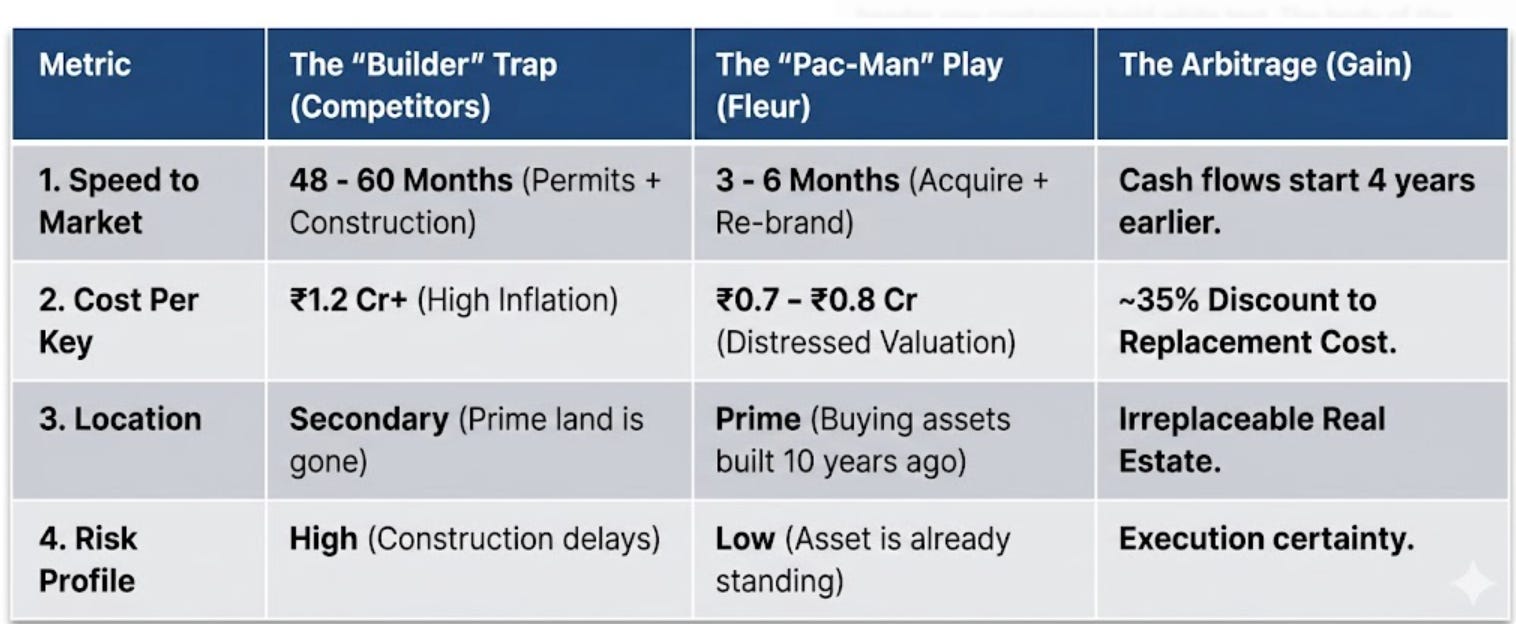
The Forensic Proof (Jan ‘26 Update) This is not a theory. Management explicitly stated they are in active discussions to acquire 2,500 operational rooms immediately, funded by the ₹2,500 Cr debt expansion.
The Punchline: Pac-Man is eating the maze while the others are still trying to build one. By the time competitors finish their new hotels in 2030, Fleur will have already amortized these acquisitions.
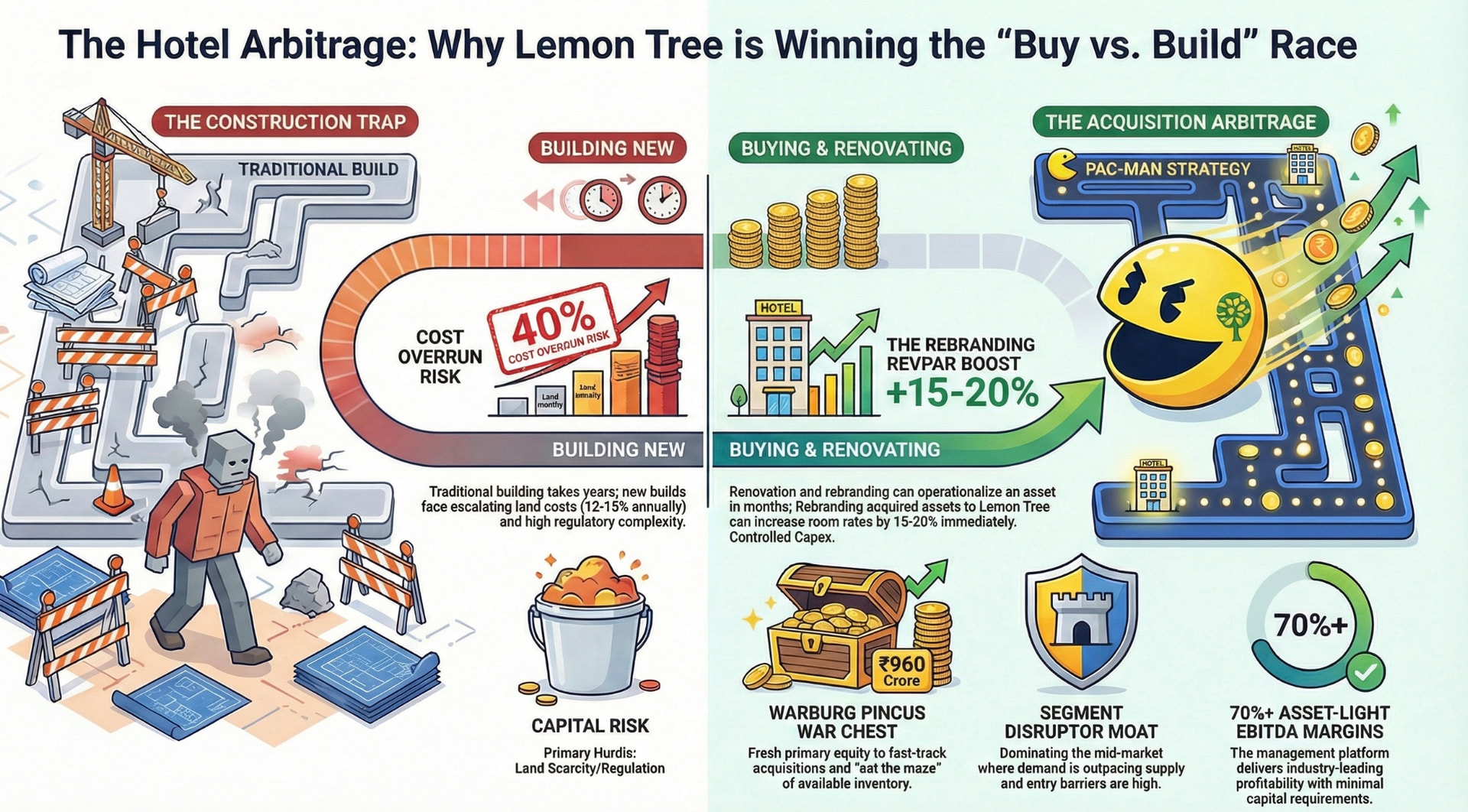
The Third Moat: The Hidden Arbitrage: The Alchemy of Old Concrete
To the average analyst, “Renovation Expense” is a red flag. It eats cash. To the structural investor, it is the most beautiful line on the P&L. It is a money-printing license.
Lemon Tree isn’t just painting walls. They are running a Change-of-Use Arbitrage on their own assets.
Exhibit A: The Proof of Concept (Pune Pilot) In late 2025, they took a budget hotel in Pune (101 Rooms), upgraded the interiors, and re-priced it as Premium. Same land. Same building. Same staff. Double the profit.
The Master Data Grid (Unit » Hotel Level):
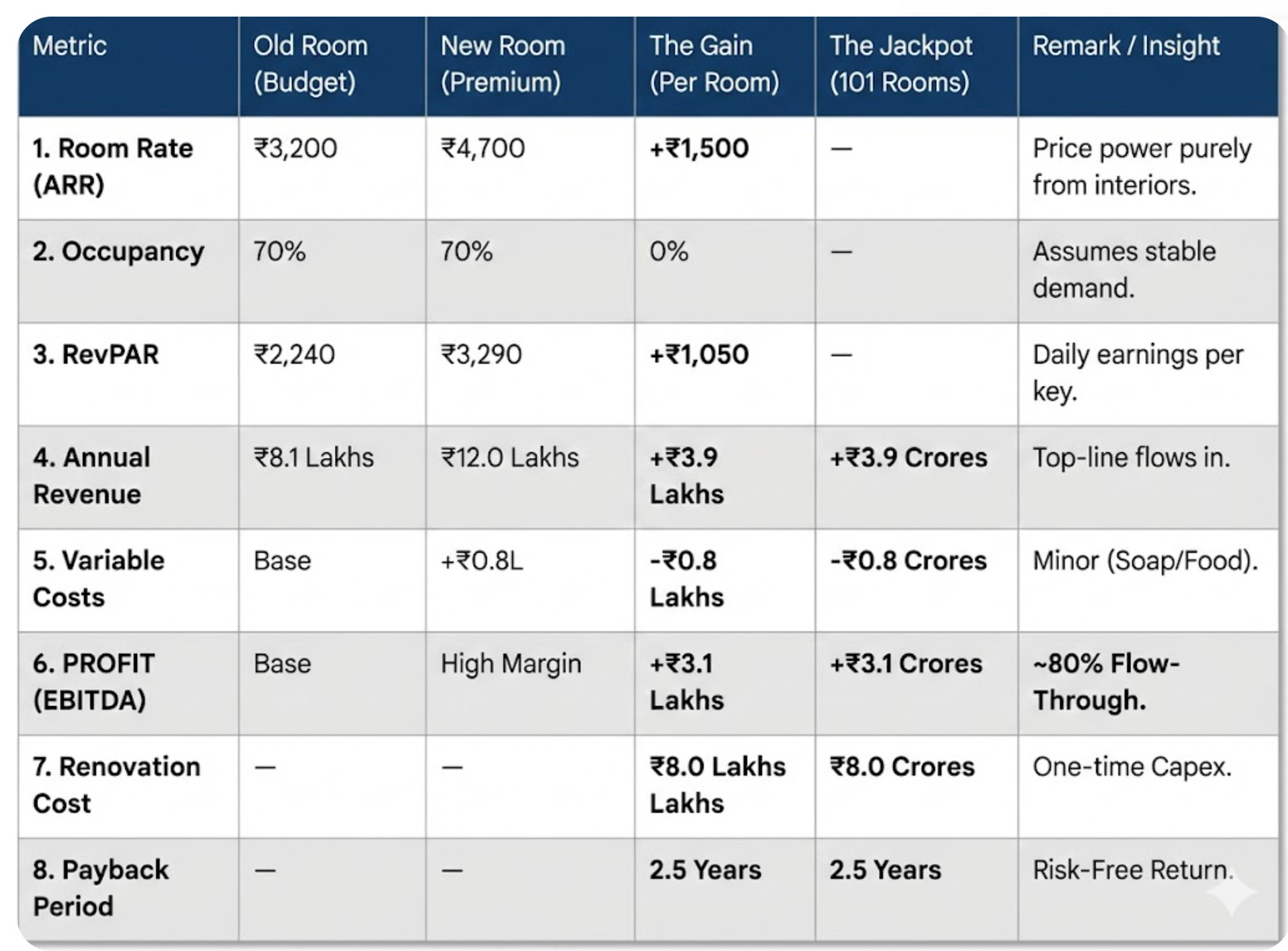
The “Demerger Kicker”: Capital Efficiency Here is the structural advantage for the Lemon Tree Hotels (LTH) shareholder post-demerger.
The Mechanism: The renovation cost (Capex) sits on the balance sheet of Fleur Hotels (the Asset Owner). They absorb the debt and the execution risk.
The Benefit to LTH (The Manager): Since Lemon Tree manages the property, it captures the upside through two channels without deploying its own cash:
- Fee Growth: LTH earns a 5-7% management fee on the new revenue base. When revenue jumps by ₹3.9 Crores due to the upgrade, LTH’s fee income rises automatically—with zero incremental investment.
- Equity Share: LTH retains a 41% stake in Fleur. While it doesn’t fund the renovation directly, it still captures nearly half of the resulting ₹3.1 Crore profit through its equity ownership.
The Verdict: The demerger allows the listed entity (LTH) to participate in high-return renovation projects while keeping its own balance sheet asset-light. It captures the pricing power of the “Premium” tag without bearing the full capital load of the upgrade.
What is Next? (The Delhi Trigger) Pune was just the warm-up. Next in line is the massive Red Fox at Delhi Aerocity.
- The Asset: A flagship asset with 207 Rooms sitting on India’s most expensive hospitality real estate.
- The Plan: Renovate and re-launch as Lemon Tree Premier.
- The Math: In Aerocity, the rate gap isn’t ₹1,500. It is over ₹3,500 per night.
The Impact: When you apply that flow-through math to 207 rooms instead of 101, the numbers stop being linear and start being exponential.
 The Kingmaker: Why Warburg Pincus Changes the Game
To understand why this stock is re-rating, you have to look at who just wrote the check. In the world of Private Equity, there are “Vultures” and there are “Architects.” Vultures buy distressed companies, strip the assets, fire the staff, and flip them for a quick buck.
Warburg Pincus is not a vulture. In Indian corporate circles, they are known as “The Architect.” They don’t just buy companies; they design category leaders. With over $85 Billion in Global AUM and more than $10 Billion deployed in India since 1996, they have a very specific, very profitable playbook: Spot a fragmented, chaotic sector and back a single player to consolidate it into a giant.
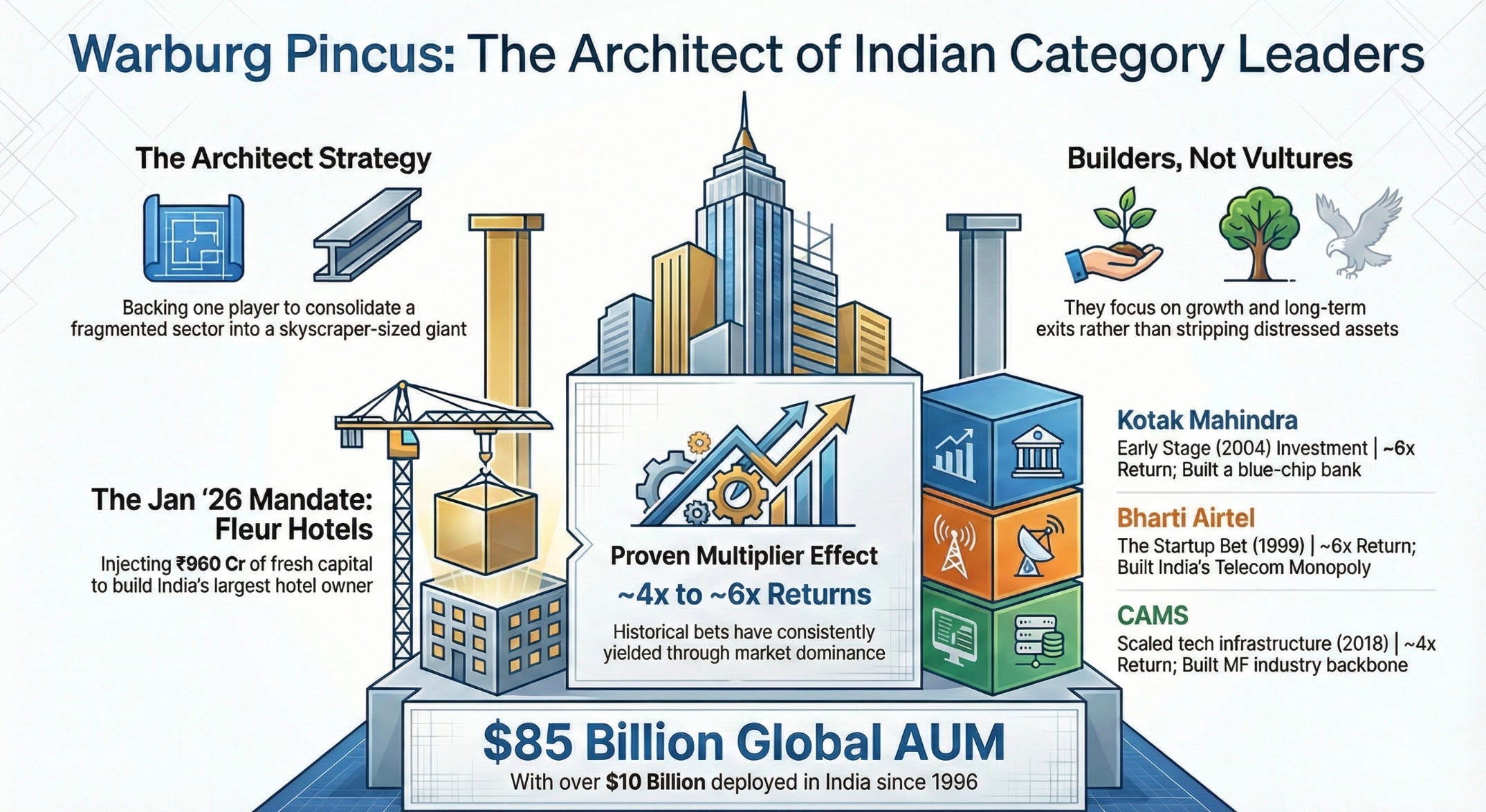
 The Architect’s Track Record (Forensic Proof)
You don’t have to take my word for it. Look at the “Master Data Grid” of their Indian bets. They have executed this exact strategy before, and the results were effectively coronations.
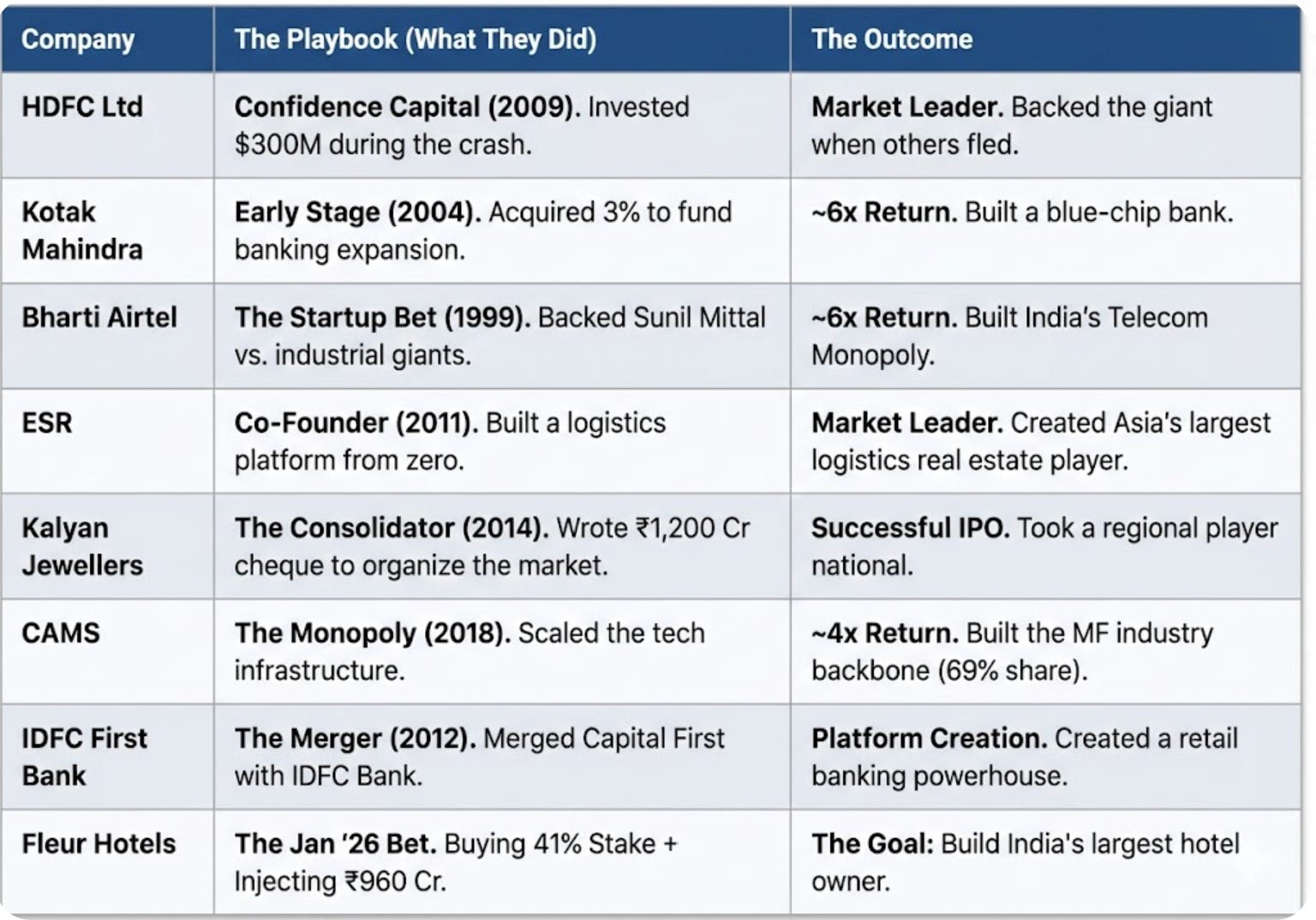
 The Logic: The Fuel Meets The Engine
This is the critical context you need to understand the deal. Warburg Pincus isn’t just buying APG’s stake to sit on it. They have structured this deal to force growth.
- The Injection: They are pumping ₹960 Crores of FRESH Primary Capital directly into Fleur.
- The Blueprint: This capital isn’t for renovation; it’s for acquisition. The Architect is handing Lemon Tree a “war chest” to go out and buy distressed assets while competitors are weak.
Completing the Circle: Now, please look back at Moat II (The Pac-Man Strategy)
We asked: How can Fleur afford to eat the maze? Here is your answer: Warburg just handed them the credit card.
The Catalyst: Getting Paid Twice (The Demerger)
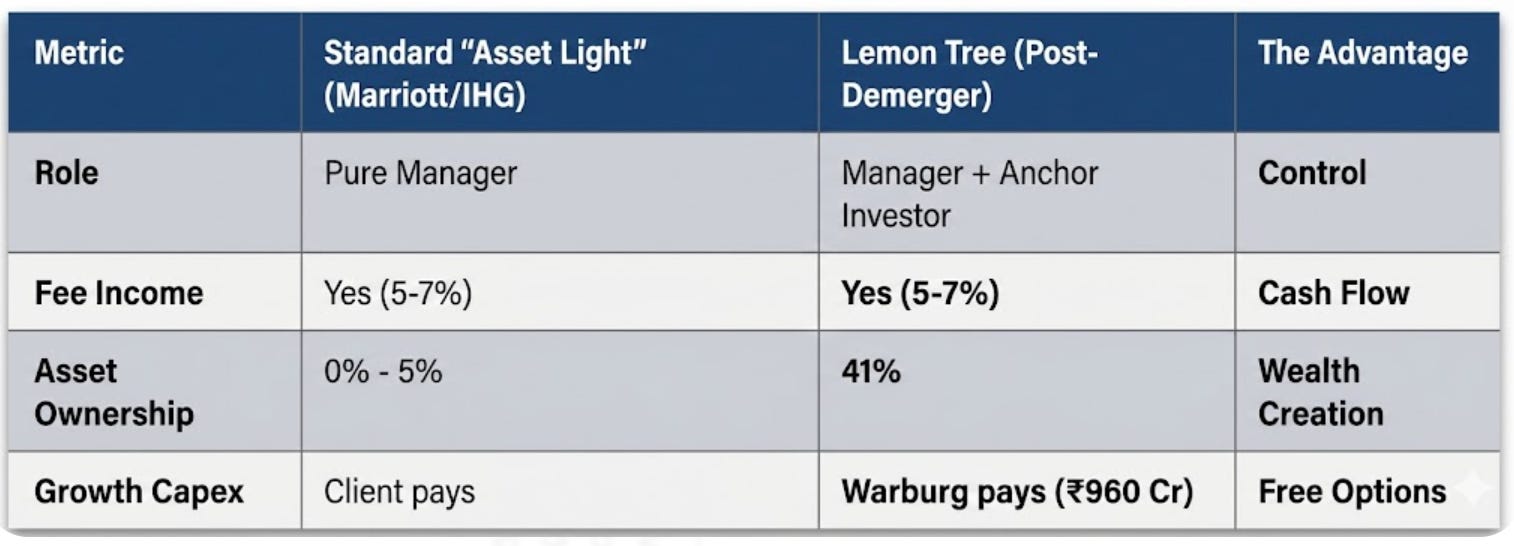
The headline “Lemon Tree becomes Asset Light” is misleading. Patanjali Keswani rigged the game to keep the best of both worlds: The Manager-Owner Hybrid.
The “Double Dip” Mechanism Post-demerger, Lemon Tree Hotels (LTH) gets paid three times on every single room night.
- Paycheck #1: The Risk-Free Skim (Top Line) LTH takes ~5-7% of Gross Revenue as Management Fees. This is “Senior” capital. It gets paid before the bank, before the staff, and before the taxman.
- Paycheck #2: The Equity Kicker (Bottom Line) LTH retains a 41% equity stake in Fleur Hotels. If the value of the land in Mumbai doubles, LTH captures 41% of that wealth creation.
- Paycheck #3: The “Free Growth” (The Capital Shield) Warburg Pincus is injecting ₹960 Crores of fresh equity into Fleur. LTH owns 41% of Fleur, but Warburg is funding the expansion. LTH gets a “free ride” on Warburg’s capital. Every time Warburg buys a new hotel, LTH gets a new management contract without spending a rupee.
The Jan ‘26 Update: The “U-Turn” Blueprint
The most dangerous thing in investing is sticking to a narrative that has changed. On January 15, 2026, Lemon Tree management hosted a call that scrapped their old playbook.
For the last six months, the mantra was “De-leveraging.” As of 48 hours ago, the mantra is “Re-leveraging for Growth.”
1. The “Old vs. New” Reality Check Management explicitly walked back three major promises. To the untrained eye, this looks like a failure. To the forensic investor, it looks like an aggressive pivot to capture market share while competitors are weak.
The “Pivot” Data Grid
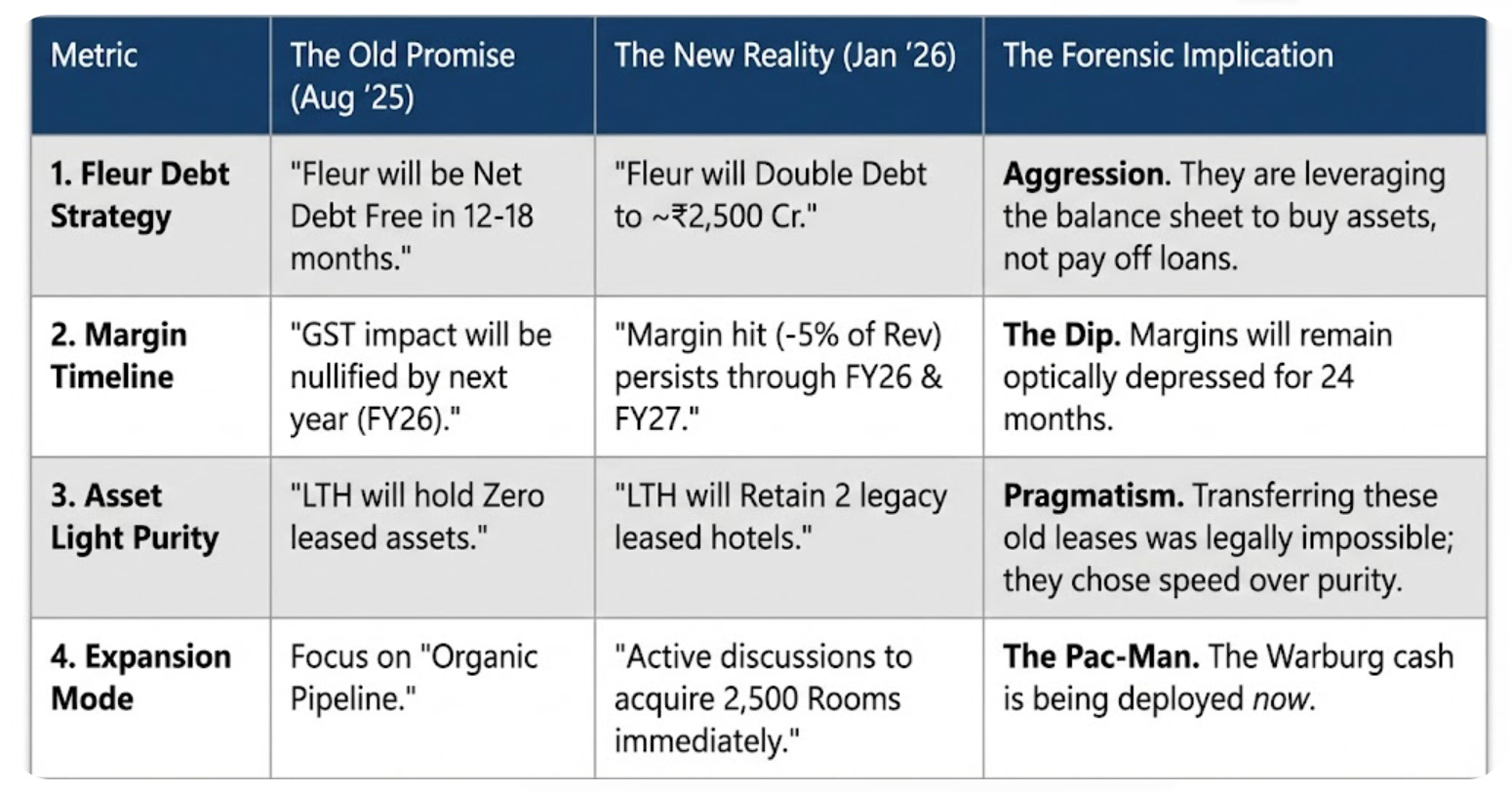
The “J-Curve” Projections (FY25 - FY29) Based on the explicit guidance of ₹1,000 Cr EBITDA for Fleur by FY28 , the financial roadmap has shifted from a straight line to a “J-Curve.”
The “Structural” Forecast (Consolidated View):
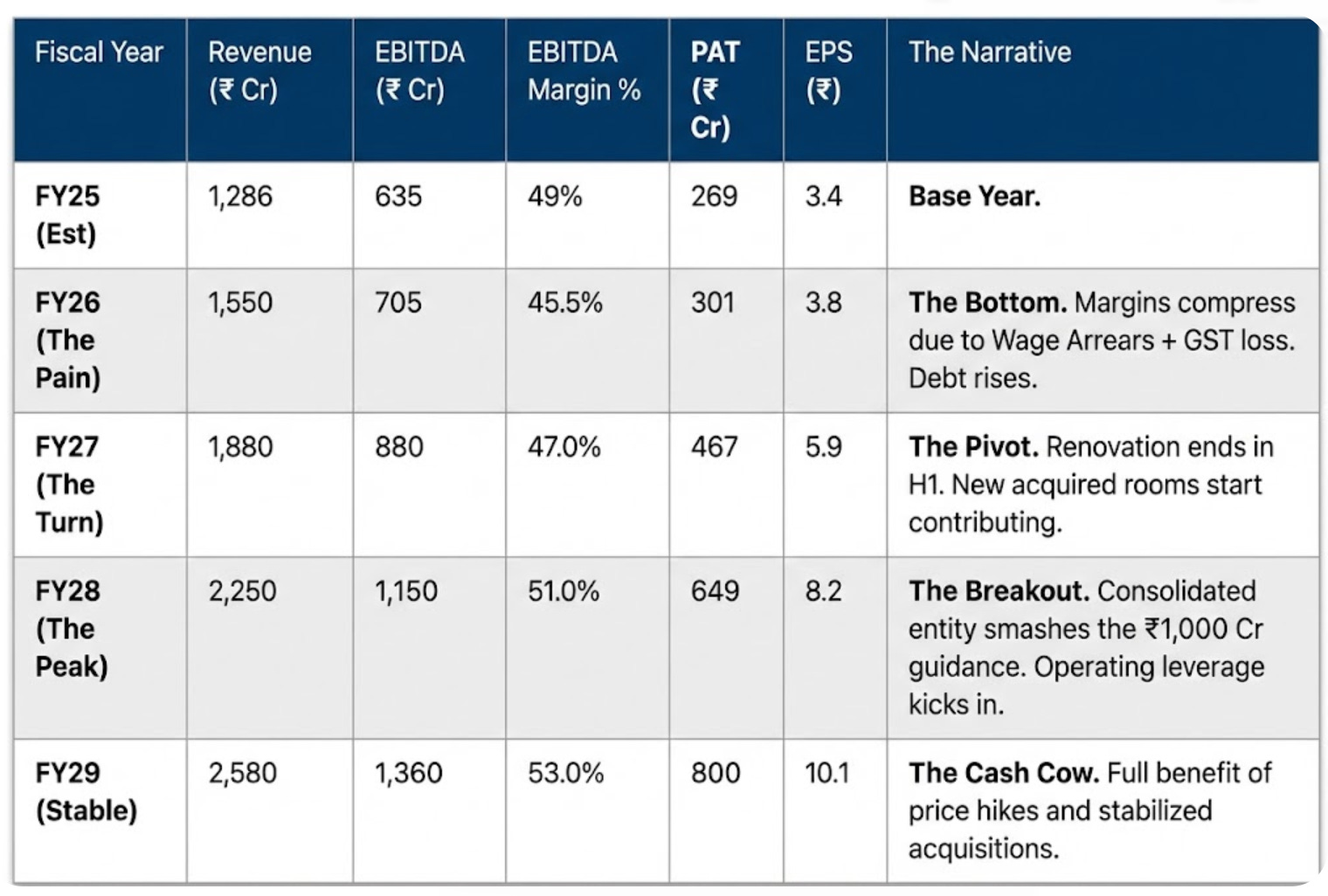
(Note: FY26/27 margins are adjusted down to reflect the management’s guidance of a 5% revenue headwind from GST and renovation costs.)
The Verdict: The market is selling the “U-Turn” because it hates the short-term margin pain (FY26). Smart money is buying the J-Curve . You are getting paid to wait for the aggressive capacity expansion (2,500 rooms) to hit the P&L in FY28.
The Valuation: Pricing the Machine
How to buy hotel stocks like a Private Equity Baron, not a Day Trader.
To value a hotel, you must answer two fundamental questions:
- The Asset Question: “Am I paying less for this building than it would cost to build it myself?” (EV / Key )
- The Cash Question: “Is the profit growth fast enough to justify the price tag?” (Forward EV / EBITDA )
1. The “Brick & Mortar” Test (EV / Key)
The Ultimate Margin of Safety.
This metric strips away the accounting noise. It tells you the raw price you are paying for every physical room key the company owns.
- The Rule: If EV/Key < Replacement Cost , you have a “Moat.” No competitor can build a new hotel to compete with you because their capital cost will be higher than your entry price.
The “Cost of the Keys” Benchmark (Jan 2026):
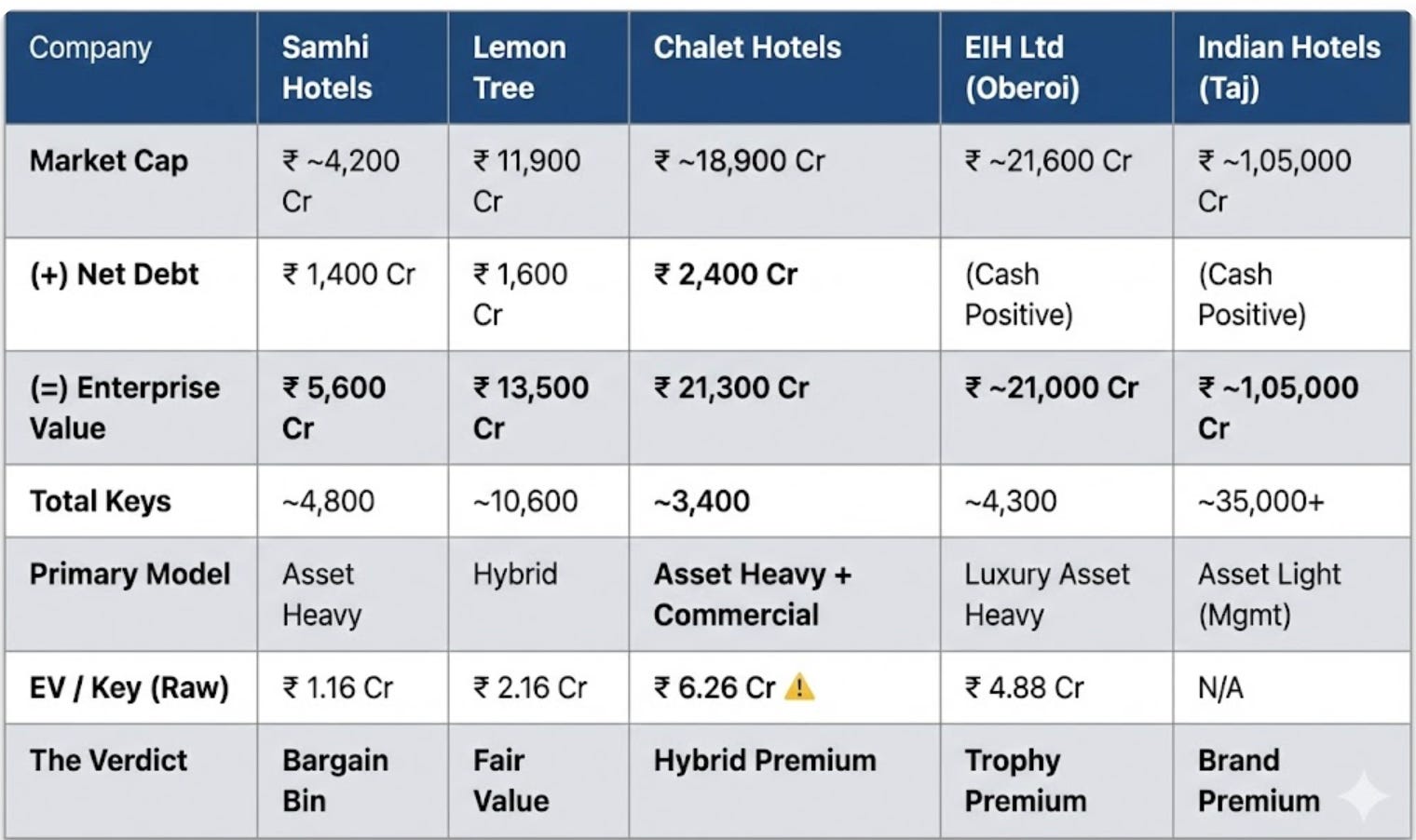
2. The “Cash Flow” Forecast (EV / EBITDA)
The Growth Justification.
Wall Street focuses on Trailing P/E. That is useless for hotels because renovations and one-time costs hide the true earnings power. You must look at the Forward EV/EBITDA (What are we paying for future cash flow?).
The Lemon Tree “Time Arbitrage” (The 3-Year View): Current Enterprise Value (EV) = ₹13,500 Cr.
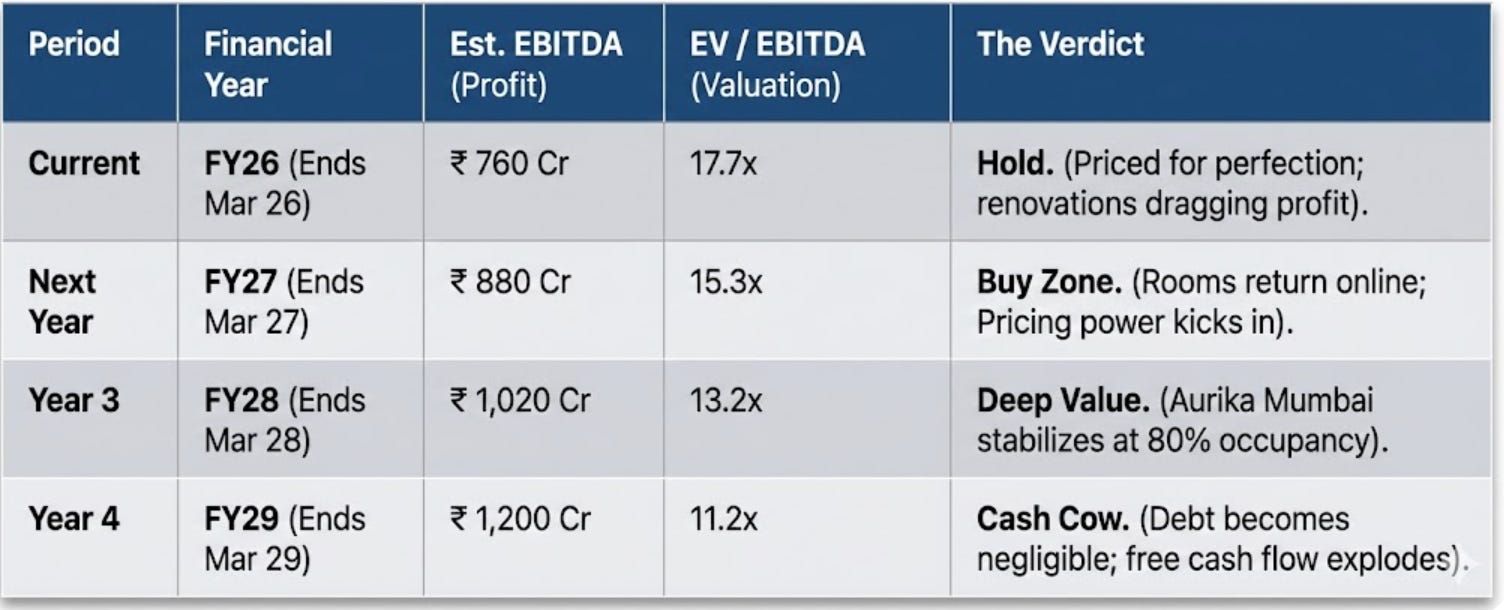
The World Class Verdict:
- The Trap: If you look at today’s screen, Lemon Tree looks expensive (18x EBITDA).
- The Opportunity: If you believe the cycle holds for 24 months, you are effectively buying the stock at 13x FY28 earnings today.
- The Rule of Thumb: Institutional investors typically enter Hotel Assets at 12x–14x forward EBITDA. The current price offers a clear path to that zone simply by holding through the renovation cycle.
3. Operating Leverage (The “Flow-Through” Effect)
- Concept: Once you pay the hotel staff and the electricity bill (Fixed Costs), every extra rupee from a room is ~70-75% pure profit.
- Where is Lemon Tree right now? It is sitting exactly on the “Tipping Point.”
The Real-Time Data (Q2/Q3 FY26 Data):
- Current Occupancy: ~69.8% (Just touching the magic 70% threshold).
- The “Hidden” Leverage: Currently, ~9% of their rooms are closed for renovation. This is artificially depressing their occupancy and margins.
The “Napkin Math” on Flow-Through: Right now, Lemon Tree’s EBITDA Margin is ~42-44% .
- Scenario A (Status Quo): They sell a room for ₹5,000. Cost is ₹2,800. Profit = ₹2,200.
- Scenario B (Pricing Power kicks in at 72% occupancy): They raise the price to ₹6,000 (a 20% hike).
- The cost to service that room stays ₹2,800 (Staff doesn’t get a raise just because you raised room rates).
- New Profit = ₹3,200 .
- The Result: Revenue went up 20% , but Profit went up 45% .
The Signal to Watch: Don’t just watch “Revenue Growth.” Watch EBITDA Margin expansion .
- If Revenue grows 15% but EBITDA grows 30%, the Operating Leverage has kicked in. (This is expected in FY27).
The Anti-Thesis: The “Premortem” (How We Lose Money)
1. The “Lynch” Risk: The Renovation Trap (Hidden Capex)
- The Insight: “Renovations always cost twice as much and take twice as long.”
- The Trap: Fleur buys a distressed hotel assuming ₹15 Lakhs/key for renovation. Once they open the walls, they find corroded plumbing and broken HVAC.
- The Blow-Up: The “Cheap Acquisition” becomes expensive. Return on Capital (ROCE) drops from 15% to 8%.
2. The “Buffett” Risk: The Capital Cycle (Asset Inflation)
- The Insight: “A low price for a bad company is worse than a high price for a good one.”
- The Trap: Too much PE money (Blackstone, Brookfield, Warburg) is chasing the same few “clean” distressed assets in India right now.
- The Blow-Up: Sellers double their asking prices. Fleur is forced to overpay (₹1.2 Cr/key) just to meet growth targets, destroying the arbitrage.
3. The “Munger” Risk: The Agency Cancer
- The Insight: “Show me the incentive, I will show you the outcome.”
- The Trap: LTH (Manager) wants Revenue (Fees). Fleur (Owner) wants Profit (EBITDA).
- The Blow-Up: In a downturn, LTH slashes room rates to fill beds. They keep their fees intact, but Fleur bleeds cash.
4. The “Macro” Risk: The Margin Squeeze (Wages)
- The Insight: Revenue grows, but the bottom line flatlines.
- The Trap: Aggressive minimum wage hikes in Maharashtra/Karnataka (~25%) squeeze operating margins from the bottom up.
- The Blow-Up: Inflation eats the top-line growth before it ever reaches the shareholder.
5. The “Regulatory” Risk: The ₹7,500 GST Trap (The Invisible Handbrake)
- The Insight: “Low taxes for the customer can mean high costs for the business.”
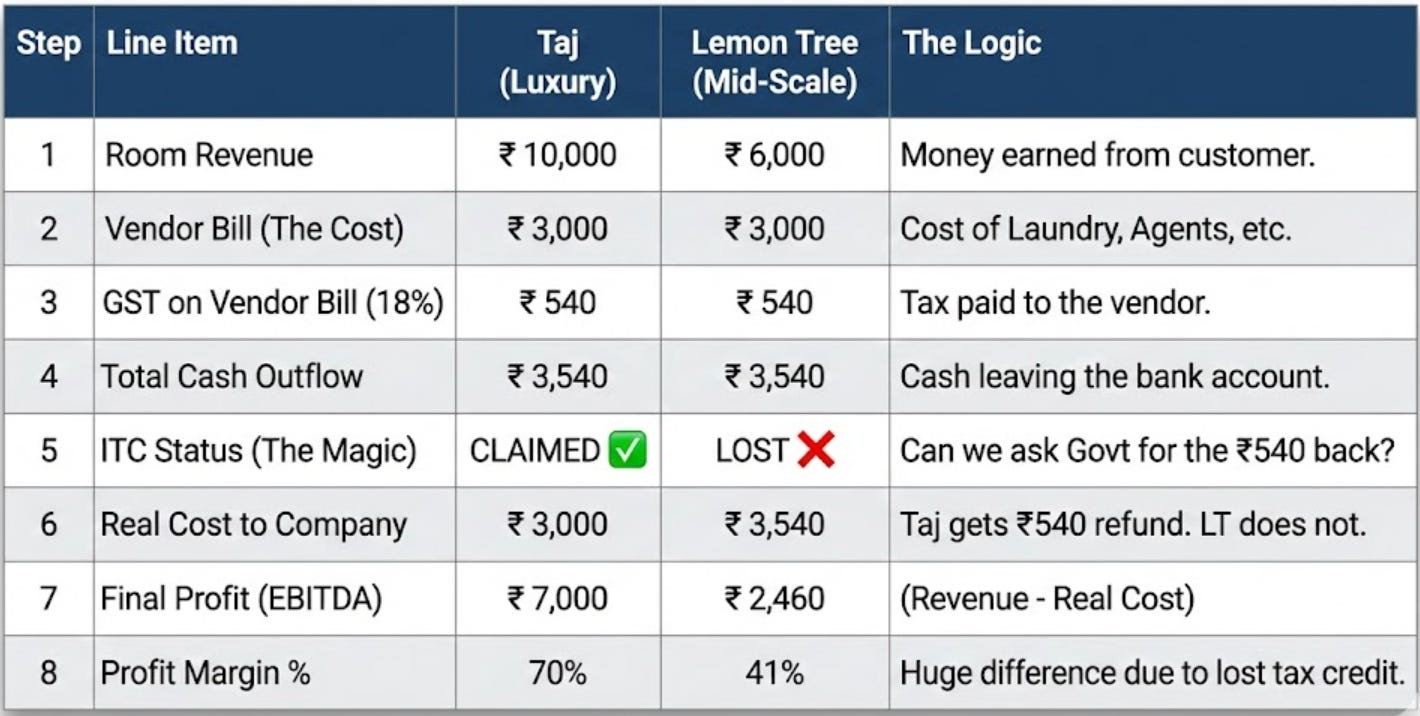
- The Trap: The “Inverted Duty Structure.” When a room sells for <₹7,500, the GST is 5% (without Input Tax Credit). However, the hotel still pays 18% GST to vendors (Booking.com commissions, laundry, rent). Because they cannot claim ITC, this 18% becomes a sunk cost rather than a refundable asset.
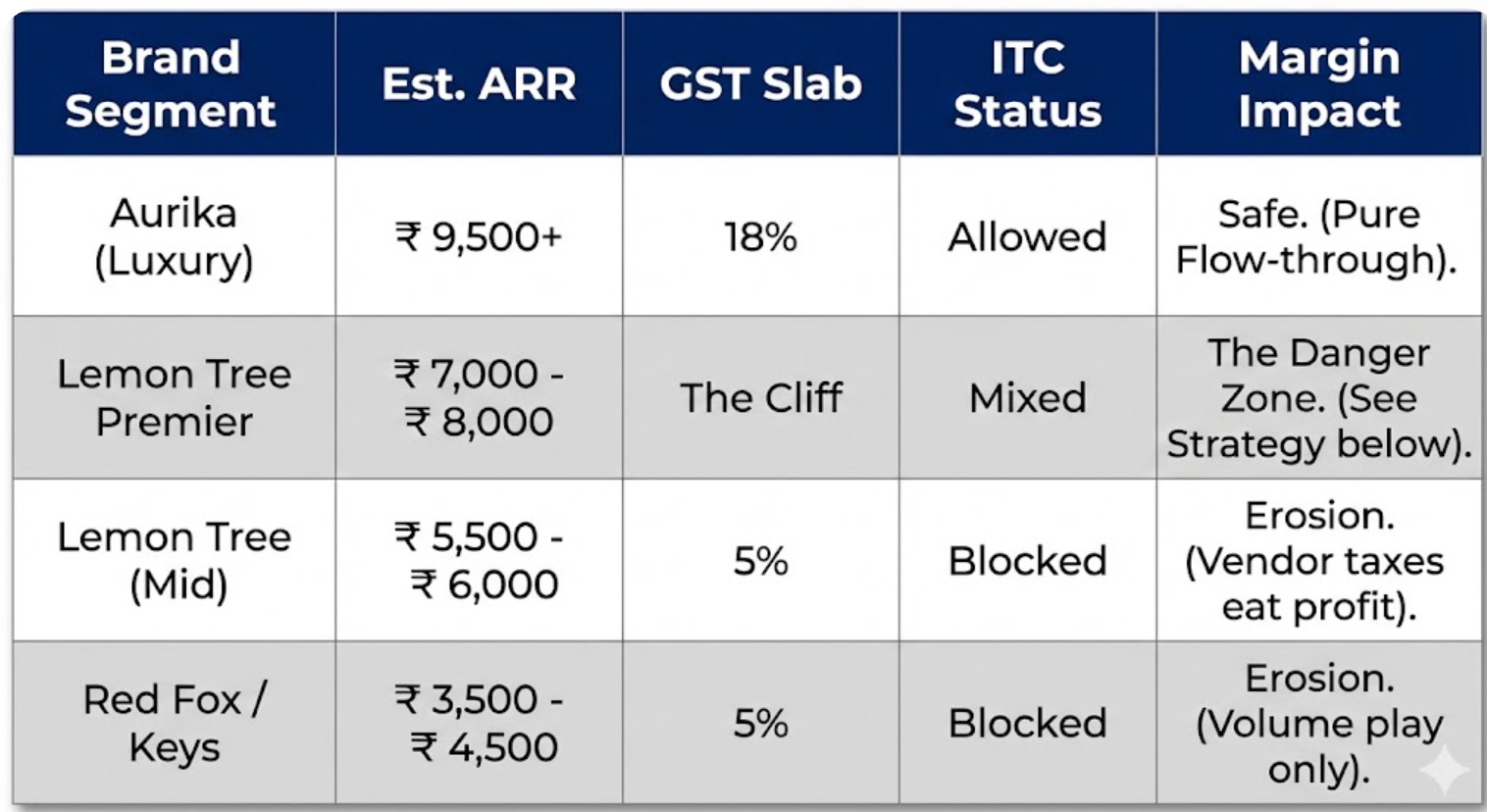
- The Blow-Up: This creates a structural margin drag of 300–400 basis points (3-4%) compared to luxury peers like Taj who claim full credits.
- Forensic Audit (The Margin Bleed):
- Blended ARR: ~₹6,247 (Deep in the “No-ITC” danger zone).
- Exposure: ~65% of inventory (Red Fox, Keys, Mid-Scale) sits in this trap.
- The Consequence: The company is effectively bleeding ~3% margin on 65% of its revenue. This is why EBITDA margins struggle to cross 50% even as occupancy hits record highs.
Lets take Taj vs Lemon Tree For Example
6. The “Graham” Risk: The Valuation Trap
- The Insight: The market can remain irrational longer than you can remain solvent.
- The Trap: The market refuses to value the 41% Fleur stake, assigning it a permanent 60% “Holding Company Discount.”
- The Blow-Up: The stock remains stuck at 30x Fee Earnings, and the “Asset Value” never reflects in the price.
The Final Verdict: The Asymmetric Bet
If you zoom out, the Lemon Tree thesis is not really about hotels. It is a structural arbitrage on the two biggest forces shaping the Indian economy in the 2020s: Inflation and Inequality.
While the industry tries to fight these forces, Lemon Tree has weaponized them.
- Wage Inflation: They bypassed it by hiring a workforce the market ignored (The Missionary Moat).
- Asset Inflation: They captured it by owning the bricks before the cement prices doubled (The Inflation Fortress).
- Capital Scarcity: They solved it by bringing in the “Architect” (Warburg Pincus) to fund the war chest.
The Synthesis: Why the Market is Wrong The market is currently pricing Lemon Tree as a “Mid-Scale Hotel Chain” facing margin pressure in FY26. That is the noise. The Signal is that Lemon Tree is transforming into a Specialized Real Estate Asset Manager .
 Investment Status & Thesis
Disclosure: Invested with Allocation: 3-4%
Thesis Written On: Jan 17, 2026
Current View: Biased due to holding.
Strategy & Risk: This is not a “Coffee Can” compounder; it is a Special Situation / Turnaround bet. The thesis rests entirely on the successful execution of the “U-Turn” strategy (leveraging up to acquire distressed assets).
Formal Disclaimer
I am not a SEBI-registered research analyst or investment advisor. Nothing in this post constitutes investment advice, a recommendation, or a solicitation to buy or sell securities. All cited facts are sourced from the company’s official filings and the Q2 2025 earnings call
Please conduct your own thorough due diligence before making any investment decisions. Your capital, your responsibility.
Reference
11 Likes