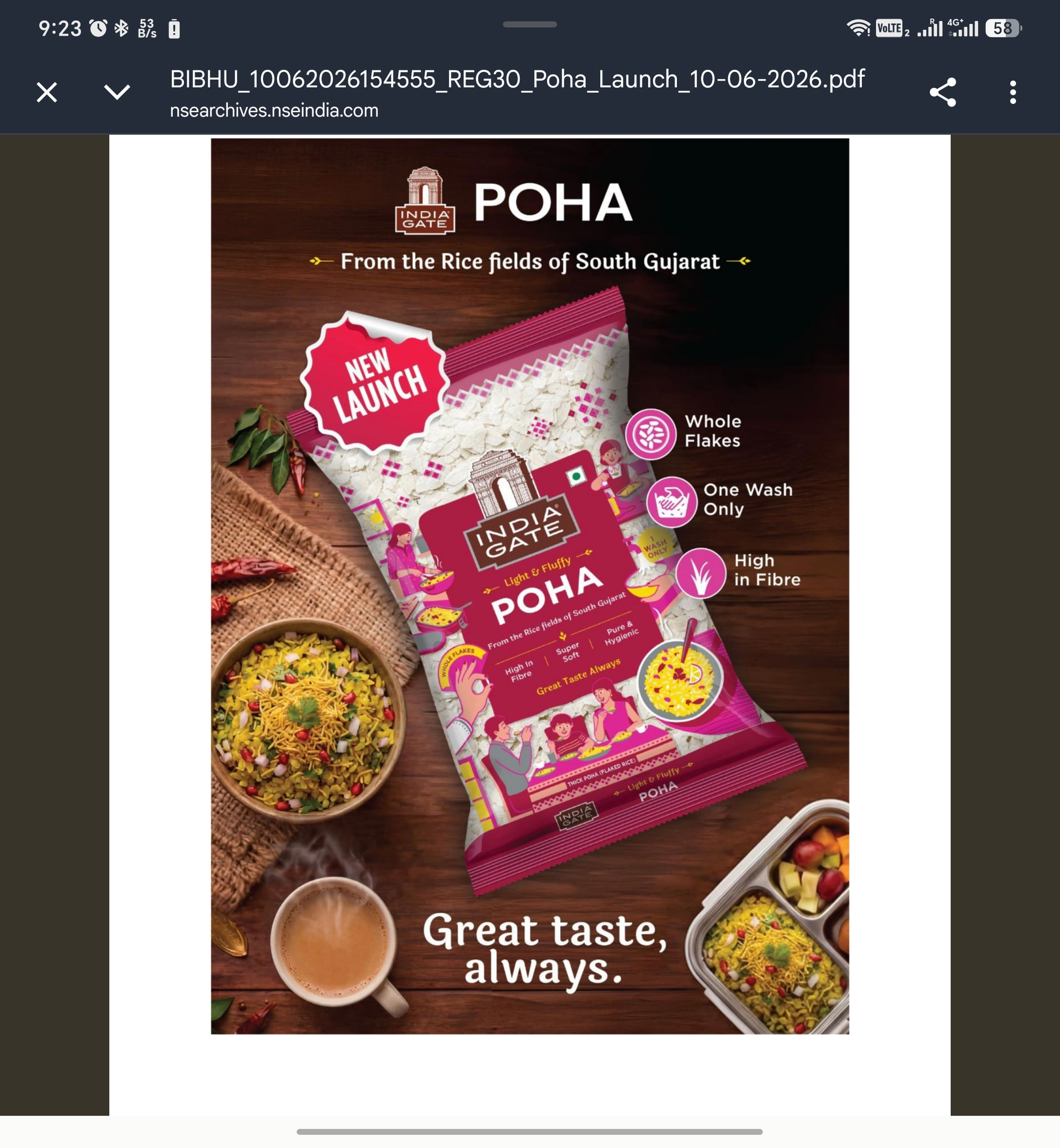
KRBL- The King of Basmati rice

63c54f35-be48-4c02-a533-fcf095d491fd.pdf (7.1 MB)

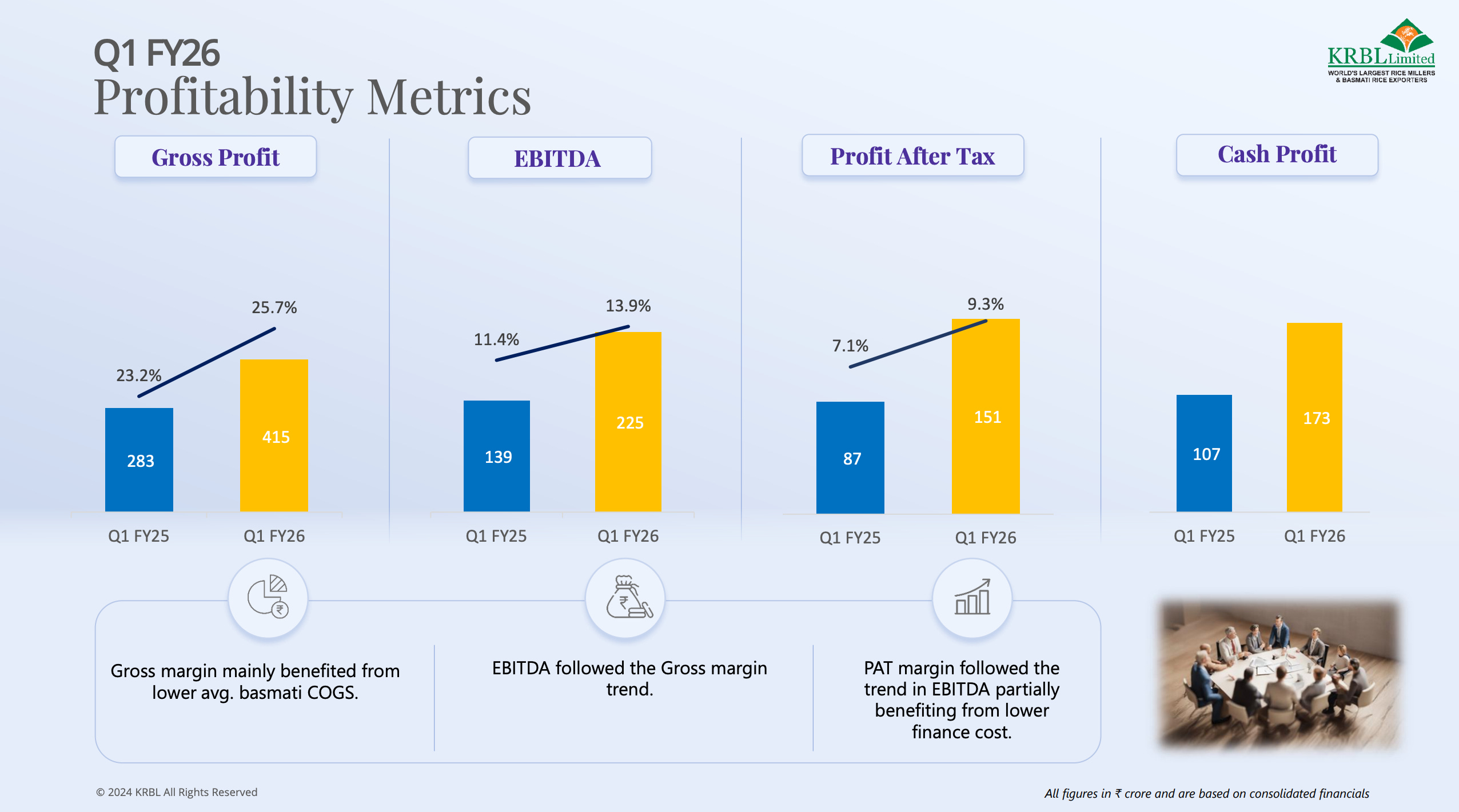
Good results both QoQ and YoY basis. The company has been a target of a concentrated effort to malign its reputation. AZB partners would not risk their reputation by offering them a clean chit in the corp governance issues cited by the Ex- Independent director. The company is now chepaest on Net Worth basis( 5482 Cr, Mcap 7884 Cr on 30.09.25) The market reaction to both the result announcement and AZB reports has been quite positive but we need to watch for few more days beofre arriving at any conculsion whether the stock would hold at current level or not. Their result presentation shrugs away any traces of a family owned enterprise and points to being as good as any MNC when it comes to reaching consumer mind.

Investor Presentation:
91af1cfa-681e-430e-a7e4-fc8ec620ed8e.pdf (6.7 MB)

3 Likes

Earlier this year, I published an investment research note on KRBL—the world’s largest basmati rice miller and owner of the iconic India Gate brand.

Note: I am no longer registered with SEBI. This analysis is for educational purpose only.

This is that note, followed by what happened next.

I’m sharing both parts because the lessons are inseparable. The analysis was solid. The outcome was not what I expected. The gap between those two statements contains something worth examining.

Part 1: Original Thesis

Why Nobody Wanted It?

Commodity product. Pursued by Enforcement Directorate in AugustaWestland / money laundering case. Failed to capitalize/grow their largest market. Has disappointed/not fulfilled their promise in the last 4-5 years. Mediocre financial performance. Has most of its working capital tied in inventory - high inventory days. Poor revenue and profit guidance. These signs are enough to reject an investment idea.

One would reject a business on the first two points alone, and indeed, most investors have done exactly that with KRBL. However, peeling back these surface-level concerns reveals a fundamentally strong business with decent competitive advantages hiding in plain sight.

The Business

KRBL is the world’s largest basmati rice miller and exporter with its flagship “India Gate” brand commanding premium pricing. KRBL has 36-37% market share in branded Basmati in India. The company has built a vertically integrated business model spanning the entire value chain from seed development to distribution, creating multiple competitive advantages.

Risks

  1. The company is experiencing some margin pressure, with EBITDA margin declining to 12% in Q3 FY2025 from 14.1% in Q3 FY2024, and gross margin affected by higher input costs (4% average basmati COGS increase vs. flat realization) and lower other income.
  2. Continued negative perception about the business: The negative perceptions regarding the business have created a material disconnect between its valuation and the underlying business economics. There is no certainty that this perception will change in the near future. In all likelihood, this one will test the patience of investors who call them long-term. A few good value investors have been waiting for the perceptionturnaround since 2019.

Troubled History

KRBL used to be valued like other FMCG companies before 2018 until the lightning struck.

In 2018, KRBL faced scrutiny due to its former independent director, Gautam Khaitan, who was implicated in the AugustaWestland VVIP chopper scam . The Enforcement Directorate (ED) alleged that funds linked to the scam were routed through a Dubai-based step-down subsidiary of KRBL, RAKGT. ED froze Balsharaf’s (Saudi investor) KRBL shares in 2018, claiming proceeds from the AugustaWestland scam.

The High Court ruled the freeze unlawful, noting Balsharaf acquired shares in 2003 - 5 years before the alleged crime. The High Court noted that RAKGT was no longer directly connected to KRBL in India.

In 2019, the Income Tax department slapped a Rs. 1,270 crore tax demand notice. After 12 months, the notice was reduced to Rs 101 Cr.

No charges have been filed against KRBL or its directors despite over seven years of investigation.

Read more about the case - KRBl Governance | Candor Investing

The market’s fixation on these apparent negatives has created a compelling opportunity for investors willing to look deeper and take a contrarian view based on business fundamentals rather than sentiment.

KRBL represents a fundamentally strong business currently clouded by market prejudices regarding a commodity business, high inventory, poor management efficiency, and legal issues - creating an attractive entry point for long-term investors. At current valuation levels, the risk-reward is favourable even if we value it as a cyclical commodity business rather than a premium branded FMCG player.

In the words of Prof. Sanjay Bakshi “The opposite of a good idea can also be a good idea.”


What Bears Overlooked

  1. Entry barriers: Basmati rice has a Geographical Indication (GI) tag, limiting production exclusively to the Indo-Gangetic Plain Despite some competition from Pakistan, India maintains approximately 85% of global basmati exports, with KRBL as the dominant Indian player. Maintaining its signature aroma requires specific growing conditions only available in this region .
  2. Market leadership : KRBL holds the largest market share in India’s branded basmati segment (36-37%), with management targeting 45% in the coming years. This dominant position provides economies of scale in procurement, processing, and distribution. The company’s “India Gate ” brand commands an 8-15% premium over competitors due to quality perception built over decades.
  3. Procurement expertise : Managing the complex 90-day harvesting window for 1.2 million tons of paddy requires significant logistical capabilities. KRBL processes approximately 700 trucks daily during procurement season, requiring experienced purchasers who can quickly assess the quality and make bidding decisions across 300-400 mandis (markets) in Haryana, Punjab and UP.
  4. Aging Process and Infrastructure: KRBL maintains capacity to warehouse rice for up to 2 years, while competitors typically age for only 8-9 months. This extended aging enhances aroma and quality but requires substantial capital investment in warehousing facilities and locks the working capital in inventory.
  5. Inventory as a strategic asset : High inventory isn’t inefficiency but a competitive advantage - aging improves quality and enables premium pricing (like wine or whiskey aging)
  6. Distribution Strength: The company has expanded its distribution network to over 850 distributors nationwide with retail presence in over 400,000 outlets (as of Q3 FY2025).
  7. Brand loyalty: Basmati has strong brand appeal, particularly in biryani-eating regions e.g. Southern India and Middle East where consumers demonstrate high brand loyalty and reluctance to switch.
  8. Strong getting stronger: KRBL management has strengthened its balance sheet considerably over the years. The company is debt free as on December 24. What appears to be high inventory on KRBL’s balance sheet is actually a strategic moat. Longer aging of rice allows for premium pricing and creates a barrier to competition.
  9. Difficult to operate business: Major players like HUL, ITC, and PepsiCo have entered and exited the basmati market, demonstrating high entry barriers. The recent struggles include Kohinoor and Adani Wilmar. This business requires tight control and skin-in-the-game which most others lack.
  10. Resilience: KRBL got struck by lightning twice (ED allegations and distributor bankruptcy in Saudi Arabia). Despite these crises, the company has grown its market share in India.

Valuation

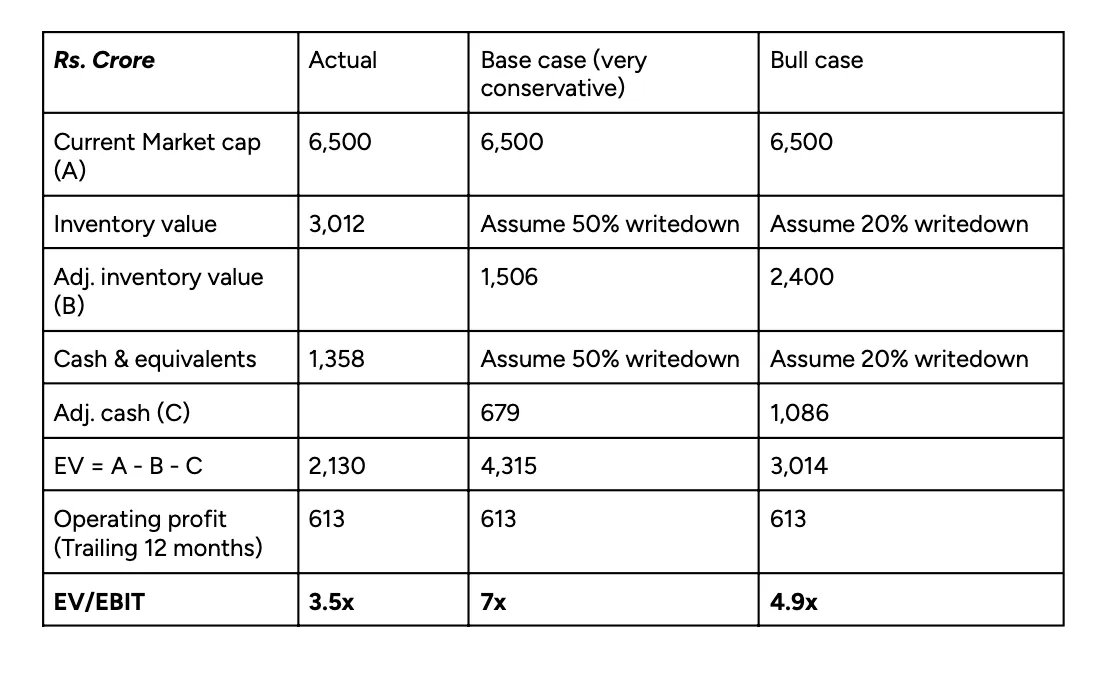
At the current market cap of Rs. ~6,500 crore, KRBL’s valuation requires careful consideration of its inventory-heavy business model.

Without getting into future projections and speculation, the current valuation offers a significant margin of safety. We’re essentially looking at buying a robust business close to its depreciated book value. The valuation discount is particularly striking when comparing KRBL to other branded consumer businesses in India, which typically trade at much higher multiples.

On a conservative side, let’s assume that it’s not a branded play and rice is like sugar (where consumers don’t care about the brand). Even with this conservative assumption, the downside in intrinsic value is limited.

Competition

The closest competitor to KRBL is LT Foods, which sells Daawat basmati rice. Incorporated in 1990, LT Foods has evolved from a small trading company into a global consumer food franchise specializing in basmati and specialty rice. It has demonstrated exceptional financial performance, outpacing KRBL with:

  • Revenue CAGR of 14.8% over FY19-24, compared to KRBL’s 5.5%
  • EPS CAGR of 34% over FY19-24, exceeding KRBL’s 4%

So why not look at LT Foods? While LT Foods is a good business (possibly better than KRBL), the present valuation of KRBL offers more margin of safety. Moreover, I prefer companies with extremely strong balance sheets. Another listed competitor, Chaman Lal Setia, is primarily a trading company and has limited branding and pricing power. Chaman Lal Setia predominantly sells in bulk packaging, which further restricts its ability to command premium pricing in the market.


Everything in Place

My reasoning was that one of the catalysts could trigger re-rating

  • Legal resolution. Seven years without charges - eventual closure of the ED case would remove the governance overhang.
  • Institutional interest. With the stock having underperformed for years, any signs of turnaround could bring institutional capital back.
  • Business momentum improving. Company has been gaining market share in the basmati and regional rice segments in India driven by strong distribution across general trade and modern channels.
3 Likes

What are your views on their foray in real estate business.

I believe while the business was available cheap, and stock struggling for all the reasons mentioned, the management did a self-goal with the real-estate business. Practically everybody was raising concerns in teh last call, but the management seemed indifferent. We could say the management knows their business better than outsiders, but this seems like a big mis-step, call it poor capital allocation. And hence, the stock may continue to languish until there are signs that the real-estate is proving to be profitable. If they announce that they will not enter real estate, stock may rerate sooner.

Disc: Not invested

1 Like

Part 2: Belief Calibration

My thesis seemed to be playing out. The company had returned to growth after struggling for 2-3 years. I had been studying this business for over two years. Convinced by the quality and resilience of the business model, I kept buying. It became my largest holding.


The Icing

Management disclosed a large asset monetization plan for their Ghaziabad plant—~150 acres valued at ₹4,000 crore currently, potentially ₹7,500 crore by the time of shift. The plan was to move the plant 50-80 km away near Meerut over 2.5-3 years and develop the Ghaziabad land into a township. They would tie up with a developer. KRBL would retain majority economics.

This made sense. Asset-light value unlock. Let someone else do the heavy lifting.

I was elated. The downside to my base case valuation was now further protected—the company could unlock value from this land bank whenever they wanted.

The Crack

Just when everything seemed to be falling into place, lightning struck again. Albeit, it was caused by internal, rather than an external factor.

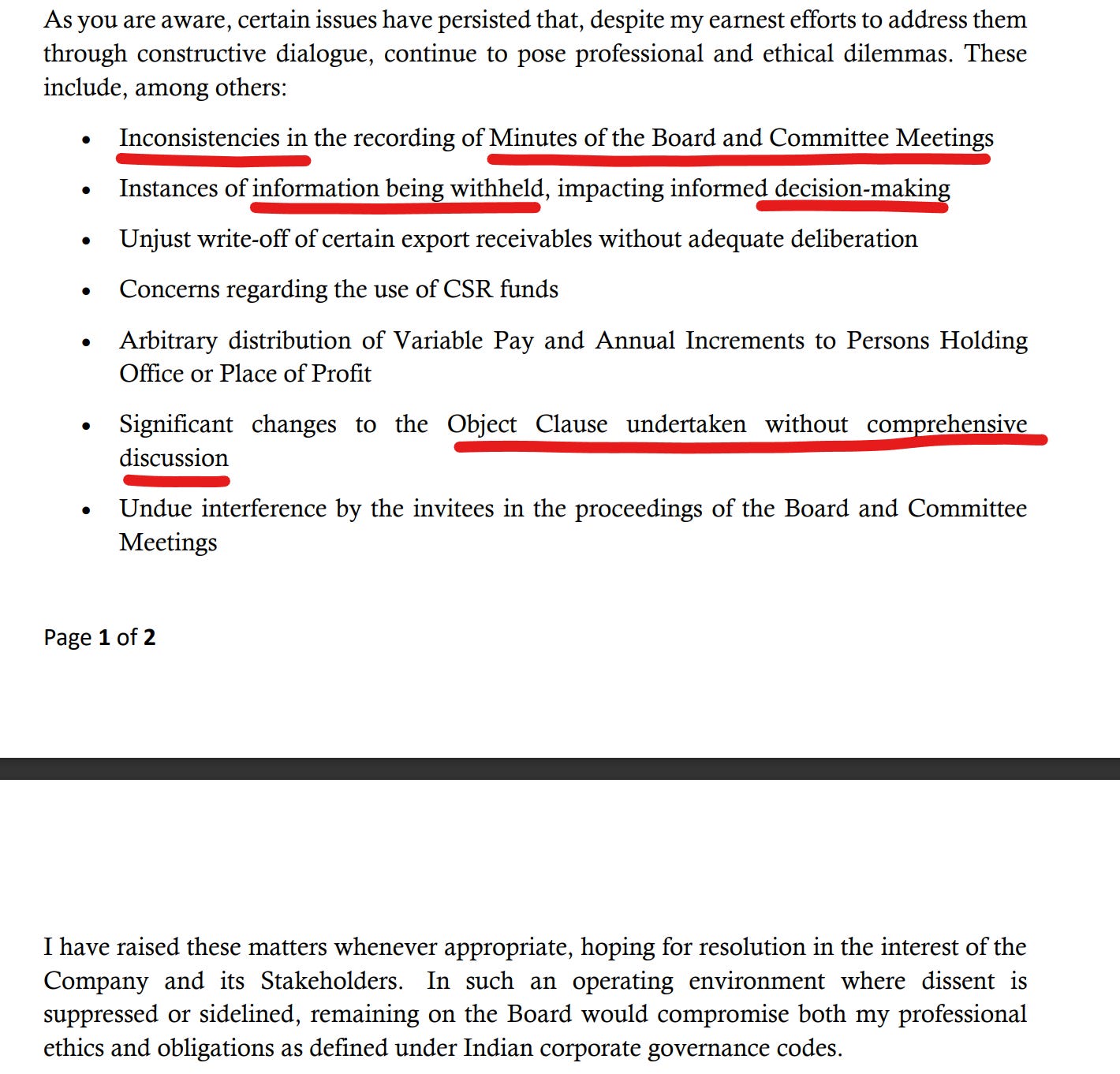
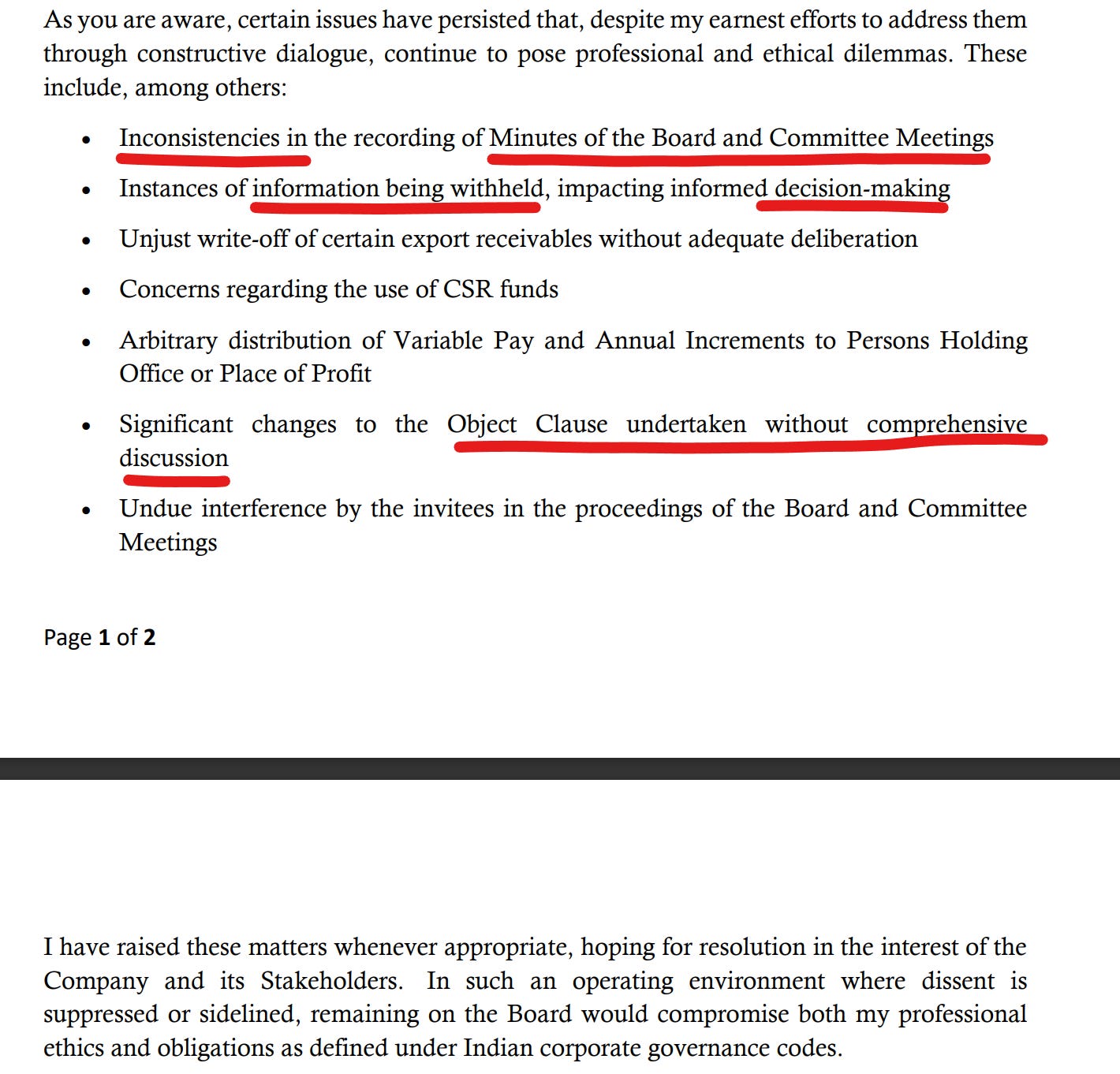
An independent director resigned on September 8. The company disclosed the resignation letter to stock exchanges on September 13—a gap of five days. The letter dropped like a bomb. It cited multiple concerns: inconsistencies in board minutes, information being withheld, unjust write-offs, and an environment where “dissent is suppressed or sidelined.”

|532x510.27042253521125

Source: Intimation to Stock exchanges

This was unusual. Independent directors rarely cite specific reasons for resignation. The standard template is “personal reasons” or “to pursue other opportunities.” This was neither.

I was nervous. It was a couple of sleepless nights as I tried to ascertain the severity. I spoke to a few fellow investors. The consensus was that this could be a personality clash, or perhaps a disagreement that got out of hand. Don’t read too much into it - this is a business run by Indian promoters. Mediocre governance is already priced in. Anyway, the governance quality advertised in glossy annual reports of most promoter-run firms is mostly overstated. It’s the promoters who call the shots.

The market’s short-term negative reaction was expected. That didn’t worry me. What worried me was the continued cloud over governance. I decided to take it slow. The downside was limited. No need to panic.

The company arranged an investor concall to address concerns. The CMD dismissed the allegations as “all wrong and false.” Suggested the director had become “hostile.”

Subsequently, they announced that AZB & Partners—a reputed law firm—would conduct an independent review of board practices.

I wanted to give management the benefit of doubt. The business fundamentals were strong. Stay focused on what matters.


The Turn

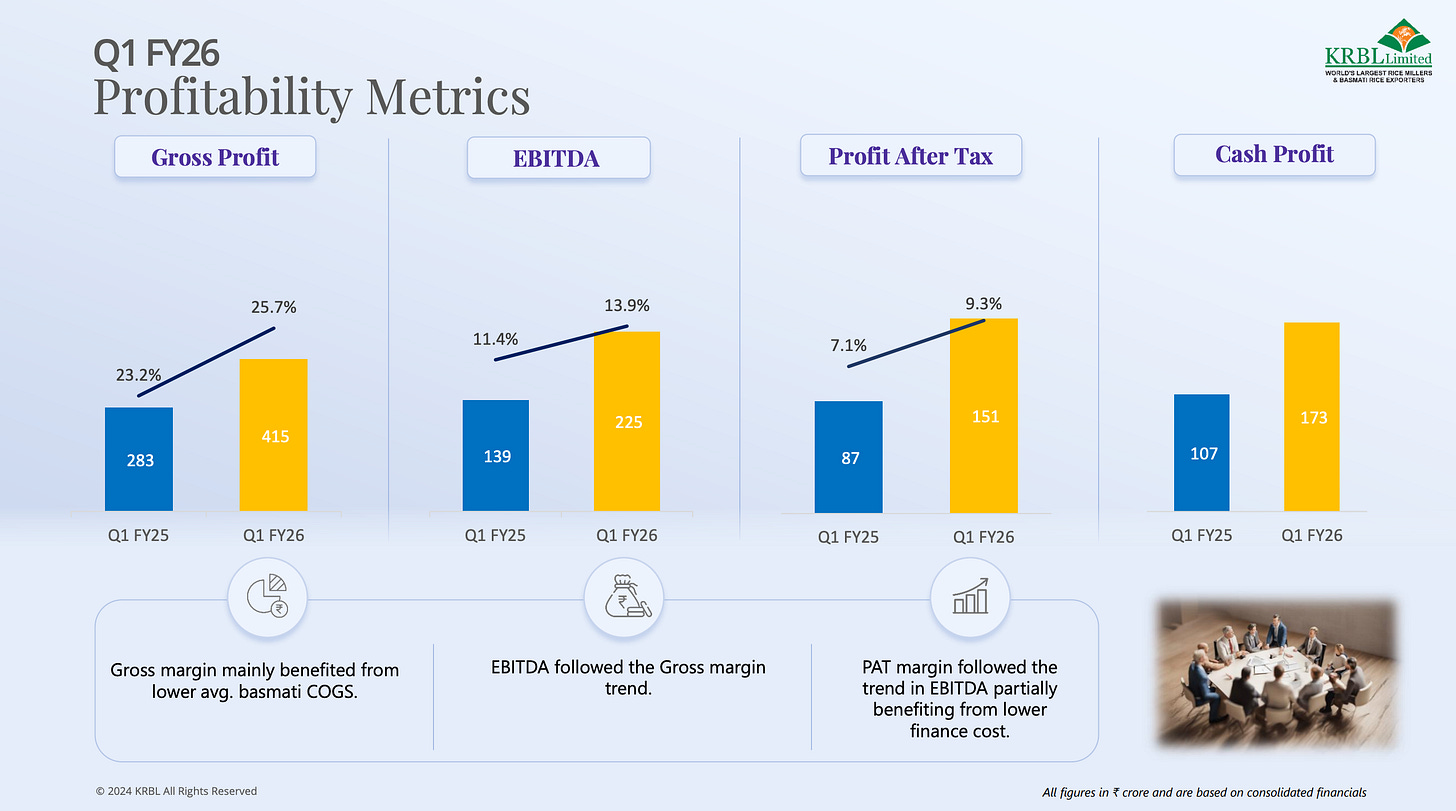
KRBL delivered a solid performance in the Q2 FY26. Income up 18%, Gross margin improved by over 5 percentage points. Inventory situation improved - resulting in cash and equivalents of over Rs. 2,000 Crore.

But buried in the CMD’s opening remarks was a horror story in the making:

“Built on our strong financial position and healthy internal accruals, KRBL is now set to enter the real estate sector as a strategic step towards long-term value creation.”

They announced that they have acquired a land parcel through NCLT at a distressed valuation. They plan to trade Rs. 1,000+ crore of such assets over the next 3-4 years.

In August, the story was that we would monetize the factory land, that’s it. That story lasted just three months.

An investor asked the obvious: “If funds aren’t utilized well, return cash to shareholders through dividends. They can invest in real estate companies themselves.”

The rationale of not returning cash to shareholders? Dividends and buybacks are not tax-efficient.

The company has been reluctant to return cash via dividends. KRBL had massive headroom for FMCG growth - making tuck-in acquisitions in adjacent categories or returning surplus cash through buybacks. Even failed FMCG acquisitions would have been better; at least the market would value the company as a consumer business with growth optionality.

₹2,100 crore in cash. Market cap ~₹9,000 crore.

Imagine if management had announced a ₹500 crore special dividend, a ₹300 crore buyback at depressed prices, ₹200 crore for strategic FMCG acquisitions.

Same ₹1,000 crore outflow.

But the stock could possibly have re-rated. If market cap reached ₹15,000 crore (still at discount to its peers in FMCG), the promoters’ 60% stake would be worth ₹3,600 crore more.

Everyone wins.

Instead, they chose to deploy cash into a business where they have no competitive advantage, returns are uncertain, and the market will apply a conglomerate discount.


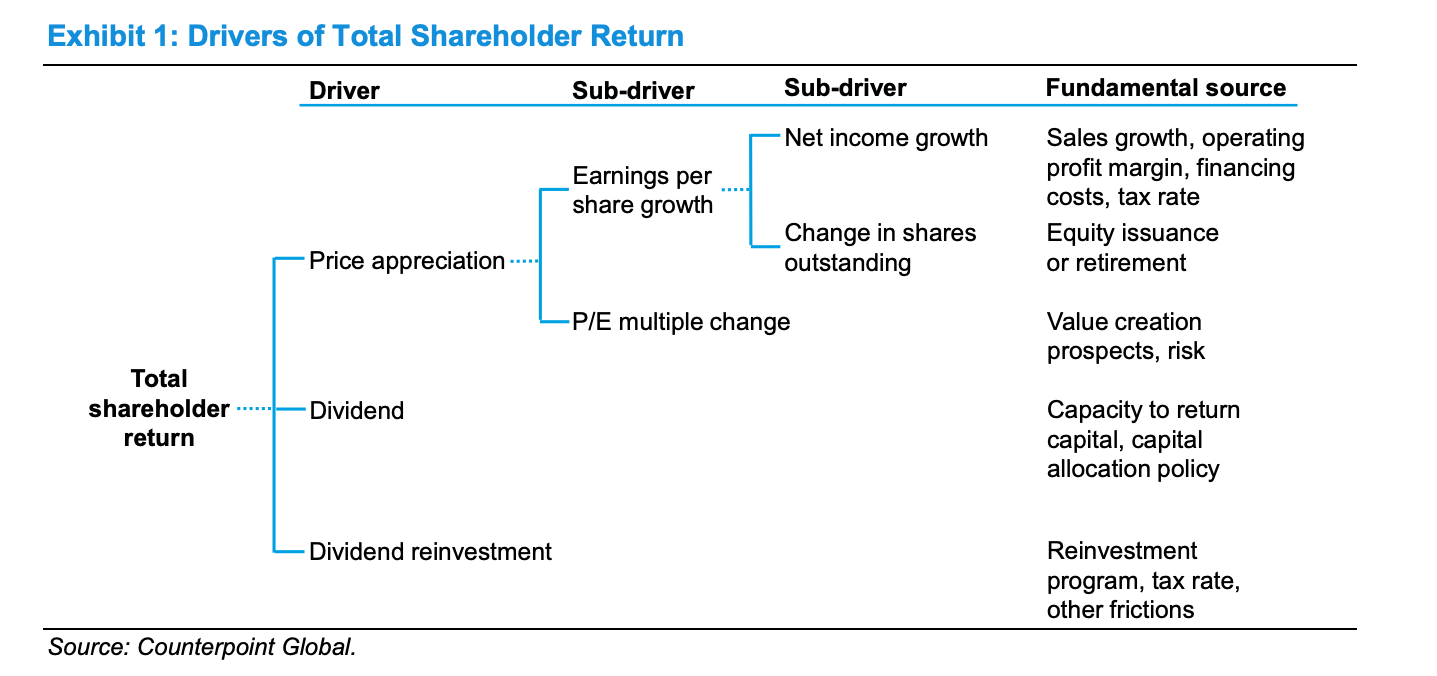
Investing 101: What Drives Shareholder Returns
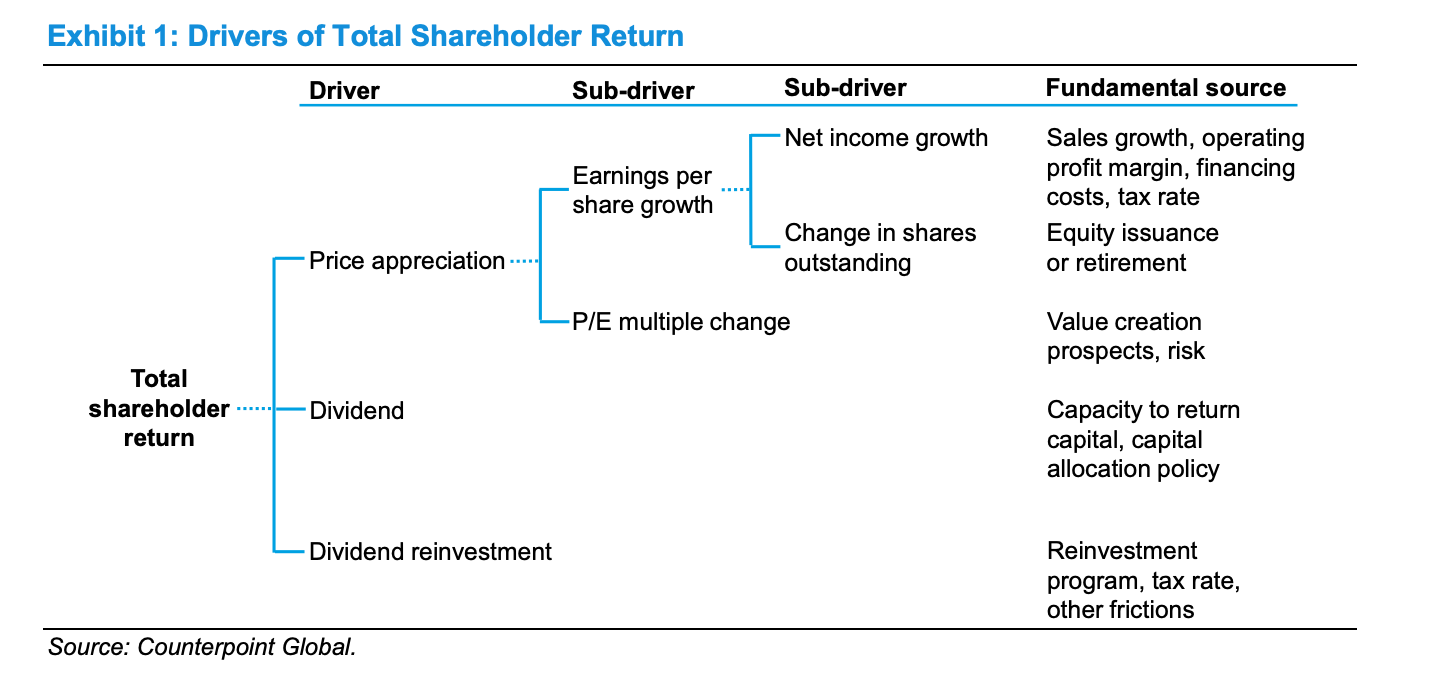


Source: CounterPoint Global / MS

Putting this in simple equation

Price = Earnings × Multiple (aka PE or PB or PS ratio)
P = E × M

Therefore, price return decomposes into:

ΔP/P ≈ ΔE/E + ΔM/M

Price Return ≈ Earnings Growth + Multiple Change (Re-rating)

Minority Shareholder Value Creation

Value Creation = Price Appreciation + Capital Returns

Value Creation = (Earnings Growth + Re-rating) + (Dividends + Buybacks)

The KRBL Problem

For significant re-rating (ΔM > 0) in this case, we would need institutional capital flowing in. But institutions are unlikely to allocate to companies where management isn’t aligned with them.

Which means:

Value Creation = Earnings Growth + 0 + 0
                      ↑          ↑   ↑
                  (business)  (re-rating) (capital returns)

KRBL delivered earnings growth. But without re-rating AND without capital returns, minority shareholders are left holding a business that compounds intrinsic value that they can never extract.


The Structure Problem

Promoter-backed companies have created enormous wealth in India. But there are many horror stories of poor capital allocation and minority shareholder treatment.

The issue isn’t promoter ownership—it’s concentrated power without adequate checks.

In a recent episode of Everything is Everything , the hosts make a simple observation: when power is concentrated in one person, the quality of decisions is generally inferior.

Good decisions require disagreement, many minds, checks and balances.

A dominant shareholder doesn’t have these constraints. More damning: “How do we make sure that 40% minority shareholders get 40% of the cash?” They call this a pervasive problem in how many Indian firm works.

The dominant shareholder often extracts more than their proportionate share of value—not through fraud, but through capital allocation choices that prioritize family interests over minority returns.

KRBL’s real estate move isn’t unusual. It’s structural. The incentives of a 60% owner are not the incentives of a 40% minority holder. I should have weighted this more heavily from the start.

In one of the interviews, promoter’s son sang praises of Harsh Mariwala and said they want to build an organization like Marico.

Marico has razor focus on capitalizing their core strengths. Marico returns cash to shareholders. Makes strategic acquisitions within their competence. Doesn’t become a real estate developer because treasury yields are low.


The Tuition

Being contrarian for the sake of being contrarian is stupid. Some businesses deserve cheap valuations - not because the market is wrong about the business, but because the market is pricing in something else correctly; management behavior in this case.

Just because it’s listed doesn’t mean it’s investible. A stock can have excellent fundamentals and still be a poor investment if there’s no pathway for value realization. This deserves a separate piece that I intend to write about soon.

There is a distinct difference between a lifestyle business and a professionally run company. In a lifestyle business, the company exists to support the family. In a professionally run company, management exists to create value for all shareholders. KRBL’s actions reveal which category they belong to.

When facts change, update the probabilities. I had an investment thesis with multiple catalysts. When the independent director resigned citing governance concerns, that was new information - the probability of management alignment shifted downward. When management announced real estate diversification, that was decisive information - the thesis became invalid. Waiting for certainty is a mistake. Each new piece of information should update your view, not get rationalized away.

Watch what they do, not what they say. Admiring Harsh Mariwala means nothing. Acting like him means everything.


The Exit

I am learning to define a clear exit/trim criteria for every position I buy. Not price targets. The criteria based on what would make the thesis invalid.

For KRBL, diversification into unrelated businesses was an exit criterion. When management announced ₹1,000 crore into real estate, the criterion was hit.

So I exited.

Not because the business deteriorated. The business is fine. Possibly better than fine. Basmati rice consumption in India has long way to go. KRBL’s competitive position is intact.

That’s not my concern anymore.

I was lucky to exit with modest gains - the thesis worked long enough for the stock to re-rate partially before management revealed their hand. Not every mistake gives you this grace period.

When an exit/trim criterion is triggered, you exit/trim. No renegotiation. No “let me see how this plays out.” No attachment to the meticulousness of your original thesis. A four-legged stool with one broken leg can stand, but is structurally weak. I don’t keep it.

Liked this post? Share it with a friend.

This is not about maximizing returns. It’s about sleeping well . It’s about having a process that doesn’t require me to be right about things I cannot control - like whether a consumer goods co. will suddenly decide to become real estate developers.

I’d rather miss upside I can’t back than stay in a position where my original reasoning no longer applies. That’s not discipline - that’s hoping. And hope is not an investment strategy.


The opposite of a good idea can also be a good idea.

But sometimes, the opposite of a good idea is a bad idea for the right reasons.

15 Likes

Indeed, that’s the deal breaker. Covered in part 2 of the post - couldn’t upload the full post from mobile.

3 Likes