
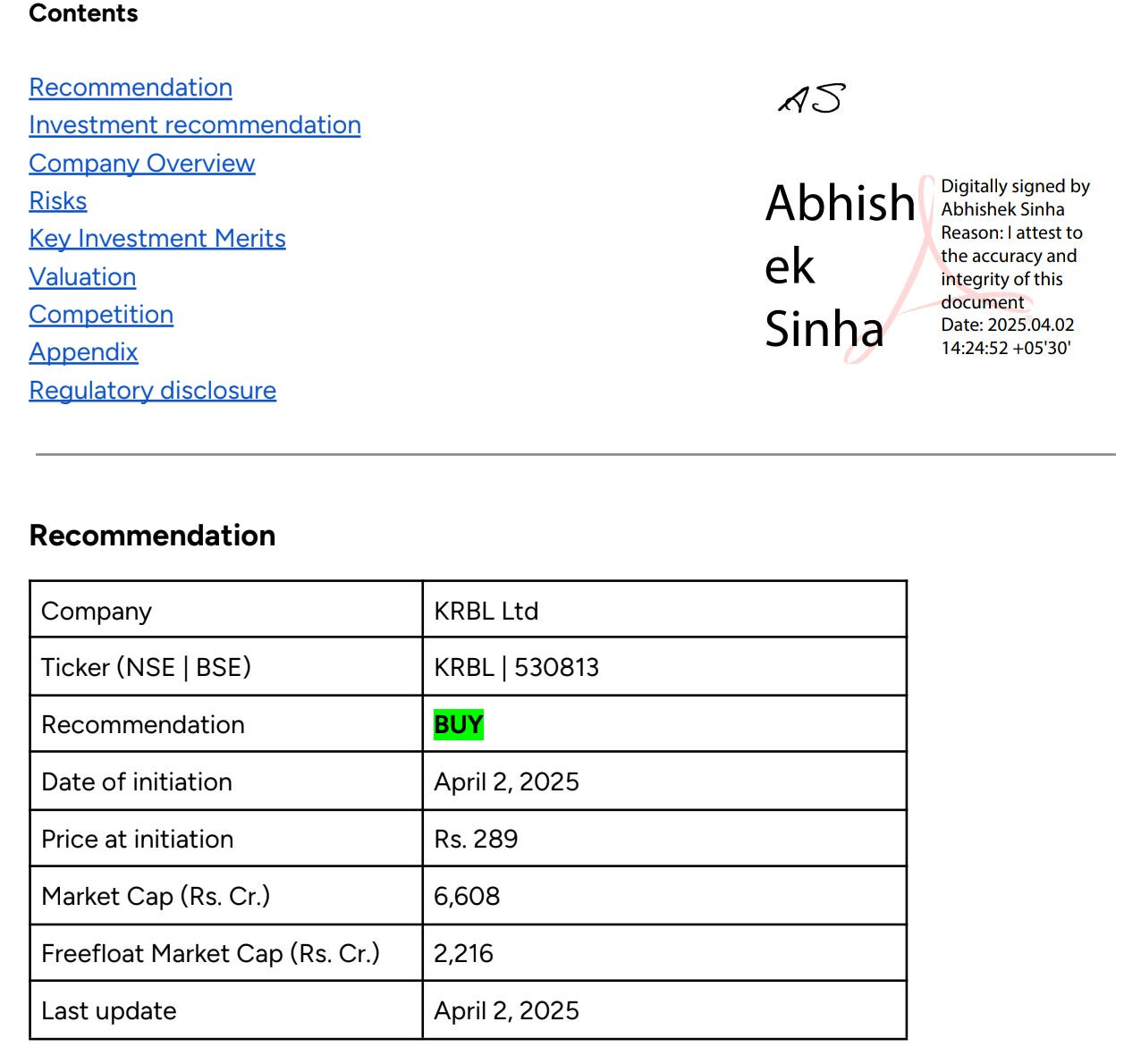
Earlier this year, I published an investment research note on KRBL—the world’s largest basmati rice miller and owner of the iconic India Gate brand.
Note: I am no longer registered with SEBI. This analysis is for educational purpose only.
This is that note, followed by what happened next.
I’m sharing both parts because the lessons are inseparable. The analysis was solid. The outcome was not what I expected. The gap between those two statements contains something worth examining.
Part 1: Original Thesis
Why Nobody Wanted It?
Commodity product. Pursued by Enforcement Directorate in AugustaWestland / money laundering case. Failed to capitalize/grow their largest market. Has disappointed/not fulfilled their promise in the last 4-5 years. Mediocre financial performance. Has most of its working capital tied in inventory - high inventory days. Poor revenue and profit guidance. These signs are enough to reject an investment idea.
One would reject a business on the first two points alone, and indeed, most investors have done exactly that with KRBL. However, peeling back these surface-level concerns reveals a fundamentally strong business with decent competitive advantages hiding in plain sight.
The Business
KRBL is the world’s largest basmati rice miller and exporter with its flagship “India Gate” brand commanding premium pricing. KRBL has 36-37% market share in branded Basmati in India. The company has built a vertically integrated business model spanning the entire value chain from seed development to distribution, creating multiple competitive advantages.
Risks
- The company is experiencing some margin pressure, with EBITDA margin declining to 12% in Q3 FY2025 from 14.1% in Q3 FY2024, and gross margin affected by higher input costs (4% average basmati COGS increase vs. flat realization) and lower other income.
- Continued negative perception about the business: The negative perceptions regarding the business have created a material disconnect between its valuation and the underlying business economics. There is no certainty that this perception will change in the near future. In all likelihood, this one will test the patience of investors who call them long-term. A few good value investors have been waiting for the perceptionturnaround since 2019.
Troubled History
KRBL used to be valued like other FMCG companies before 2018 until the lightning struck.
In 2018, KRBL faced scrutiny due to its former independent director, Gautam Khaitan, who was implicated in the AugustaWestland VVIP chopper scam . The Enforcement Directorate (ED) alleged that funds linked to the scam were routed through a Dubai-based step-down subsidiary of KRBL, RAKGT. ED froze Balsharaf’s (Saudi investor) KRBL shares in 2018, claiming proceeds from the AugustaWestland scam.
The High Court ruled the freeze unlawful, noting Balsharaf acquired shares in 2003 - 5 years before the alleged crime. The High Court noted that RAKGT was no longer directly connected to KRBL in India.
In 2019, the Income Tax department slapped a Rs. 1,270 crore tax demand notice. After 12 months, the notice was reduced to Rs 101 Cr.
No charges have been filed against KRBL or its directors despite over seven years of investigation.
Read more about the case - KRBl Governance | Candor Investing
The market’s fixation on these apparent negatives has created a compelling opportunity for investors willing to look deeper and take a contrarian view based on business fundamentals rather than sentiment.
KRBL represents a fundamentally strong business currently clouded by market prejudices regarding a commodity business, high inventory, poor management efficiency, and legal issues - creating an attractive entry point for long-term investors. At current valuation levels, the risk-reward is favourable even if we value it as a cyclical commodity business rather than a premium branded FMCG player.
In the words of Prof. Sanjay Bakshi “The opposite of a good idea can also be a good idea.”
What Bears Overlooked
- Entry barriers: Basmati rice has a Geographical Indication (GI) tag, limiting production exclusively to the Indo-Gangetic Plain Despite some competition from Pakistan, India maintains approximately 85% of global basmati exports, with KRBL as the dominant Indian player. Maintaining its signature aroma requires specific growing conditions only available in this region .
- Market leadership : KRBL holds the largest market share in India’s branded basmati segment (36-37%), with management targeting 45% in the coming years. This dominant position provides economies of scale in procurement, processing, and distribution. The company’s “India Gate ” brand commands an 8-15% premium over competitors due to quality perception built over decades.
- Procurement expertise : Managing the complex 90-day harvesting window for 1.2 million tons of paddy requires significant logistical capabilities. KRBL processes approximately 700 trucks daily during procurement season, requiring experienced purchasers who can quickly assess the quality and make bidding decisions across 300-400 mandis (markets) in Haryana, Punjab and UP.
- Aging Process and Infrastructure: KRBL maintains capacity to warehouse rice for up to 2 years, while competitors typically age for only 8-9 months. This extended aging enhances aroma and quality but requires substantial capital investment in warehousing facilities and locks the working capital in inventory.
- Inventory as a strategic asset : High inventory isn’t inefficiency but a competitive advantage - aging improves quality and enables premium pricing (like wine or whiskey aging)
- Distribution Strength: The company has expanded its distribution network to over 850 distributors nationwide with retail presence in over 400,000 outlets (as of Q3 FY2025).
- Brand loyalty: Basmati has strong brand appeal, particularly in biryani-eating regions e.g. Southern India and Middle East where consumers demonstrate high brand loyalty and reluctance to switch.
- Strong getting stronger: KRBL management has strengthened its balance sheet considerably over the years. The company is debt free as on December 24. What appears to be high inventory on KRBL’s balance sheet is actually a strategic moat. Longer aging of rice allows for premium pricing and creates a barrier to competition.
- Difficult to operate business: Major players like HUL, ITC, and PepsiCo have entered and exited the basmati market, demonstrating high entry barriers. The recent struggles include Kohinoor and Adani Wilmar. This business requires tight control and skin-in-the-game which most others lack.
- Resilience: KRBL got struck by lightning twice (ED allegations and distributor bankruptcy in Saudi Arabia). Despite these crises, the company has grown its market share in India.
Valuation
At the current market cap of Rs. ~6,500 crore, KRBL’s valuation requires careful consideration of its inventory-heavy business model.
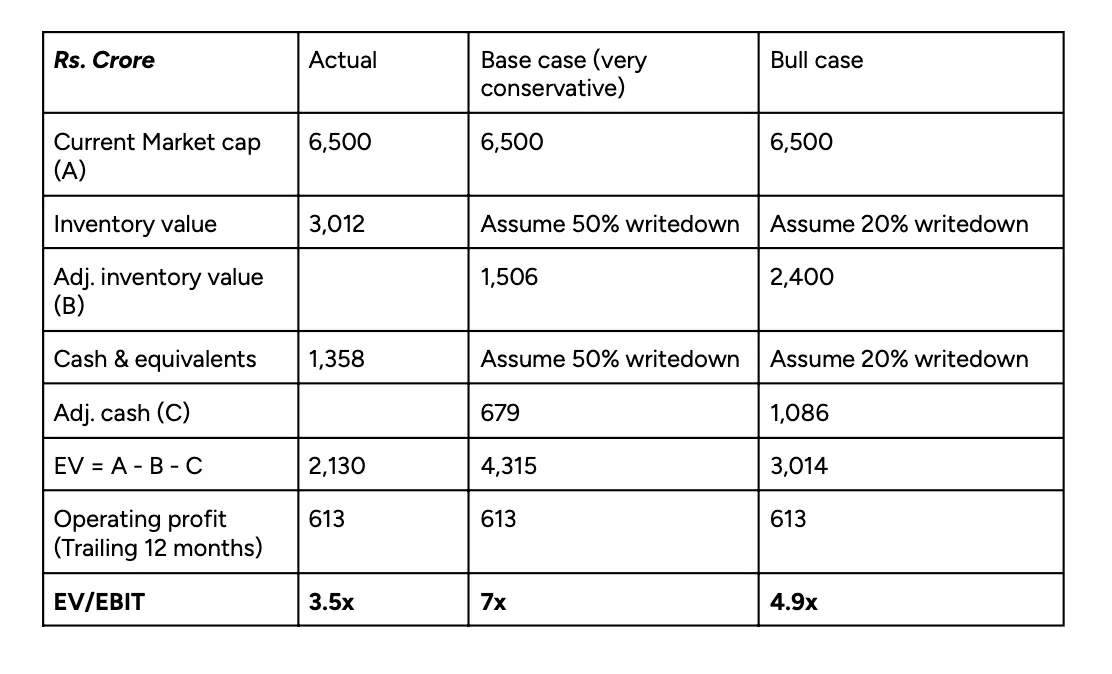
Without getting into future projections and speculation, the current valuation offers a significant margin of safety. We’re essentially looking at buying a robust business close to its depreciated book value. The valuation discount is particularly striking when comparing KRBL to other branded consumer businesses in India, which typically trade at much higher multiples.
On a conservative side, let’s assume that it’s not a branded play and rice is like sugar (where consumers don’t care about the brand). Even with this conservative assumption, the downside in intrinsic value is limited.
Competition
The closest competitor to KRBL is LT Foods, which sells Daawat basmati rice. Incorporated in 1990, LT Foods has evolved from a small trading company into a global consumer food franchise specializing in basmati and specialty rice. It has demonstrated exceptional financial performance, outpacing KRBL with:
- Revenue CAGR of 14.8% over FY19-24, compared to KRBL’s 5.5%
- EPS CAGR of 34% over FY19-24, exceeding KRBL’s 4%
So why not look at LT Foods? While LT Foods is a good business (possibly better than KRBL), the present valuation of KRBL offers more margin of safety. Moreover, I prefer companies with extremely strong balance sheets. Another listed competitor, Chaman Lal Setia, is primarily a trading company and has limited branding and pricing power. Chaman Lal Setia predominantly sells in bulk packaging, which further restricts its ability to command premium pricing in the market.
Everything in Place
My reasoning was that one of the catalysts could trigger re-rating
- Legal resolution. Seven years without charges - eventual closure of the ED case would remove the governance overhang.
- Institutional interest. With the stock having underperformed for years, any signs of turnaround could bring institutional capital back.
- Business momentum improving. Company has been gaining market share in the basmati and regional rice segments in India driven by strong distribution across general trade and modern channels.