Kaynes Technology India Limited - The EMS giant in making

Why Kaynes has corrected 40%+ in last few months? What should investors do?

Iskraemeco was acquired in Sep 24 for 43Cr, now says it contributed 48.9Cr in 6 months (this forms 44% of total profit increase for Kaynes in FY25) But P&L shows profit of Iskraemeco is only 5.87 Cr

Goodwill and reservations misadjustments (for Iskraemeco and Sensonic)

Disclosures for related party transactions inconsistent

Operating Cash flow negative (rising working capital and capex)

Big capex plans

Expects govt grants

Selling receivables to banks (120 cr)

Cash flow does not match cash spending

Valuation concerns

2 Likes

Breaking down Q4 results of EMS companies | The Daily Brief #469

Kaynes stood out as the highest-margin EMS company among the three discussed (Dixon, Kaynes, Syrma). The quarter was slightly below market expectations, mainly because the West Asia / Hormuz conflict disrupted supply chains, delayed projects, and led to some customer deferrals, even though the order book remained strong. Kaynes is the most premium EMS player in the group, with strong margins, aggressive vertical integration, and strategic expansion into railways, defense, semiconductors, and data centers

4 Likes

Hi everyone,

I recently completed my first independent research project on India’s semiconductor ecosystem and Kaynes Technology. Since Kaynes is frequently discussed on this thread, I have focused on sharing a few sections from my report that I felt could add to the ongoing discussion along with some of my own observations and takeaways.

This is my first detailed research report so I would genuinely appreciate feedback or corrections from more experienced members. I will include the link to the full report if anyone is interested.

Company Snapshot - Kaynes Technology Limited is one of India’s emerging players in the Electronics Manufacturing Services (EMS) industry with operations across industrial electronics, automotive, aerospace, defence and semiconductor related technologies

Kaynes Technology operates on an integrated ESDM business model, offering end to end electronics solutions ranging from conceptual design and embedded engineering to manufacturing, assembly, and testing.

Growth Strategy -

Kaynes occupies a strategic middle position between large scale EMS manufacturing and semiconductor ecosystem participation which could support long term growth opportunities.

Key Observations :

  • The company’s expansion strategy suggests that the company is attempting to position itself much earlier in India’s semiconductor and advanced electronics manufacturing cycle rather than waiting for the ecosystem to mature fully. Its investments in OSAT, HDI PCB manufacturing and integrated electronics capabilities indicate a long term approach aimed at building technological relevance before domestic demand scales materially. This is important because companies that establish process capability and client qualification early in electronics manufacturing often benefit disproportionately once industry adoption accelerates.

  • Instead of depending heavily on short cycle consumer electronics demand, company is focusing on sectors where electronics content per product is structurally increasing over time.

  • The company also appears to be strategically deepening its role within customer supply chains. Rather than remaining a contract manufacturer executing isolated assembly work, Kaynes is increasingly integrating design, engineering, PCB manufacturing and system integration capabilities. This potentially increases switching costs for customers and allows the company to participate in a larger portion of the product value chain over time.

Manufacturing & Semiconductor Expansion -

A major strategic development for the company has been its expansion into semiconductor assembly and advanced PCB manufacturing. Kaynes Semicon’s OSAT facility at Sanand, Gujarat, officially commenced commercial production in FY26 under the India Semiconductor Mission. The project involves an investment of around ₹3,300 crore and focuses on semiconductor assembly, testing, marking and packaging operations.

The company is also developing HDI PCB manufacturing capabilities at Chennai which could strengthen backward integration and improve long term value addition within the electronics manufacturing chain.

Key Observations :

  • Manufacturing facilities located across multiple Indian industrial hubs.

  • Strong presence in high reliability and engineering intensive electronics manufacturing.

  • FY26 order book exceeded ₹8,000 - 9,000 crore, supporting future capacity utilisation.

  • Large ongoing capital expenditure and infrastructure expansion may strengthen future growth potential, although these projects also increase execution and operational risks in the near term.

Financial Performance -

Revenue Growth :

  • Revenue increased from ₹706 crore in FY22 to ₹3,626 crore in FY26, nearly 5x growth in four years. This reflects aggressive scale up capability, strong industry tailwinds in EMS/ESDM, increasing outsourcing by global electronics companies and successful customer acquisition across sectors like automotive, industrial, aerospace, railways and defense.

  • The important point is not merely that revenue grew fast but that Kaynes maintained >30% growth even after crossing ₹2,500 crore scale. Most EMS firms face growth normalization after scaling; Kaynes is still compounding from a much larger base. This indicates strong execution capability, demand visibility and scalability of business model.

  • However, growth moderation from 50 - 60% to 33% may suggest the company is entering a more mature phase where execution quality becomes more important than pure expansion speed.

EBITDA & EBITDA Margin :

  • EBITDA rose from ₹90 crore in FY22 to ₹574 crore in FY26 while margins improved from 12.8% to 15.8%. This suggests operating leverage, improving product mix and movement toward higher value manufacturing.

  • Traditional EMS companies usually struggle to expand margins because assembly work is commoditized. Kaynes margin expansion is a Positive signal as improving margins during aggressive expansion usually indicates strengthening competitive positioning rather than revenue being purchased through low pricing.

Order Book

  • The order book increased to around ₹8,000 - 9,000 crore by FY26, reaching nearly 2 - 3 times its annual revenue.

  • This matters because a large order book tells us customers are already committing to business ahead of time which gives the company visibility and confidence to expand capacity aggressively.

  • What is interesting is not just the size of the order book, but the kind of industries contributing to it like automotive electronics, industrial systems, railways, aerospace, defense and EV electronics. These are not purely short term or low value contracts. They usually involve long qualification cycles and sticky customer relationships. Once a company gets integrated into these supply chains, replacing it is not easy.

Free Cash Flow (FCF)

  • Free cash flows remained negative across multiple years suggests aggressive capital expenditure and working capital requirements.

  • Negative free cash flow is not necessarily negative for high growth manufacturing businesses. In Kaynes case, the key issue is whether current investments create durable long term advantages.

  • Since the company is investing in strategic manufacturing capabilities rather than merely adding generic capacity, the market may tolerate weaker near term cash flows.

  • However, sustained negative FCF over very long periods can eventually pressure balance sheet quality if returns do not materialise.

Red Flags / Key Risks

  • Extremely High Valuation Multiples - Kaynes Technology is trading at premium valuation multiples compared to traditional EMS and manufacturing companies, indicating that a large portion of future growth expectations is already priced into the stock. This leaves very little margin of safety for investors and increases the possibility of a sharp correction in valuation if the company faces execution delays or fails to meet earnings expectations.

  • Weak Free Cash Flow Conversion - Despite Earnings Growth, free cash flow generation remains extremely low due to high reinvestment requirements. Capex intensity (assumed ~10% of revenue) absorbs a major portion of operating profits, resulting in near-breakeven FCFF in early projection years. This indicates weak short-term conversion of accounting profits into cash flows.

  • Execution Risk in Semiconductor and OSAT Expansion - The company is aggressively expanding which require substantial capital investment and technological expertise. Delays in project execution or operational inefficiencies may impact future profitability and return ratios. Since a significant portion of the current valuation is dependent on successful execution of these projects, any delay may adversely affect investor sentiment.

  • Dependence on Government Incentives and PLI Support - Delays in approvals, disbursements or changes in government policy may impact project economics and increase financial burden on the company.

A few questions for members who have followed the company closely -

  1. Do you view Kaynes primarily as an EMS company today, or as an emerging semiconductor/technology manufacturing play?

  2. How significant do you think the OSAT opportunity could become relative to the core EMS business over the next 5 - 10 years?

  3. Are there any important aspects of the company or industry that I may have overlooked in my analysis?

3 Likes

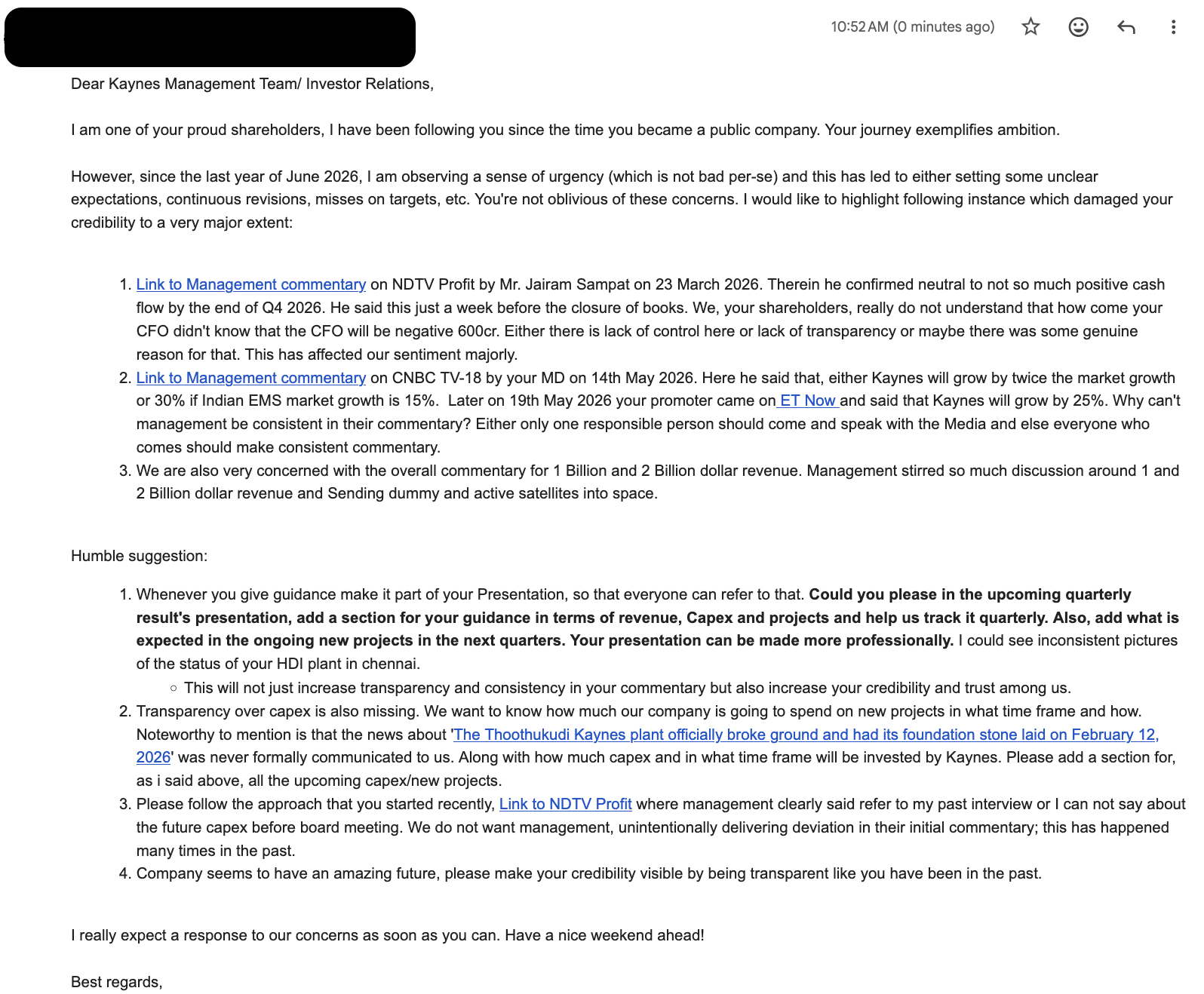
Today sent an email to Kaynes management, let’s see if or what they reply. I am quite annoyed with some of the things, though the future of the company seems bright to me.

11 Likes

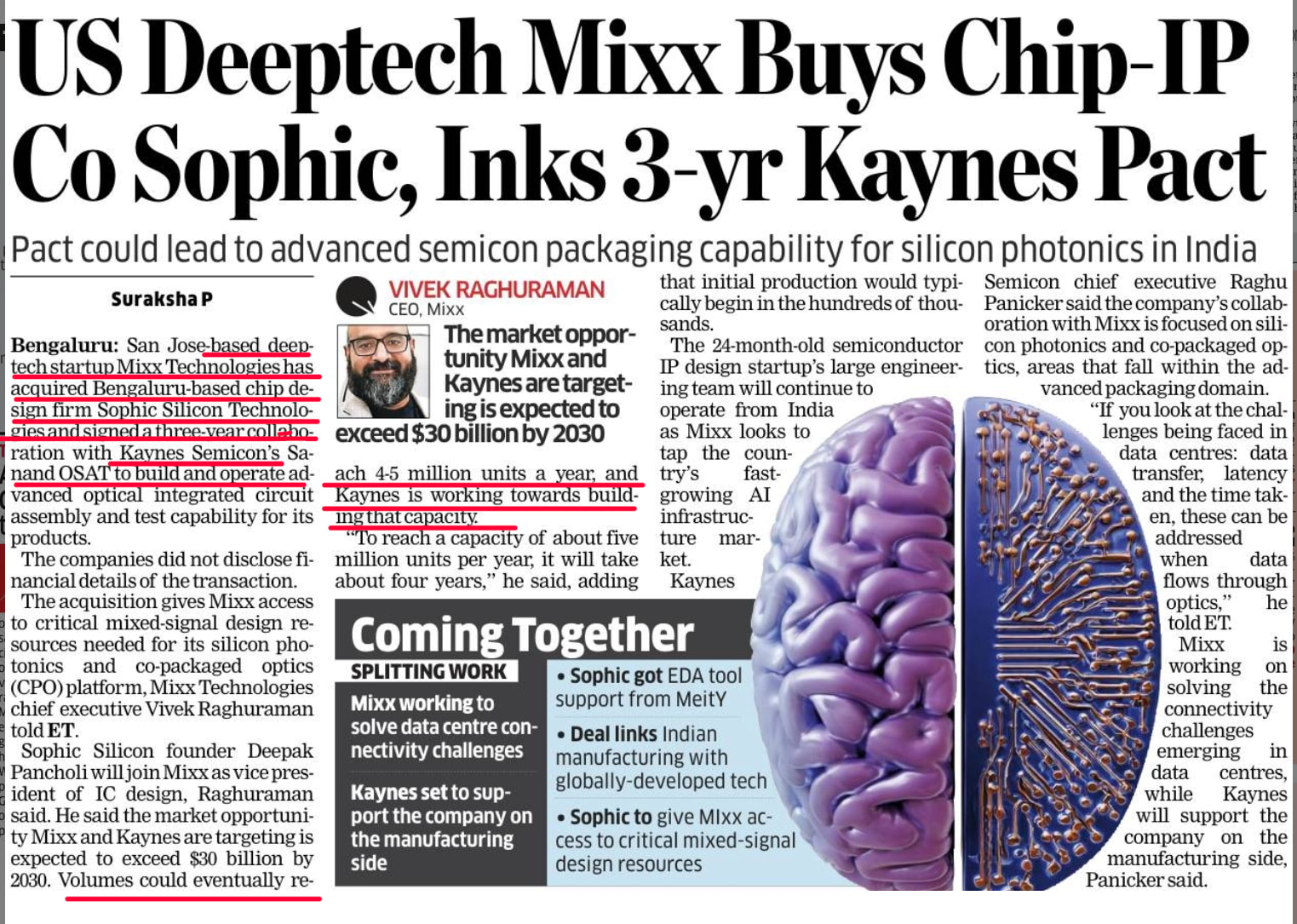
Orders starting to trickle in for Kaynes Semicon

3 Likes

Challenge is start-up funding may becoming challenging going forward and these contracts with startups may not mean a lot.

Syngene took a big knock when bio-tech start-up funding environment got tough.

1 Like

As expected, I have not yet received a response from management.

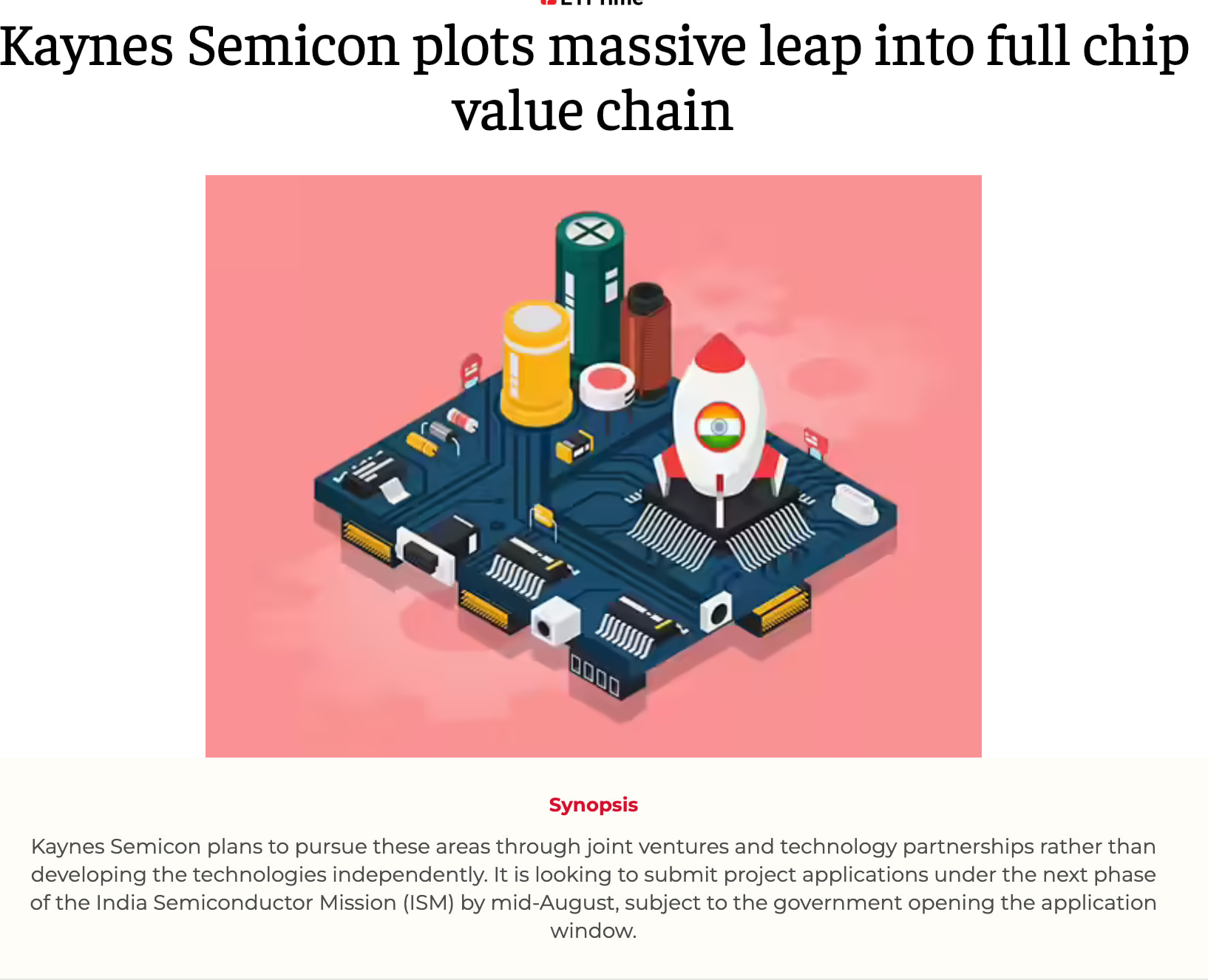
However, in the meantime, I learned about a recent interview with Kaynes SemiCon CEO Mr. Raghu Panicker. He stated that Kaynes is targeting joint ventures (JVs) for wafer fabrication, compound semiconductors, advanced packaging, semiconductor materials, and equipment manufacturing under ISM 2.0. The company is in advanced discussions with global technology partners on this front. These initiatives remain at the evaluation stage and are contingent on JV finalisation, government approvals, and successful execution.

However, I believe there are several reasons Kaynes SemiCon/Kaynes Technology can pull this off:

  1. Kaynes has successfully built and commercialized its first OSAT (Phase 1) plant in Sanand. Mass production of one module has already begun for A&O, and others are in the validation phase. Kaynes has struck deals with three global semiconductor companies - Infineon, A&O, and Fujitsu General - which is by no means an achievement that should go unnoticed. I am hoping the HDI PCB plant is also commercialized in July, though I have not found any news confirming this.

    1. The OSAT plant will scale steadily and should reach a stable scale within the next 4-6 quarters. By FY2028, it should also generate positive cash flow. There are some assumptions and uncertainties involved, but the fact remains that there is strong visibility.
  2. As you may know, the GOI does not approve companies under ISM 2.0 easily - it looks for companies with a strong pedigree, established players like Micron, or those who have already proven themselves.

    1. Given Kaynes’ achievements, the GOI is likely to approve another project (or projects) for them, as it prefers to back proven performers.

I expect Kaynes to submit applications for the following projects through JVs:

  1. Compound Semiconductor Fab 1 - GaN (complements their current offerings to the EV and Industrial/Power domains)

  2. Display-cum-Compound Semiconductor Fab 2 - Micro LED

  3. Advanced Packaging and Manufacturing (complements their already approved project under ISM 1.0)

  4. Wafer Fabrication: I am doubtful about this one - it is a capital-intensive business, and I am unsure whether Kaynes has a sufficient capital base to support it. I need to check what their plans are here.

  5. Equipment Manufacturing: Possibly for the semiconductor ecosystem and for self-consumption, such as substrates, lead frames, and molding compounds. They are also manufacturing CCL (copper clad laminate) for PCBs. In another 3–4 years, their SemiCon scale should be significant enough to absorb this capacity, which would improve margins and reduce dependency on global suppliers. I am really counting on this one.

Disc. Please do your own research before investing. Invested.

Some references:

https://www.moneycontrol.com/technology/kaynes-semicon-eyes-gan-fab-micro-led-joint-venture-under-ism-2-0-as-osat-facility-ramps-up-shipments-article-13880869.html

https://www.icicidirect.com/research/equity/blog/kaynes-semicon-plans-to-expand-beyond-osat-into-the-broader-semiconductor-value-chain

8 Likes

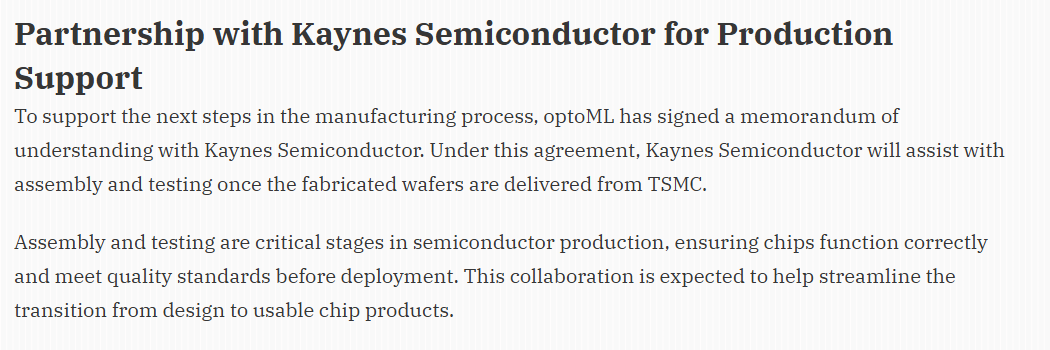
Another MOU with a silicon valley startup to provide ATMP services.

3 Likes

Looks like some of the fund houses did value buying yesterday. Despite the short term pain in receivables due to smart metering subsidiary, there is a huge visible runway for growth for Kaynes. I wasn’t convinced as to why the market was or still too much pessimistic about Kaynes. As per their Q4 2026 result, the standalone business actually generated free cash in the tune of 120cr+. If they resolve the receivable situation in their smart metering subsidiary (which I am really hopeful of given Kaynes pristine execution record) the overall situation and eventually the sentiment could improve dramatically in no time.

I have learned that if the company is growing steadily, expanding business, share price will eventually follow suit. Despite all this exuberance, Kaynes still needs to strengthen their corporate governance and accelerate institutionalization. Nevertheless, within my limited knowledge, i don’t doubt the integrity of the management and reckon that the past misses were just unintentional mistake. I hope they learn form it and ensure to not repeated them.


For our reference, Claude has prepared a consolidated, chronological record of Kaynes Semicon’s external agreements - MoUs, JVs, technology transfers, and related transactions - starting from when the OSAT project was first announced (Kaynes Semicon was formed and OSAT plans disclosed around October 2023) through today (July 30, 2026). It has grouped by type and flagged sourcing/certainty throughout.

Here’s a consolidated, chronological record of Kaynes Semicon’s external agreements — MoUs, JVs, technology transfers, and related transactions — starting from when the OSAT project was first announced (Kaynes Semicon was formed and OSAT plans disclosed around October 2023) through today (July 30, 2026). I’ve grouped by type and flagged sourcing/certainty throughout.

Chronological record

Date Partner Country Type What it covers Status as of today
Mar 2024 Globetronics (via subsidiary ISO Technology) Malaysia Technology provision agreement OSAT technical services, valued at ~$7.59mn (~RM35.9mn); ISO Tech also agreed to reinvest ~$5.28mn into Kaynes Semicon securities, with an IPO/strategic-sale exit obligation within 3 years Confirmed, executed
~2024 (reported alongside Globetronics) Aptos Technologies Taiwan Technology partner One of three named OSAT packaging technology partners (alongside Globetronics, AOI) Reported by company/CEO, not independently verified via filing
~2024 AOI Electronics Japan Technology partner (initial) Backend packaging technical partner from the outset; later deepened (see Dec 2025 below) Confirmed
2024 (reported) Mixx Technologies USA (California) Minority equity investment Kaynes’ early-stage investment in an optical-interconnect deep-tech firm Confirmed by CEO interview; relationship expanded materially in 2026 (see below)
Sept 23, 2024 Government of India (Union Cabinet) India Regulatory approval, not a JV Approval for Sanand OSAT unit, ₹3,300–3,307 crore investment, 6 million chips/day capacity Confirmed (BSE/exchange filing + PIB)
Early–mid 2025 Mitsui & Co. (with AOI Electronics) Japan Strategic business partnership Facilitated OSAT launch; exclusive rights to source raw materials (lead frames, molding compounds, die-attach materials, specialty gases, chemicals) from Japan/global suppliers; also coordinates sales of Kaynes-produced items; Mitsui holds an option to acquire Kaynes Semicon shares later Confirmed
~Apr 2025 Alpha & Omega Semiconductor (AOS), USA USA Multi-year customer/offtake agreement 5-year agreement; AOS to use ~60% of Phase-1 capacity for IGBT, IPM, power MOSFET packaging/testing Confirmed; already generating shipments (see Oct 2025, Apr 2026)
Jun 2025 Fujitsu General Electronics (FGEL) Japan Acquisition (asset transfer) Fujitsu’s power-modules business sold for ~¥2bn (~₹118 crore); the business itself went to L&T Semiconductor Technologies, while the production facilities/lines transferred to Kaynes Semicon, which manufactures on contract for L&T Confirmed; physical relocation to Sanand phased over 12–18 months
Sept 1, 2025 US Technology International (UST) India/USA Equity-linked agreement (SSSA) Kaynes Semicon to issue Compulsorily Convertible Preference Shares to UST, convertible into up to 10% equity, tied to revenue milestones Confirmed (exchange filing)
Sept 2–4, 2025 (Semicon India 2025) Infineon Technologies Germany MoU Kaynes to launch India’s first “Made in India” MEMS microphone using Infineon bare-die tech (targeting TWS earbuds); Infineon also to supply power bare-die wafers for Kaynes to package Confirmed
Sept 2–4, 2025 SPARSH-IQ Solutions, 3rdiTech, Focally, SenseSemi Technologies India Consortium MoU Design, build and validate an indigenous automotive/industrial AI vision camera module entirely in India Confirmed (announced), execution stage unclear
Sept 2–4, 2025 Emerson (NI Semiconductor Test business) USA Technology/equipment agreement Deployment of Emerson’s NI Semiconductor Test System (STS) as preferred test platform across analog, mixed-signal, RF, power, MEMS devices Confirmed (announced)
Sept 2–4, 2025 Mirrorcle Technologies USA MoU Produce MEMS mirrors in India Confirmed (announced), early stage
Sept 2–4, 2025 Caligo Technology, FermionIC (DLI-scheme design startups) India Collaboration Advanced packaging collaboration with India-based chip-design startups Confirmed (announced)
~Sept 2025 (brokerage-referenced) Lightspeed Photonics Customer MoU Advanced packaging solutions customer Reported via brokerage note, not independently corroborated by a primary filing in my search
Dec 2025 AOI Electronics (deepened) Japan Technology collaboration Access to advanced backend know-how: advanced packaging, panel-level packaging, wafer-level redistribution layer (RDL) technologies Confirmed
Jan 2026 SEALSQ / WISeKey International Switzerland/USA (SEALSQ) Joint Venture (LOI/term sheet) SEALKAYNESQ JV — SEALSQ 51% / Kaynes Semicon 49%; Outsourced Semiconductor Test & Personalization (OSTP) facility inside Sanand site; PKI + post-quantum cryptography (PQC) personalization for national-security-grade applications LOI/term sheet signed Jan 2026; JV entity formation “in process” as of April 2026 — not yet a fully operational, formally incorporated JV per the most recent update I found
~Feb 2026 (referenced) Fibocom China Manufacturing partnership Reported as a Kaynes Technology (parent-level, not Kaynes Semicon-specific) manufacturing tie-up Low-confidence, single secondary source; flagging for your awareness but not treating as an OSAT/semicon JV
Mar 31, 2026 India Facility inauguration (not a JV) PM Modi formally inaugurates the Sanand OSAT plant Confirmed
Apr 14–15, 2026 Alpha & Omega Semiconductor (AOS) USA Commercial production milestone Commencement of commercial production of Intelligent Power Module (IPM5) products at Sanand, under the existing AOS agreement Confirmed
Jul 23, 2026 Mixx Technologies (with acquired Sophic Silicon Technologies) USA/India Manufacturing collaboration Multi-year collaboration to establish a test-and-assembly facility for optical IC packaging (co-packaged optics for AI infrastructure); separate from Kaynes’ earlier minority investment in Mixx Confirmed — most recent, just one week before this conversation

Edit1:

Disc. Please do your own research before investing. Invested.

3 Likes

There haven’t been any updates recently about the PCB plant in Chennai.It was originally planned to commence in April 2026.

The following are information that I had gathered from past concalls and investor PPTs. Sharing this for our reference.

Kaynes is attempting to make up to 74 layer MLB PCBs in phase I at a greenfield plant in oragadam, chennai.
They will also be subsequently making flexible PCBs(up to 16 layers) and HDI PCBs(up to 8 layers) in phase 2.

Second plant- They have signed a MOU with TN govt to have a second plant in Thoothukudi.
This plant will make copper clad laminates and prepreg which are raw materials to make PCBs.

Most likely the second plant will start only after they have ramped up the chennai plant to a reasonable extent.

One important point is, unlike OSAT they have not entered into any technical tie ups for PCB manufacturing.
HDI PCB manufacturing is a fairly complex process.
The video here, details the complexity involved.

In one of the concalls, when enquired about the technology factor for PCB, management replied that equipment suppliers themselves are process experts and the process development
happens overseas at the vendors end. Only after the process is stable, they will ship the entire line to their plant in chennai.

A key monitorable for me would be the commissioning of the PCB plant along with progress in OSAT.

3 Likes

Came across one of the LinkedIn post stating that there is a possibility that Kaynes might tie up with Seoul Semiconductor for Micro-LED joint venture. It is based on the premise that Kanyes is looking for a non-Chinese partner for Micro-LED JV. Given the fact that Seoul Semiconductor is based in South-Korea and have major manufacturing presence in Vietnam, this JV is a possibility

Dis. Invested, do you own research before investing.

1 Like

A detailed writing of OSAT process step by step:

https://theprint.in/the-fineprint/giant-stride-with-micron-precision-inside-indias-1st-semiconductor-chip-packaging-cluster-in-gujarat/2929084/

4 Likes

Some important excerpts from Q1 call::

The CapEx done in FY26 was 473 crores for OSAT and 324 crores for PCB. Our current goal is to CapEx about 300 crores for OSAT and PCB, but as and when as I said earlier with the subsidies coming up, we’ll be funding more and as and when we have more customers, we have to move. Cash is not a constraint here. We want to make sure that the modular investments to make sure that we have checks and balances on our CapEx spending and the revenue. We also received, happy to say that we also received the government subsidy to the tune of 170 crores in OSAT business till July 26. On OSAT specifically, our partnership between Mitsui and Kaynes SemiCon is a major milestone of our subsidiary. I congratulate our team for entering into such a strong partnership and that gives Kaynes SemiCon the opportunity to access the significant market opportunity in Japan.

OSAT all the trials and validation is getting over now. We will start the commercial billings. And as far as PCB is concerned, our entire capacity has been requested by one large player, a global player.

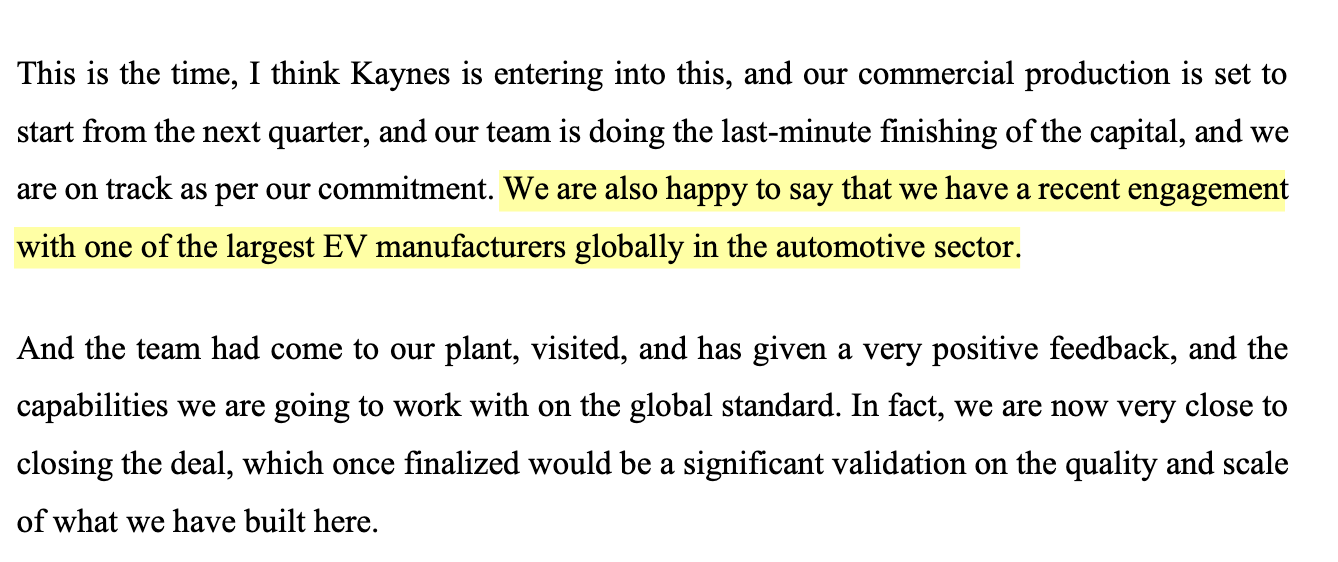
PCB is one component where it is getting into that global shortage at this point in time. The suppliers are demanding that we need to pay advance, and it takes about six to eight months even for order booking. This is the time I think Kaynes is entering into this, and our commercial production is set to start from the next quarter, and our team is doing the last minute finishing of the capital and we are on track as per our commitment. We’re also happy to say that we have a recent engagement with one of the largest EV manufacturers globally in the automotive sector, and the team had come to our plant, visited and has given a very positive feedback and the capabilities we are going to work with on the global standard. In fact, we are now very close to closing the deal which once finalized would be a significant validation on the quality and scale of what we are building here. As we said earlier, we continue to evaluate the opportunities of internal consumption versus external sales, which will be taken care of by the business mathematics. Let me also give you an update on our space technology initiative.

7 Likes

What I learned from the q1 concall:-

  1. The collections from the smart metering business are very less and are impacting cashflows. Of the 212 crores some 88 crores have only been collected. This number is close to 843 crores of the 855 crores in the EMS business.

  2. A divestment of the smart metering business might help improve the company’s overall financials as well as cashflows. The rest of the businesses remain on strong footing.

  3. About 400-450 crores can come from semicon and osat business from q3 and q4. This is where the next growth engine of the company can come in the upcoming quarters.

  4. Many marquee clients have been signed in the semicon business. Need to check for more updates in upcoming quarters.

Execution remains strong. Raw material challenges remain due to which ebitda margin has been affected this quarter. Once this resolves, company will continue to do good is my opinion.

Discl:- Invested, biased.

4 Likes

Came across this specific point from the earning call: ‘Kaynes has a recent engagement with one of the largest EV manufacturers globally in the automotive sector and are now very close to finalizing a deal with them.’ I think they are also the one asked to book the entire capacity of the Phase 1 of their PCB plant.

I forced Claude to name me that potential ‘one of the largest EV manufacturers globally’ :grinning_face_with_smiling_eyes:.

AI generated response:

If forced to rank, I’d put Tesla as the more probable guess of the two, mainly because the economic logic (China-diversification, existing India supply-chain buildout, active India market entry) all points the same direction, whereas the BYD case requires a more specific and less obviously advantageous rationale.

If this happens, it will be huge for Kaynes. Let’s see how good the prediction modeling of Claude works.

Dis. Invested, do you own research before investing.

5 Likes