Based on the Q2 and Q3 earnings calls, there is a distinct shift in tone from celebratory confidence to defensive resilience, alongside conflicts regarding margin stability and deal momentum. However, the long-term strategic “design” remains consistent.
1. Change in Tone: From “Momentum” to “LTM Defense”
Q2 Tone: Euphoric and Aggressive
In Q2, the management tone was highly confident, driven by “solid” performance and “accelerating growth” [1], [2].
Key Theme: The focus was on immediate quarterly success, with revenue growing 34% YoY and PAT nearly doubling (94% growth) [3].
Leadership Presence: Chairman Arun Jain led the call with high energy, aggressively challenging analysts to understand their “business impact AI” and comparing the company to Palantir [4], [5].
Narrative: The narrative was about “momentum in topline and profitability” and hitting the “sweet spot” against competitors [1], [6].
Q3 Tone: Defensive and structural
In Q3, the tone shifted to being measured and defensive. With Chairman Arun Jain absent (in transit), Executive President Manish Maakan led the call, focusing heavily on “Last 12 Months” (LTM) metrics rather than the specific quarter’s performance to smooth out volatility [7], [8].
Key Theme: The quarter showed a sequential revenue dip (from ₹789 Cr in Q2 to ₹753 Cr in Q3) and a sharp margin drop [3], [9]. Consequently, the commentary pivoted to “structural progress” and “long-term value” rather than immediate quarterly wins [10].
Narrative: Management spent significant time explaining that investors should “not look at quarter on quarter” but rather on annual trends, using the LTM data to demonstrate they are still crossing milestones (e.g., crossing ₹3,000 Cr revenue) [8], [11].
2. Conflicts in Management Commentary
A. Margin Guidance vs. Reality
Q2 Commentary: Management stated they were in the “range of 25%” for EBITDA margins despite heavy AI investments [12]. They suggested that without these investments, margins would be over 28% [12].
Q3 Reality: EBITDA margins dropped steeply to 16% [9].
The Conflict: While Q2 suggested a sustainable 25% band, Q3 missed this significantly. Management attributed this to “capacity building,” “seasonality” of events, and a one-time gratuity provision [13], [14]. When pressed if they could hit 25% for the full year given the Q3 dip, management remained vague, stating they are “driving towards 20% plus” but relying on the LTM average of 23.8% to justify the target [15], [16].
B. Deal Wins and Momentum
Q2 Commentary: The company celebrated “18 new deal wins including 11 multi-million dollar destiny deals,” citing a “strong global deal funnel” [17].
Q3 Reality: Deal wins dropped to 8, the lowest in eight quarters [18].
The Conflict: Despite the sharp drop in closed deals, management insisted they were “not reading too much into it” and that it was not a concern [18]. This contrasts with the Q2 narrative where high deal counts were presented as proof of “accelerating growth” [2].
C. “Design for 20%” Interpretation
Q2 Commentary: “Design for 20%” was presented almost as a baseline floor, noting they were growing at 26% (H1) and 34% (Q2) [3], [6]. The tone suggested upside surprises.
Q3 Commentary: “Design for 20%” became a shield to defend slower growth (21% YoY, but negative sequential growth) [9]. Management clarified that they “stay away from guidance” for the next year and emphasized that 20% is a long-term design, implying investors should tolerate quarters where growth dips [19], [20].
3. Consistency in Commentary
Despite the volatility, several strategic pillars remained consistent across both calls:
A. The “Purple Fabric” (AI) Narrative
Target: In both quarters, management reiterated the revenue target of ₹200 crore for Purple Fabric for the current year [21], [22].
Competition: The company consistently identifies Palantir and C3.ai as their primary competitors, dismissing traditional Indian IT peers as lacking the “full stack” or “research DNA” required for this specific type of AI [5], [23], [24].
Investment: The commitment to investing roughly ₹15–25 crore incrementally per quarter in AI remained unchanged, viewing it as essential for future relevance regardless of short-term margin impact [25], [26].
B. Cash and Balance Sheet
Strategy: The goal to maintain high cash reserves (ideally six months of revenue) remained constant [27].
Performance: Cash generation remained a highlight in both quarters, rising from ₹927 Cr in Q2 to ₹1,198 Cr in Q3, used as a buffer against risks [3], [28].
C. Market Strategy (The “Highway”)
North America Focus: The strategy of using India/Asia as a testing ground and North America as the scale engine remained consistent. In Q2, they noted the “highway” goes from India to Europe to America [29]. In Q3, they confirmed North America is approaching ₹1,000 Cr in revenue and remains the primary growth driver [30], [31].
It’s always prudent to not take management commentary as is.. Something that I’m still learning. Never get too excited in good quarters and never lose hope in bad quarters.
This AI-generated response is a good example of prompt framing and confirmation bias. The LLM is hallucinating and generating a negative bias thesis out of thin air based on events which didn’t even happen. I attended the conference call and didn’t see any shift in management tone. They have always guided for 20% topline growth and never given bullish guidance. They have always mentioned to look at LTM growth and margins as the business is lumpy quarter to quarter. Regarding the fall in deal count, they mentioned they are focusing on winning larger deals than multiple smaller deals. Regarding margins, they said LTM margins are ~24% and are on track to close financial year around similar number.
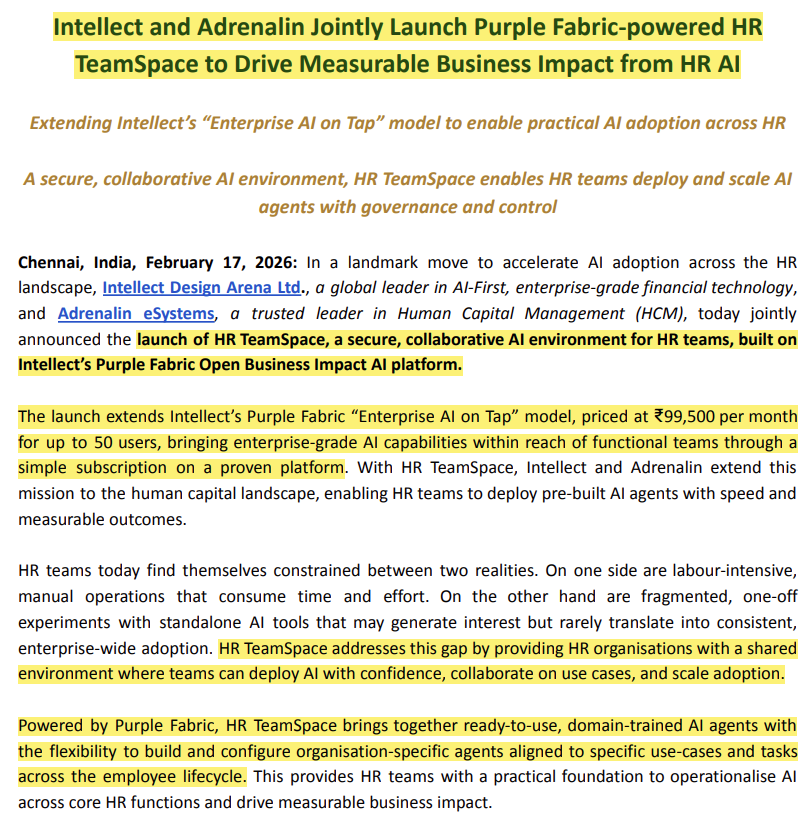
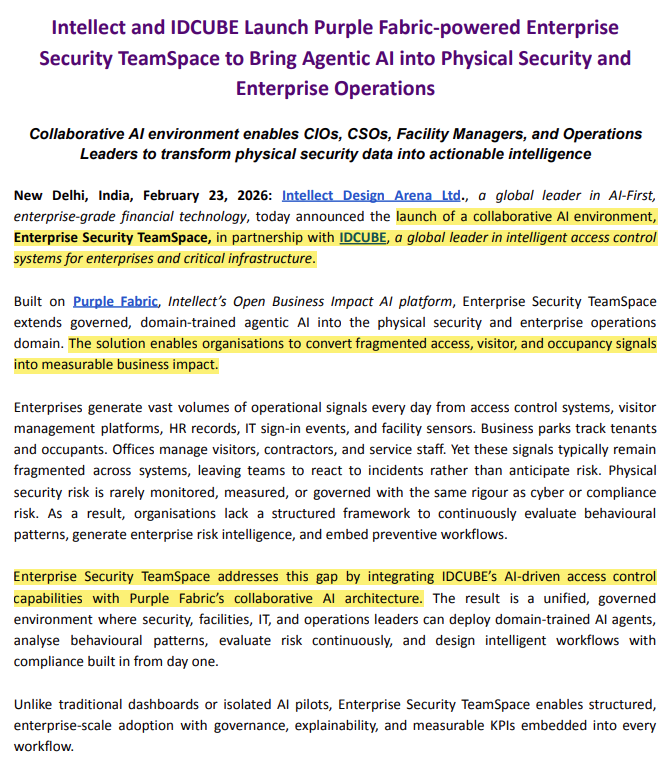
Intellect’s recent announcement regarding Purple Fabric is essentially an AWS playbook for Enterprise AI. Historically, building a private data center was a luxury reserved for Tier-1 firms with massive capital. AWS changed that by offering on-demand instances (servers) and credits, breaking the cost barrier and allowing smaller players to compete on the cloud. Intellect is now following that exact playbook. By launching an “AI on Tap” plan specifically for mid-market enterprises, they have effectively increased the TAM of Purple Fabric. Most mid-sized firms currently struggle to move AI beyond simple code generation because building resilient, hallucination free solutions requires an R&D heavy lift they can’t afford. Intellect is now handing them that sophisticated infrastructure, backed by 1000+ engineers for a flat monthly fee. This marks a significant pivot from complex, long-cycle enterprise deals to a high-volume SAAS model. If this subscription model scales as intended, it could lead to a massive expansion in margins and a much more predictable, recurring revenue stream.
This is not to be negative about the company. I’m still invested.. Intention was more about setting our expectations right and not to make decisions based on a good quarter excitement or commentary..
I found this piece on the company website, on a product page related to procurement.
“Our Digital Experts, built on Purple Fabric, analyzes data to suggest smarter procurement plans and helps buyers discover the best prices. By optimizing procurement strategies, the agent enhances decision-making and resource allocation, ensuring more efficient and cost-effective procurement processes.”
What concerns me is that if you look at the english, they seem to be promising so much. However, what they are saying can work only if every procurement by the organization is completely digital, with structured data, APIs, etc.
What does smarter procurement plans even mean?
What does “optimizing procurement strategies” mean?
In most organizations, the procurement functions are a combo of e-mails, phone calls, etc.
What I suspect, is that this product, and many others like this in the Purple Fabric umbrella, are glorified LLM based search engines, with some custom curation of outputs built in.
I would really love to hear from people who are actually using these products, to see if they actually deliver what they promise.
I spent a few hours going through the Temenos Capital Market 2026 call, and here are my key notes from the presentation. It’s always better to hear directly from a leading competitor than from social media “experts” commenting on the impact of AI. I was particularly curious to understand their views on the banking products business and the potential impact of AI going forward. Here are the key points:
Here are key points
CEO Quote: “There is strong demand from regulators to use solutions that remain out-of-the-box compliant and continuously up to date.” Regulatory changes continue to drive demand for out-of-the-box solutions that stay current.
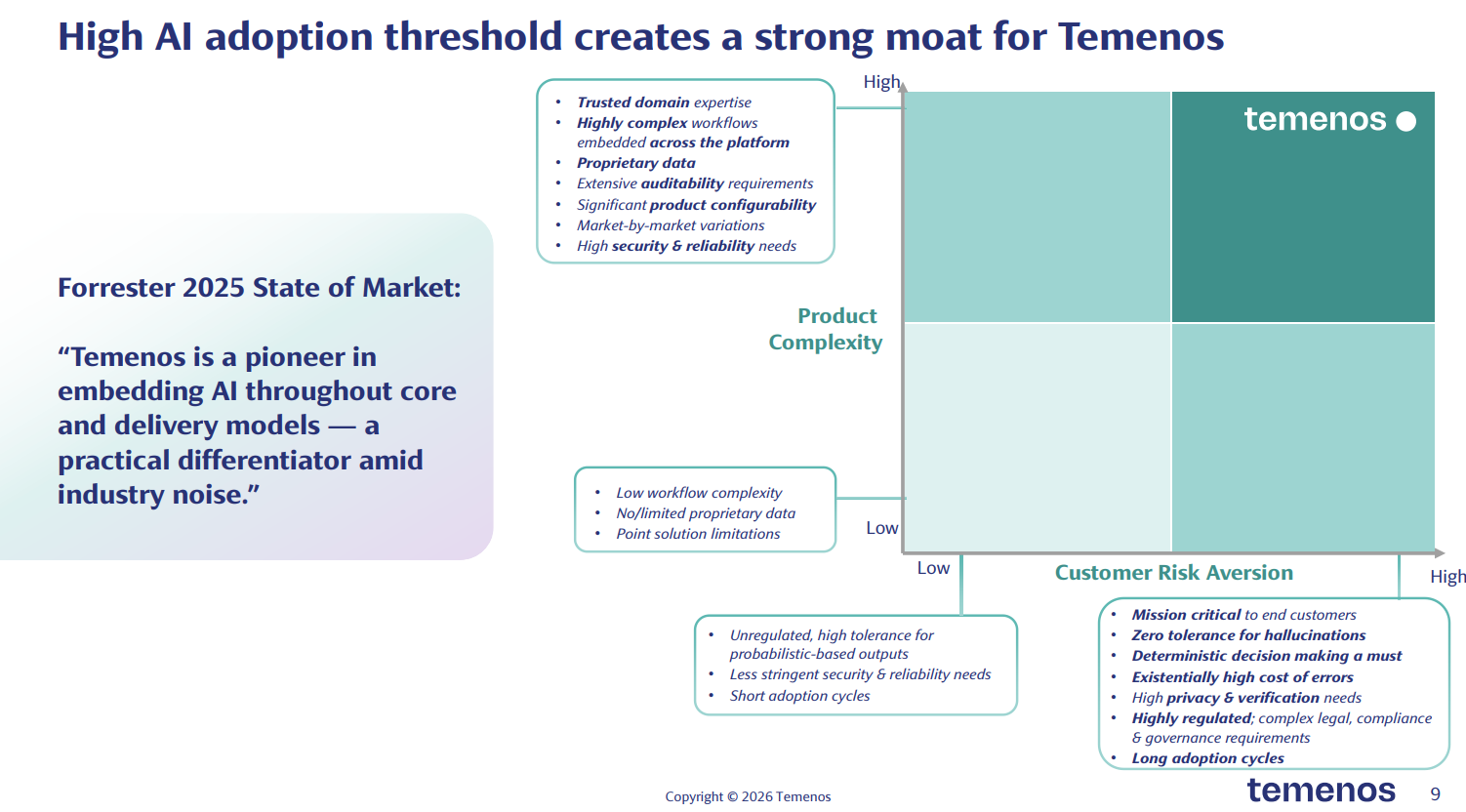
Banks’ thresholds for AI adoption remain high. They are moving mission-critical workloads to the cloud but prefer a composable core solution that can incrementally add capabilities.
Revenue is not manpower-dependent but linked to transaction and volume growth — both areas that AI will help accelerate.
In the US, Temenos compete with traditional vendors who have not invested heavily in technology upgrades. Many of them still plan to maintain multiple legacy platforms.
Globally, competition from neo-vendors was visible 4–5 years ago, but that is no longer the case.
If they embed AI into various parts of the product and reduce the implementation cycle by even six months, it could create numerous new opportunities.
Around 90% of the US order book is SaaS-based, reflecting strong market appetite.
In some markets where the product is not fully out-of-the-box, system integrator (SI) partners build customized solutions on top of Temenos products and offer them as managed services to their customers (e.g., the Saudi market).
Tier 1 banks still relying on COBOL are generally risk-averse and have been hesitant to move away from it. However, recent developments in AI have encouraged them to start exploring migration. AI can assist in understanding legacy code, though full automation is not yet possible. Most banks prefer using off-the-shelf products that can be customized — an area where Temenos adds significant value.
Large banks are not pursuing complete core replacements. Instead, they are adopting a “progressive modernization” approach — starting with small modules and gradually integrating additional products over time. For many, this modernization journey with Temenos may extend over 10 years.
Currently, we have two customers willing to speak with prospective clients and serve as references. As this number grows to around ten, it will significantly strengthen trust and accelerate new customer acquisition.
My take
I believe AI will greatly benefit product companies where deep domain knowledge is essential. No bank or financial institution builds its own core banking product; instead, the push from boards and regulators is to adopt off‑the‑shelf solutions that provide strong functionality, continuous feature updates, and ongoing regulatory compliance. In this context, domain expertise remains critical — something AI cannot fully replace (at least for now, as banks are unlikely to place full trust in it yet).
Given the pace of change, banks that have not upgraded their systems in the last 8–10 years will be compelled to do so soon. This modernization trend should expand the overall market, benefiting companies like Intellect that are well positioned to serve these needs.
I used to think of AI as efficiency increasing tool only till now although i was inquisitive and knew it will evolve for better use, little did i know it will evolve so soon with new recent launches on some specific intelligent tasks & projects. AI will need human intervention no doubt, new roles would emerge…even current CIOs do not have clear roadmaps/vision (except mandate to use AI as much possible) as things are evolving too fast.
Services companies will play role of AI integrators via platforms or otherwise.
For product companies, I believe the real test will come a little later (I maybe wrong)….They would first need to build products which integrate with AI where they create those options in their products and their service partners help integrate during implementations or maintenence.
Real test will begin when AI ultimately starts building products and evolving those products with deep domain knowledge & expertise, which would directly compete with product companies and to be ready for that, they need to incorporate AI not just in their product’s end use but also in its very creation and evolution….if they not already started that…
Just for example if a new regulation comes regarding any product company’s product, the existing product would need business (and/or consultant and in best case scenario direct product) intervention to highlight & later few months to implement & incorporate those in existing product for complaince….compare that to an AI created & evolved product which identifies such new regulations real time even before business (or anyone else) does, recommends possible region specific approaches and if implementation needed, does that & incorporates into existing product within days with much less time & material costs…..this maybe real test for product companies if AI evolves the way it is doing….they need to become these AI deep domain product co-creaters else someone else will….
The eureka realisation moment for IT services has already come and good news is they are adopting, partnering & acquiring AI in their stride so far…I think same would be needed from product side much before the eureka moment for AI deep domain specific product creation & evolution starts….as recovering from that shock maybe tougher as product creation cycle is tougher. On positive side, product replacement, licencing is a barrier for quick replacement at client level, so they should also get their time to react but they must learn now from the IT services example to proactively attack this future possibility. Also, most of these product & services companies are well run businesses by able promoters & excellent management so all that we talk must be very well in their minds & beyond and hopefully they will take right steps & decisions in this AI evolution….all we can do is track the progress….
Views invited
Disc: Invested in Indian IT services and in OFSS as IT product hence biased & critical. Transactions recently. Not a buy/sell recommendation. Not eligible for any advice. Post only for learning and I can be wrong in all my assessments.
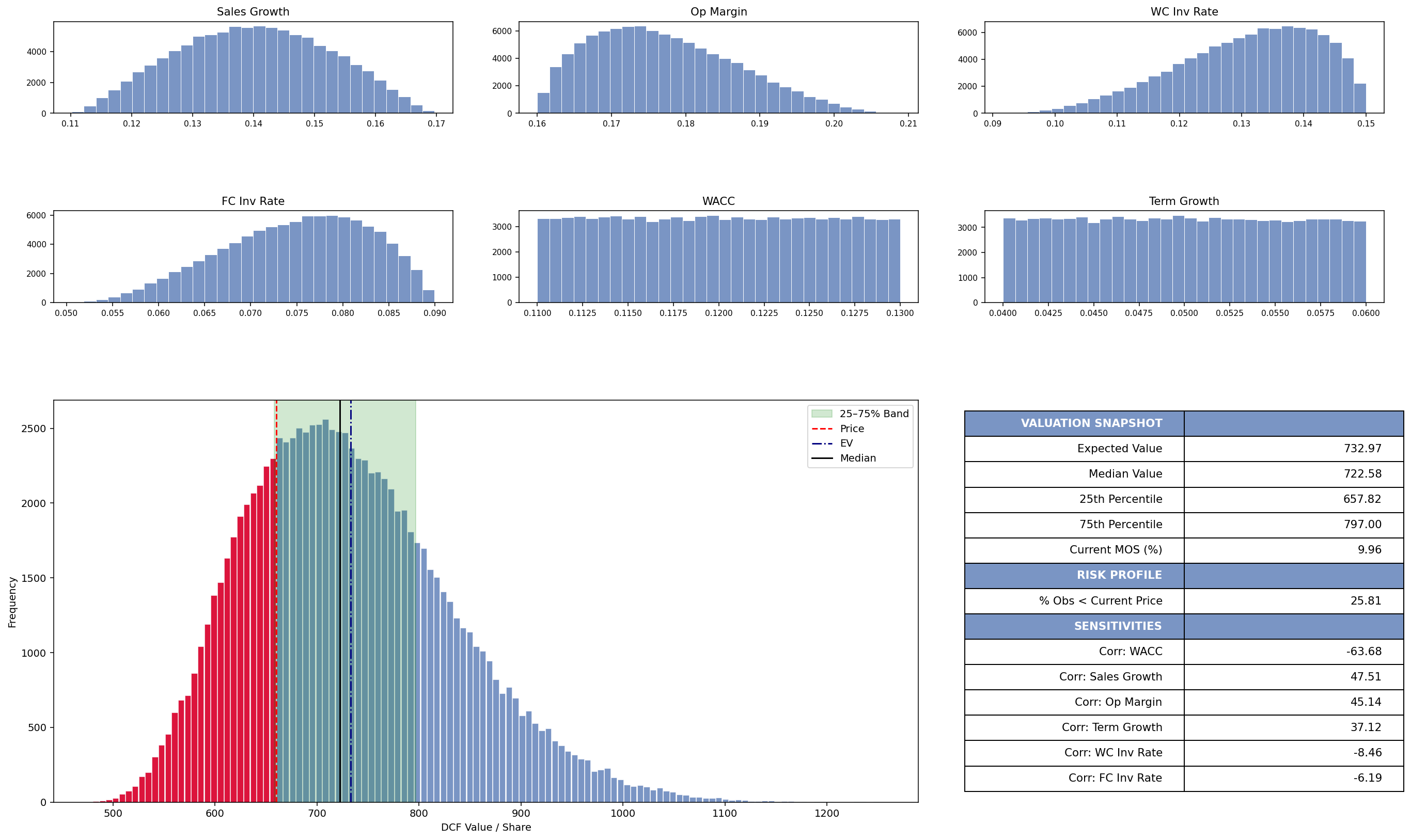
Rather than trying to predict a specific target price, my thesis focuses on reading the current expectations embedded in the CMP of ₹660. By using an “Expectations Investing” framework, I want to identify the performance hurdle Intellect must clear to justify its current valuation.
To do this, I’ve used a Monte Carlo Simulation (100,000 iterations) to map out the range of intrinsic values. This allows me to see where the current price sits within a distribution of probable outcomes.
1. My Assumptions: Calibrating for Reality
I have grounded my input ranges in the company’s historical performance but added a “safety buffer” by assuming the business might become slightly less efficient as it scales its AI-led platforms.
Variable Category
Range (Low to High)
Distribution Mean
My Strategic Justification
Sales Growth
11.0% – 17.0%
14.0%
Aligned with the 5-year CAGR; accounts for the $eMACH.ai$ rollout.
Operating Margin
16.0% – 21.0%
17.3%
Captures the mix shift from licenses to SaaS/Subscription.
Inc. WC Rate
9.0% – 15.0%
13.8%
Higher than the recent 9% to account for unbilled revenue “drag.”
Inc. FC Rate
5.0% – 9.0%
7.8%
Higher than the recent 3% to buffer continued R&D capitalization.
2. The Expectations Gap: Visualizing the Mispricing
When I overlay the current market price on my simulation, the “pessimism” of the market becomes visible.
My Median Intrinsic Value:₹722.58
Market Position (₹660): The CMP is currently priced at the 25.8th percentile.
The Opportunity: Roughly 74% of my simulations suggest the business is worth more than its current price.
In my view, the market is currently pricing Intellect for a “Bottom Quartile” performance. For the current price to be “fair,” the company would essentially have to deliver results in the lowest 25% of its probable outcomes.
3. Strategic Levers: Growth & Margin over Macro
While discount rates ($WACC$) are a core feature of any DCF math, my focus is on the Operating Pedigree. My sensitivity analysis shows that the business’s internal “efficiency levers” are the true drivers of value.
Internal EVA Drivers: Sales Growth and Operating Margin show the highest correlation to value. Because Intellect operates with a high Sales-to-Capital ratio (~8.3x), small improvements in growth create outsized returns in Free Cash Flow.
Resilience to Inefficiency: A key takeaway for me is the low sensitivity to reinvestment rates. Even if my assumptions about Working Capital and Fixed Capital are overly optimistic, the impact on value is marginal relative to the impact of growth. This suggests that the “Software Product” model provides a robust buffer against operational slippage.
4. What I am Monitoring (The “Anti-Thesis”)
To invalidate my reading of the market, I am looking for signs that the business is falling into that “Bottom Quartile” red zone:
Sales Velocity: Does growth slip toward the 11% mark, signaling that the “platform” story is losing its competitive edge?
Structural Margin Erosion: My model assumes a median margin of 17.3%. However, there is a risk of a drastic fall in margins if AI disruption fundamentally changes the “Product” unit economics. If LLM-based coding (what I used to code this simulator) and generic banking agents allow competitors to build “good enough” software at a fraction of Intellect’s R&D cost, the company may lose its pricing power.
R&D Productivity: Is the capitalized R&D failing to convert into new deal wins for the $eMACH.ai$ platform?
Balance Sheet Bloat: Is there a permanent spike in “Other Assets” (Unbilled Revenue), indicating that implementation cycles are becoming more cash-intensive?
Everything said and done - why are all major stakeholders selling - right from Polaris holding to Arun Jain to all major FIIs, to all major DIIs to even Mukul Agarwal. Lack of profit growth can’t be the only reason here - given the valuation comfort it is offering and the AI readiness. They may have overpromised the use case of Purple fabric - but is there something else the market seems to be factoring in?