
Sorry for being dramatic by saying ‘half’ but CERC is planning to reduce fees. The staff paper isnt released yet. Some insider leaked this information as per this report.
If this is implemented, it cuts revenues by 25% approx.

1 Like
SOURCE: https://www.bseindia.com/xml-data/corpfiling/AttachLive/536a19a5-a3c8-4d70-ae72-4527319b0fb4.pdf
Deep Technical Analysis of open risks with the proposed Market Coupling. rpsingh’s blog on Energy Transition - Market Coupling Rigging Analysis makes case for high upfront investment by MCO and deeper markets as precondition.
2 Likes
There was further discussion on this analysis in a recent forum on Market Coupling. This had some other industry veterans expressing their views. Mr Narshiman former Grid Controller had some interesting remarks on sequencing of reforms in power trading market and he felt the need to grow the trading market first by setting capacity market rules, growing contract for diff, congestion mgmt etc before implementing market coupling. Link to Discussion https://www.youtube.com/watch?v=VKXFlEdPbdg
4 Likes
Went through the entire video.
There were 2 very important points which really caught my eye.
- Mr. Arun Goyal was part of the commission that framed 2021 market coupling laws. He said that initially he was against the coupling as competition should prevail but his views have changed since. He pointed out that due to the nature of DAM and RTM, other exchanges cannot make inroads and that IEX will continue to be a monopoly. He questioned whether a private player should have such monopoly and whether a private player should be allowed to make such kind of high margin profits for long.
This makes it clear that currently, the sole motive of coupling is to curb iex’s monopoly and distribute the volumes across the exchanges and not actual market deepening.
- Mr. Narasimahan, the former grid controller pointed out why he thinks that Grid India should not be the MCO. He said that a good portion of market distortions occur due to government intervention (he gave several examples). So if grid india is made MCO, a “letter” from the ministry could distort the market clearing and he explicitly said that the algorithm has to be shielded from the government intervention. He also said that it is very difficult to say this formally.
As I was hearing Mr. Narasimahan’s view, I suddenly remembered power minister’s remark where he said that coupling would be implemented at all costs. So maybe by making grid india MCO, the ministry wants some more “control” over the power market?
disc: invested and biased
4 Likes
I sense that the some players in the power business are not happy with IEX success and want its progress to be curtailed. It makes less sense to focus on coupling first in a market where barely 7-8 % power is traded and given the growth of renewables there is urgent need to grow the trading share and also improve things like congestion in the system- pts which Mr Narshiman highlighted. We have to see how this plays out in Supreme Court hearing. And even if coupling is implemented I have doubts on how quickly it can come in RTM segment, given the complexities involved.
6 Likes
I feel not only other players but cerc and govt ministry also doesnt like iex’s monopoly.
After Mr. Narashimahan’s remarks, i sense the ministry wants to control the power market as well.
Disc: biased and invested
2 Likes
From what I can understand, considering all the challenges which market coupling brings for DAM and RTM markets, in terms of execution, system upgradations, system integration for buyers and suppliers….and amid all the issues within power sector which the panel was discussing to focus on …It seems like an easy 5-6 years unless the coupling actually takes place …because from that above discussion, I could only understand one thing that coupling won’t bring much value addition to the power sector ecosystem as a whole but is only been done to reduce the monopoly of IEX, so that the other exchanges can make some money themselves.
4 Likes
Sometimes to me, IEX looks like a private company which operates under the influence and regulation of policies as framed by the government. Government typically may frame such policies either to become popular or to distribute market share to those entities which they may prefer, and this is in conflict with the minority shareholders which are invested in IEX. Though IEX is a private player, if it is indirectly controlled by policy makers, then it may not be a wealth generating stock.
I may be wrong in my views but it looks a risky business to me, from this perspective.
3 Likes
correct.
And then you look at steel, rice, coal, cement, pharma, telecom, NBFCs, the signature of the policy makers decide their fates and fortunes. duties, exemptions, taxes, PLIs make or break private companies.
no difference in this case too.
2 Likes
I would respectfully disagree. While there is policy and regulation in all markets, in this instance, the key difference is that there is one player with a 85% market share and 99%+ market in areas where the regulator is looking to create regulation that will reduce the market share. If market shares were equal and had an equivalent impact on most players (as other markets typically are), regulation is a normal course of ensuring consumer protection. So regulation per se is not the problem, regulation of a 99% entity with disproportionate downside vs competition brings into question the investment case for the stock
Having said that, based on the video shared by @SidT above, the argument for market coupling appears to be quite strong. IEX has continuously argued that the economic benefit is quite low - which is factually correct. However, as RP Singh explained (and I concur), this has to be the case because market share of 1 player is 99% and mathematically any deviation from price discovery will be low + the total traded quantity is 4% so the economic benefit has to be small.
He also raised the point as to how does one deepen the market (so that more than 4% is traded on power exchanges) rather than just focusing on market coupling. The question for me is that should the market deepen first or is market coupling a necessary step to support deepening of market. Either ways, seems financially this is a FY28 issue for IEX
So for me, the investment case continues to be difficult to decide either ways - market opportunity will grow - increasing power consumption and expected levers of increasing traded power. However, the regulatory rationale and motivation to reduce IEX’s monopolistic position seems to be strong. There also seems to be some motivation in reducing transaction charge through regulation (seems like CERC has an internal paper on this in 2025). Net effect for my calculation seems to be that this looks to be a good business but the valuation does not seem to be support the risks at this price
Disc. Personal views to help me crystalise my own though process. Not a recommendation either ways. Not a SEBI registered analyst. Invested with a partial position - and needing to decide whether to exit or add
7 Likes
Don’t think there’s going to be a scenario where the other exchanges steal significant market share from IEX. I can see 80-20 split between IEX and the other players post MC implementation. The industry is still in early days.
Disc. Invested and monitoring.
5 Likes
Coming back to the same network effect of exchanges. Even if power ministry introduces coupling, why would any buyer or seller move to the other exchanges?. As a buyer/seller - we look for best bid-ask/liquidity. Just because of coupling - i see no reason for buyer/sellers to move away from liquidity and maintain multiple accounts and margin money. Disc: not invested abd tracking
at the moment other exchanges do not have participants, if coupling happens, IEX’s liquidity is available at all the exchanges, so liquidity as a moat will be gone, anyone can compete with anyone on the pricing, products, technology etc
2 Likes
To add to Sachin’s point, the coupling will make every existing exchange into a broker similar to how Zerodha, Groww take bids on their platform but liquidity is provided by the exchanges (Grid India in the case of IEX). Interested to see how IEX intends to tackle this going forward.
Disc - Not invested, tracking.
1 Like
This might sound stupid but shouldn’t we have more brokers instead of more exchanges.
There’s only 2 stock market exchanges NSE and BSE but there are tens of brokers. The same mechanism can be followed in the energy market as well.
1 Like
Interesting read:
9 Likes
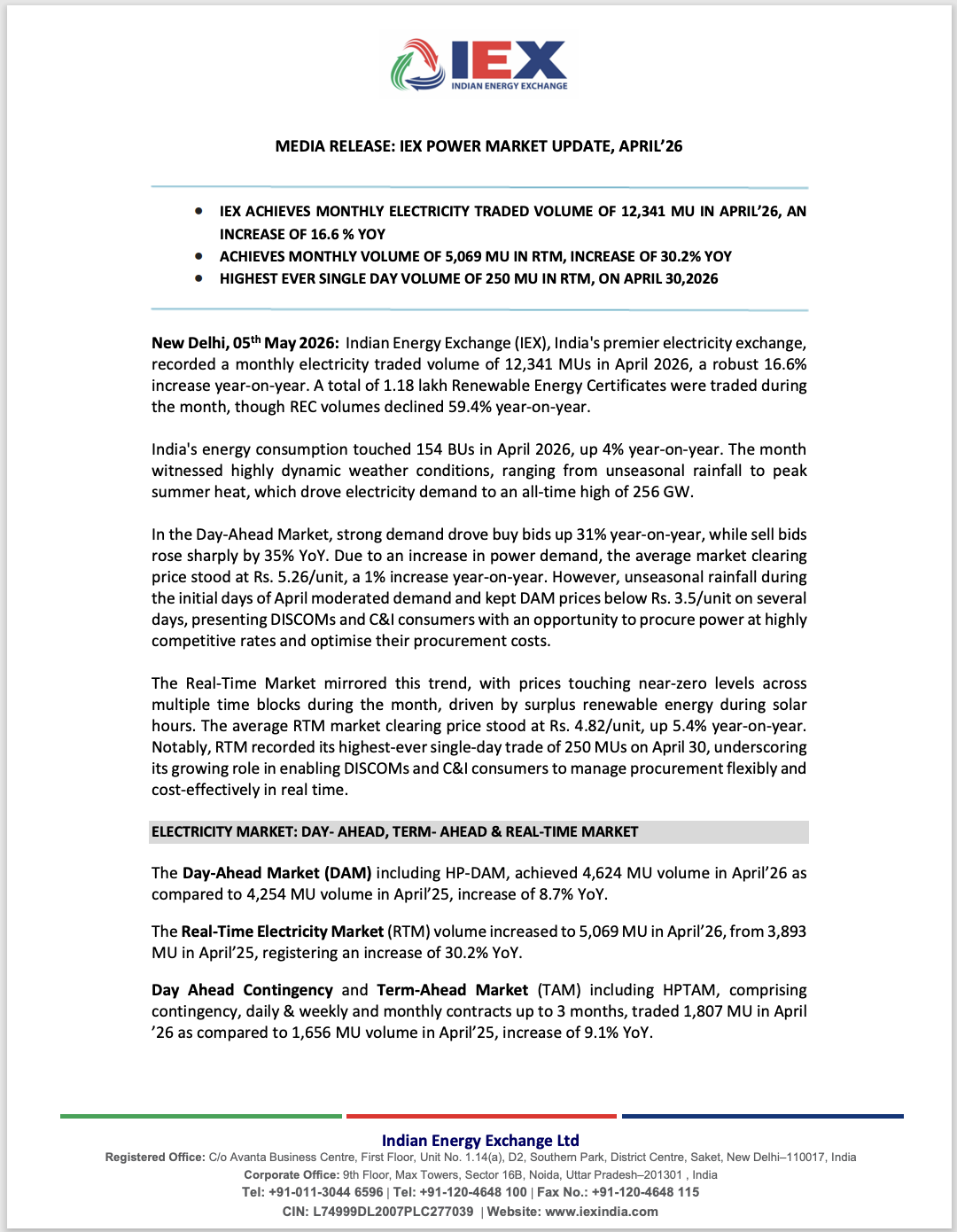
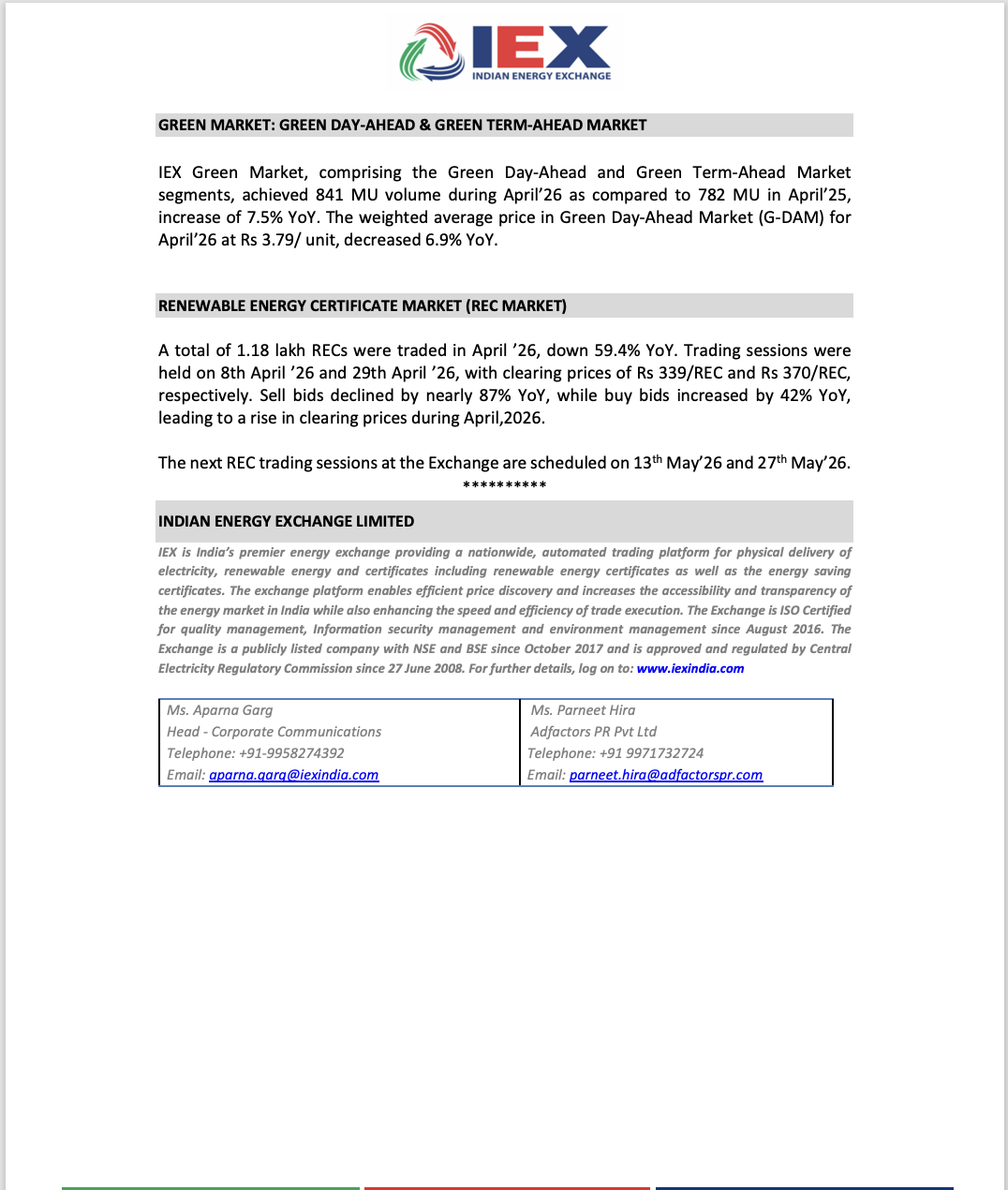
June volume reports out. RTM continues to grow at a much faster pace.
1 Like
Thanks for sharing this @TKarthik . Excellent read by the way. Out of the four scenarios, which one do you guys think is the most probable? I guess because of the low social benefit, tribunal will most likely rule in favour of IEX when MC is implemented and in retaliation the fee cap may be lowered by 25%, which I think way worse than just MC.
And I felt those projections are a bit too conservative, what do you guys think?