Assume downside risk at 50%. CERC can come up with more shenanigans.
Disc - invested
Assume downside risk at 50%. CERC can come up with more shenanigans.
Disc - invested
The APTEL Cause List lists the cases and the court schedule. The corresponding PDF has the link for streaming.
Please note that the streaming seem to be meant for the use of people involved in the case, and may not be really for general public. I didn’t find any such assertions though.
UPDATE
This is the link for 19 Jan 2026 Court 1 stream: https://registrar-aptel.webex.com/registrar-aptel/j.php?MTID=m617ff09536ea3b03bca9d564d98a5573
@harshc shared below that the judge clarified that people like us can watch the court session. We just need to be sure to mute our microphone and video.
Market coupling case is scheduled at 2:15PM (It may get delayed by 15-30min)
In last hearing CERC’s counsel was complaining about unrelated parties being in the stream, however Justice told him they can stop anyone as long as they maintain decorum, just like they can’t stop anyone from entering the courtroom.
A good article on how regulator handles new exchange,
points to Note:
market regulator, SEBI, requires a minimum net worth (assets minus liabilities) of ₹100 crore just to grant a licence. But that’s not enough. You also need to set up a separate clearing corporation — the entity that settles who owes money to whom after trades. That clearing corporation also needs a net worth of ₹100 crore. So right from day one, you’re looking at over ₹200 crore invested even before you’re in business.
Then, after you launch, you need to achieve a minimum annual trading volume of ₹1,000 crore. If you fail to hit this threshold for two consecutive years, SEBI can shut you down, no questions asked
https://scanx.trade/stock-market-news/stocks/iex-awaits-critical-aptel-hearing-on-market-coupling-directive-dispute/30350301 can someone please share, if hearing happened today? did not find any news regarding the delay/hearing outcome
19 Jan 2026
APTEL Market Coupling court case 19 Jan 2026, my vague understanding:
* IEX counsel argued that the order for market coupling cannot stand. Additionally they mentioned that IEX cannot be forced to give data for this process. Their point is, “we’re in a competitive business. This data is crucial for my business. Why should I agree to share the data which may be used by my competitor?”
* CERC counsel claimed that IEX cannot even appeal or question any regulation or direction that CERC comes up with, and least of all the process it follows to arrive at these decisions, especially not in this appellate court.
The case will continue on 20 Jan 2026 2:15PM.
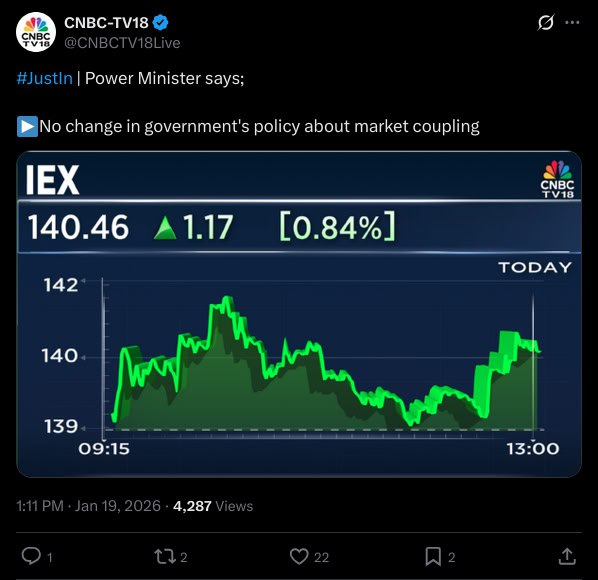
Earlier CNBC-TV18 reported that Power Minister said “No change in govt’s policy about market coupling”
Many thanks to @rpattabi for the link to the hearing and the summary. If I may add my additional perspectives to the same
IEX counsel tried to argue that the coupling direction itself should be removed, to which APTEL responded that there is no action from the coupling direction - so there is no grievance to be addressed. The counsel tried to demonstrate that the requirement for data being asked by the CERC from direction itself was a grievance (from my limited regulatory knowledge this seemed to be a weak argument and the CERC counsel I think was able to defend this in their submission). They did try to argue that the direction did not have any merit due to the only0.03% benefit in the CERC shadow pilot which APTEL said they will not debate as the CERC counsel may argue that the benefit is much more. The senior counsel then brought back the issue of corruption linked to the actual direction which was towards one particular CERC member - but at the same time they do not raise the same objection against CERC as an institution. As a lay person, I thought IEX’s arguments were not cogent and they ended up arguing two different issues by the end of their submission. There was a lot of toing and froing on whether coupling can be debated by APTEL - and I don’t think APTEL were convinced as they said they can only debate something where there is evidence of grievance (and not possible future grievance - for which IEX can go to court separately).
CERC counsel had a single objective and again as a layman, I thought they were much more cogent and convincing in their submission. The APTEL chair let them speak without much interruption which seemed to me to imply there was less disagreement (they were constantly interrupting IEX for clarifications and challenges). The position that CERC counsel took was that the APTEL was not the right entity to rule on market coupling per se and CERC were perfectly within their legal regulatory ambit to ask for data to prepare draft regulations (this seemed logical to me) so there is no grievance here. CERC counsel seems to have hardened their position against taking APTEL direction on market coupling from the first hearing. They agreed they need to form draft regulation - but for which they need data from all participants (not only IEX) and that was entirely in their purview
Senior IEX counsel said they will rebut all CERC counsel’s claims today (or may be even tomorrow depending on available time). CERC Counsel says they are more than happy to debate IEX until they are fatigued from arguing.
My own conclusions from the hearings (which can change based on outcome of subsequent hearings) is that the directive for market coupling is unlikely to be removed by APTEL since there is actually no grievance that they can address (as there is no regulation yet). This is potentially corroborated by what was flagged as the view of the Govt policy on market coupling. IEX could potentially continue to challenge this in alternate courts - but I suspect they will need to challenge the ruling based on the SEBI report of corruption if they want to go down that route.
Look forward to any comments on whether my interpretation are erroneous or I missed anything
It seems like the process will continue for a bit (even if APTEL hearing winds up, there could be additional legal challenges) and then the process of forming the regulation. The implies that if market coupling is to be implemented, we are still some time away. From my perspective, my longer term valuation will continue to assume that market coupling will be implemented as the probability of that is increasing for me - for the moment only in DAM - and will likely only start having an impact in 6-12 months.
Disc. Please note that my conclusions are not based on legal principles (as I am not a lawyer), but based on economic principles of regulation (of which I have some background). My conclusions are meant to inform only my actions and help me clarify my own thinking / put my thoughts out to be challenged. Please do not rely on my views for your action. Not SEBI registered and invested with a non-full position so likely to be biased
Update on APTEL case (20 Jan 2026, I joined a bit late):
Next hearing is scheduled to tomorrow (2:15PM).
The honorable judge and the counsels even commented (they don’t mind) on the unusual number of people watching the live stream.
Please feel free to add, correct, and/or improve on this reporting. I appreciate all the additional info, perspectives, and even individual opinions and view points. These have been quite helpful.
Sounds like a whole lot of nothing from CERC councel.
What I don’t understand is how can CERC antagonise IEX when it is not their job to create MC regulations, a pooling body where bids are collected etc. Their fundamental argument is stupid. What took 10 years to implement in Europe can’t happen in months in India. Don’t even get me started about all the bureaucratic hassles in implementing MC.
Disc. Invested and biased.
Disclaimer: Personal opinion, Not a recommendation,
From today’s hearing, it became evident that other exchanges - primarily PXIL - have been attempting to find mechanisms to combine bids since 2013. To this end, they have periodically filed petitions before CERC and made representations to the Ministry of Power. The first such petition was decided by CERC in 2016 and primarily dealt with pro-rata allocation of transmission corridors. Under that order, 10% of the corridor was allocated to PXIL, with the balance allocated pro-rata (largely to IEX based on trading volumes) for a six-month period.
Subsequently, PXIL faced operational issues, including sustained losses and failure to meet minimum capital requirements.
In 2020, through the Draft Power Market Regulations, CERC attempted to introduce market coupling. However, following objections and hearings, CERC deferred this proposal to a future date, stating that market coupling would be introduced through separate regulations. In the process, the provisions relating to the Market Coupling Operator were removed. HPX was granted permission to operate as a power exchange only in 2022.
In Europe, what is coupled are the markets, not the exchanges themselves. In India, the five regional grids are already interconnected and effectively coupled.
In the contested order of July 2025, CERC decided to implement market coupling through a round-robin mechanism. This, according to IEX, violates CERC’s own regulations, which require a separate regulatory framework for market coupling.
IEX’s core arguments are:
1. CERC bypassed its own regulations.
2. The process lacked transparency.
3. The stated objective of welfare enhancement was not achieved, as shadow-market studies showed only a marginal welfare increase (approximately 0.3% / 0.01%).
4. The order is tainted due to selective leaks by CERC officials, allegedly enabling profiteering, invoking the “fruit of the poisonous tree” doctrine.
One argument that IEX could not raise before APTEL, but may raise in the future before the High Court or Supreme Court, is a challenge under Article 19(1)(g) of the Constitution, on the ground that market coupling imposes an unreasonable restriction on the freedom to carry on trade.
CERC’s counsel broadly argued that the impugned order/direction forms part of a legislative process and is therefore not amenable to appeal before APTEL. Regarding the SEBI report, they stated the early repatriation of one employee and the transfer of two others to other departments of CERC, and that a suo-motu case/inquiry initiated by CERC has been stayed by the Punjab and Haryana High Court.
For interim relief, the primary issues are whether the appeal is maintainable (as contested by CERC’s counsel) and whether IEX has established a prima facie case. If such a case is made out, IEX must also demonstrate that it is an aggrieved party and that it would suffer irreparable harm if the order is not stayed.
In this context, IEX’s counsel is likely to focus on paragraph 6 of the order, which directs implementation of market coupling and effectively places all exchanges - including two with negligible market share—on an equal footing.
This challenge would remain relevant even if the round-robin mechanism is introduced later through fresh regulations. Notably, despite CERC’s counsel asserting that market coupling will not be implemented without formal regulations, the order itself directs the implementation of day-ahead market (DAM) coupling and further states that real-time market (RTM) coupling will follow based on the experience gained from DAM coupling.
Conclusion:
Power exchanges operate as a regulated monopoly in a winner-takes-all market, with trading done by at most a few hundred participants who are producing or distributing power. The disputes arising from this order and future regulations (if any) for market coupling are likely to continue for years—challenging the order itself before APTEL and the Supreme Court, and the eventual regulations before the Delhi High Court and Supreme Court. IEX has reasonable grounds to challenge market coupling, and SEBI’s findings regarding gains from UPSI strengthen its position. Prolonged litigation benefits IEX rather than its competitors, and the pro-rata allocation of transmission corridors continues to work in favour of IEX.
did not get one thing, CERC Council said in previous hearing ‘is not order, is directive’ and regulations are not formulated yet, why APTEL did not ask fundamental question that market coupling regulations are not formed then how could CERC say in public domain that starting jan’2026 market coupling will come in play, its like apartments are not build but residents are given possession.
disc: invested and biased
APTEL judge did ask them to whom this order was issued? Also questioned CERC official’s involvement in share market scam.
This was the first time I got a chance to hear actual court proceedings, and I felt it was very casual/unprofessional, where judge was telling I have never invested in market, lawyer asked him to invest in Mutual funds,then judge said after retirement I will come to you for suggestions. Then every lawyer was busy trying their best level of sycophancy by saying “Lordship” “Lordships” more than their actual argument.
That banter is quite understandable given this context:
I’m 100% with you on that. I think this lording-prostrating-thing is so ingrained in the court culture, these folks have become numb to this. Must be the remnant of the British era master-slave mindset. For us outsiders, it is jarring indeed.
I’m also completely new to witnessing how courts actually work. It is all quite fascinating to me.
its quite common for energy sector lawyers to just read their submissions, because hardly any legal point is to be argued, so they just read, people who are in this sector is used to hours of hearing but the crux can summarized in 10-15 mins, but the fees are also quite high, they charge around 7-8 lakhs per hearing.
Bench seems to be tired with the hearings and seemed to have reached a conclusion among themselves, imo.
A second lawyer of CERC today pretty much repeated the same points as Additional Solicitor General Venkataraman did earlier this week and bench jokingly called it round robin method of arguing.
IEX lawyers started the final arguments but couldn’t finish today. Next hearing is on 30th January & order likely by 2nd February.
I am a little frustrated that the IEX lawyer wasn’t presenting points cogently. Just want them to say the following:
CERCs argument that the order is rule-making and not administrative is a cover-up. The order stated coupling must be executed by Jan 2026, just changing the name to directive doesn’t change the intent. None of the steps for rule-making like draft rules, consultation etc were followed. An order cant become a rule post-facto. CERC is using this distracting and long-winded argument since the order cannot be defended on merits
The main supposed merit for market coupling was to be economic benefit. However CERCs own report said economic benefit to customers was an negligible 0.3%, so the hurry to issue the order needs to be examined.
Per SEBI, the people making ‘economic benefit’ from the order are the Chief of the CERC Economics division & her group with 170CR of insider trading profit as a result of this order. There is voluminous financial, communication & photo evidence of CERC officer’s involvement in the SEBI report. This is the only reason the order was issued, since there was no actual benefit to anyone else.
CERC is free to make rules in the future, but this order is corrupted in intent, and cannot stand, whether implemented in Jan 2026 or not.
Maybe there is more to it than what we know. If we can understand these in simple words counsel can as well