IDFC First Bank Limited - First Bank Preference for Long Term Investors too?

Its PCR is lowest amongst the leading banks. Industry average is 76-78 vs 72

So, it makes sense for them to use big chunks of quarterly profits for provisions. With MFI stress, they kinda hit the pedal to the metal in last three quarters.

https://www.perplexity.ai/search/compare-pcr-for-leading-banks-4divrx_TT2GtPenyDe5Lcg

“IDFC First Bank’s CAR at 16.3% places it above the regulatory floor and close to peers like Axis and IndusInd, despite higher retail risk weights”

It appears, PCR is a priority, with added tax benefit, whereas CAR is comfortable after recent dilution.

4 Likes
  1. I asked Perplexity to “get your facts right” (it is of course limited by the quality of inputs it gets) - here is what it says - Perplexity admits inaccuracies

  2. What matters in CAR is CET 1 (which is shareholders’ equity) and not Tier 2. Here is how various banks compare at Sept 30, 2025

The inadequacy of CET 1 of IDFC First in comparison to other banks is quite clear - leading to the biggest fund raise at the lowest cost of Rs 60 / share; lower than the July 2024 fund raise at Rs 80.63 per share - a discount of 25%.

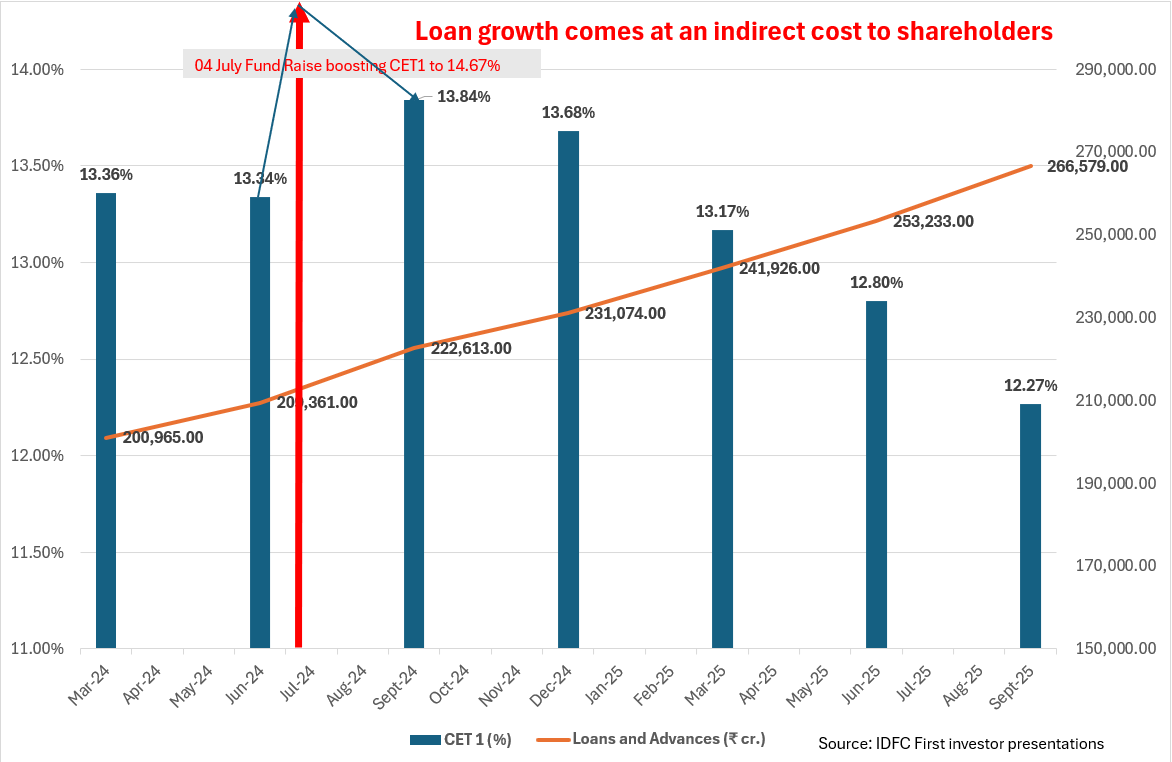
  1. This decline in CET 1 is on account of aggressive growth in Loans and Advances (L&A) but not in profits. This is despite a 04 July 24 fund raise boosting CET 1 to 14.67%

You may see that CET1 declines rapidly because IDFC First boosts loan growth even with deteriorating profits

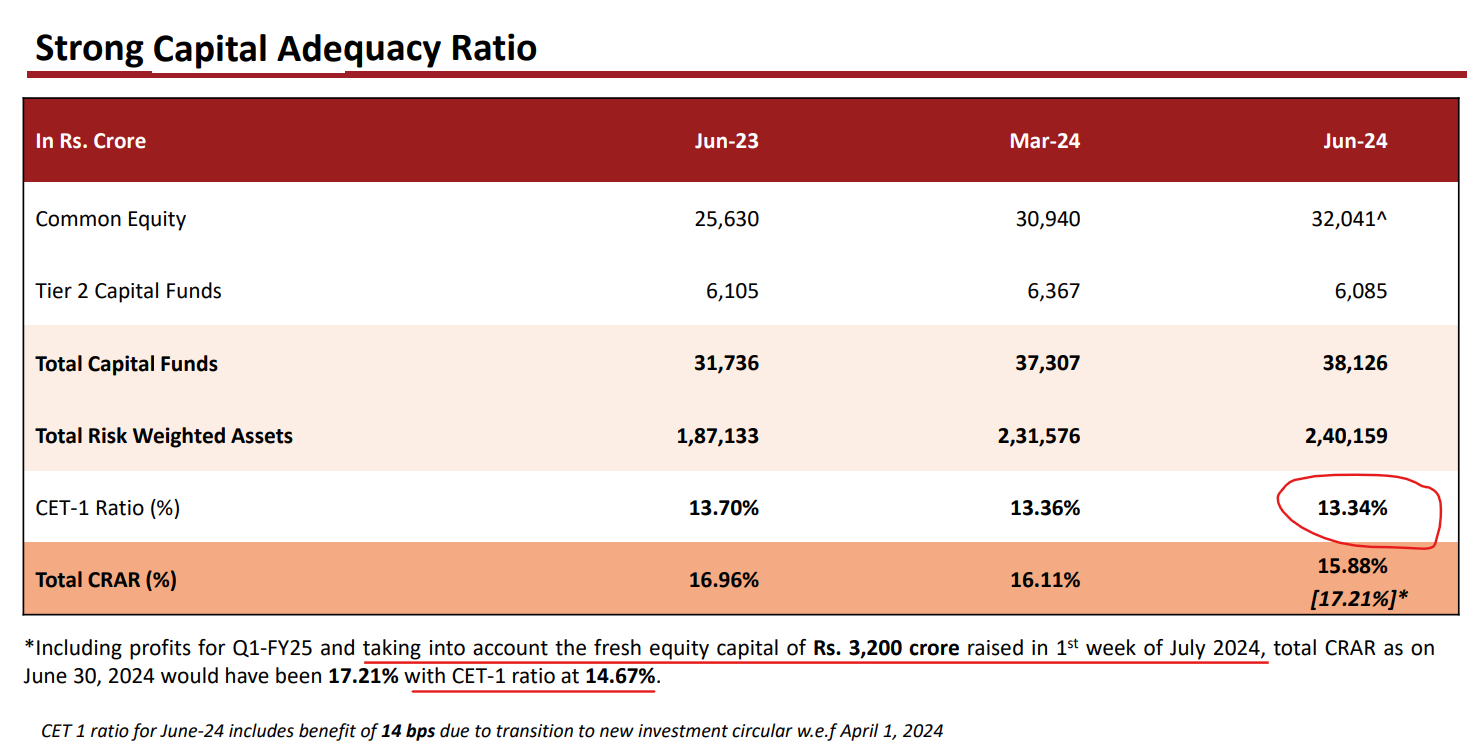
  1. Management will ofcourse bring future fund raises to current CET1 and say it’s so nice; like it did in July 2024 when it raised Rs 3,200 cr (snip below)

But CET1 deteriorated rapidly from that 14.67% to a dangerous 12.27% in less than 15 months!

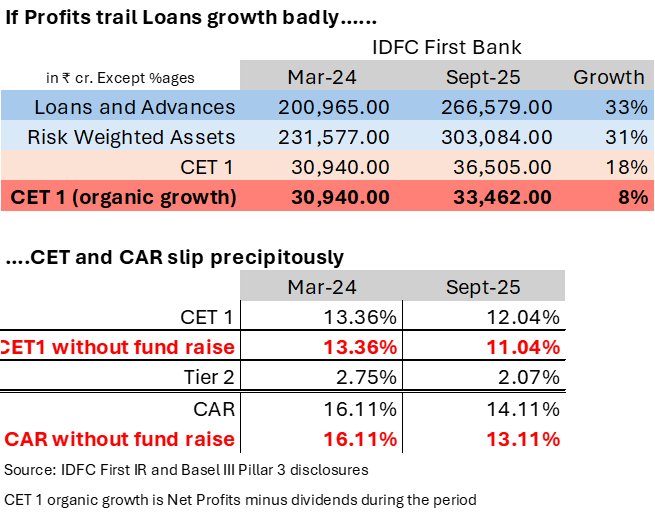
  1. To understand how aggressive L&A but tepid profits affects CET1 look at the table below

This necessitates fund raise, which IDFC First has been doing again and again.

  1. So what will happen if IDFC First grows its Loan Book by say 20% annually here on? The Loan Book will grow by ~ Rs 53,000 crores (and so will RWA mostly). To maintain its CET 1 ratio at 14.75%; the bank needs CET incremental capital at 14.75% of 53,000 crores = Rs 7,817 crores next year. Can the bank generate these kinds of after tax profits? If not, then either the loan growth will have to shrink, CET 1 will come down, or existing shareholders face the prospect of further dilution!

To sum: Banks raising equity capital without appropriate profits, just to fund loan growth is bad for minority shareholders

18 Likes

I have read your posts several times, and I agree.

True, either growth slows or else a capital raise.

growth won’t slow, I feel.
A lot is at stake. Bank needs to trim down CI ratio. They are on a timeline.

But, profits could accumulate.
With MFI issue behind us, half of 7500 Crs in next 4 quarters seems possible. Hence, delaying another round of equity dilution.

2 Likes

Good to see we are on the same page in this aspect. Let’s see how this pans out.

I would be very surprised if they can make Rs 7,500 cr or even thereabouts in the next year until Sept 26; but then I could be wrong too. Let’s see!

1 Like

While raising capital of 7500 Cr, VV had mentioned that they will come to the market in another 2 years for capital again, but it was very subtle..Until ROE reaches 15% at least, expect this cycle to continue for few more years..

There is no doubt that the bank would start considering additional CET1 by end of FY 27 or thereabouts, depending on how much net profit it makes in next 6 quarters. If the profits are decent in this period then the equity raise would get pushed forward.

If things go well and there are no further hiccups it will push up the share price, then the bank would be able to get a good price thus reducing the dilution. We can hold and watch for six quarters. It is not a recommendation.

Invested since merger.

4 Likes

IDFC First Bank has become a FOMO investment for many, including myself largely because of the trust investors have in Mr. V. Vaidyanathan’s past track record.

After doing my own analysis as a relatively new investor, I noticed both pros and cons worth highlighting.

Pros & Positives

1.GNPA < CAR and GNPA < NIM
The bank has consistently maintained this.
However, CAR has been declining for 3–4 years and is being propped up via capital raising.
But NIM improvement depends heavily on the cost of funds, which hasn’t reduced yet.

2. CASA Growth
CASA growth remains strong, a good sign.
A growing CASA base supports cross-selling and higher fee income, which is currently ~14%. I expect this could touch ~18% in the coming years.

3. Concentration Risk
Top 20 advances, depositors, and exposures look well-distributed.

4. Divergence
No divergence reported since 2019, a healthy indicator.

5. Yield on Advances
Currently around 15%, which is good. It would be even better if it moves toward 18%.

Mixed Bag – Areas to Watch

1. Secured vs Unsecured Lending
The bank’s secured lending ratio has been 50–60% for the past 5–6 years.
While some reports and rating agencies show 70–80%, the Annual Report (Schedule 9 – Advances) indicates otherwise.
A higher share of unsecured loans can:

  • Make NIMs volatile
  • Pressure CAR
  • Limit aggressive future lending

So, while risk management is often praised, the real mix deserves a closer look.

2. Loan-to-Deposit (LTD) Ratio >100% since 2023
This should raise eyebrows, as it can signal tighter liquidity and reliance on borrowings.

3. Provision Coverage Ratio (PCR)
Was below 70% historically; now around 72% (FY25).
It would be more comforting to see this consistently above 75%.

4. Cost-to-Income Ratio
Persistently high at 70%+.
Despite guidance to bring it below 65% by FY25, it hasn’t materialized yet.
Concall explanations have been unconvincing so far.

5. Contingent Liabilities
Consistently over 100% of total assets, making the balance sheet riskier.
Also, since 2023, there’s a ~50 bps difference between ROA and Return on Risk-Weighted Assets worth monitoring.

6. Financial Leverage
Historically above 9x, now at 8.21x.
Would be healthier if the bank sustains growth with leverage between 7–8x.

Other Metrics

  • Slippage Ratio: Improved from ~3% (FY23) to 1.85% now. Aiming below 2%/1.8% would be ideal.
  • Credit Cost: ~2%, I am okay as this is a young & growing bank(at snail’s pace).
  • Employee Turnover: Manageable; not a major concern for me yet.
  • ROA: Only crossed 1.1% in FY23–FY24. Only a sustained ROA >1.1% for a few quarters in the future will make the market to assign >2x book valuation. Else it gonna trade 1.2x to 1.5x for many weeks.
  • ROE: Naturally tied to ROA; leverage is in line.
  • Dividend: Surprising, given the capital needs reinvestment might have been better.

Valuations & Outlook

  • Book Value per Share: ₹54.20
  • Given the current risks and the bank’s early growth phase, I assign a fair multiple of 1.1–1.2x Book Value.
  • Until the bank demonstrates sustained NIM, CAR, and cost control improvements, I expect it to trade between 1.1x–1.5x book.
  • Once it crosses 1.5x, many long-term investors (considering opportunity cost) might start booking profits.

Disc: I entered due to FOMO and have held it for ~1.5 years now, initially a small tracking position, now around 5% of my portfolio after averaging near book value.

I’ll reassess after the next few quarters’ results with a deeper dive into capital adequacy, unsecured lending trends, and cost-to-income metrics.

This is just my understanding, open to corrections or additional insights from others.

12 Likes

VV sold 6,36,00 shares from his trust last week. Anyone knows the reasons? No news in media.

Rukmani Social Welfare Trust has disposed 6,00,000 equity shares of IDFC FIRST Bank Limited to support social activities. It is submitted as part of these disclosures, that there are no direct or indirect benefits derived by Mr. V. Vaidyanathan from these transactions.

6 Likes

At 48 PE is the stock expensive?
In 2024 EPS was 4.16 for the whole year.
going forward two years, assuming a 20% growth, EPS = 6, hence PE of 13!

It can go 2x before the price falters.

2 Likes

If the bank can deliver about 30% profit growth in FY27, then by the end of FY27 the share price may potentially be 3 times the current CMP.

around 18% is reasonable to assume, considering:

a. They intend to improve PCR, bringing it at par.
b. margin contraction due to rate cuts
c. obvious traction in the economy.

BV(standalone) has risen about 11% over the last 10Q, and the stock has traded at an average of ~1.5x its BV during this period.

If we project a similar trend on a conservative basis for the next 10 quarters (i.e., up to Q4FY28), the BV could reach around ~73 to 75. Assuming the stock trades at 2x BV, the share price could hover around 140-150. roughly 80% upside. Lucrative enough to stay put.

In nutshell, Banking is a business of earning principal + interest it’s a game of protecting the downside rather than chasing the upside.

The sector often delivers more negative surprises than positive ones, and the real winners are the banks that excel in risk management and cost control consistently.

Only time will tell whether IDFC First Bank can continue on that disciplined path and prove itself in the long run.

3 Likes