Just started reading “How to make money in stocks by William J O’Neil”.
In one of the chart he describes sell criteria as follows
“Sell on the way up if prices go above uptrend line on a logarithmic chart plotted over 3 peaks spread out over a period of months”
My query is, in general which chart makes more sense/significance (normal or logarithmic price chart)?
or we have to switch between normal and log chart based on certain conditions/scenario?
So much noise around the rally & now the expected corrections in small and mid caps.
If one has hefty allocation in small and mid caps then how to handle this situation specially after the correction in this space in last couple of days.
Profit booking is the way or complete exits.
Also, what’s your views on HBL Power after some correction it has seen recently.
We have had a brutal correction in overall markets since past few days. By now it’s become all too familiar. Whenever these corrections come about, the kind of downward force that is there takes most market participants by surprise. This has happened in the past also and is the case in most corrections.
When these corrections come about is anybody’s guess, and personally I have found them difficult to predict on a consistent basis.
How to negotiate them is often the big question. What I usually do is evaluate my portfolio stocks, and try to weed out the least conviction stocks, both in terms of fundamentals and technicals and try to get into new better options, or increase allocations to existing high conviction bets.
If we take a broader view on overall markets, 18880-18890 was a major top previously. In this correction we have reached those very levels. So logically based on change of polarity principles, we could get support at those levels. Nifty is close to 200 dema at around 18840. So current levels need to be watched for arrest of fall in Nifty and a possible tradeable bounce. Otherwise things can get ugly.
HBL is also in a corrective mode, and has corrected to levels of around 260 from highs of 310. This seems in line with the market correction.
@rmjp Logarithmic scale is used on very long term chart of months and years. For short to medium term, its better to go for normal price charts. While reading William O Neil’s book, (or any other book for that matter) try to focus on the overall learnings rather than getting stuck with a single point. We have to remember that this book was written decades ago, so some things may not apply to today’s markets. But if we get the overall concept described in the book, which is that of getting into stocks with both earnings and price momentum, it should serve us well.
I always have been fundamental guy so far but recently started looking into technical charts more seriously. Basically picking stocks on technical basis and then evaluating whether fundamentally it’s underpriced or not. Can’t thank enough for doing that because all my recent investments are in green even during this maddening carnage.
Sir, do you keep Stop loss (mental or real) for your long term holdings? Do you take exit call based on chart even if Business is Fundamentally Strong? If yes what is your stop loss criteria for long term holdings?
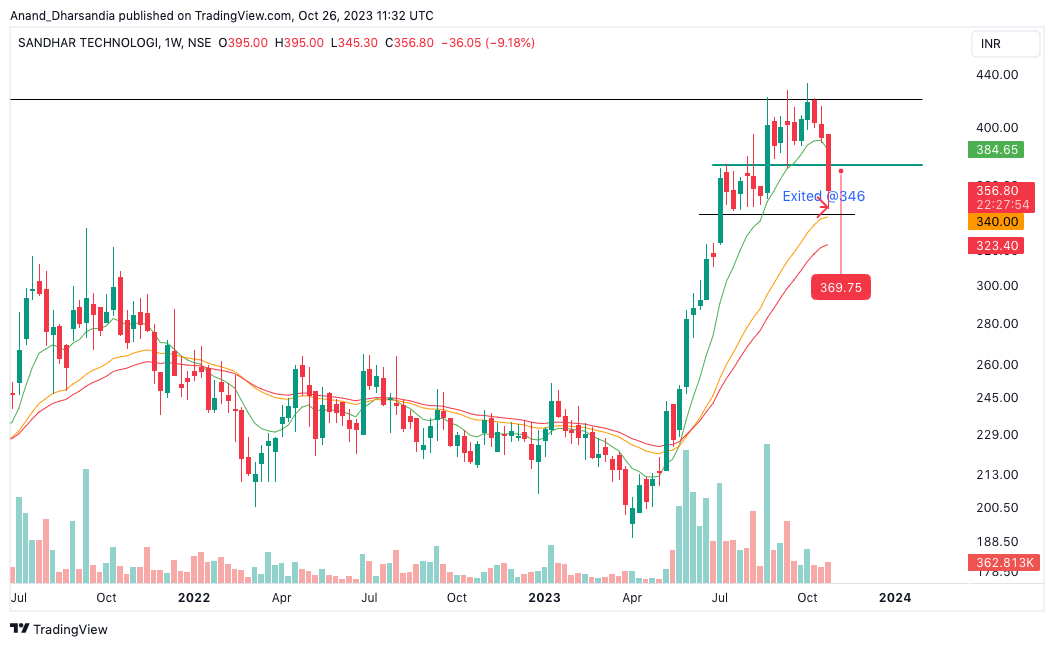
Problem with me is I keep mental stop loss for my long term holdings based on weekly major support and resistance and mark them on charts. But during this kind of market correction majority SL get triggered and I take exit call. And the next day stock bounces back very sharp. Some time we miss good entry price. Ex Sandhar Technologies: SL was at 369 and got triggered since last two day and I have exited. I will take entry again if Stock Breaks Out from Green Line (375) .
My long term holdings usually have very strong conviction based on fundamental research. So in those names, since my holding periods are more (1-3 years) as compared to the short to medium term bets, (of a few weeks to few months) I tend to give these positions long ropes. During the stock’s journey in a 2-3 year period, there will be atleast a couple of occasions when the situation will be close to a technical stop loss being triggered. But in these fundamental picks I tend to rely more on the business performance. Exits if at all are based more on fundamental performance. Unless it is trimming these positions based on some sharp run ups where I feel rally is not sustainable and stock price will need to rest/correct for some time. And the capital is needed elsewhere.
Recent example is of Usha Martin where the head and shoulders pattern I highlighted in the technical analysis thread indicated a trim/sell, but since I feel confident about the business prospects of the company, I am okay to bear the temporary pain of seeing stock price go down. Here I had figured out that according to various moving avg supports, 30 WEMA around 290 , 200 dema around 270 and below that, 252 which is 50% retracement level to previous strong rally were the levels to watch. Today stock price took support around the retracement level mentioned above. Today was again a big bar with big volumes day. These kind of findings are usually seen after a strong rally near peak, or after sharp fall near bottom. If this support indeed holds and stock price rallies, today’s bar will qualify as an important daily bar on daily chart. 308-310 is a gap area on daily charts. disc : holding. added more today.
Hi @hitesh2710
Firstly thanks a ton for the wealth of knowledge that you keep sharing Hitesh bhai. I have picked hbl following you and it has been an almost 3x in less than year timeframe
The way i look at the story now onwards-
On revenue gront
Fy26 revenue at 2900 cr, and giving it a 6/7 price to sales, cagr over next 2.75 years (q2 is not yet out) is 32%/39%.while revenues could overshoot management estimates…management estimates are not conservative as well. Hbl has developed capabilities through r&d but their execution capabilities are yet to be established.
On pe front…going by management guidance of 18% ebida on fy26 revenues,and assuming interest +depreciation of 60 cr pat is 350 cr. At 50 pe ,returns are 32%
Hence am expecting a 30%-35% cagr provided there is no negative surprise on revenue/margin.
Company being in twin positives of ev/ defense ensures buzz stays for some time…however i am not able to assign >7x price to sales.
Would be keen to understand your view on the story going forward.
Sir, are there any visible indications or patterns on charts that could mean froth, or it is not possible to identify froth on charts, and one has to rely on fundamentals alone to gauge?
Regarding HBL Power, I don’t try to go by management projections. The main thing to know about this business is that it does have strong tailwinds in all its business units. But there can be lumpiness on a quarterly basis. I try not to do crystal ball gazing with relation to its sales, profits or expected returns. Idea is to take things as they come.
On what kind of valuations it gets from markets, its difficult to guess. As long as earnings keep chugging along and tailwinds persist, it makes sense to ride it. There will be sharp rallies and corrections off and on, more so with the kind of markets we are in currently. If one is nimble enough, one can ride these also to do a bit of trading with a part of the position.
Froth in any stock will lead to parabolic moves. These take the form of moves ranging from 50-100% within a few weeks. These kind of rallies are often followed by sharp corrections, or prolonged sideways movements. Sideways movements post parabolic moves are often seen in stocks which hold promise of good future earnings.
But what I have usually seen is that post parabolic moves, most of the upsides are captured, and hence it might make sense to atleast book partial if not full profits. ( there will be exceptions to this too, where post parabolic moves also upsides can materialise)
You can see examples of parabolic moves in stocks like HBL, Som distilleries, Zen tech, etc. One indication with these moves is that the weekly and monthly RSI are well above 80, usually approaching 90, and sometimes cross 90 also. Chances of getting parabolic moves are higher once weekly and monthly RSI cross 70, and trend on the upside. ( this is contrary to conventional wisdom, where very high (above 70) RSI is an indicator of overbought state of affairs) .
Sir, if one were to focus more on the price movement and not give much importance to the fundamentals, or not give any importance at all, as the holding period is shorter, whose works have to be studied? Like Buffett, Lynch who exist for FA, who exist for non-FA?
And in those works which you have read, are there any concepts that have lost relevance, and are not applicable in this day and age? On the same note sir, have you found anything changing in the behavior of the markets, with the increasing use of tech like automation, AI etc?
I ask this because, from what I know, you must have started with FA, and had a long term PF, found TA after FA, moved to more short term bets, taking bigger positions with technofunda approach.
Yes, my question does not limit to books, my question was also about developing a perspective, a trading psychology. I should have mentioned this in my query, my bad.
I would like to know if anyone exists who moves along with the market and does not focus too much on macros and micros, and has been successful for decades. I am looking at a lot of content, and while I am coming across many successful traders with varying styles and varying perspectives, so I wanted to know if Hitesh sir has encountered anyone whose works resonated with him, like Lynch did w.r.t investing. I ask because unlike investing, trading styles vary very much, there are more number of ways to skin the cat in trading, than in investing.
There exist some threads which are helpful in creating a trading psychology.
And I personally believe that, there is nothing Hitesh sir cannot answer as far as my questions are concerned, and as he explains in a lucid and succinct manner, my doubts get cleared, and I get to learn.
Some basics related to technical analysis remain relevant all throughout these years even with the use of new age technologies. Some basic concepts like drawing trendlines and looking out for trend reversal, and when this happens with a big candle with big volumes, there are high chances of getting expected results. The more you look at charts, the more things you uncover about simple things working out most of the time.
The one person who focusses a lot on technicals (some methods devised of his own style) and can be a comparable role model to Lynch ( for fundamental based investing) is Mark Minervini. I have read his books and was lucky enough to watch his master trader program videos. Some of his basic concepts like watching out for a sector that breaks out to a fresh high when market is coming out of correction being the sector to be in are very relevant. There are a lot of other things which he teaches and are easy to follow and implement.
Hello Sir I’ve heard a lot about you.
I am a med student doing internship at Nair hospital Mumbai.
But since last 2 and a half years I am involved much more in investing and how to manage money.
I want to ask you sir how do you go about analysing a company, and as warren buffet said you should invest in business that you understand so I think that will be Pharma sector for me. So how would you go about analysing a Pharma company. How would you analyse a sector as well and their future prospects.
Others views re also welcomed.
This thread of Dr. Hitesh is as large as your medicine books, it consists of thousands of questions from members and Hitesh sir’s answers, which can be divided into volumes. As you are interested, you can go through the thread to find answers, not just for the questions you have asked, but for thousands of other questions that are related to investing, FA, TA, markets, psychology and what not. It will take time, it will be overwhelming but it is educational.
And there are many other doctors who are active in the forum, apart from Dr. Hitesh, you can check their threads too, if you have not already.
Sir, In above reply to my last year question of How to Avoid Big Drawdown, you had mentioned that you had gone through 40% drawdown during 2018. I asked my self ‘how can I avoided that drawdown If I were at your place?’ I found following bearish pattern and chart by which I could have taken cash call to Exit Portfolio during Starting week of March 2018:
First Dark Line of previous support was clearly violated 3 times and index was forming LH-LL on Weekly chart of Mid cap Index and went below 30-40 EMA (Stage 4) (same was the case for Small Cap Index). At that time Most of The Individual Portfolio Stocks must have broken down their previous support and resistance and went below 10-30-40 WEMA and we could have taken exit call on individual stock also (Hypothetical statement but most of the stocks developed bearish chart patterns).
Sir If you had knowledge of Technical Analysis at that time and seen such bearish chart pattern, could you have avoided that kind of drawdown?
I strongly believe that if we observe charts daily or weakly and spot such bearish charts for all of our portfolio stocks along with bearishness in Index Charts, we can take exit calls on portfolio level. (For me its only belief because I have not experienced any large drawdown and implemented this Cash Call for my portfolio.)
You can provide your inputs about my Cash Call Strategy from you experience, so that we can finetune it.
Even though you have asked this question to someone else, I just want to add my 2 cents here.
Technical analysis does not work every time, b/w 2020 to 2023 I have seen this pattern in multiple stocks, but in the end reversal did come and those stocks gave very good returns. There could have been a possibility that the pattern you pointed out became triple bottom pattern in 2019 May. Only looking at historical charts now we can say “Oh it was clearly visible”. Technical analysis is very important, but we might need to stay invested for a long time to cash big.