
https://x.com/lnprcapital/status/1990245645861744800?s=46 some good inputs
Woah, very different to my view. They seem to be at peak or near peak levels in terms of both margins and sentiments. I will be very surprised if the stock performs even near to what is mentioned here. Anyways, that’s what makes the market. Let’s see!
3 Likes
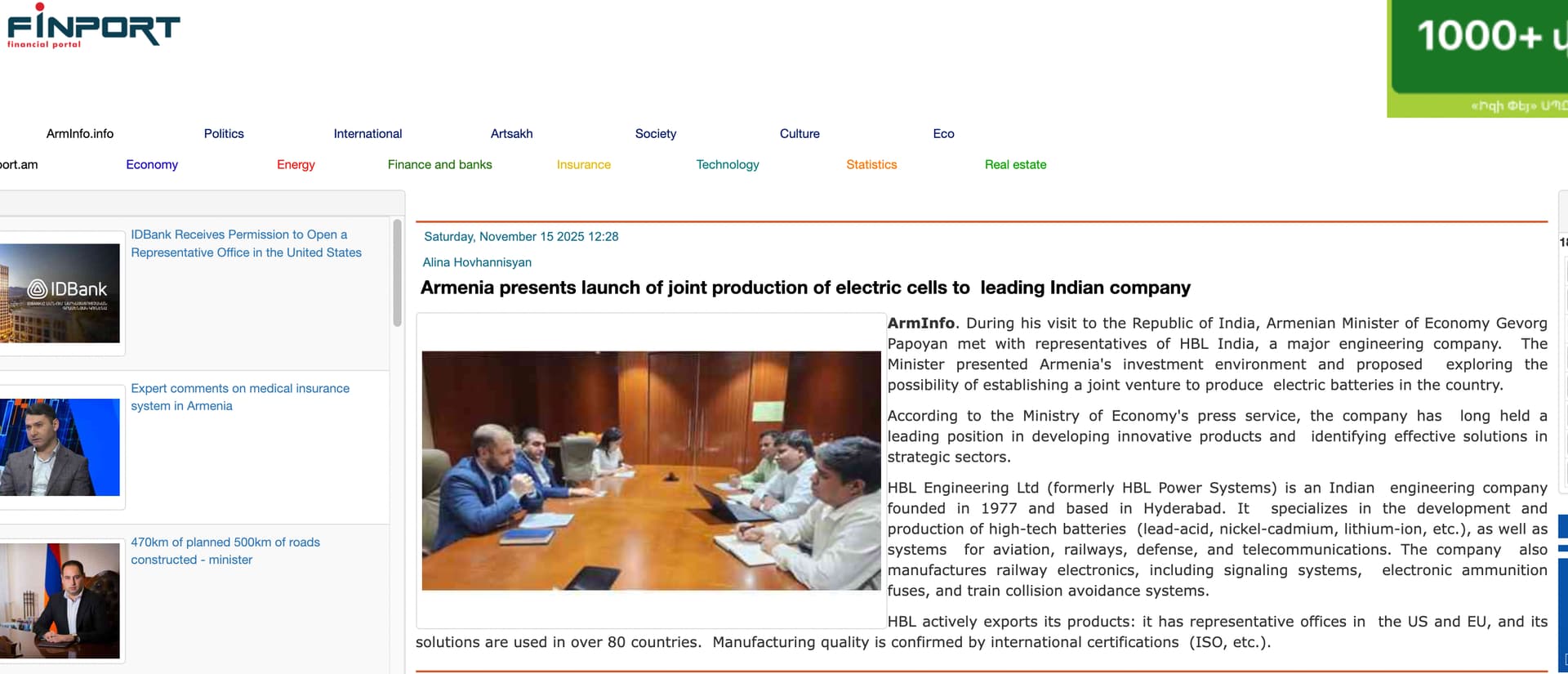
HBL in Armenia news : talks to setup battery production in Armenia with HBL as JV partner.
22 Likes
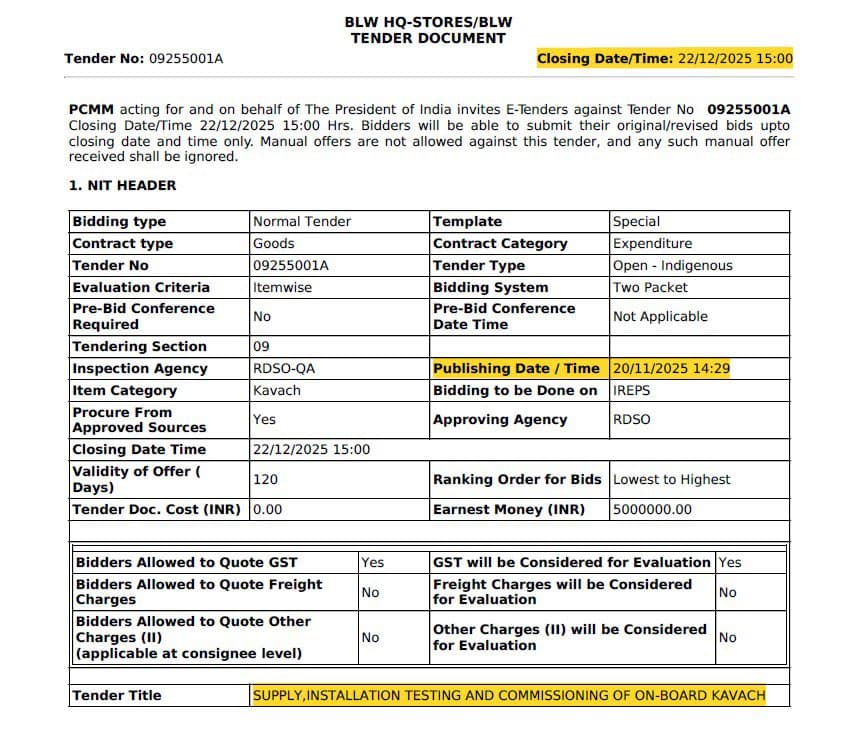
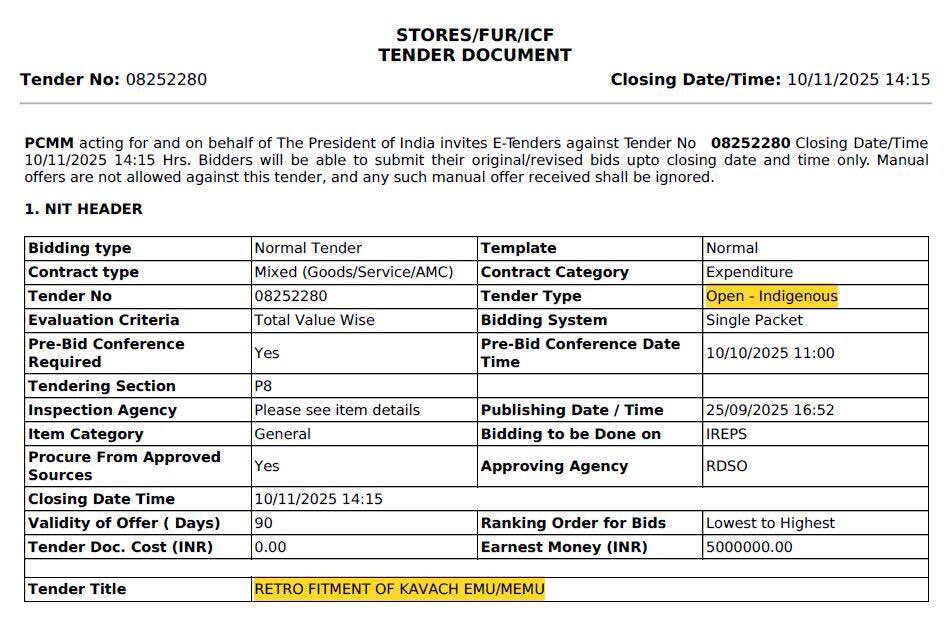
OPP SIZE FOR KAVACH KEEPS INCREASING . Railways (BLW) has floated another tender for Loco Kavach worth about ₹2,000 crore.
The government is clearly in no mood to slow down the Kavach rollout.
New tenders issued recently:
CLW: 5,600 crore
ICF: 1,900 crore
BLW: 2,100 crore
That’s nearly ₹9,600 crore of new Loco Kavach orders to be awarded soon, which in my opinion signals an expanding TAM for all OEMs.
18 Likes
HBL Engineering Limited
New tenders for locos floating/closed to be awarded to the companies:
CLW - 6303 Locos
ICF - 2530 Locos
BLW - 2680 Locos
Which makes total of 11,500 Locos (one locos cost is 75 lakhs) - ₹8625 Cr Total orders
Out of this HBL can get atleast 30% of total order - ₹2600 Cr
Last year government issue 9600 locos order out of which 3500 Locos will go into retendering as not fulfilled by the companies from them also HBL get 30% (1050 locos order worth 780 Cr).
**Total order from Kavach loco order makes up ₹3380 Cr and Track & Station order are also there which also worth of 1000 Cr plus. **
This gives clear visibility for FY27.
Locos Kavach have minimum margins of 50% on EBITDA and Track and Station have 40% EBITDA Margins
14 Likes
There is no certainty that HBL will get 30% of the tenders. If we go by previous track record - in the CLW 10k Loco tender, HBL only got an order for 2200 locos, which is 22%. Irrespective of whether companies have received v4.0 approval or not, 20% of the tender is reserved for developmental vendors whose equipment is undergoing field trials with KAVACH v4.0. The balance 80% is split based on whether the company is L1, L2 or L3. In the 10k loco tenders Medha got 3300, Kernex 2500 an HBL got 2200. Balance 2000 locos were split between developmental vendors GG Tronics (800) and Quadrant Future Tek (1200).
Can you please state the source of this information? How do you know 3500 locos will go for re-tendering? The order end date is 11th Dec 2025 and locos fitted with KAVACH equipment atleast 10 days before the end date will only be eligible for commissioning. Any equipment installed post this date will be rejected. So we will know the exact numbers only by 1st Dec 2025.
7 Likes
Well said,
Firstly, Sorry for my words I forgot to put the words that each and every analysis is based on assumptions might be i am wrong, so also do you own analysis.
Secondly, As of now no one knows how the retendering will work. I am making my assumptions on the basis of yesterday order cancellation because of not getting Kavach 4.0 Approval. and on the other front that HBL will get 30% or not, its base on the strong execution that HBL has made in past. At present there is 3 major players in the market and HBL has best execution capabilities till date. I am taking my numbers on this basis. Lets wait for the award of orders, then we all will get to know how much they will get.
Disclaimer: Do you on review analysis, above statement are based on certain assumptions.
6 Likes
Does this recent cancellation of order of CG, leads to retendering and opportunity for a better executor like HBL?
1 Like
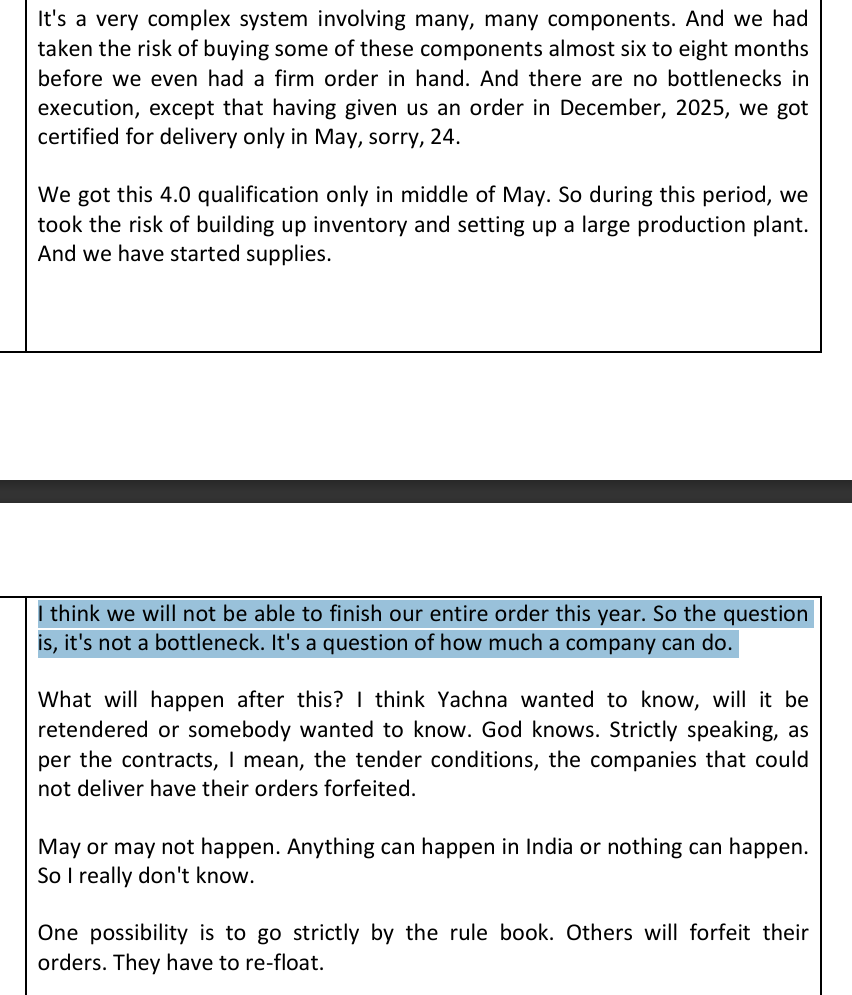
Leave re-tendering process. Even the HBL management was not confident of completing the orders of this year.
Seems out of 2200 Locos order scheduled to get completed by 11th December, it seems they may also miss the deadline & their pending orders may enter re-tender process.
In a lighter sense, Makes me remember a hindi movie title,
“Iski Topi, uske sarr” & Uski topi, iske sarr.
We will only get to know on 1st December.
7 Likes
Although HBL indicated during the AGM that it might not be able to fully execute the locomotive orders, the company has demonstrated strong execution in H1 FY26. Based on the current trajectory, the likelihood of completing the entire order appears quite high.
3 Likes
https://x.com/alpha_defense/status/1993645153228382243?t=vhN9Jy9COWUJpwrMTVnrog&s=19
Another interesting opportunity coming up for HBL. If the company is able to participate and show execution capability, this can be another big segment for the company.
3 Likes
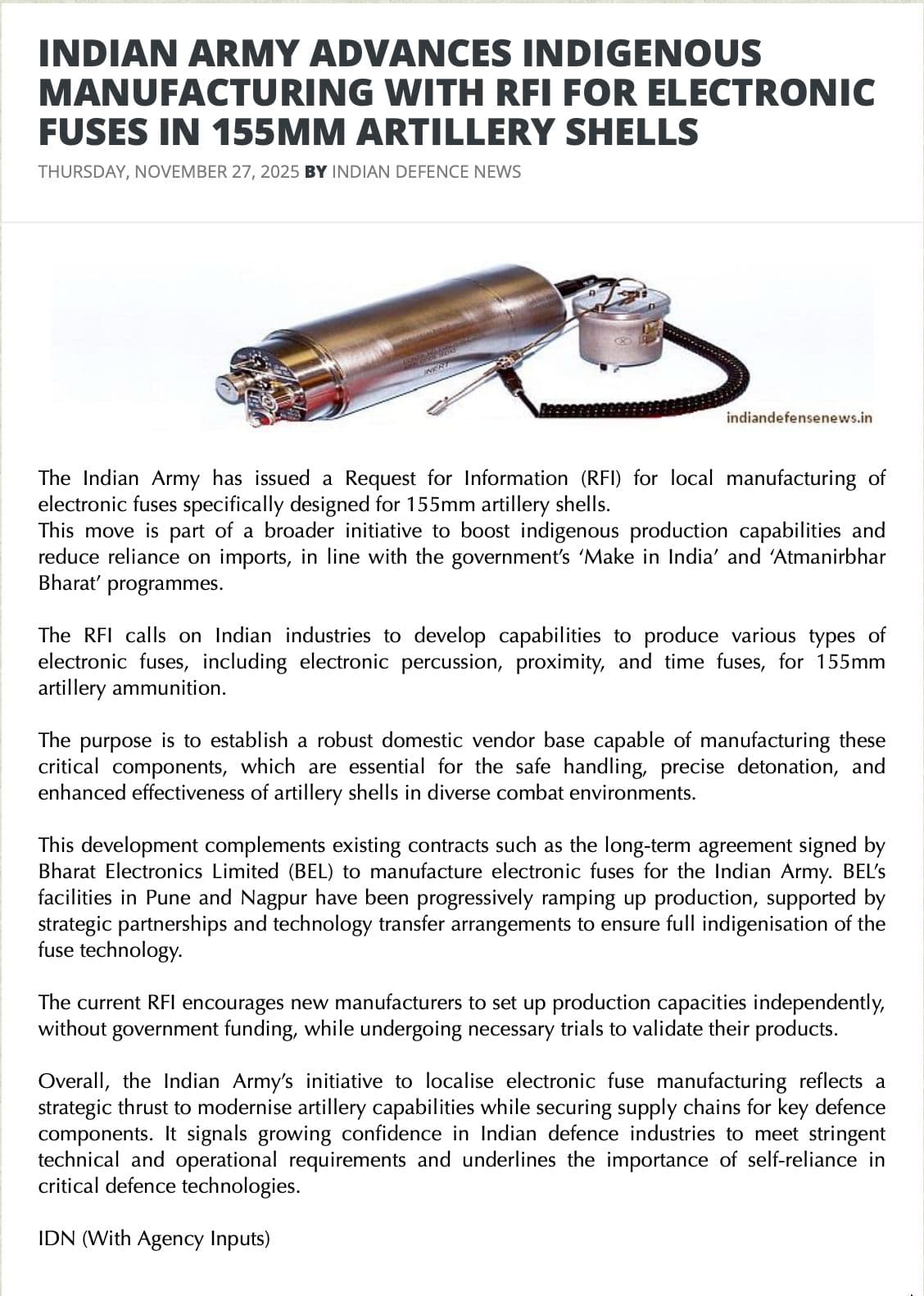
I don’t think, HBL right now has any production know-how of 153MM artillery fuses.
Do you even know what you are talking about?
12 Likes
The company does have production know how of electronic fuzes and has already supplied test supplies. The company was expecting production orders to start from FY26 but is now expecting good production volumes from FY27 onwards.
7 Likes
Just a note:
HBL mgmt understates their capabilities, mostly to avoid unnecessary competition.
Won’t be surprised if they keep giving out similar result in future as well.
11 Likes
Is there a way to get an assessment of revenue prospect from ammunition (FUZE) ? this is more likely a next avenue of success for HBL, but does any one have any research done on the estimates?
6 Likes
Hello,
Does anyone have idea of what is the installed capacity for manufacturing KAVACH units for HBL, Medha & Kernex?
Wanted to understand what is the order intake capability of the company given they have approvals in place and new tender results are expected to comeout.
1 Like
Nova Control Tecnologix, a deeptech subsidiary of Etoe Transportation Infrastructure, and Tata Elxsi have decided to co-develop the next generation of India’s indigenous automatic train protection (ATP) system, Kavach 4.0, and expect the Indian train protection market to witness orders worth around ₹50,000 crore during the implementation of Kavach Phase-I over the next six to seven years, two senior executives of the companies told Business Standard.
The companies are also targeting export markets, including Southeast Asia, Africa, and West Asia, which could boost their business in the long run. Nova announced a strategic partnership with Tata Elxsi to co-develop Kavach 4.0 in October. Nova will serve as the primary original equipment manufacturer for Kavach 4.0, responsible for manufacturing, testing, and integration, while Tata Elxsi will lead hardware and software design, prototyping, safety certification, and cybersecurity engineering.
“The average cost of installing the Kavach system per kilometer (km) is ₹50–60 lakh, and Indian Railways has about 40,000 km likely to be covered initially. For each locomotive (loco), the initial investment will be ₹70–80 lakh. This means the safety segment is expected to see enormous demand for companies in the sector. Overall, Phase-I of Kavach could see investments of around ₹50,000 crore,” said Sourajit Mukherjee, director and chief executive officer, Nova. He said Kavach is expected to be rolled out across the Indian Railways network within six to seven years.
The industry expectation comes at a time when overall spending on safety by Indian Railways has nearly doubled from ₹39,463 crore in 2013-14 to ₹1.16 trillion in 2025-26.
“From a technology standpoint, we are future-proofing our architecture so that when Kavach 5.0 comes, including cybersecurity and moving block, it becomes easier to adopt within the existing solution. This way, it will not require a major overhaul after Kavach 4.0. Compared to others in the industry, we will have a more future-ready architecture, enabling a smoother rollout of Kavach 5.0 whenever it comes,” said Jayaraj Rajapandian, head of aerospace, rail, and off-highway, Tata Elxsi.
“It is not possible for just two or three players to deploy the system at the pace required. The Research Designs & Standards Organisation has opened up the ecosystem, and more than 10 players have approached it for approval. For us, this is a good time to enter — the product has matured, specifications are stable, and it is ready for engineering rollout,” Mukherjee said. He added that private majors see considerable export opportunities in Southeast Asia, Africa, and West Asia, where countries are scouting for cost-efficient and reliable safety systems.
Inside Kavach: Safety layer behind India’s rail network
Kavach is an indigenously developed ATP system that aids loco pilots in operating trains within specified speed limits through the automatic application of brakes if the pilot fails to do so. It also helps trains operate safely during inclement weather.
The first field trials on passenger trains began in February 2016, and Kavach was adopted as the national ATP system in July 2020. As of October 2025, the government has spent around ₹2,354 crore on Kavach. The allocation for 2025–26 stands at ₹1,673 crore.
The system is being implemented in phases. Kavach Version 3.2 has so far been deployed on 1,465 route km (rkm) of South Central Railway and 80 rkm of North Central Railway. Kavach 4.0 was approved late last year and has been commissioned on the Palwal–Mathura–Kota–Nagda section (633 rkm) on the Delhi–Mumbai route and the Howrah–Bardhaman section (105 rkm) on the Delhi–Howrah route. Another 15,512 rkm is scheduled to be taken up soon.
13 Likes