
As the capacity will increase there profit margin will improve, they will buy raw material in bulk and fixed cost will remain unchanged so overall once they run up the plant at 100% capacity, there bottom line margin will improve.
With all above incentives, company can receive ~100 Cr as incentive in a span of 3 years from Assam Plant itself. This can boost the bottom line to great extent and company can beat the grain inflation with these incentives.
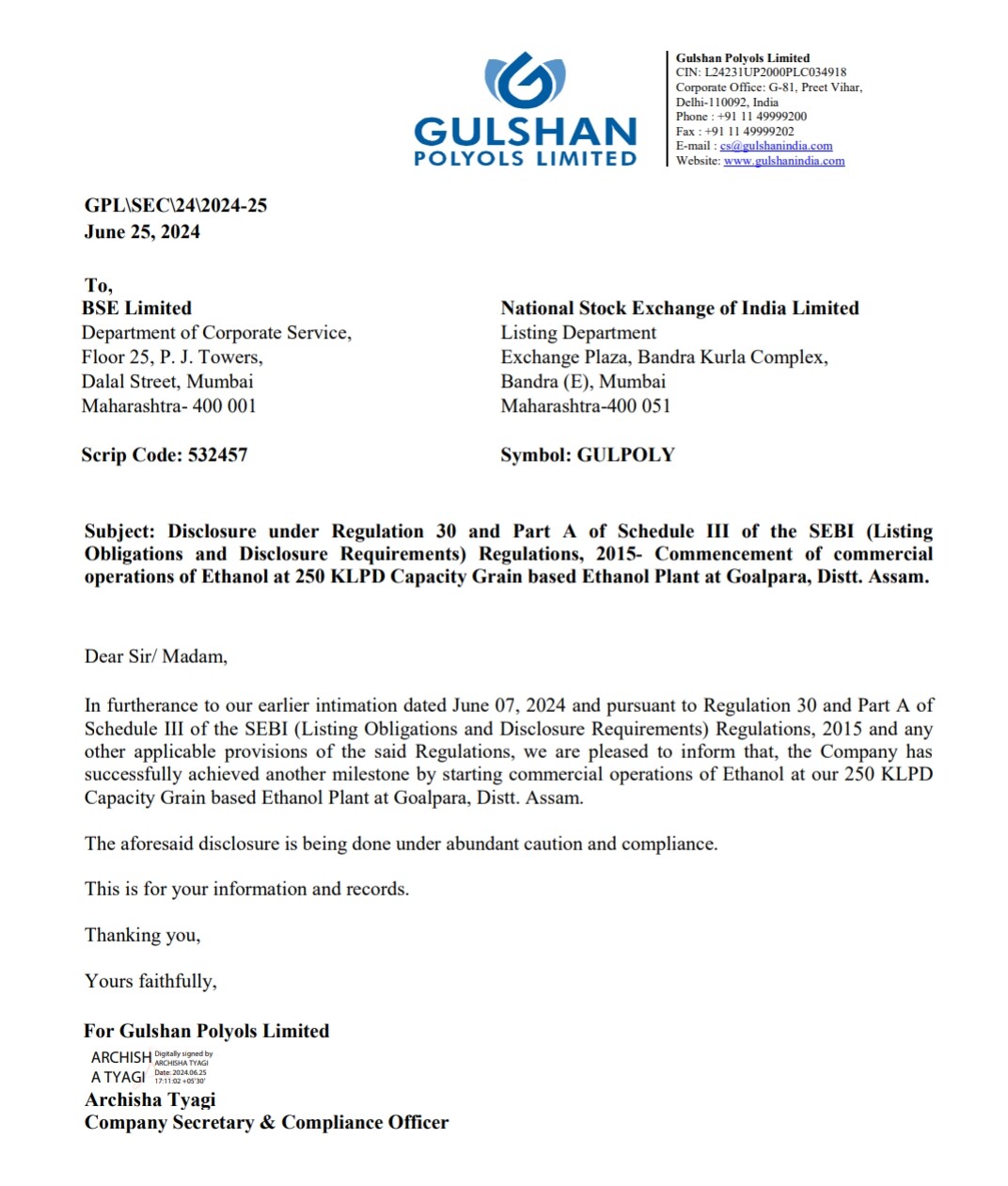
Even though Assam plant was commissioned by the June end, there is no improvement in the Top line of Q2FY25, as they said its running at 70% capacity we may expect some improvement in the numbers of distillery in Q3
2 Likes
Q3 is very good number
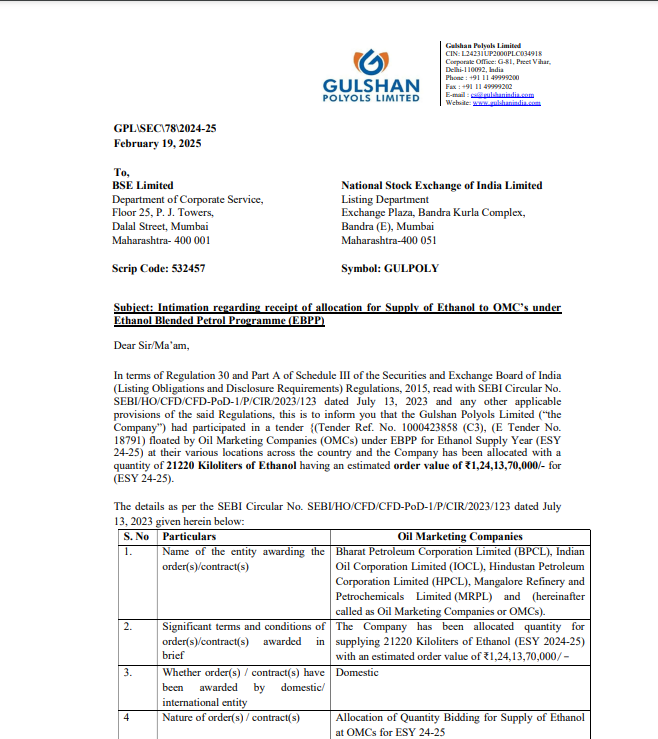
Gulshan Polyols won a tender to supply 21,220 KL of ethanol to OMCs for ESY 24-25, valued at ₹124.14 crore.
3 Likes
Hi Friends,
Could anyone explain me following points who track this stock’s fundamentals in details,
-
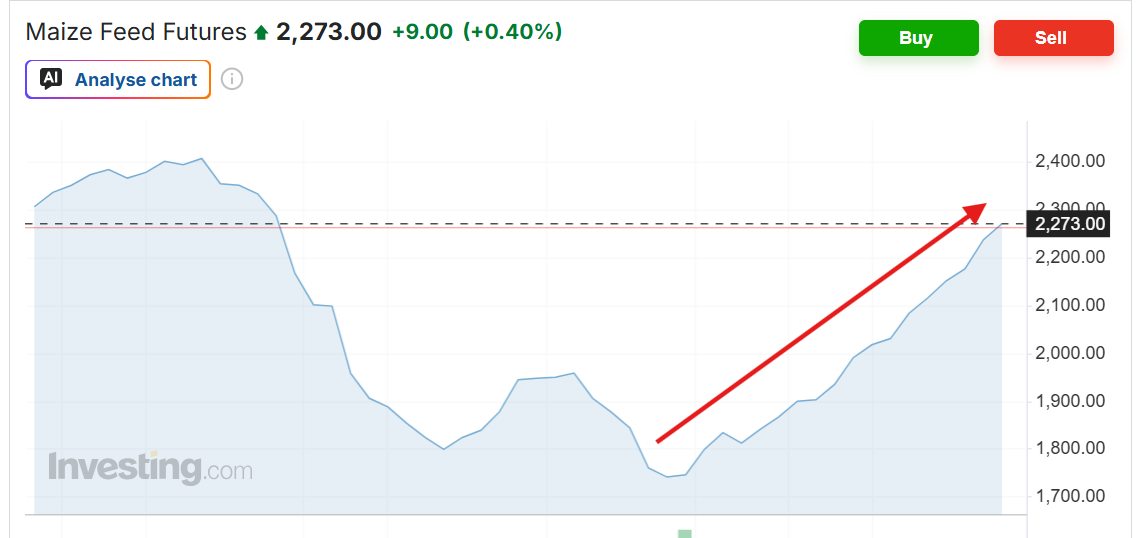
After GoI Scheme for maize purchases for ethanol production, has the company able to secured its RM Procurements at affordable purchasing prices, because it has been the 1 year, since the announcement of schem?
-
What type of Quality of Grain based Ethenol does Gulshan produces and who is in charge of such Ethenol Prices is GoI or OMCs or National/International Demand/Supply?
-
Is there any feasibilty if this Ethenol purachsing programme are abondend by GoI for particular period of time or for any reason, can they able to Sell Same Grain based Ethenol to Liquor companies which obviously has higher margins?
-
At what pricing Gulshan procures its Raw Material compared to its peers like BCL and others, in Q3FY25?
-
How has been their Operating Cost variations over the last 3 years and where they are finding it diffulty to maintain Good Operating Margins?
-
What about capacity utilization programme, are they going to use 100% capacity utilzation across all the Ethenol plants, be it, MP or Assam plant, because in past they were using only 50% of MP plant to supply MOCs?
Four-to-six-quarter monitoring dashboard
| KPI | FY26 reference | What we want to see |
|---|---|---|
| Ethanol utilisation | 80% | Sustain >80%; ideally 85-90% |
| Ethanol EBITDA margin | ~12% | Sustain 10-12%+ |
| Group EBITDA margin | 10.0% | Remain ≥10% |
| ROCE | 14.9% | Move towards 17-20% |
| Net debt/equity | 0.3x | Decline towards ≤0.2x |
| Operating cash flow | ₹207 crore | Positive EBITDA-to-CFO conversion |
| Ethanol volumes | 21 crore litres | Approach 22-24 crore litres |
| DDGS/by-product contribution | ~25% segment revenue | Stable realisation and inventory |
| ENA / potable alcohol | Limited disclosure | Separate volume/revenue disclosure |
| OMC order visibility | 18 crore litres / ₹1,220 crore | Maintain high forward coverage |
| Feedstock mix | 40% FCI rice / 45% maize / 15% others | Continued flexibility |
| New capex | Potential ₹500 crore project | ROCE-accretive, funded conservatively |
Gulshan Polyols should no longer be analysed primarily as a sorbitol and calcium-carbonate company.
FY26 marks the point at which the company became, economically, a large grain-based ethanol and distillery platform with legacy specialty-product operations.
The 810 KLPD installed capacity, 26 crore litre annual capability, 80% FY26 utilisation and ₹1,609 crore ethanol revenue demonstrate that the capex transformation has crossed the proof-of-concept stage.
The next stage is more difficult.
Gulshan must prove that ethanol EBITDA margins can remain in the 10-12% range through grain cycles; that OMC allocations remain adequate as industry capacity expands; and that its distillery infrastructure can increasingly participate in ENA, Rectified Spirit and potable alcohol markets.
The latest Madhya Pradesh country-liquor allocation is directionally positive, but we would require substantially greater disclosure on ENA volumes and Alcobev customer relationships before assigning the company a true Alcobev valuation premium.
At roughly 6.4x trailing EV/EBITDA, the stock appears priced more like a policy-sensitive commodity ethanol producer than a fully proven high-ROCE grain conversion platform. That creates rerating potential—but the rerating must be earned through ROCE, free cash flow and margin durability, not additional KLPD announcements.
The central bull case is asset sweating + deleveraging + alcohol-product diversification.
The central bear case is grain inflation + ethanol allocation pressure + premature re-leveraging for another capex cycle.
For institutional investors, ROCE is the single most important metric over the next 4-6 quarters. If ROCE moves sustainably towards 18-20% while net debt falls and ethanol margins remain above 10%, the market may have to reassess Gulshan’s valuation identity.
Key near-term watch item: India’s E20 policy and ethanol-allocation framework are currently experiencing unusually high public and legal scrutiny.
Not Invested but planning to take position.
2 Likes