
Greenlam Industries – Company Analysis
1. Company Overview
Greenlam Industries is one of the leading integrated wood panel and surfacing solutions providers globally. It is recognised as Asia’s largest laminate manufacturer and among the top three laminate manufacturers worldwide.
The company offers a diversified portfolio of surfacing and substrate solutions, catering to residential, commercial and institutional applications. Its product portfolio includes:
- Decorative and specialty laminates
- Plywood and blockboards
- Decorative veneers
- Melamine-faced chipboards (MFC)
- Restroom cubicles and locker solutions
- Engineered wooden doors and frames
- Engineered wooden flooring
- Exterior and interior cladding solutions
Greenlam has established a strong international presence, exporting its products to 120+ countries. It is also India’s largest laminate exporter and has maintained this position for 16 consecutive years, as stated by the company.
| Metric (30 Oct 2026) | Value |
|---|---|
| Price / market cap | ₹207 / ₹5,331 cr |
| P/E: trailing / FY27E / FY28E (consensus) | 57x / 33x / 22x |
| Net debt (Jun 2026) | ₹934 cr, ~2.6x EBITDA |
| ROCE / ROE (FY26) | 8% / 5% |
| Promoter holding | 50.98%, unchanged since Dec 2023 |
| Next results | Q2 FY27 on 5 Nov 2026 |
2. Journey and Key Milestones
Greenlam has gradually evolved from a laminate-focused manufacturer into a diversified global wood panel solutions company.
Year
Key Milestone
1992–93
Established its first laminate manufacturing facility at Behror, Rajasthan, marking the beginning of its journey.
2005–08
Expanded its international footprint by establishing overseas subsidiaries in Singapore and the United States.
2014
Demerged from Greenply Industries Limited and became an independent listed entity.
2023–24
Amalgamated HG Industries Limited with the company. Commenced commercial operations at its plywood manufacturing facility in Tindivanam and laminate facility in Naidupeta.
FY 2025–26
Streamlined its brand architecture around two flagship brands – Greenlam and Mikasa. NewMika was rebranded as Mikasa Laminates.
3. Product Portfolio and Addressable Markets
Greenlam operates across multiple categories within the broader interior infrastructure and wood panel industry. Its strategy is to leverage its established distribution network and brand equity to expand into adjacent product categories.
A. Laminates – Core Business
Greenlam is a leading manufacturer of premium and specialty High-Pressure Laminates (HPL).
- Estimated Indian market size: ₹13,300 crore
- Greenlam’s estimated market share: 17%
Laminates are widely used across residential, commercial and institutional interiors. Their durability, design versatility and ease of maintenance make them suitable for applications across hospitality, healthcare, education, retail, corporate offices and other high-traffic environments.
This remains Greenlam’s core business and an important contributor to its brand positioning, revenue and profitability.
B. Plywood
- Estimated Indian market size: ₹30,000 crore
- Organised sector: Approximately 30%
- Unorganised sector: Approximately 70%
Plywood has evolved from a basic construction material into a high-performance engineered wood solution, offering structural strength, dimensional stability and durability.
Through its MikasaPly brand, Greenlam offers a diversified portfolio of plywood and blockboard products designed for applications such as furniture, cabinetry, shelving, marine environments, kitchens and bathrooms.
Its portfolio includes Sapphire, Marine Blue, Marine, MR+, BWP+ and Fire Guardian, catering to different performance and application requirements.
Strategic opportunity: The plywood market remains highly fragmented, with approximately 70% of the industry belonging to the unorganised segment. Increasing quality awareness, regulatory requirements and the growing preference for branded products provide an opportunity for organised players like Greenlam to gain market share.
C. Decorative Veneers
Decorative veneers cater to the growing demand for premium and aesthetically differentiated interior spaces.
As consumers increasingly seek distinctive interior experiences, demand is shifting towards materials that combine natural beauty, craftsmanship and design versatility.
Veneers offer authentic wood textures and unique grain patterns, making them attractive for premium residential, hospitality and commercial applications.
D. Melamine-Faced Chipboard (MFC)
Greenlam MFC offers dimensional stability, versatility and premium surface finishes.
Its applications include:
- Modular kitchens and wardrobes
- Office furniture and workspaces
- Hospitality interiors
- Cabinetry and shelving
- Retail fixtures and interior fit-outs
- Partitions and furniture manufacturing
This category provides Greenlam with an opportunity to participate in the growing modular furniture and organised interior solutions market.
Notably, Greenlam’s MFC – Aurix Collection received the Interzum Award for High Product Quality 2025 by Red Dot, marking an important international recognition of its product quality and design capabilities.
E. Restroom Cubicles and Locker Solutions
Greenlam provides durable and fire-resistant restroom cubicle and locker solutions designed for high-traffic environments.
These products find applications across:
- Hospitals and educational institutions
- Airports, railway and metro stations
- Shopping malls and commercial offices
- Hospitality establishments
- Other public infrastructure facilities
The category benefits from the increasing requirement for durable, low-maintenance and quality-assured infrastructure solutions.
F. Engineered Wooden Doors and Frames
Buy House Doors | House Front Doors | Wooden Doors for Home | Mikasa Doors
The engineered doors and frames category has evolved from a basic construction component into an integrated architectural solution.
Greenlam’s offerings cater to modern residential and commercial projects, with an emphasis on durability, aesthetics and consistent product quality.
G. Engineered Wooden Flooring
Residential, Bedroom & Living Room Wooden Flooring | Mikasa Floors
Through Mikasa, Greenlam offers a premium range of engineered wooden flooring manufactured in India using advanced technology and precision craftsmanship.
Its portfolio includes:
- Long planks
- Herringbone
- Chevron
- Parquetry
- Staircase solutions
- Coordinated accessories
The category combines natural wood aesthetics with durability and precision engineering, catering to premium residential and commercial interiors.
H. Cladding Solutions
Greenlam Exterior Grade Compact Laminates Catalogue
Greenlam offers exterior and interior cladding solutions for modern architectural applications.
Exterior cladding can be used across building facades, exterior walls, boundary walls and ceilings. Interior cladding solutions cater to hospitals, educational institutions, shopping malls, airports, metro stations, railway stations and hospitality environments.
This allows the company to expand its presence beyond traditional interior surfaces into architectural and exterior building solutions.
4. International Presence and Export Leadership
Greenlam Industries expands capacity at Nalagarh unit - Construction Week India
International markets have historically played an important role in Greenlam’s growth strategy.
The company exports to more than 120 countries and has established itself as a globally recognised laminate manufacturer.
Its international presence provides several competitive advantages:
- Geographical diversification: Access to multiple international markets reduces dependence on any single geography.
- Brand recognition: Consistent product quality and international distribution strengthen Greenlam’s positioning as a premium global brand.
- Distribution network: Established overseas subsidiaries and distribution relationships improve market access and customer engagement.
- Product diversification: A broad product portfolio enables the company to cater to varying consumer preferences and market requirements.
- Resilience: A diversified geographical presence helps mitigate the impact of demand fluctuations in individual markets.
How has Greenlam continued to grow globally despite industry challenges?
FY 2025–26 was a challenging year for global laminate manufacturers due to tariff uncertainty, pricing pressure and changing international trade flows.
However, Greenlam’s management highlighted that the company focused on strengthening customer relationships rather than pursuing short-term growth opportunities.
Its strategy included:
- Strengthening local customer engagement.
- Expanding service infrastructure in international markets.
- Increasing the contribution of value-added products.
- Improving brand credibility and customer relationships.
- Adopting localised communication, vernacular engagement and hyperlocal marketing initiatives.
The company also expanded its premium and differentiated collections, launched trend-led designs and improved its positioning against regional and low-cost competitors.
International recognition, including the Interzum Red Dot award, further strengthened its design and innovation credentials.
My observation: Greenlam’s international growth appears to be driven not merely by pricing or manufacturing scale, but also by its established distribution network, brand positioning, product differentiation and long-term customer relationships. These factors can provide a competitive advantage in a fragmented global market.
5. Financial Performance and Capital Allocation
Greenlam is currently in an investment-intensive phase, with significant capital being deployed towards expanding its manufacturing capabilities and diversifying its product portfolio.
The company has been investing in new capacities across plywood, laminates and allied product categories.
This expansion has implications for its near-term financial performance.
Key observations
1. Expansion-led margin pressure
The company is expanding into plywood and other adjacent product categories. The initial ramp-up of these facilities, coupled with the associated operating expenses, has put pressure on EBITDA margins and profitability.
2. Consistent growth in the core business
Laminates and allied products continue to remain the company’s established business segments. However, growth in the previous financial year was affected by global supply disruptions and challenging international market conditions.
3. Increasing contribution from plywood
The plywood business has been witnessing year-on-year growth as the company expands its presence in this category.
With newly commissioned manufacturing facilities, the business has the potential to contribute more meaningfully to revenue and profitability as capacity utilisation improves.
4. Reinvestment for future growth
A significant portion of the company’s resources is being directed towards expanding manufacturing capacity, strengthening distribution and building new product categories.
Consequently, near-term profitability needs to be viewed in the context of the company’s long-term expansion strategy.
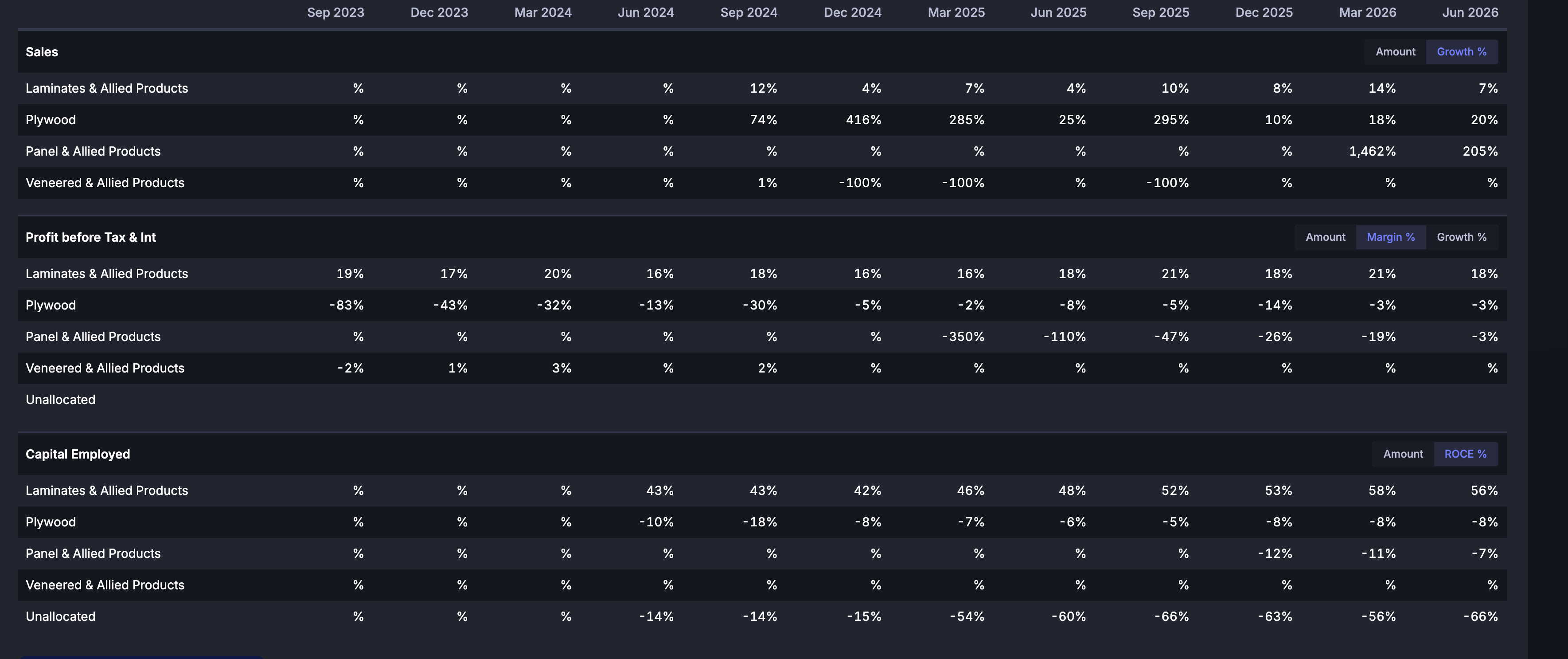
ROCE and Segment Economics
The company’s segment-wise financial performance and capital employed provide an important perspective on its expansion strategy.
The key aspect to monitor is whether the newly established businesses can gradually achieve returns comparable to the company’s established laminate operations.
While expansion can initially dilute consolidated margins and capital efficiency, successful utilisation of new capacities can improve operating leverage and overall returns over time.
6. Why Did Greenlam Enter the Plywood Business?
Management has provided a clear strategic rationale for entering the plywood segment in FY 2023–24.
The Indian plywood industry is one of the more structurally resilient categories within building materials, supported by demand from:
- Residential housing
- Commercial construction
- Furniture manufacturing
- Interior refurbishment
More importantly, the industry is undergoing a gradual transition from unorganised to organised manufacturing.
This transition is being driven by:
- Increasing consumer awareness about product quality.
- Greater demand for branded and quality-assured materials.
- Regulatory tightening.
- Growing influence of architects and interior designers.
- Increasing participation of institutional procurement teams.
Greenlam believes that a branded player operating in the premium segment can benefit from this structural transition.
Management’s long-term rationale
The management’s expectation is that the plywood business will gradually benefit from increasing scale, better capacity utilisation and stronger customer relationships.
An important advantage is the opportunity to leverage Greenlam’s existing distribution network and brand equity across multiple product categories.
As customers increasingly purchase laminates, plywood, flooring and other interior solutions from the same supplier, Greenlam can strengthen its relationship with distributors, architects, dealers and institutional customers.
This creates the possibility of cross-selling opportunities and a more integrated product offering.
7. Management Guidance and Growth Outlook
Management has expressed confidence in the company’s long-term growth prospects, supported by capacity expansion, product diversification and increasing international penetration.
Management’s stated growth ambition
18–20%
Annual revenue growth guidance
₹5,000 Cr
Target revenue
Management indicated this growth ambition from FY 2025–26, with the ₹5,000 crore revenue target envisaged over the subsequent three to four years.
The expected growth is likely to be supported by:
- Capacity utilisation: Gradual ramp-up of newly commissioned manufacturing facilities.
- Product diversification: Increasing contribution from plywood, chipboard and other allied categories.
- International expansion: Continued penetration into existing and new export markets.
- Premiumisation: Higher contribution from differentiated and value-added products.
- Operating leverage: Better absorption of fixed costs as manufacturing volumes increase.
- Distribution synergies: Leveraging the existing network across multiple product categories.
Management also expects margins to improve meaningfully as the newly commissioned capacities scale up and operating leverage starts playing out.
8. Balance Sheet and Credit Rating
Despite undertaking the largest expansion in the company’s history, Greenlam maintained its credit rating during the previous financial year.
Management highlighted this as an endorsement of the company’s balance sheet strength, business model attractiveness and management credibility.
This is an important aspect to monitor because the company’s ongoing expansion requires significant capital investment.
Maintaining financial discipline while funding capacity expansion will be critical to ensuring that growth translates into sustainable shareholder returns.
| Segment | FY26 revenue | Share of sales | EBITDA margin | Capacity | Utilisation | Market / Greenlam share | Role | |||||||
|---|---|---|---|---|---|---|---|---|---|---|---|---|---|---|
| Laminates & allied | ₹2,433 cr (+9.3%) | 80% | 16.3% FY26; 13.4% Q1 FY27 | 24.5 mn sheets (+2 mn in Q4 FY27) | 86% (Q4 FY26) | ₹13,300 cr incl. exports; ~17% | Cash engine | |||||||
| Plywood & allied (plywood, veneers, floors, doors) | ~₹400 cr (derived) | 13% | Loss; −5.2% Q1 FY27 | 18.9 mn sq m plywood | 39% (Q1 FY27) | ~₹30,000 cr, 70% unorganised; <1.5% | Growth option, still a drag | |||||||
| Chipboard / MFC | ₹213 cr | 7% | −13.4% FY26; +5.6% Q1 FY27 | 2.92 lakh CBM | 61% (Q1 FY27) | ~₹5,000 cr, ~80% unorganised; ~4% | Turning profitable |
Capex cycle and capital allocation
Profit fell because the new plants added interest and depreciation before they added EBITDA. Interest plus depreciation rose from ₹86 cr in FY23 to ₹238 cr in FY26. That alone explains most of the drop in net profit from ₹129 cr to ₹56 cr.
Investing outflow was ~₹1,300 cr over FY23–FY26, and borrowings rose from ₹398 cr (FY22) to a peak of ₹1,199 cr (FY25).
| Project | Cost | Started | Latest utilisation | Latest EBITDA | Management target |
|---|---|---|---|---|---|
| Chipboard, Naidupeta (AP) | ~₹875 cr | Jan 2025 | 61% (Q1 FY27) | +₹5.3 cr (Q1 FY27) | ~70% in FY27; 18–20% margin at optimum (FY29) |
| Laminates, Naidupeta (AP) | ~₹365 cr | Sep 2023 | Within laminates’ 86% | Profitable | — |
| Plywood, Tindivanam (TN) | ~₹105 cr | Jun 2023 | 39% (Q1 FY27) | −₹5.5 cr (Q1 FY27) | ~50% and EBITDA breakeven in FY27 |
| Two laminate lines, Naidupeta (AP) | ~₹70 cr | Due Q4 FY27 | — | — | ₹375–400 cr revenue at full use |
Guidance vs actuals
Management hits what it controls and misses its ramp-up dates, usually by about a year. Of nine past promises now due, four were met and five missed, a credibility score of 44%. Every miss was a new-business timeline or a growth target.
Credibility = (Beat + Met) ÷ (Beat + Met + Missed + Revised down), the same formula as the Guidance Tracker sheet in Concall-Capex-Tracker.xlsx.
Open promises (FY27 and beyond)
| Given | Promise | Due | Latest (Q1 FY27) | Status |
|---|---|---|---|---|
| FY26 annual report | ~₹5,000 cr revenue in 3–4 years, growing 18–20% a year | FY29–FY30 | FY26 ₹3,046 cr; needs ~18% a year | Pending |
| Q1 FY27 call (Aug 2026) | Net debt down ~₹100 cr in FY27 and ₹150 cr+ in FY28 (May call said ~₹50 cr) | Mar 2027 | ₹934 cr vs ₹940 cr in March | Pending |
| Q1 FY27 call | Plywood ~50% utilisation and EBITDA breakeven in FY27 (May target was 55–60%) | Mar 2027 | 39%; −5.2% margin | At risk |
| Q1 FY27 call | Chipboard ~70% utilisation in FY27 | Mar 2027 | 61%; EBITDA-positive | On track |
| Q4 FY26 call (May 2026) | Consolidated revenue growth 18–20% in FY27 | Mar 2027 | +18.2% | On track |
| Q4 FY26 call | Consolidated EBITDA margin 13–14% in FY27 | Mar 2027 | 10.2% | At risk |
| Q4 FY26 call | Laminate revenue +10–12% and margin 16–17% in FY27 | Mar 2027 | +7.4%; 13.4% | At risk |
| Q2 FY26 call (Nov 2025) | Two laminate lines at Naidupeta live in Q4 FY27 | Mar 2027 | On schedule per ICRA (May 2026) | On track |
Past promises
| Given | Promise | Due | Outcome | Status |
|---|---|---|---|---|
| Q2 FY26 call (Nov 2025) | Laminate EBITDA margin ~16% for FY26 | FY26 | 16.3% | Met |
| Q3 FY25 call (early 2025) | FY26 revenue growth 18–20% (trimmed to 17–19% in Feb 2026) | FY26 | +18.6% | Met |
| Q3 FY25 call | Net debt below ₹1,000 cr in FY26 | Mar 2026 | ₹940 cr | Met |
| Q3 FY25 call | FY26 capex ~₹100 cr | FY26 | Investing outflow ₹80 cr | Met |
| Q3 FY25 call | Chipboard EBITDA breakeven within FY26 | FY26 | FY26 loss ₹28.6 cr; first profit in Q1 FY27 | Missed |
| Q3 FY25 call | Plywood sales roughly double in FY26 | FY26 | Volume +33% | Missed |
| Q2 FY25 call (Oct 2024) | Plywood EBITDA breakeven in FY26 at 35–40% utilisation | FY26 | Still loss-making; moved to FY27 | Missed |
| Q2 FY25 call | Chipboard plant commissioned in Q3 FY25 | Dec 2024 | Started 23 Jan 2025 | Missed |
| Q2 FY25 call | FY25 revenue growth 18–20% | FY25 | +11.4% | Missed |
Investment Thesis – What Makes Greenlam Interesting?
Based on the company’s business model, industry positioning and management commentary, I see the following key investment drivers.
1. Leadership in the laminate industry
Greenlam has established a strong position in the domestic laminate market and a significant international presence. Its brand recognition, manufacturing capabilities and distribution network provide a competitive foundation.
2. Opportunity in the organised plywood market
The Indian plywood industry remains highly fragmented, with approximately 70% of the market belonging to the unorganised sector.
The gradual shift towards branded and quality-assured products provides a long-term opportunity for organised manufacturers.
3. Cross-selling opportunities
Greenlam is gradually transitioning from a laminate manufacturer into a comprehensive interior solutions provider.
Its expanded portfolio allows it to offer multiple products to the same distributors, dealers, architects and institutional customers.
This can improve customer relationships, increase wallet share and create distribution efficiencies.
4. International market presence
Exports to more than 120 countries provide geographical diversification and access to a much larger addressable market.
The company’s established international relationships and brand positioning can support continued global expansion.
5. Operating leverage from new capacities
Greenlam has invested significantly in new manufacturing facilities.
As these facilities ramp up production and utilisation improves, the company could benefit from better fixed-cost absorption and margin expansion.
6. Premiumisation and product differentiation
The company’s focus on premium collections, innovative surface solutions and international design recognition can help it differentiate itself from regional and low-cost competitors.
10. Key Risks and Monitorables
While the long-term opportunity looks interesting, there are certain factors that need to be monitored.
| Risk | Why it matters | Early signal |
|---|---|---|
| Laminate share loss | 80% of revenue and all segment profit; price-led growth can hide lost volume | Volume down while Century and Stylam grow |
| Plywood never scales | South-only, late entrant against Century and Greenply’s dealer and carpenter networks | Utilisation stuck below 45% through FY27 |
| Chipboard oversupply | Near-commodity; imports and new plants such as Century’s Chennai unit | Realisation per CBM falling while volume rises |
| Chemical and resin swings | Prices move 30–80%; price hikes lag by a quarter | Gross margin below 51% |
| Debt and rating | ICRA outlook Negative; ₹167 cr of repayments due in FY27 and ₹188 cr in FY28 | Net debt not falling by mid-FY27 |
| Export logistics and tariffs | ~29% of India’s laminate exports; West Asia shipping delayed ₹27–30 cr in Q1 FY27 | Export growth below domestic for two quarters |
| Institutions leaving | Domestic institutions cut from 15.7% to 10.8% since Mar 2025 | Further selling after results improve |
| Low liquidity | Six-month average traded value ~₹3.8 cr a day | Wide moves on small news; size positions accordingly |
11. Overall View
Greenlam is attempting to evolve from a leading laminate manufacturer into a diversified global wood panel and interior solutions company.
Its core laminate business provides an established foundation, while its expansion into plywood, chipboard, flooring and other adjacent categories opens up additional growth opportunities.
The strategic rationale is straightforward: leverage existing manufacturing expertise, brand equity and distribution relationships to enter adjacent categories and increase the company’s share of the overall interior solutions market.
However, this transition comes with near-term costs. Capacity expansion, initial underutilisation and investments in new product categories have put pressure on margins and profitability.
The key question going forward is whether Greenlam can successfully convert its capacity expansion into higher revenues, improved operating margins and attractive returns on capital.
The investment thesis ultimately rests on three things:
- Sustained growth in the established laminate business.
- Successful scaling of the newly commissioned plywood and other manufacturing facilities.
- Improvement in consolidated EBITDA margins and ROCE as the expansion matures.
If management executes successfully, Greenlam could benefit from both structural industry growth and operating leverage from its expanded manufacturing base.