
Grand Continent Hotels

Ramesh Shiva, after spending 20 years of his professional career in the hotel and related industries, ventured into entrepreneurship with his wife Vidya Ramesh in late 2011, establishing Grand Continent Hotels in India with an initial unit of 54 keys he was Management Trainee at the Oberoi Hotels group to the CEO position at Sabari Hotels, a regional chain of hotels in South India he is also a Graduate from Institute of Hotel Management, Chennai in 1993

GCH employes asset light model, leasing properties for 10 to 15 years and operates through franchising partnerships with renowned Indian brands like Royal Orchid Hotels (Regenta) and Sarovar Hotels (Golden Tulip), where franchisors are responsible for sales and marketing

Started 1st hotel unit under the GCH brand and subsequently transitioned to a franchise model, utilizing established hotel brand names for marketing and sales

In the Franchisee Model, the company selectively expands by partnering with franchisees when favorable deals arise, allowing for growth without the heavy capital expenditure of owning each property. Leasing properties long-term reduces capital requirements, while the company retains the right to exit leases, minimizing risks. Franchisees benefit from the franchisor’s established marketing channels, sales support, and national brand recognition, helping them reduce advertising costs and attract a wider customer base. The franchisor also provides operational support and a proven business model, which lowers risks and improves success rates for franchisees. An example of this model is Royal Orchid Hotels, which operates over 100 properties across 70+ locations in India, offering premium stays and catering to midscale travelers through its Regenta Inn brand.

In the Own Model, the company directly owns and operates its hotels, giving it full control over branding, operations, and guest experience. This model requires significant capital investment in acquiring and developing properties but offers long-term ownership benefits. The company keeps all revenue generated from the hotels, which can result in higher profitability. An example of this model is Sarovar Hotels and Resorts, which operates 120+ properties across 75 locations, offering upscale stays under the Golden Tulip brand and midscale options under Tulip Inn. This model enables the company to maintain strong brand identity and consistency across its properties.

State it operates in: Karnataka, Tamil Nadu, Goa, AP, Telengana

It operates under asset light model where it takes the lease from Hotel/Assset owner for 15 years and runs the same

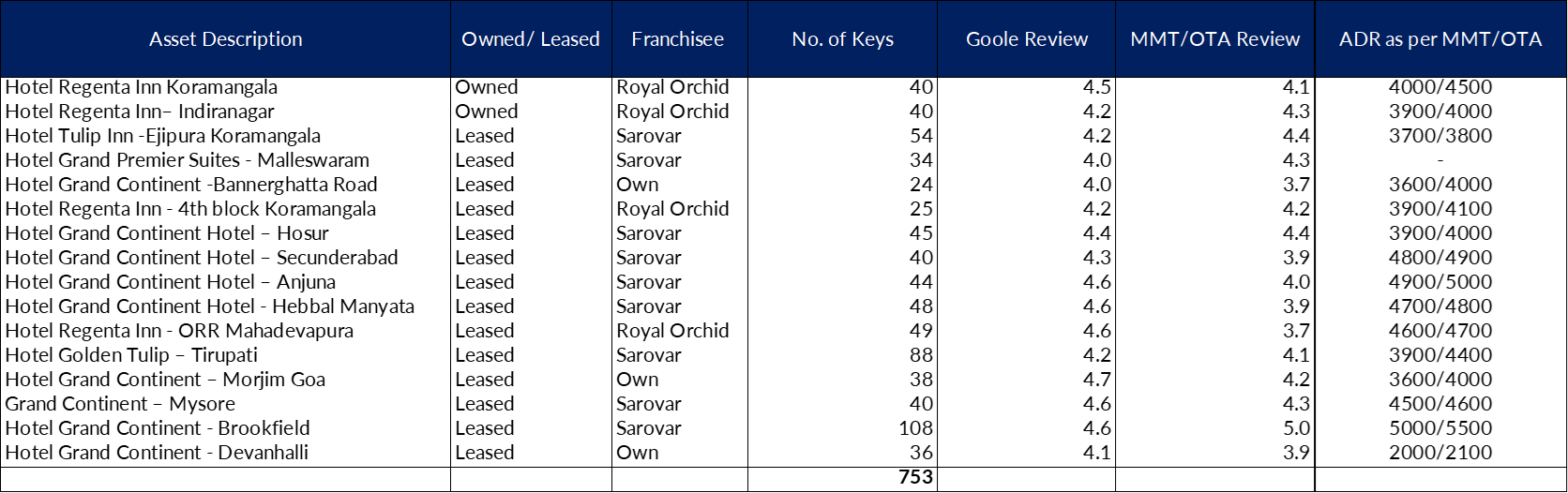
Grand Continent Hotel (GCH) is a Bangalore-based company that was founded in 2011, specializes in managing and operating 3-star hotels in prime locations. The Company started by solely operating and managing flags owned by Sarovar Hotels/Louvre (Tulip Inn) and Royal Orchid (Regenta Inn) – these brands market their own inventory respectively. Pays marketing fees to sarovar hotels at 3.5- 4% of top-line. Gradually, it started implementing its own brand Grand Continent Hotels wherein the entire inventory will be under the GCH brand and will be marketed by GCH itself. It primarily operates on an asset-light model i.e., either the asset is leased for long term (15 years) or built by a JV partner and the entire operation and management is undertaken by GCH. As of September 2024, they had ~753 keys and expect to increase to ~1500 keys by FY6. Any future additions would be made through lease arrangement model.

'The faster turnaround allows GCH to capitalize on peak demand cycles ahead of competitors, ensuring higher occupancy and revenue growth.GCH operates multiple hotels across Bangalore’s prime commercial and IT corridors, including Koramangala, Indiranagar, Bannerghatta Road, Hebbal Manyata, Brookfield, and Devnahalli, ensuring access to business hubs, tech parks, and corporate offices

Now the company has slowly and steadily started to go and penetrate their own brand name under the name Grand Continental hotels

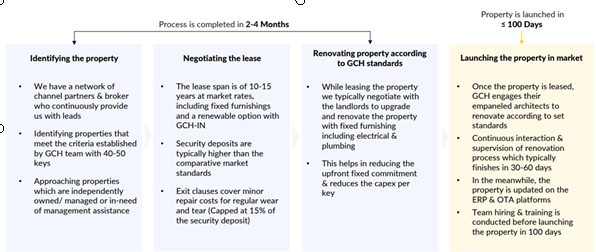
The company follows asset light approach for opening the hotels: The Asset Light Model allows for rapid property deployment, with hotels operational within 3 to 6 months post Letter of Intent, which is faster than the Ownership Asset Model. In this structure, landowners manage the construction of fixed assets, while GCH handles movable assets such as mattresses, linens, and minibars. This approach enables GCH to expand quickly while maintaining a high-quality guest experience without heavy capital investment. The model involves lower capital expenditure per room (₹6-6.5 lakhs) and a quick payback period of less than 24 months, resulting in higher Return on Capital Employed (ROCE). Since GCH does not own the real estate, fluctuations in property values do not affect profitability. Additionally, exiting properties is simpler and more cost-effective, with an exit clause that covers minor repair costs, capped at 15% of the security deposit. The company aims to scale up to 5000+ keys within the next five years, reinforcing its presence across multiple high-demand locations

From the DRHP: We plan to continue focusing on our core strength of developing upper-midscale and midscale hospitality assets and to
increase the number of keys across our hospitality assets by an estimated 1,500 keys, from 753 keys as at September 30, 2024
to approximately 2000+ keys in FY2026


image

Over the past 13 years, expertise in managing and operating hotels has been developed. As of September 30, 2024, a portfolio of 16 operational hotels with 753 rooms has been established. Additionally, one hotel was mobilized in October 2024, and another is set to open by November 2024, bringing the total to 18 hotels and approximately 850 rooms. MOUs/LOIs have been signed for 5 more properties in the upper mid-priced and mid-priced categories, adding around 346 rooms to the portfolio.

Identification to starting of the Asset:
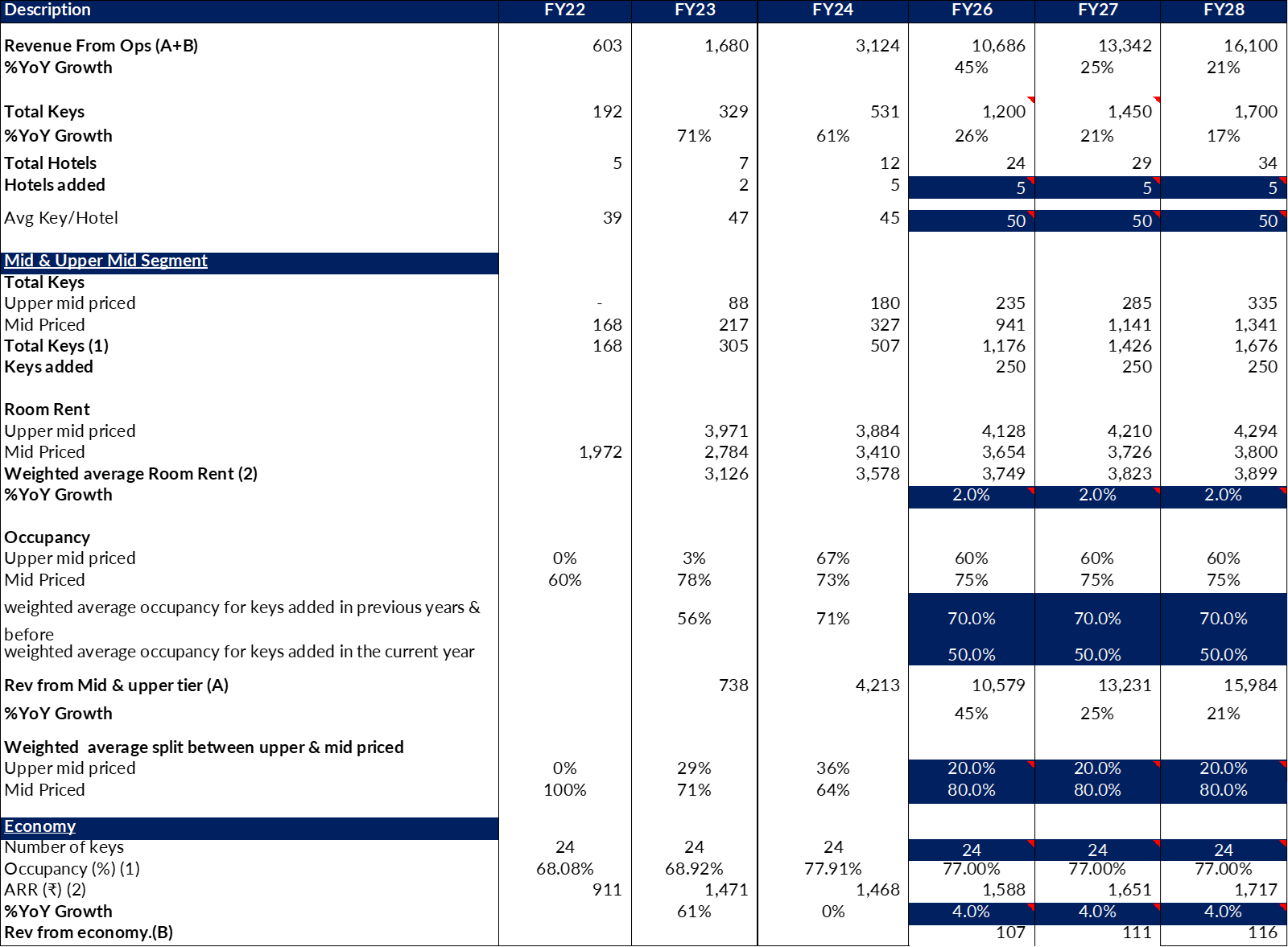
Valuations Assumptions:
Profit and Loss Statement Assumption:
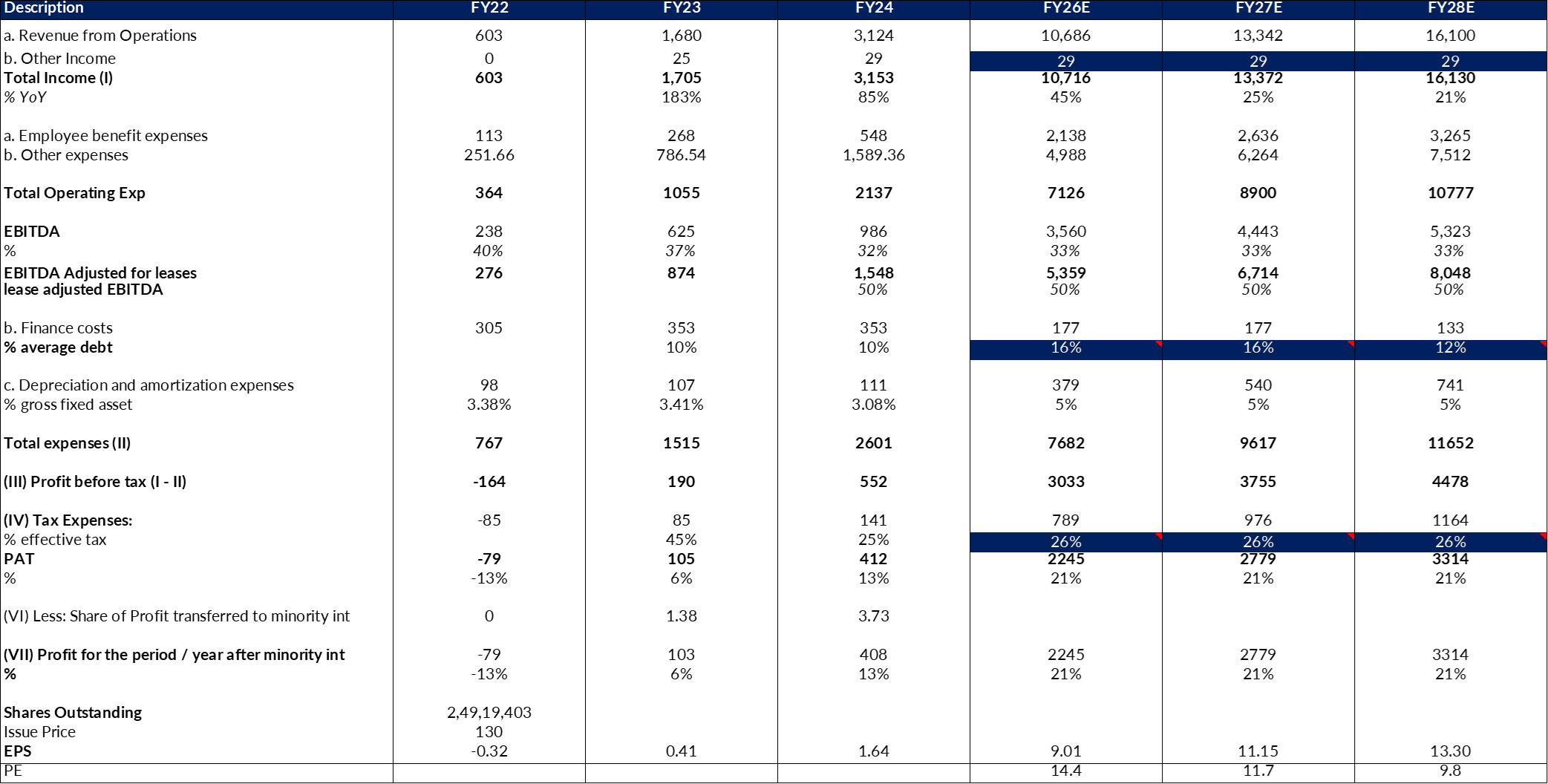
At current valautions the company is trading at 14x FY28 Which is on tad higher side, How ever the EV/EBITDA Trades at on SD -1 To it’s peers offering a good valuation comfort

One thing that was very attracted me here is Quality of hotels and Location and how much the promoter and team puts thought into the same

Have Stayed in the hotels in Banglore and the vicinity of their Whole PF in Banglore is one of the finest for corporate employees

Only Risk that I see here:

  • The entity is going internationally to expand their operation I’m highly usnure of the reason for the same since the company is already doing well in India and has good pipeline in India why will be a very good question?

  • The company has been expanding pretty aggresively in terms of its room inventories Generally have seen the value is created immesily here but there will also be sort of Pre-Opex of the hotels which multiple people seems to ignore I think that might not lead to Linear Results QoQ basis but that’s the fun of Venture type bets in listed companies :)

  • I don’t have any doubt on the execution of Ramesh Shiva Since they way he has scaled up in last 3-4 years is commedable but the same was on back of the depressed lease market the Rentals were depressed so we don’t know at what margins are the new leases getting entered so the margins might not coninute going ahead at this high level, Something to look out for too

Disclaimer: Holding Signifcant of the company from near the IPO price, No buy or sell recomendation, sharing Just for informational purposes
8 Likes

Few observations/questions from my side.

  1. Promoter had started Elysium Holidays India Private Limited in 2010. GCH has given some loans to this entity. Although the loan balances are very small in relation toe GCH size so may not be a red flag at the moment, but would be interesting to know the size of this business.
  2. Good set of institutional investors like Niveshaay and Negen. Also a few members from the Jaisinghani family (Polycab) own some stake in this company.
  3. Can anyone comment on the corporate governance of this company?. Given the history of Mr. Siva of working in Oberoi and other hotel companies, the governance is expected to be good but would like to hear opinion of other participants. The independent directors seem to have good experience
  4. Regarding the lease rent point, below is a table highlighting how lease rent expense has grown faster than the revenue. This would be a key monitorable as the company rapidly expands. Revenue and lease rent figures are in Rs Cr
Mar-22 Mar-23 Mar-24 Mar-25 FY22-25 CAGR
Rev 6.02 16.8 31.23 72.62 129%
Lease rent 0.375 2.485 5.61 14.13 235%
Lease rent as % of sales 6.23% 14.79% 17.96% 19.46%
  1. Regarding the valuation, it should be looked at in the context of the potential growth. The company is guiding to increase the key count by ~3x

Disclosure: Not invested but tracking closely

1 Like
  1. Agreed on the 1st Point, they have been going out of India too, Don’t know the reason for the same, But this is the concern for me too
  2. on Lease rent what you forget to take in acount is at the starting point they had 2 owned hotels and hence the rental in 22 was mere 37 lakhs, incremental rental to lease is more or less Constant, Hope that Helps

Disc: Invested and Biased

1 Like

Rent for properties leased in future will not necessarily be the same. It’ll depend on the negotiation skills even though company in their concall has mentioned that they try to keep lease exp as a % of revenue upto 25-27% (when I did the math using numbers from the AR it came to ~20% so I may be missing something).

Even if owned properties were 2 in 2022, but lease expense as a % of revenue still increased from 2023 (~15%) to 2025 (~20%) which could mean that newer leases were signed at potentially higher rates. Hence, this % of revenue will be a key monitorable to check if it stays constant or it keeps increasing.

I want to know if the lease agreements contain an exit clause / put potion which allows the company to exit a property if revenue does not come up to its expectations. If anybody knows this, please share.

I’m sorry but you are i think wrong in your analysis here
its highly unjust to compare current lease rent with past lease rentals the reason being that Inventoy are being added left right and centre.
Say you have 1000 rooms at start of the year and ending at 1600 rooms, revenue would be generated of 1200-1300 rooms only however the lease would be for all 1600 rooms

You have right numerator and wrong denominator you see where are you missing now may be
The same position was different early in 2022, 23

Also agreed on the part of the lease on standalone becoming expensive but the same i think would be adjusted for ARR growth

But yeah standalone lease are becoming bit expensive on ground that’s is something I have checked

I am talking about % of revenue and you are talking about absolute number. Agreed ARR can increase but I am saying that if future leases are much more expensive, then lease expense could increase faster than the pace of ARR, which will then increase as a % of revenue and thus margins will decrease. This will all depend on how the negotiation goes with the landlord etc and how much they are actually able to charge from the customer compensate for the increase rent. And even if rooms were added rapidly in the past, the pace at which the lease expense has increased was not compensated by the pace of increase in revenue or ARR. Hence one of the reasons why margins have decreased (although not the only reason). But the main point is % of sales and not absolute number.

I’m still 100% not conviced with your above argument.

  1. Margins have been falling cause of Pre-Opex of the hotels, You are considering pre-opex (rent) while considering the leases as a % of revenue of current year, my very small argument is that rent you have considered in the current year might be for the property which isn’t live yet or is live but there is no revenue hence your analysis is flaud by nature margins for 27 will go down thats for sure but sustanaible or core margins are cross of 30% is they stop growing, Always consider second order rather than 1st order thinking, if i was having your understanding by that logic my nature of business will be margins will be less than 25% hence not investable at Good valns too since margins falling top of the clif my understanding is on 2nd order derivative that margins for normalised inventory are still north of 29%-30% hence if expansion slows down or rate of change in adding inventory slows down the margins will be much more superior
  2. That being said i dont dis regard the fact that lease rent due to post covid hotel boom might increase on comparision to the deals signed in the Covid era but that’s the risk you are paying for right if everything was locked in, you won;t have got this at 300 cr MCAP

I don’t understand the need of the Post, anybody can do ChatGPT and cut copy paste it, please use your understanding and thinking before posting post making your own view

Thanks and Regards

Its ok you will never be 100% convinced in investing. You can use any order derivative of thinking but at the end of the day, lease cost is a fixed expense and more so a risk because it is an upfront expenditure and in most cases cant be renegotiated downwards. If they are unable to charge/achieve an adequate level of ARR/Occupancy then it will hurt the margins in the long term.

Consider this scenario for any property signed on lease in the past or will be signed in the future:
Company signs a lease at Rs X per year assuming they will be able to charge Rs Y as ARR and at Z% occupancy in 6-12 months. When the lease is signed, Rs X remains a fixed cost but company later realises that Rs Y is a bit too high to charge for that particular property so it has reduce its ARR for that particular property or at Rs Y ARR it is unable to achieve Z% occupancy even after 12 months. So in this case the company may be forced to lower its ARR to attract demand and profitability would naturally come under pressure as lease cost will stay the same. Vice versa can also be true. But this is a key monitorable is all I am saying.

I am not saying that it has happened or will necessarily happen in the future but it is a plausible scenario which investors should be mindful of. You are assuming that the margin fall is purely due to upfronting of opex and the company has been or will be able to achieve its targeted ARR or occupancies as properties mature. That may not always be the case particularly in the segment which GCH operates in, which is highly price sensitive and competitive.

On your point about growth. This business at Rs 540 Cr market cap is not cheap (in my opinion) and investors are willing to pay so high because there is a reasonable expectation that it will keep up its growth, which for a hotel company, largely depends on continued addition of new keys. So if the growth slows down in the future, a valuation derating could follow. Given this is a micro/small cap company, so talking about growth deceleration so soon doesnt make sense in my opinion.

The company reported its H1FY26 results, and a key risk has played out. While revenue grew ~75%, lease rent rose nearly 3x, leading to a sharp margin decline despite the strong topline growth. Need clarity on what drove such a steep increase in rent— Part of it may be due to upfronting of lease expenses but it is also important to assess the company’s pricing power and its ability to raise room rates in line with the higher lease costs.

In H1FY26 results, the company reported an increase of Rs. 21.35 Cr (from FY25 value of Rs. 20.19 Cr) in ‘other non-current assets’. Based on past annual reports, these non-current assets represent security deposits paid to land/building owners. This shows a significant increase (~100%) compared to the key additions (~30-40%) between the end of FY25 and the end of H1FY26.

I reached out to the company to get clarity on this and as per their response, ~11Cr are security deposits and rest ~10Cr are FDs.

Below is their response:

  1. Fixed Deposits (FD)
    Increase of Rs. 1,035 Lakhs
    This represents the placement of surplus liquidity into short-term interest-bearing instruments during H1FY26.
  2. Security Deposits
    Increase of Rs. 1,137 Lakhs
    This relates to lease-linked or contractual deposits required for properties.
    Importantly, this includes not only deposits for properties that became operational during H1FY26, but also deposits placed for properties signed during the period,even if the keys have not yet gone live.
    As a result, the movement may not appear directly proportional to the keys added during the period, since deposits are often paid ahead of operational readiness.
  3. Other Non-Current Assets
    A minor reduction of Rs. 0.37 Lakhs.

Note that the company reports security deposits outflow (which is a capex item) through non-current assets as part of CFO

2 Likes