
GHCL Textiles traces its roots to GHCL Limited, a major producer of soda ash and sodium bicarbonate, used across glass, detergent, and chemical manufacturing. Alongside its chemicals business, GHCL had built up a substantial textiles operation in spinning cotton and blended yarn, with manufacturing anchored in Tamil Nadu.
The company separated the textiles operations into their own standalone entity that eventually became GHCL Textiles. In 2023, GHCL shareholders received one share of GHCL Textiles for every share they already held in GHCL.
GHCL textiles financial summary:
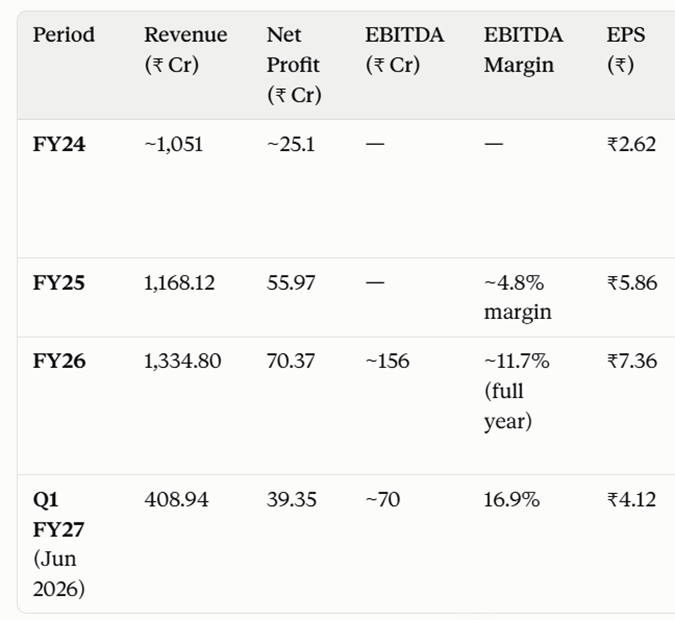
In its first couple of years independent, GHCL Textiles was much like a typical Indian yarn spinner, profitable and exposed to the classic commodity dynamics of cotton price cycles, energy costs, and thin, volatile spreads. FY25 marked a turnaround, net profit surged roughly 123% year on year to 56 crore on revenue of about 1168 crore, as demand and pricing conditions improved.
The company has started moving from a pure yarn seller toward a vertically integrated model spanning knitted fabric, fabric, and eventually processed, ready-to-cut fabric. The Company even investment heavily in captive renewable energy (rooftop and ground-mounted solar. Power costs are one of spinning’s largest variable expenses. Currently 65 MW installed capacity is already operational and additional 11 MW ground mount solar project expected to commission around August 2026, contributing in total 75% of energy demand.
A large capacity expansion including a new 25,000-spindle unit and the first tranches of knitting machinery 15 in numbers are commissioned recently.
With Market cap of 1173 crore, price to sales at 0.8 and price to book at 0.75 the stocks is priced as a commodity stocks. The Company is net debt free with debt of 135 crore compared to cash of 171 crore at end of financial year 2026. ROCE has been less than 10 % last 3 years hence the low stock price is somewhat justified.
Q1 2026 Concall summary:
- The 17% EBITDA margin in q1 will not hold due to one time inventory gain from low-cost cotton bought earlier. Normalized margin for the standalone yarn business is 14 to 15%.
- The margin can increase up to 18% on the vertical integration into fabric. Currently 15 knitting machine installed in Jan2026 are operational with 85% utilization. Additional 25 machine will be commissioned in December 2026. After all 40 machine operational in house knitting will use 15 to 20% of total yarn production, contributing 2 to 3% incremental EBITDA.
- The low-cost cotton buffer covers demand only through November to December 2026. After that, the company will be buying at current elevated prices. Then the spreads will decline from elevated level of 155/kg in q1 2027 but still be more than 138/kg from last year as per Management.
- GHCL Textiles is a tier-2 supplier that sells yarn to fabric/garment makers who then sell into the US/UK. The effective US tariff structure nets out to 10% over the MFN duty of 16.5%, with a potential path to zero duty if 20%+ US cotton content is used. This means the FTA benefit flows to GHCL Textiles customers first, and to GHCL Textiles second-order through stronger customer demand.
- Land allotment under PM MITRA closed in Q1 FY27. GHCL Textiles has three years from allotment to build its own facility.
- Spinning utilization steady at 98%+, with 1.5 to 2 months of forward order book
As with any commodity stocks lot of inherent risks comes with it as mentioned below:
- Spinning margins are highly volatile with cotton prices and yarn cotton spreads currently at elevated level, will move down going ahead.
- Stock has already gone up from 60 to current price of 120, taking lot of positive already into price.
- ROCE has been less than 7 % in last 3 years and might continue to stay at low single digit.
- Elevated EBITDA level of 17 % will normalised to 15% going forward as per Management in the concall.
- US trade deal is not yet signed, US FTA risks remains.
With all the risks mentioned above, multiple FTAs stacking up, PM MITRA park infrastructure, the PLI scheme for textiles, and a lot of spindle capacity having permanently exited the industry in recent years can benefit GHCL textiles in mid to long term.
Disclosure: Invested from lower level. No recent transactions. This is not a buy or sell recommendation.