
Been tracking GAIL for a while specially after Iran-US conflict and a couple of recent developments have made me revisit the thesis more seriously. Would love the forum’s perspective.
What caught my attention
Came across the BSE filing (25th March) via Daily Market Digest - GAIL infused $64M into its US subsidiary GAIL Global (USA) Inc. to repay debt tied to a 20% stake in Eagle Ford shale assets. The asset itself is declining - CY2025 turnover of $7.6M vs $11.6M in CY2024, a 34.5% drop. So the filing itself is unremarkable. Routine debt cleanup on a non-core asset.
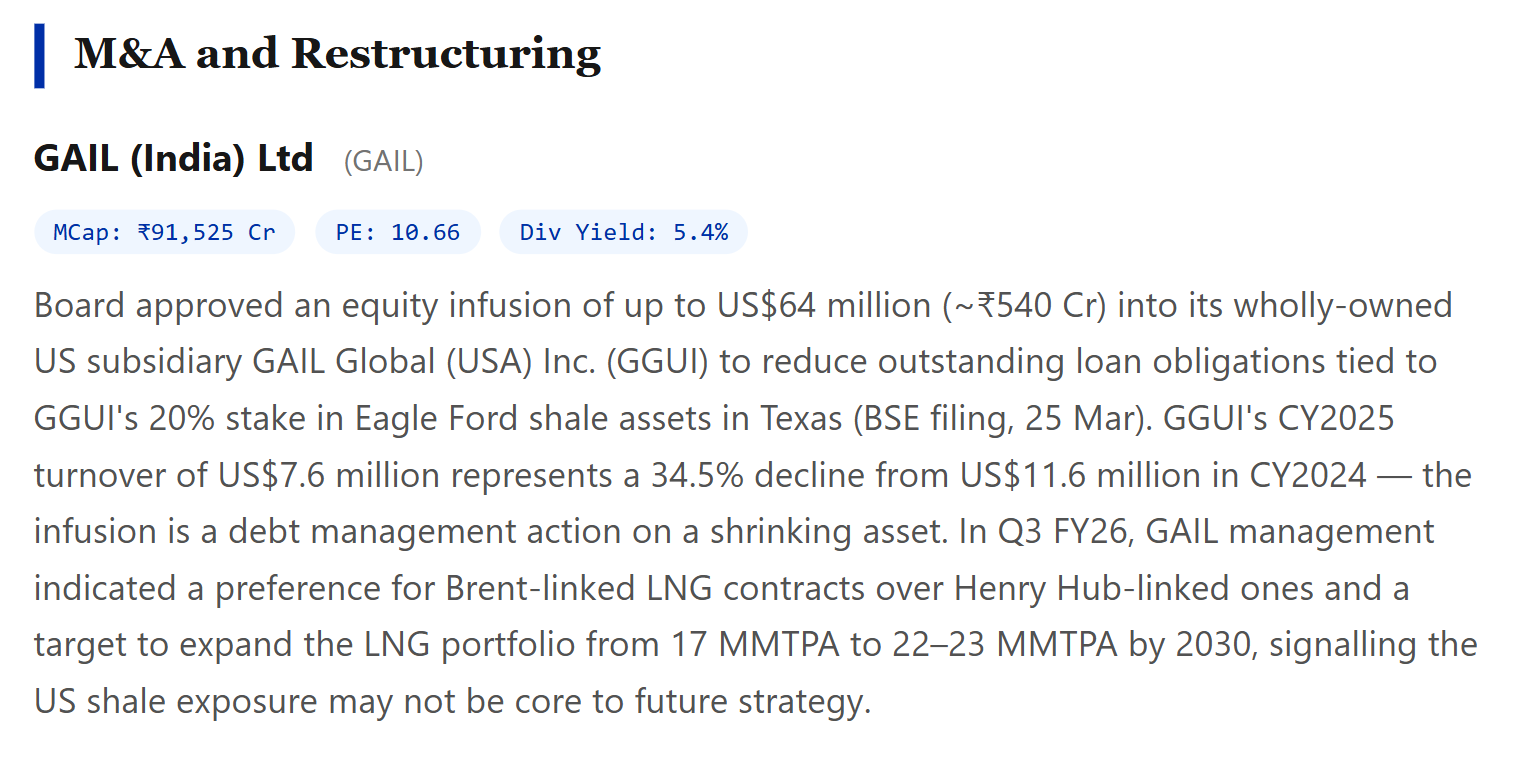
Source : CompoundingAI
But it made me dig deeper into their US strategy overall, and that’s where it gets more interesting.
The actual thesis
GAIL has floated a tender for up to 26% equity stake in a US LNG liquefaction project, bundled with a 15-year supply agreement for 1 MMTPA. They’ve already received 5 proposals. This sits on top of existing long-term contracts of 5.8 MMTPA from Cove Point (Berkshire Hathaway Energy) and Sabine Pass (Cheniere). The US is already India’s second largest LNG supplier after Qatar.
Management has guided for growing the LNG portfolio from 17 MMTPA to 22-23 MMTPA by 2030. A meaningful portion of that incremental 5-6 MMTPA appears to be pointed towards the US.
Why this matters structurally
Qatar is India’s #1 LNG supplier. Qatar LNG transits the Persian Gulf and through the Strait of Hormuz. With Iran-US tensions at an uncomfortable simmer, any escalation scenario creates genuine supply chain risk for India’s Qatar-linked volumes. Roughly 20% of global LNG passes through Hormuz.
GAIL is specifically targeting FOB-based US contracts. FOB gives you cargo rerouting flexibility that DES or DAP contracts don’t. This is about optionality in a disruption scenario. Whether management is explicitly thinking about this as a hedge or it’s an incidental benefit is a fair question, but the structural logic holds either way.
The geopolitical tailwind
India is sitting on a $45.7B trade surplus with the US. The Modi government is actively trying to reduce this to avoid Trump tariff exposure - energy imports are the fastest lever to pull. India is reportedly considering removing import duties on US LNG entirely. GAIL, as the primary state-owned gas distributor, is essentially the execution vehicle for this policy intent.
This means the US LNG expansion isn’t just a commercial call - it has sovereign backing. That’s a different risk profile than a purely commercial energy deal.
What changed
The LNG portfolio optionality, the geopolitical hedge value, and the potential re-rating if gas penetration in India actually moves toward the stated 15% target by 2030 (from 6.2% today).
Transmission volumes are growing steadily - Q2 FY26 at ~123.6 MMSCMD, guided to reach 133-134 MMSCMD by FY27 as new pipelines (Mumbai-Nagpur-Jharsuguda etc.) commission.
Open questions I’m sitting with
-
How much of the US LNG expansion is genuine strategic intent vs diplomatic signalling for the trade deal?
-
Henry Hub at $3.5-4 makes US LNG economics work per management’s own commentary - what’s the sensitivity if HH moves above $5?
-
The Eagle Ford asset is clearly non-core and declining - is there a divestiture possibility there that unlocks some value?
-
How does the Brent-linked vs Henry Hub-linked contract preference play out as they sign new deals?
Not a SEBI registered advisor. This is a research discussion, not a recommendation. Would genuinely value perspectives from those who’ve tracked GAIL longer than I have.