Fundamental Ratios

□ Fundamental Ratios

■ Profitability Ratios:

●ROE: It measures the ability of a firm to generate profits from its Shareholder’s investments in the company.

                Net Income
   ROE= ---------------------- ×100
         Shareholder's Equity 
  
 Shareholders’ Equity = Share Capital + Retained Earnings – Treasury Stock                            

●ROCE: It measures how efficiently a company is using its capital employed [Debt & Equity].

                     EBIT
 ROCE: --------------------------- ×100
             Capital Employed

Capital Employed = Total assets - Current Liabilities.

●EPS: It is the profit allocated to each outstanding share of common stock.

                   Net income of the company  
    1. EPS   ------------------------------------------‐-------
                   Averages Outstanding shares


                     Net income after tax   - Total dividends                                                                                                                                                                                                                                                                                       
    2. Weighted EPS ---------------------------------------------
                       Total number of outstanding shares


■●  EBITDA
     - D&A(Depreciation, and Amortisation)
    ----------------
     EBIT  
   -   I    (Interest)
    ----------------
       EBT       
        -T   (Tax)
   -----------------
    PAT/NET PROFIT
8 Likes

■ Valuation Ratios:

● P/E: It is a valuation parameter that measures the company’s current share price relative to its per-share earnings. Generally, high P/E is Overvalued & low P/E is Undervalued.

P/E Rerating happens when the stock price rises without any growth in earnings, just on the basis of future earnings growth possibility. P/E Derating is when stock price falls without fall in earnings, but due to the expectation of fall in earnings.

(Stock Return= PE Rerating + Earnings Growth)

              Market value per share
P/E Ratio : ----------------------------
                Earnings per share 

● PEG Ratio: a PEG ratio value of 1 represents a perfect correlation between the company’s market value and its projected earnings growth.

               P/E
PEG Ratio: ------------
          EPS Growth Rate

                            EV
● Enterprise Multiple: --------------
                          EBITDA

EV=Enterprise Value= Market capitalization + total debt − cash and cash equivalents

● DCF: Discounted cash flow is a valuation method that calculates the value of an investment based on the present value of its future income. The method helps to evaluate the attractiveness of an investment opportunity based on its projected future cash flows.

1st Step:  FREE CASH FLOW FORMULA

                  Free Cash Flow = EBIT
                                - Taxes
               +  Depreciation & Amortization
                       - Capital Expenditures
          - Increase in non-cosh working capital
   ------------------------------------------------------
              =         Free Cash Flow    

NON-CASH WORKING CAPITAL FORMULA = Current Assets - Cash - Current Liabilities

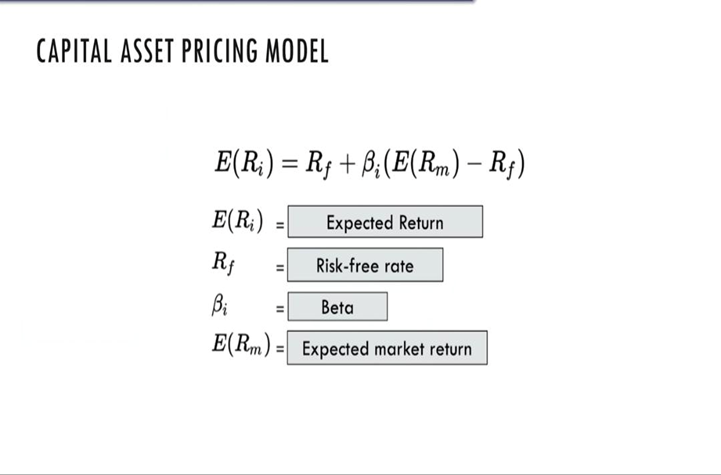
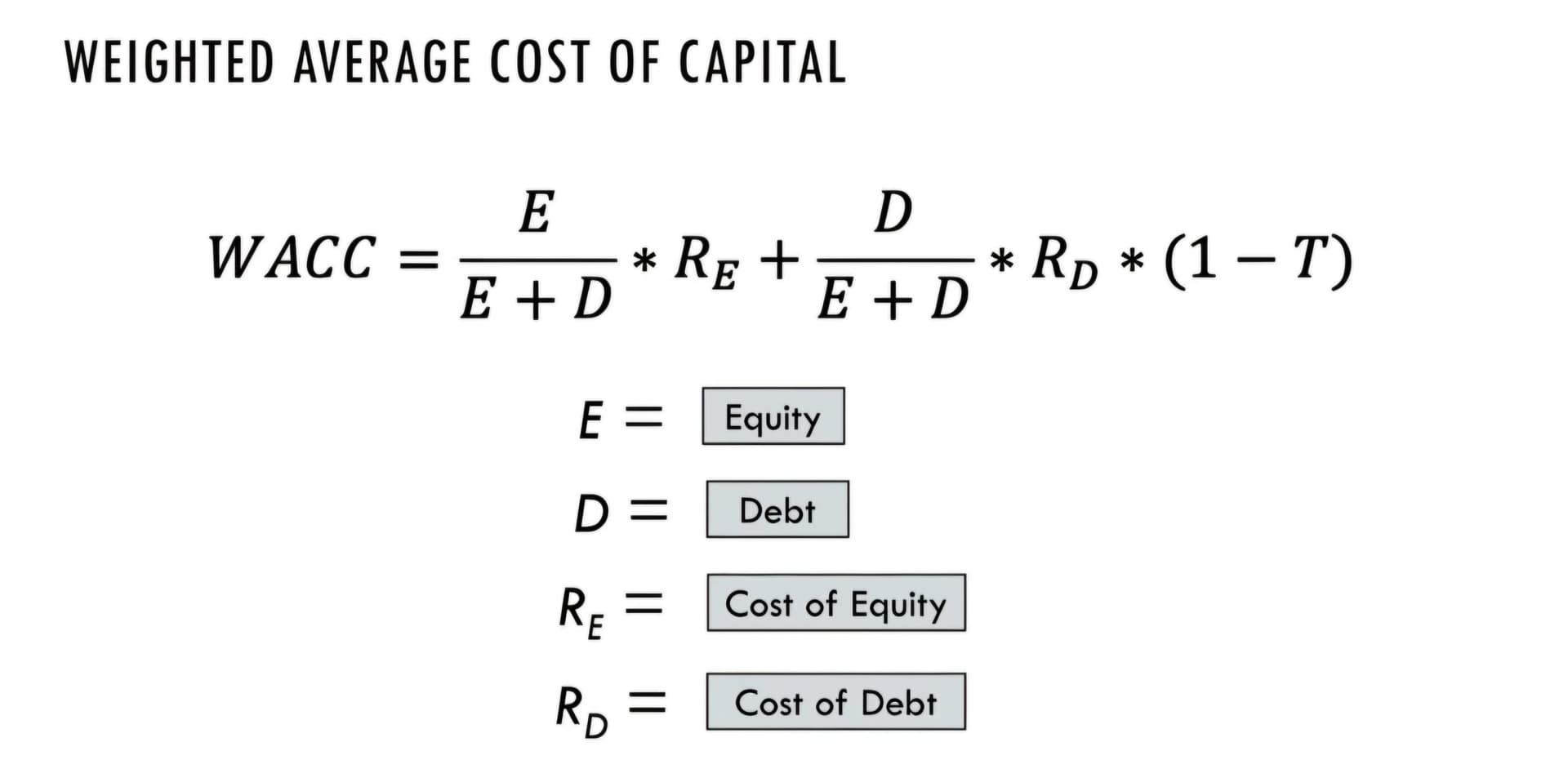
2nd Step: WACC Calculator 

 WEIGHTED AVERAGE COST OF CAPITAL

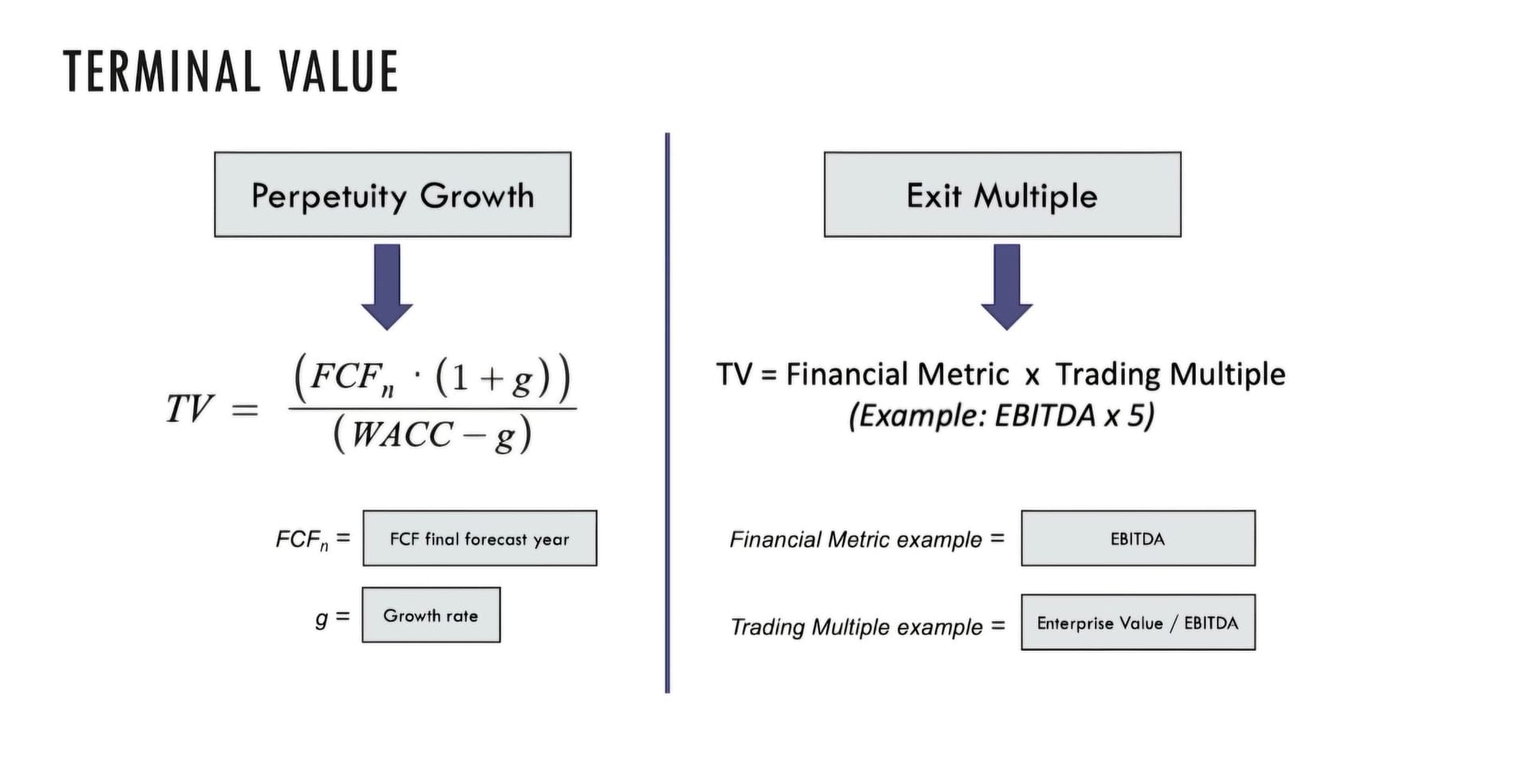
3rd Step: TERMINAL VALUE CALCULATOR 	

4th Step: Discounted cash flows	

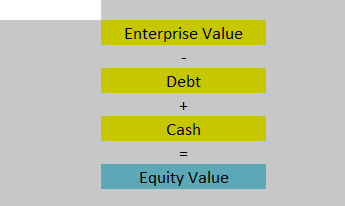
5th Step : ENTERPRISE VALUE  TO EQUITY VALUE		

Screenshot 2024-09-09 114847

              Market price per share
   ● P/B= ----------------------------------
              Book value per share

  
                             (assets - liabilities)
    Book value per share = ------------------------------
                            number of shares outstanding

■ Solvency Ratios:

                                     EBIT
   ● Interest Coverage Ratio= ----------------------
                                Interest Expense


                        Current Assets
   ● Current Ratio = ----------------------
                      Current Liabilities

                           
                      Total Liabilities
   ● Debt/Equity= -----------------------------
                   Total Shareholders’ Equity

Thank you!

2 Likes

■ Efficiency Ratios :

                                             Net Credit Sales
 ● Accounts Receivable Turnover Ratio = -----------------------------
                                        Average Accounts Receivable


                                  ( Beginning Accounts Receivable + Ending Accounts Receivable )
     Average accounts Receivable = --------------------------------------------------------------
                                                                    2

                                      365
Receivable Days Ratio = -----------------------------------
                         Accounts Receivable Turnover Ratio


                                      Net credit purchases 
 ● Accounts Payable Turnover Ratio = ----------------------------
                                   Average accounts Payable


                               ( Beginning Payable + Ending Payable )
     Average Accounts Payable = ---------------------------------------
                                                   2


                                     365
 Payable Turnover Days = ----------------------------------
                          Accounts Payable Turnover Ratio


                                 Cost of Good Sales 
  ● Inventory Turnover Ratio = ----------------------
                                 Average Inventory


                         ( Beginning Inventory + Ending Inventory )
    Average Inventory = ---------------------------------------------
                                           2


                                     365
 Inventory Turnover Days = -----------------------
                           Inventory Turnover Ratio


                                   Sales 
  ● Assets Turnover Ratio = ------------------------
                             Average of Total Assets 

                                  ( Beginning Assets + Ending Assets ) 
     Average of Total Assets = ----------------------------------------
                                                  2


  ● Working Capital = Current Assets - Current Liabilities 

        Working Capital Cycle = ( Inventory Days + Receivable Days ) - Payable Days

Thank you!

1 Like

How important is PEG to assess the value of stock vs its price?

The Price/Earnings-to-Growth (PEG) ratio is an essential financial metric that combines a stock’s price-to-earnings (P/E) ratio with its projected earnings growth rate. It provides a more nuanced view of a stock’s valuation compared to the P/E ratio alone by factoring in growth potential. Here’s why the PEG ratio is important:

1. Accounts for Growth

While the P/E ratio measures how much investors are willing to pay for each unit of earnings, it does not consider how fast a company’s earnings are expected to grow. The PEG ratio addresses this limitation by incorporating the earnings growth rate, offering a clearer picture of whether a stock is fairly valued, undervalued, or overvalued.

2. Identifies Undervalued Stocks

A PEG ratio below 1 generally indicates that a stock may be undervalued relative to its growth potential, making it an attractive investment opportunity. Conversely, a PEG above 1 suggests overvaluation. This makes the PEG ratio particularly useful for identifying high-growth companies that might otherwise appear expensive based solely on their P/E ratios.

3. Enables Cross-Sector Comparisons

The PEG ratio normalizes valuation by accounting for growth, allowing investors to compare companies across different industries or sectors with varying growth rates. This is especially helpful when evaluating high-growth sectors like technology versus slower-growing sectors like utilities.

4. Encourages Long-Term Perspective

By emphasizing future earnings growth, the PEG ratio promotes a forward-looking approach to investing. This aligns with long-term investment strategies focused on sustainable growth rather than short-term market fluctuations.

5. Enhances Decision-Making

The PEG ratio acts as a filter for screening stocks with strong growth potential at reasonable prices. It simplifies the stock selection process and complements other valuation metrics like P/E and P/B ratios, leading to more informed investment decisions.

Interpreting the PEG Ratio

  • PEG < 1: Stock is likely undervalued.
  • PEG = 1: Stock is fairly valued.
  • PEG > 1: Stock may be overvalued.

For example, if a company has a P/E of 20 and an expected annual EPS growth rate of 10%, its PEG ratio would be 2010=21020=2, indicating overvaluation.

Limitations

While valuable, the PEG ratio has its drawbacks:

  • It relies on projected earnings growth, which can be uncertain or inaccurate.
  • It may not account for industry-specific factors or cyclical variations.
  • Negative or zero earnings can render the metric meaningless.

In conclusion, the PEG ratio is a powerful tool for evaluating stocks by balancing current valuation with future growth prospects. However, it should be used alongside other metrics and thorough research for comprehensive investment analysis.

Hope you will find this useful sir.

3 Likes

So grateful. :folded_hands: In the last few days, I have used this ratio to select stocks which are under valued to weed out overvalued stocks.
I was not sure if I was over emphasising it.

3 Likes

In my view you are going right.
but in few sectors like IT, FMCG, Consumer and other sectors which command a premium valuation i.e. having higher PE multiple, one should remember there are very low chances that these will be available at undervalued price.
in my view for these sectors PEG ratio greater than 1 to less than 2 can also be a good valuation sign as you know some stocks and sectors remain in premium valuation most of the time.
Only seeing PEG ratio 1 or less as a sign of undervaluation will lead to a opportunity loss in these sectors.
Sir I’m not that experienced to give you any advice. You have way more knowledge and experience than me. This is only my view point. :folded_hands:

3 Likes

Thanks a lot Prashant. :folded_hands:I have mainly got out of stocks at more than 2 PEG.
Some of the stocks I have replaced them with indeed have more than 1 PEG.
You are right about some stocks commanding better premium. I had to get out of CG Power to it racing away today :grin: but that is the name of the game.
I am still not able to buy consumer sector stocks, many of which are at more than 4! But then opportunity is elsewhere too.

1 Like

yes sir, you are absolutely right.

2 Likes

As per I know but not sure, screener is a data oriented app which gives results on the basis of solid number. For that they should be using trailing earning data because you know forward earning projections are just some maths combined with guess work and hope, there is no guaranty.

You are right. This is the game, If you can get the future numbers absolutely right then you are the GOD or a INSIDER :laughing:

You can get future projections of a company from their con-call and Invester presentation (this is a view of the management not an absolute number). From that you can take a calculated guess about future earnings, Rest is your luck too. :sweat_smile:

2 Likes