
FII : Tum Kab Aaogey ?
By Chandra Rampuria | 27 August 2026
A personal analytical note on whether foreign institutional capital returns to Indian equities, stays on the sidelines, or keeps exiting
Disclaimer: This note reflects the author’s personal views based on publicly available information as of 27 August 2026. It is shared for general information and discussion only, is not investment advice or a recommendation to buy, sell, or hold any security, and should not be relied on for any investment decision. Please do your own diligence or consult a qualified advisor.
Where things actually stand
The framing of “twenty years of buying, a couple of years of selling” understates how structural this shift already is. FPI ownership of NSE-listed companies has fallen to 15.1% as of the June 2026 quarter (Q1 FY27), a 17-year low, while domestic institutions now hold a record 19.5%, with mutual funds alone at an all-time high of 11.6% and rising for a twelfth straight quarter. That crossover in who sets the marginal price would have been unthinkable in 2020. However, while domestic retail SIPs provide a formidable floor against panics, they also keep entry valuations sticky, preventing the classic post-outflow valuation reset that global allocators typically wait for.
The flow numbers, read carefully across both the fiscal-year and calendar-year conventions India’s data providers use, tell a two-part story. On a fiscal-year basis, FY25 (April 2024 to March 2025) saw net FPI equity outflows of about ₹1.27 lakh crore. FY26 (April 2025 to March 2026) was worse, at a record ₹1.76 lakh crore net outflow, with FIIs selling roughly ₹3.15 lakh crore gross, offset only by ₹8.31 lakh crore of DII buying. On a calendar-year basis, 2025 saw ₹1.66 lakh crore of net outflows for the full year, and 2026 had already exceeded that by the third week of August, with roughly ₹2.3 lakh crore withdrawn, ₹1.92 lakh crore of it in just the first four months. March 2026 alone accounted for close to $12 billion in the single worst month, triggered by the Iran-Israel war escalation and the crude spike that followed.
That is the first part of the story. The second part is more recent and matters just as much. After four consecutive down months (March to June 2026), flows turned. July 2026 posted a net inflow of about ₹20,200 crore, the first positive month in five, and August extended it with roughly ₹23,544 crore of net buying through August 23, on the back of a Q1 earnings revival, an unwinding of the “chip trade” that had pulled allocator dollars to Korea and Taiwan, and a more stable rupee. The honest picture is therefore neither “still in freefall” nor “already turned the corner.” 2026 remains, cumulatively, one of the worst years for foreign outflows on record, even as the two most recent months show a genuine, data-confirmed reversal.
The case for staying away, or at best staying put
Three data-grounded arguments support a base case of minimal net new FII commitment over the next five years, even absent a fresh shock.
First, the valuation-versus-growth mismatch that drove the exit has been only partially corrected. Nifty earnings growth decelerated well below the mid-teens pace that justified 2021-23 multiples, while India’s valuation premium to EM peers, even after two years of underperformance, remains above its historical average. The July 2024 Budget’s hike in long-term capital gains tax on equities (from 10% to 12.5%) and short-term gains (from 15% to 20%), alongside a higher securities transaction tax on F&O, compounds this by mechanically reducing post-tax dollar returns. When combined with a 3-4% annualized INR hedging drag, the hurdle rate for foreign equity risk in India has structurally shifted upwards. This is a structural, not sentiment-driven, headwind.
Second, India has been competing for a shrinking pool of EM-allocator dollars against destinations with better near-term momentum and cheaper entry points. China’s DeepSeek-triggered rally added well over a trillion dollars of market cap through 2025-26 and pulled global EM allocations back toward Chinese tech at valuations still below India’s, while Korea and Taiwan captured AI-hardware-cycle flows India cannot structurally access, lacking meaningful semiconductor-equipment or advanced-fab exposure. Tellingly, the same “chip trade” that analysts credit for the July-August 2026 reversal was, until recently, one of the reasons money left India in the first place. That shows how quickly and mechanically this particular rotation can run in either direction.
Third, and more durable, the India-US relationship has become explicitly transactional rather than strategic, and transactional relationships carry recurring risk premia. The 2025 tariff dispute, a 25% “reciprocal” duty plus a punitive 25% tied to India’s purchases of discounted Russian crude that took the total to 50%, was de-escalated only in February 2026, and only in exchange for India agreeing to wind down Russian oil purchases and commit to over $500 billion in US energy, technology and agricultural purchases. That is a large, specific and revocable concession, not a settled alliance, and no comprehensive deal with reciprocal Indian tariff cuts has yet been confirmed as finalised. Layer on the $100,000-plus H-1B visa fee introduced in September 2025, which strikes at the revenue model of India’s IT-services majors, historically among the most FII-owned sectors and a top dollar-earning export category, and this is a structural threat, not a cyclical one. India’s strategic-autonomy posture, hedging between Washington, Moscow and the Global South, makes this kind of friction likely to recur over a five-year horizon rather than resolve once.
The case for returning, potentially at greater scale
The counter-case now has real, recent evidence behind it rather than just a plausible narrative.
The tariff de-escalation itself is a genuine regime change. A cut from 50% to 18% is one of the larger tariff reversals the US has granted any trading partner in this cycle, with India honouring the Russian-oil wind-down that made it possible. A fuller reciprocal deal, if it follows, removes the single largest geopolitical overhang of the past eighteen months. Separately, the macro backdrop for EM flows generally has turned more favourable than at any point since 2021. The dollar index fell to a four-year low in 2026, and most sell-side FX desks expect continued weakness into 2027 as the Fed’s cutting cycle proceeds. Dollar downcycles have historically coincided with EM, and specifically Indian, inflow upcycles, since a weaker dollar mechanically improves USD-denominated returns and lowers EM hedging costs.
The valuation argument now cuts both ways too. After two years of underperformance and multiple compression, India’s premium to EM peers has narrowed materially, broadly the same setup that preceded prior re-entry cycles in 2013-14 and 2020.
A separate channel worth understanding on its own terms is the bond-index story, because it behaves differently from equity flows and the record so far is mixed rather than uniformly positive. India’s inclusion in JPMorgan’s GBI-EM index is a proven, completed example of how this mechanism works: weight was added in fixed monthly steps from 1% in June 2024 to the 10% cap by March 2025, against a defined pool of eligible government bonds, and this pulled in an estimated $20 to 30 billion, because funds benchmarked to that index have to hold India in that proportion regardless of any individual manager’s view. That money is scheduled and formulaic rather than sentiment-driven, which is genuinely different from how equity FII flows behave. But it is debt-market money, not equity, and its effect on stocks is indirect: a stronger rupee and lower government borrowing costs support the macro backdrop rather than buying Nifty companies directly. The next, larger step in this story, India’s inclusion in Bloomberg’s Global Aggregate Index, was deferred in August 2026. Bloomberg cited operational readiness rather than economics, wanting to see automated trading and foreign-investor onboarding actually working in daily practice before certifying the inclusion, even though India had already removed capital gains and withholding tax on foreign bond investors to qualify. That deferral paused an estimated further $20 to 30 billion of scheduled inflows, so this channel remains real but is currently on hold rather than compounding as previously expected.
SEBI and GIFT City have also been actively easing FPI registration, NRI access and custody/onboarding friction through 2025-26, lowering the fixed cost of re-entry for funds that exited tactically rather than structurally.
The most concrete evidence, though, is the tape itself. After four straight down months, July and August 2026 delivered two consecutive months of real net buying (₹20,200 crore and ₹23,544 crore respectively), explicitly attributed by strategists to an earnings revival evident in Q1 results, a stabilising rupee, and money rotating back out of the Korea/Taiwan “chip trade.” Two months do not make a trend, but this is materially stronger evidence than “early signs.” It is a confirmed, if young, reversal.
The “larger scale” version of this case rests on India’s underlying structural story staying intact through all of this. The IMF has kept India as the fastest-growing major economy (FY26 growth estimated near 7.3%), the China+1 manufacturing diversification thesis (PLI-driven electronics, the Apple supply chain) runs independent of the tariff dispute, and the demographic and consumption tailwinds are untouched by the last year’s geopolitical noise. If earnings growth genuinely reaccelerates into double digits alongside a weaker dollar and a durable trade truce, a flows overshoot, allocators who went underweight India for two years chasing it back on a beta basis, is a real possibility, not a tail scenario.
Probability assessment
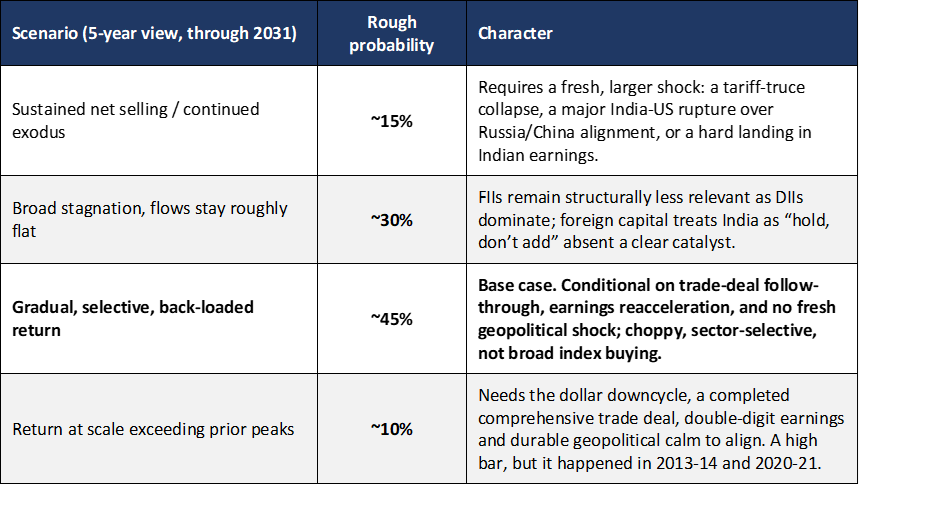
These are judgment-weighted estimates from the balance of evidence above, not a model output or a house consensus. Geopolitical variables in particular (the Iran conflict’s trajectory, any renewed US-India friction over Russia policy, a reversal of the tariff truce) can move these materially within weeks, as 2026 itself has already demonstrated twice.
Overall read
The single most likely outcome is the third scenario in the table: a gradual, uneven and more discerning return, rather than either a continued exodus or a repeat of the pre-2023 dynamic where FII flows single-handedly set index direction. Three things drive this conclusion. First, the structural rebalancing toward DIIs is not reversible on a five-year horizon. Even a full-throated FII return arrives into a market where domestic capital, not foreign capital, now sets the marginal price most of the time, which argues against a repeat of the old boom-bust amplitude. Second, the geopolitical overhang has genuinely reduced (tariffs down from 50% to 18%, an active de-escalation track) but has not been eliminated, and India’s strategic-autonomy stance makes recurrence more likely than a one-off resolution, which argues against underwriting the top-tail “return at scale” scenario as the base case. Third, the actual tape, two consecutive months of confirmed net buying after four months of heavy selling, is the most concrete, least narrative-dependent evidence available right now, and it points toward a genuine, if early, bottoming rather than either extreme.
For readers positioning around this, the next two to three quarters should be telling: whether the tariff truce evolves into a comprehensive trade deal, whether Q2/Q3 earnings confirm the reacceleration Q1 results hinted at, and whether the Iran-linked risk premium stays contained. Those are likely to determine whether this settles into the 45% base case above or drifts back toward the 30% stagnation case. Both tail scenarios are real and have precedent, but on the evidence as of today, they look like the least probable of the four outcomes.
Sources
1. Business Standard: FII/DII flows FY27 outlook
2. CNBC: record $12bn FII outflow, Iran war (March 2026)
3. Al Jazeera: Trump cuts India tariffs to 18%
4. The White House: fact sheet, US-India trade deal
5. Business Standard: FII ownership falls to 17-year low (Q1 FY27, Aug 2026)
6. Business Standard: DII ownership record high, FPI 13-year low (Q2 FY26)
7. Business Standard: FPIs pull out ₹60,847cr in April; 2026 outflows hit ₹1.92 trillion
8. Business Standard: FPI inflows resume in July 2026
9. Business Standard: FPIs add ₹23,544cr in August 2026 on earnings, rupee stability
10. CNBC: DeepSeek rally lifts China, India’s allure diminishes
11. CNBC: H-1B visa fee hike and its impact on India
12. Business Standard: Budget 2024 hikes LTCG to 12.5%, STCG to 20%
13. TradingKey: dollar index at multi-year lows, 2026 forecast
14. Business Today: record DII inflows offset $58bn FII selloff
15. TradingEconomics: IMF lifts India FY26 GDP forecast to 7.3%
16. Business Standard: explainer on India’s JPMorgan GBI-EM bond index inclusion
17. EcoNiti: Bloomberg defers India’s Global Aggregate index inclusion (Aug 2026)