if they continue to add GPUs then depreciation will keep dragging the margin and profitability will be at stake. additionally from India AI mission E2E is not getting good margin orders
how do you see at those 2 points ?
From their current batch, they can do around 120 Cr+ at peak utilization and depreciation will be around 45 Crore. So they will be profitable based on the 3900 GPU’s they possess.
Any further depreciation due to more capex will also increase the MRR, so at peak utilization, it will be accretive.
Depreciation is a part and parcel of this business. The main point is how long can they make these chips run efficiently..
1)Please read the company transcript of last 2 quarters- The Contract is between E2e and the vendor - not India AI mission.
2) No - there is no margin sharing facility with L&T. If anything - there is a contract (i dont know exact terms) that allows E2E to receive ~30 Cr from L&T for using its software platform. ( I do not vouch to the 100% accuracy of this statement - just typing from memory of reading past conference calls)
Management perceiving demand, expanded capacity and now the rate of depreciation is outpacing the sales growth for the infrastructure installed.
Fourth quarter would be interesting to see if the sales growth outpaces the depreciation.
I think the key thing to think about in E2E’s case,as Prof Bakshi would put it, is whether what is seen as ‘growth capex’ is really ‘maintenance capex’ due to the extremely high rate of obsolescence. If that is the case, the company would on a treadmill where it needs to run just to stay in place. In which case, the company would find it difficult to generate free cash flow in the long run.
PS: Invested (just a tracking position left, mostly sold off)
https://www.moneycontrol.com/news/business/stocks/ltimindtree-shares-jump-over-4-today-after-rs-3-000-crore-cbdt-order-win-for-ai-powered-tax-programme-13775251.html
Once LTIMindtree successfully executes this them the same architecture can be applied for various other govt bodies,
• GSTN
• State tax departments
• Customs
• PSU analytics
• Smart cities
• Other ministries
Need to see how this increases the addressable space for E2E.
I would just like to give my 2 cents on the “extremely high rate of obsolescnece” part. I have noticed in the media that all the big guys who think AI is bubble and are carrying shorts - have been saying that the life of these GPU’s is only 2-3 years- whereas depreciation is wrong at 5-6 years. However, it looks like the reality is different. The life of previous generation GPU’s continues to be relevant for many years. Think of it like this - If indigo airlines introduces “Business class”, we cannot imply that now people will stop using premium economy or just economy. All three will co-exist for different set of users at different price points. the Nvidia H100 was launched in march 2022, we are in 2026 now -its been 4 years already and H100 is still extremely relevant and still continues to be used aross the globe.
No they are not in the business of doing social service , E2E buys GPUs considering 4 years as its life and depreciating it accordingly and because they don’t do social service they are charging their customers keeping that in mind, infact everyone in the industry doing the same even in the USA.
But E2E management has said that even though they depreciate the GPUs in 3-5 years , they have H100-200 still getting used from 6 years and customers are happy to pay for it.
I don’t know why Prof Bakshi concluded that ? i think he is completely wrong here. he don’t understand the business.
Did he take E2E as an example ?
he spoke about sugar companies as well in one of his capex talks as expenses being indistinguishable.
Can someone please give me the context of which interview of Professor Bakshi is being referred to here??
Who said Prof Bakshi took the example of E2E? I just said ‘as he would put it’ to pull in that lens of looking at the business.
Anyone who is familiar with his thought process would know that:
Anyway, the post was not about Prof Bakshi. It was just to ask the question as analysts, whether it’s a business that will require a continuous infusion of capex to keep up with the fast pace of technological change, implying inability to produce free cash flows.
I also see that you talk about accounting profits while the point was about generating free cash flows. Obviously, the two are very different.
This was his video in 2020 on maintenance capex.

This is a wrong comparison, think in terms of electronics. Older processors are not used by new laptops or phones. Because producing company will keep improving its product to offer better processing with same or less cost. So older inventory becomes useless after some times.
To understand the evolution of the GPU space, it is essential to analyze the rapid launch timelines and technical specifications of each generation. The following data highlights the trajectory from the Hopper series through to the upcoming Rubin series.
Nvidia GPU Specification Comparison (2023–2026)
| Feature ↓ / GPU → | H100 | H200 | B200 | B300 | R100 |
|---|---|---|---|---|---|
| Architecture | Hopper | Hopper | Blackwell | Blackwell Ultra | Rubin |
| Release Timeline | 2023 | 2024 | Late 2024–25 | 2025 | 2026 |
| Memory (GB) | 80 | 141 | 192 | 288 | 288+ |
| Memory Type | HBM3 | HBM3e | HBM3e | HBM3e | HBM4 |
| Bandwidth (TB/s) | ~3.35 | 4.8 | ~8.0 | ~8.0–8.5 | ~22 |
| AI Compute (FP4) | Not Published | Not Published | ~10–20 PFLOPS | ~15–25 PFLOPS | ~50 PFLOPS |
| TDP (Power) | ~700 W | ~700–1000 W | ~1000 W | ~1100 W+ | ~1200 W+ |
| Enterprise Price | $25k–$30k | $35k–$40k | $35k–$45k | $50k–$65k | $70k–$90k+ |
| Cost / Token | 1.0× | ~0.6× | ~0.15× | ~0.10× | ~0.01× |
| Gen Improvement | — | ~1.7× | ~4.0× | ~1.5× | ~8–10× |
Economic Analysis of Hardware
The value erosion of previous GPU generations is driven by the cost-benefit ratio of the latest hardware. If a new GPU costs twice as much but delivers ten times the compute performance, the older units depreciate rapidly. This occurs because new competitors can deploy the latest generation and provide compute at a significantly lower price point than the original purchase cost of the older hardware.
The lifecycle of a GPU is a critical discussion point because performance leaps are occurring at an unprecedented order of magnitude. For example, the GPUs launching this year (2026) are projected to compute 10x more tokens, even though the price has only increased 2x and energy consumption has risen by a mere 3x than the previous generation.
Strategic CAPEX: Why Hyperscalers Continue to Spend
A logical question arises: Why do hyperscalers and Big Tech firms commit such massive CAPEX when they know superior hardware will launch within 12 months?
Time as a Strategic Asset: These companies are in an existential race. Falling behind due to compute restrictions means being excluded from the next frontier of AI development.
Value-Added Ecosystems: Large players have the “deep pockets” and integrated service offerings (SaaS, Cloud ecosystems) to extract value far beyond the raw cost of compute, allowing them to recover their investment quickly.
The Pure-Play Risk: Conversely, for “pure-play” companies whose only business is renting out server space, this cycle is incredibly dangerous. They are selling a commoditized resource that is subject to rapid price-performance deflation, making long-term ROI difficult to achieve.
Conclusion
While I am not sure what will happen to the companies providing compute power, AI will be adopted very quickly because the cost of compute is falling so fast. Many projects that were too expensive before will now become possible, leading to much more innovation. The coming years will see a wave of AI use like we have never seen before.
Note:
These are my personal views basis the limited understanding that I have on this subject and can be wrong.
Also please watch the latest CES NVIDIA event which showcases their latest Rubin GPU. https://www.youtube.com/watch?v=0NBILspM4c4
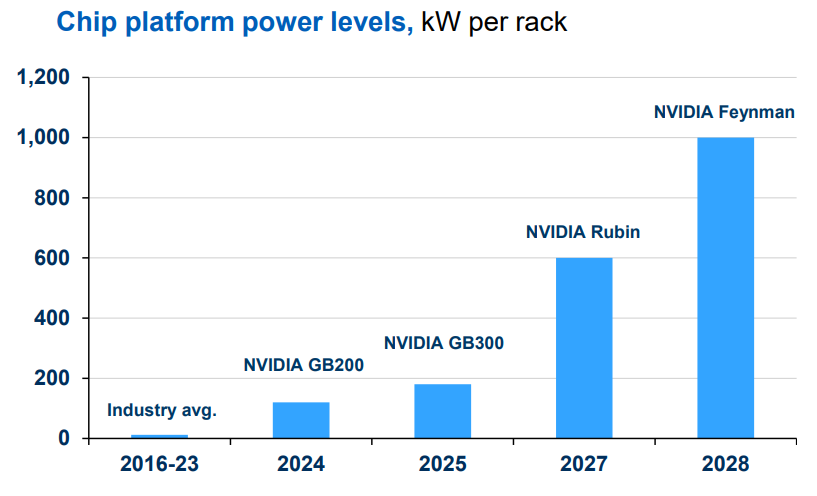
Not for or against the argument that you are putting forth, however, just wanted to draw your attention to what Eaton is projecting (link) by way of power consumption shift by each successive generation of GPUs.
Yes, those figures are per rack. I was highlighting the data per GPU, but I agree that the cost-per-token improvement is on a rack basis. You are correct. I will correct the write up.
I just want to understand one thing from the community.
Is Technology Obsolescence a big looming threat for this entire industry as new technologies comes up every year or few years.
How is that mitigated? Can someone explain me this.
Performance comparison across generations is not as straightforward and varies with applications. Token throughput is a function of multiple factors (precision, model parameters, latency, concurrency). Blackwell’s key advantage is FP4 support, higher memory and bandwidth. While this helps with frontier models, the performance leap is not that high for mid-tier SLM models with fewer parameters (which don’t require as much memory). Most of current enterprise use cases are for application specific workloads for which such SLMs are sufficient. For these, Hopper offers comparable price-performance as well as more mature software ecosystem and hence will continue to remain relevant.
Nvidia sold USD 2 bn of Hopper in Q3FY26 (https://finance.yahoo.com/quote/NVDA/earnings/NVDA-Q3-2026-earnings_call-379484.html?utm_source=chatgpt.com), four years after its launch. Recently, Coreweave also commented that it re-contracted its H100 capacity within 5% of original price, despite Blackwell being widely available. Of late H100 rental pricing has also been rising (https://www.silicondata.com/products/silicon-index), indicating continuing demand.
Even A100 (released in 2020) is seeing steady pricing and demand. The leap from Ampere (7 nm) to Hopper (4 nm) was much larger than Hopper to Blackwell (4 nm). Despite that A100 continue to remain relevant today. This indicates that old GPUs continue to remain relevant even after 2-3 newer generations are released. So, while obsolescence is an ongoing debate, at least past experience does not suggest that GPUs become obsolete so soon.
How will E2E stand to gain from tax holiday announcement? If global hyper scalars are going to come to India to serve international customers (that too likely will be in countries that do not have strict data sovereignty policies which is smaller pie) they will build out their own DCs as they always do instead of using players like E2E. Is this policy targeted more towards non CSPs like salesforce/SAP to use india to serve the world?
Looks like this only means more competition for E2E in competing for international customers as now foreign companies will also come, setup shop and compete from India (while also getting tax benefits which E2E will not get)