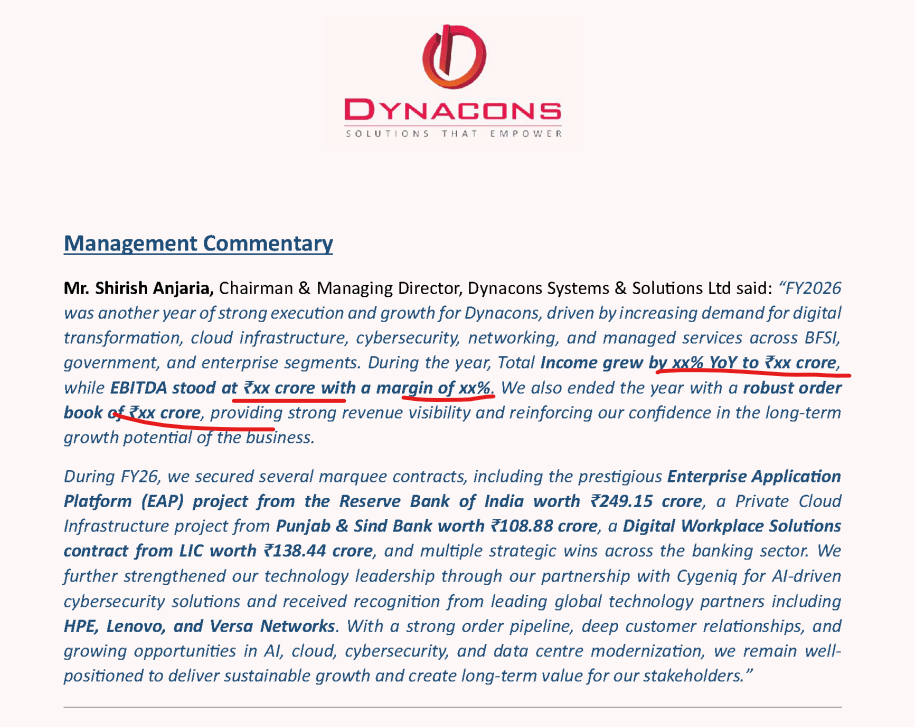
FY26 Vs FY25:
Revenue +12.4%, Operating Profit +41.4%, OPM +25%, EPS +16.9%, PAT Margin +4%.
Anually the company posted good results. Increase in EBIDTA, PAT and PAT margin are important. It’s whats driving the stock to be a growth pick, EPS growth has been steady so this share is providing value to its shareholders. OPM has increased to 10%, considering FY18 - FY25 Average is 6%, its good. Management had guided double digits OPM margins and they delivered, though i expected it to be more than this. What i am really liking about this years results is that despite 100% increase in finance costs and 780% increase in deprecition, PAT margin has increased to almost 6% ( 4 Year average: 4,4%). This is because Dynacons is now shifting from simply selling IT hardware to a reccurring revenue models like Device-as-a-Service (DaaS) and Managed Services.
| Metric |
FY25 |
FY26 |
Change |
Change % |
| CFO |
64.00 |
46.13 |
-17.87 |
-27.91% |
| CFI |
-26.00 |
-43.55 |
-17.55 |
67.48% |
| CFF |
-6 |
-24.40 |
-18.40 |
306.60% |
| Net Cash Flow |
31.83 |
-21.81 |
-53.63 |
-168.52% |
| FCF |
58.64 |
-18.87 |
-77.51 |
-132.18% |
| Capex |
-5.3551 |
-65.0043 |
-59.6492 |
1113.88% |
| Inventories |
58.2374 |
16.1631 |
-42.0743 |
-72.25% |
| Trade Receivables |
436.579 |
602.19 |
165.611 |
37.93% |
Capex has increased massively from 5.3 crores to 65 crores, probably for the revenue model shift to recurring revenue. What i am not liking here is that CFO has decreased lowering the CFO/OP.
Q3 Vs Q4
This is where i am dissapointed. Topline shows steady growth, 21% YoY and 18% QoQ, so topline growth is steady. There is a decrease in Operating Profit and OPM -10% and -25% respectively. YoY Q4 Bottom line has been flat, with very little change in PAT, PAT Margin is down -13%. QoQ bottom line has done worse -18% in PAT and -31% in PAT margin. EBITDA also flat YoY and -18.8% QoQ.
| Particulars |
Q4FY25 |
Q3FY26 |
Q4FY26 |
YoY Change |
YoY % Change |
QoQ Change |
QoQ % Change |
| Profit before tax |
24.74 |
31.39 |
25.49 |
0.75 |
3.03% |
-5.9 |
-18.80% |
| Net Profit |
18.17 |
23.45 |
19.13 |
0.96 |
5.28% |
-4.32 |
-18.42% |
| PAT Margin |
5.50% |
6.90% |
4.76% |
-0.74% |
-13.44% |
-2.15% |
-31.10% |
| EPS in Rs |
14.28 |
18.43 |
15.03 |
0.75 |
5.25% |
-3.4 |
-18.45% |
Why this company is still attrractive to me:
Management has aggressively positioned the company as an AI and sustainability play. Dynacons is upgrading data centres to handle intense computing requuriments.
AIOps embed Ai directly into the data centre, this involves predictive analysis for automated capacity, planning and anomaly identification. Green data centers and sustainable data centers are built by prioritizing space optimization and advanced cooling efficiency.
Their recurring revenue model is in the DaaS and Core banking as service segment, which the company uses to monetize its AI and sustainability initiatives over the long term.
Dynacons makes initial revenue by designing and building AI-ready, green data centers, because clients cannot easily manage these advanced computing environments internally, they sign long-term recurring contracts with Dynacons to continuously manage, monitor, and optimize the data centers.
AIOps Supercharges the Profit Margins of Recurring Contracts The integration of AIOps directly into data centers fundamentally changes the economics of Dynacons’ managed services. By deploying AI-driven predictive analytics, automated capacity planning, and anomaly identification within their own Network Operations Centers (NOC), Dynacons drastically lowers its cost-to-serve. This automation allows them to service massive, multi-year annuity contracts with fewer human resources, driving a significant expansion in their EBITDA margins as seen in FY results.
In the Q4 results they have mentioned about the RBI project secured by them in dec 2025, however no commentary on the recent 750 crore order. Lets see if management says anything in the Annual report.
DSO days streching to 28 days is a classic working capital trap when you work with government clients. I am seeing it as a cost to entry.
Talking about their balance sheet, while their trade receivables are increasing so are their payables. DSSL’s Trade Payables surged to ₹444.36 Crore . This means they are using significant supplier credit to naturally offset the massive ₹602 Crore in receivables, preventing a total liquidity drain.
Core Leverage is Still Highly Conservative Despite the massive order book, the company’s core debt profile is extremely lean. Their Debt-to-Equity ratio sits at roughly 0.25x , meaning they are highly under-leveraged and have massive untapped capacity on their balance sheet to fund further operations.
@Vijairahul This is my opinion about the DSO drag, balance sheet strength amd RBI order.
there is a concall by the company today lets see if they shed some light on the topics you raised.
note: Invested @ 1000 Levels. Added more today. 12% of portfolio, biased. Not investment advice.