
Company: Dhoot Transmission
Sector: Auto Components Manufacturer - Wire Harnesses, Battery packs, sensors, controllers, EV Cord sets and Automotive switches
Basic Details
• Market Cap: ₹30,050 crores
• Issue Price: ₹871
• Current Price: ₹1475 (as of 31/08/2026)
• Listing Date: 17th August 2026
Financial Highlights
• Revenue (FY26): ₹4,525 crores
• Net Profit: ₹397 crores
• ROE: 24%
• Debt-to-Equity: 0.38
• Revenue Growth (3-year CAGR): 28.9%
Business Overview
• What they do: Dhoot Transmission manufactures Integrated wiring harnesses, battery packs, charging solutions and sensors for Auto OEMs (Majorly 2/3 Wheeler)
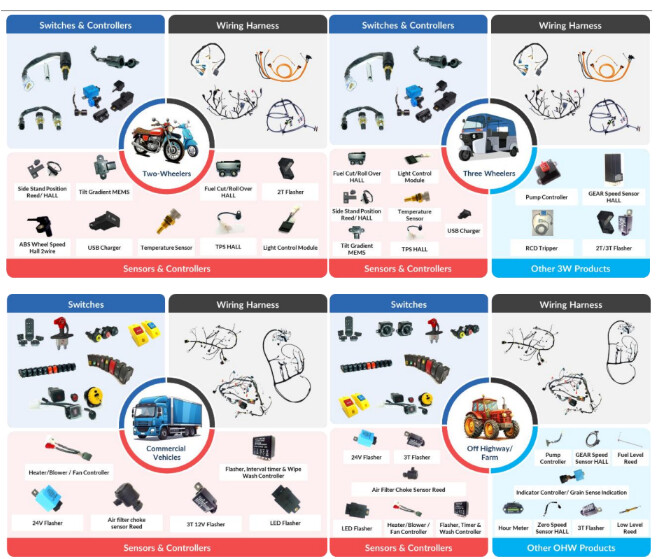
• Key Products/Services: Wiring Harness is 77% of the Revenue in FY26. A wire harness is the interconnected wires and cable that run through a vehicle transferring information and power between all electricals, electronics and mechanical components of a vehicle. These are the lists of products provided by Dhoot:
Additionally, here is the mental model for how a harness used in 2 wheelers and how is structurally complex the product gets when it comes to EVs:
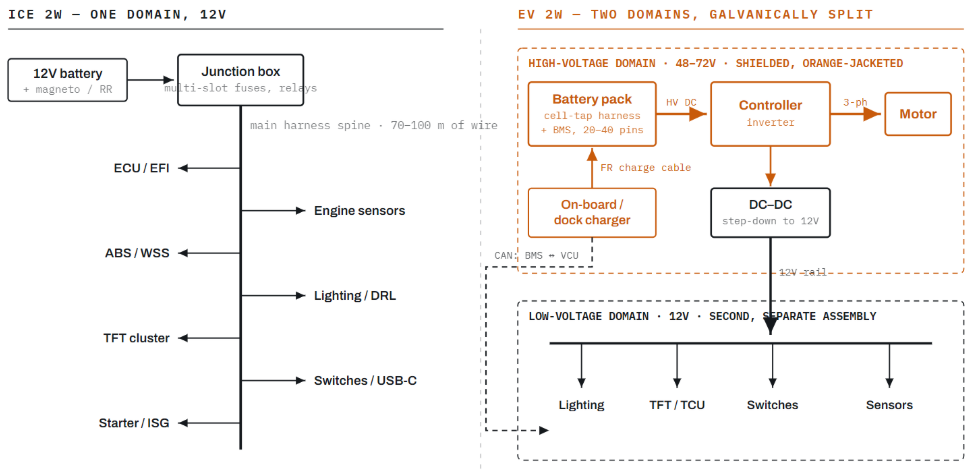
• Market Size: Total Domestic 2/3 Wheeler Market size for Wire Harness: INR 7006 cr, Growth rate till FY 31: 14%. The EV 2 wheeler Harness market in India: market size: 694.1 cr, growth rate: 39-41% (till FY31) (DRHP sourced numbers). Due to the increasing complexity of EV wire harnesses, growth is being driven not only by higher EV penetration but also by the increase in wire harness content per vehicle
• Wiring Harness Market share:
- Overall 2W wiring harness: 37.6%
- Overall 3W wiring harness: >70%
- Overall 2W + 3W combined: 41.0%
- 70% EV 2/3 wheeler
• Key Customers: Bajaj, TVS, Honda. After Multilink acquisition: Hero and Ather. Bajaj is the highest paying customer at 31.8%
Management Quality
• Promoter Background: Rahul Dhoot, Born 1973 in Aurangabad to an auto-dealership family. He took an electronics engineering degree from JNEC/BAMU in 1994, quit the family dealership after a month, and saw his first venture in used two-wheeler financing fail due to bad debts. He incorporated Dhoot Transmission in 1998, broke through supplying wiring harnesses to Bajaj Auto (~2003), and scaled from ₹1 crore to ₹107 crore by FY06
• Promoter Holding: 82.8% (But Bain Capital owns 42.8%, will exit in a phased manner in the next 5-6 years, currently the whole stake is pledged)
• Key Management:
- Naveen Kumar, CEO: Heads India (Wiring Harness & Electronics) business, who previously worked with Napino Auto and Electronics Limited, Subros Limited, Varroc Engineering Limited, Arvin Exhaust India Private Limited and Indian Seamless Metal Tubes Limited
- Nitinkumar Dagdulal Kalani, CFO: over 20 years of experience in the finance sector and was previously associated with Greenply Industries Limited, Varroc Engineering Limited, KEC International Limited, Rabo India Finance Limited and Credit Suisse Business Analytics (India) Private Limited
- Dhiren Vinodrai Sheth, ED & CHRO: more than 18 years of experience in the automotive sector by virtue of his association with our Company since 2007 and is responsible for driving the global expansion of the export business (~10% of Revenue)
Investment Thesis
Positives:
• Reliability and Pre - Qualification: Founders claim to have never lost a customer, highlighting the company’s consistent product quality. Dhoot is pre-qualified with leading 2W/3W OEMs such as Bajaj and TVS, while the Multilink acquisition could enable entry into other major OEMs, including Ather and Hero (their names aren’t explicitly mentioned in DRHP)
• Vertical Integration: Dhoot manufactures its own terminals, connectors, cables and moulded components, accounting for ~30% of raw material, which reduces incoming lot variation if sourced from a vendor, the biggest driver of crimp defects (The terminal at the end of a wire is a crimp, assume terminal as a charger pin - type c). By designing the terminal, wire and tooling together in-house, Dhoot achieves tighter process control. While competitors can replicate assembly capex, replicating this integrated capability requires operating across three businesses simultaneously.
• Cost Arbitrage: Dhoot’s stable ~15% EBITDA margin is significantly ahead of Motherson Sumi Wiring India (~9%) and Minda Corp (~12%), providing a ~3–6% margin advantage over its closest peers. Given the labour-intensive nature of wire harness manufacturing, Dhoot’s large internship program helps keep labour costs structurally lower.
Concerns:
• The right to win in adjacent products such as battery packs, EV cord sets and switches is less clear to us. At the current valuation, the stock appears to price in meaningful success in these newer businesses, leaving limited room for execution misses and effectively requiring investors to underwrite their future growth (feel free to comment on this with any relevant information). Additionally, the company does not disclose product-level revenue for these businesses, unlike the harness segment, limiting visibility into their individual growth and contribution
• A ~41% market share naturally raises the question of how much further share gains are realistically possible. This is similar to SPR Auto Technologies (formerly Shriram Pistons), where management indicated that further share gains could increase the risk of single-vendor dependence which OEMs would not be comfortable about
• With a limited number of 2W/3W OEMs and largely flat export revenue over the past three years, Dhoot’s growth story remains primarily domestic. This creates a degree of concentration risk, as a slowdown at key OEMs could directly impact Dhoot’s growth
• Despite the EV opportunity, EV contribution to revenue has remained broadly flat at ~25% over the past two years. Available capacity has not yet been fully captured, for instance, EV cord-set production more than doubled in FY26, yet capacity utilization remains at just ~35%.
Valuation
• P/E Ratio: 74
• P/B Ratio: 7.8
• EV/EBITDA: 40
• Compared to peers: Minda Corp: 42 and Motherson Sumi Wiring India: 39
Growth Catalysts
• Rapidly rising EV 2W penetration, which reached 11% in July 2026 and grew 81% YoY in 4MFY27, provides a strong structural growth opportunity. With ~70% market share in the E2W wire harness segment, Dhoot is well positioned to benefit from this EV transition
• The addressable market is quietly expanding as rising EV penetration drives a near 2x increase in wire harness content per vehicle versus traditional ICE vehicles
• With ABS becoming mandatory for all 2Ws manufactured from 1 Jan 2026, Dhoot stands to benefit from its ABS wheel-speed sensor SKU. Sensors are supplied as part of the harness assembly to OEMs, simplifying procurement and reducing supply and warranty complexity
Disclosures: Invested
Disclaimer
Small and midcap stocks and recent IPO stocks carry higher risks due to their smaller size, limited operating history. This analysis is for educational purposes only and should not be considered as investment advice. Always conduct your own research or consult with sebi registered financial advisors before making investment decisions.