
How the tariff on Brazil will impact the coffee price ?, US has put 50% tariff on Brazil and brazil is the biggest exporter, will it make coffee price to go up?
3 Likes
4 Likes
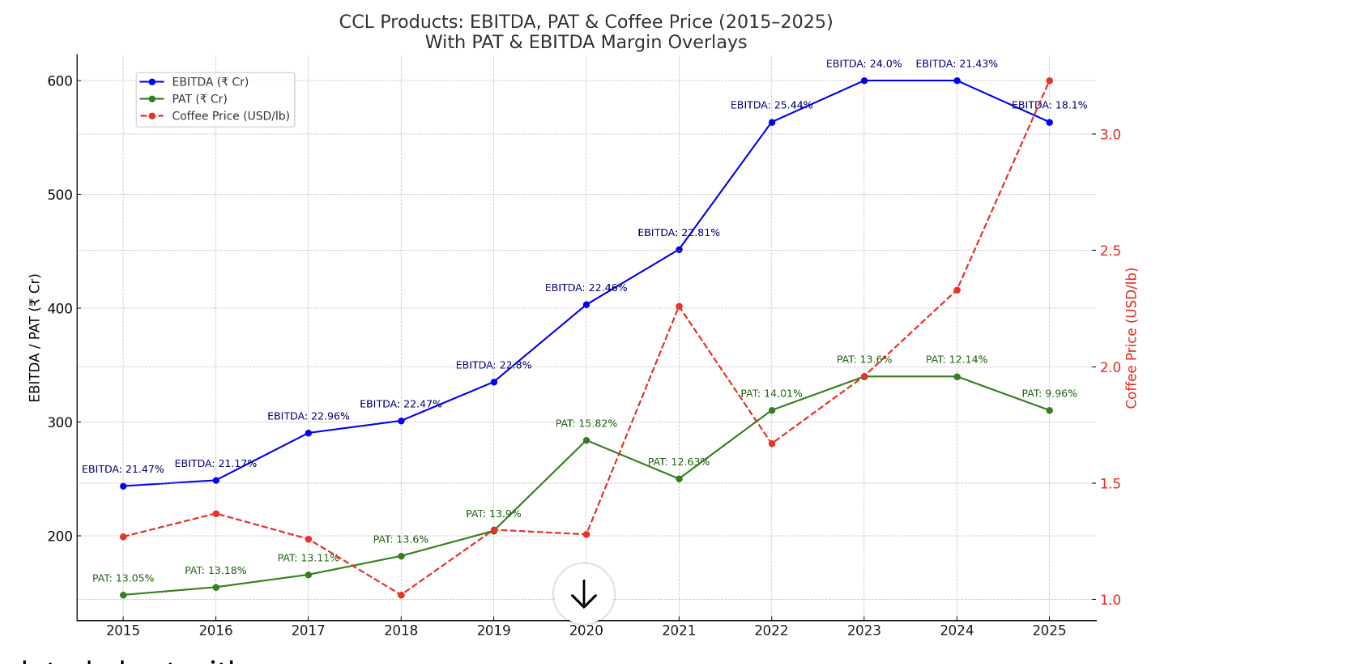
Any thoughts on the results? Seems high coffee prices has hit the P&L but business seems strong revenue wise.
I feel this is the beginning of their journey of turning into a midcap. Lower coffee prices effect will be seen in next few quarters as working capital requirement will be lower, leading to interest cost savings. With more capacity utilisation from the new plant, scale should aid profitability. Looking at cash flows, I feel debt could come down by 50% in 3 years which would lead to better valuations.
I have a large holding and am biased. have a look at my video uploaded few posts ago on CCL.
9 Likes
How do you compare this with Vintage coffee ? Especially as Vintage coffee results have been quite stronger since last few quarters.
Disclosure - Not invested in either
1 Like
Only issue is the equity dilution. CCL has never diluted, but look at the level of dilution done in Vintage Coffee. And the business models are quite different too. My bet stays with CCL for now.
3 Likes
Vintage coffee is a wrong comparison.
CCL has been a big player in the whole coffee space. They cater to lot of startups in the indian coffee space whereas vintage is just emerging.
Having said that, u can very well figure out the scale and then the capex being done by CCL vs vintage. And management has clarified that ebitda/kg is the correct metric to check for them. And with volume rising they are able to maintain these margins for sure.
Depreciation has stayed high and tax too. And management told that these things will come down as no capex is in works. Also, if coffee prices remain stable clients will lock in contracts vs in a volatile coffee price environment.
3 Likes
My question is during Q4 concall did they mentioned the PAT will go up from Q1 and onwards. From when are we going to see PAT growing on yoy basis to create value creation for shareholders
2 Likes
Earning Triggers and Management Consistency from Q2FY26 Conference Call:
Earning Triggers
Near Term (Next 1–2 Quarters)
-
EBITDA Growth Outlook:
Management expects to close the year at the higher end of its earlier guidance of 15–20% EBITDA growth. -
Domestic Market Turning Profitable:
The domestic business has moved beyond breakeven and is now adding directly to profits. -
Higher Freeze-Dried Utilization:
The newly added freeze-dried capacity is improving the EBITDA per kilo by increasing its share in the sales mix. -
Operational Efficiency Gains:
Better yield optimization, utilization, and overall efficiency are supporting steady margin improvement. -
Small Pack Momentum:
Rising sales of small packs are further lifting EBITDA per kilo. -
B2C Market Share Growth:
Retail (B2C) expansion continues to come mainly from market share gains, with the focus on sustaining this trend. -
Private Label Expansion in India:
The company has added 2–3 new private label clients in the past six months, driving strong growth in this segment. -
UK Brand Acquisition Update:
The acquired UK brands are performing well, adding new customers, and are expected to deliver 30–40% growth.
Medium Term (6–12 Months)
-
New Capacity Ramp-Up:
About half of total capacity (~35,000 MT) is new and currently running at 15–20% utilization. Around 30% more is expected to come online each year, reaching full use in 3–4 years. -
Renewable Energy Project:
The company’s 26% stake in Mukkonda Renewables will start partial power supply within 12 months and reach full supply in 18 months, meeting 50–60% of energy needs with green power and reducing costs. -
Reinvestment in B2C:
Current B2C margins (5–6%) will be maintained as earnings are reinvested to grow the coffee segment, distribution, and new product categories. -
Consolidation of New Launches:
Instead of new launches, focus will be on test-marketing and consolidating recent ones like institutional tea, consumer iced tea, and snacks.
Long Term (1+ Years)
-
FMCG Vision:
The company aims to evolve into a full-fledged FMCG player, building multiple brands across complementary product lines. -
Distribution Expansion:
The retail network currently reaches 130,000–140,000 outlets. The goal is to double this to ~300,000 within three years by leveraging new product launches. -
Deeper Domestic Penetration:
In the South, focus remains on smaller towns and sachets. In the Northeast and West, growth will come from product variety, e-commerce, quick-commerce, and modern trade channels. -
Sustained Volume Growth:
Management targets maintaining ~15% blended volume growth, consistent with the first half of the year. -
EBITDA per Kilo Improvement:
Margins are expected to rise steadily through higher end-client sales, more small packs, and lasting operational efficiencies.
Management Commentary Shifts (Q2 FY26 vs Earlier Guidance)
-
Debt Reduction Targets – From Specific to Cautious:
Earlier (Q1 FY26), management had set a clear goal to bring debt down to ₹1,350 crore by Dec 2025 and ₹1,200 crore by Mar 2026, implying ₹150 crore reduction per quarter.
In the Q2 FY26 call (Nov 2025), they noted being ahead of schedule but took a more cautious tone:
“Yes, it’s advanced by a quarter or two, but we’ll maintain guidance for now and wait for the Vietnam crop.”
This marks a move from aggressive quarterly targets to a steady, conservative approach, maintaining the ₹1,300–1,400 crore year-end guidance. -
Project Ramp-Up – Slower Than Planned:
In Q2 FY25, management guided for 30–45% utilization of new freeze-dried capacity in the first year (FY26).
However, by Q2 FY26, actual utilization stood at 15–20%. The revised plan now expects about 30% additional capacity to be used each year, with full ramp-up in 3–4 years.
This reflects a slower initial scale-up and a more gradual build-out than originally projected. -
Strategic Focus – From Consolidation to FMCG Expansion:
Previously (Q1–Q3 FY25), management emphasized no new products, focusing instead on expanding existing brands’ reach.
In Q2 FY26, their tone changed. They described a clear long-term FMCG vision, highlighting ongoing experiments in iced tea and snacks, including a small “nano test launch.”
This shows a strategic shift from a conservative stance to active brand building and category expansion. -
EBITDA per Kg Guidance – From Fixed Target to Flexible Range:
Initially (Q1 FY25), management guided ₹110/kg for two years.
By Q4 FY25, they said it could fluctuate, focusing instead on overall EBITDA growth of 15–20%.
In Q1 FY26, the range rose to ₹125–135/kg, and in Q2 FY26, they reported ₹120/kg last quarter, improving by ₹10–12 this quarter (around ₹130–132).
The company has now moved from a fixed, long-term target to a dynamic range, driven by product mix and efficiency gains.
11 Likes
Flooding in vietnam is not impacting CCL. CCL is Aiming to 2x retail outlet in 3-4Y
Management interview today on Ndtv - they mentioned Malgudi snacks pilot going on in hyderabad. Scaling would be easy as they are looking to outsource a lot of supply chains here after the pilot is done.
1 Like