
Capacit'e Infraprojects

This looks poised for some good growth in the next 3 quarters for this year (20%) while having reasonable valuations (13.5 pe) . The first quarter was lacklustre but the management is very confident of growth in the second half of the year.

If this comes through, the pricing can change upwards to reflect this for time and maybe even pe rerating.

Here is some summaries , thanks to AI form the latest con call and numbers from screener -

Key Performance & Financial Highlights:

• FY25 Performance: FY25 was a “transformational year” with record operational and financial performance, establishing a strong foundation for future growth. The company crossed 200 crores in Profit After Tax (PAT) on a consolidated basis, marking a 65% increase over FY24.

• Q1 FY26 Performance: Delivered a robust performance despite temporary challenges. The net profit after tax for Q1 FY26 was 7.84%.

• Revenue & Growth Outlook:

◦ Q1 FY26 revenue was 599 crores, with a monthly run rate close to 200 crores.

◦ Execution is expected to ramp up significantly in the second half of FY26 as monsoon activities subside.

◦ The company is confident in achieving its full-year guidance of 20% growth . Revenue targets for the full year consider heavy monsoons and winter stoppages.

◦ Momentum is expected to improve in Q2 and substantially in Q3.

• EBITDA Guidance: Full-year EBITDA guidance remains at 16.5% to 17.5% , and the company expects to achieve or surpass this. Finance costs are expected to drop as a percentage of topline.

• Balance Sheet & Working Capital: The company has maintained a healthy balance sheet and ensured operational continuity across key projects.

◦ Working capital (excluding retention) was 172.44 days as of March 31, 2025, and has not increased in Q1.

◦ Total collections in Q1 FY26 were 543 crores against a revenue of 599 crores, a significant improvement. Current collections are close to 756 crores.

◦ Generated 54 crores of positive cash flow in the last financial year, with expectations for substantial improvement in the current year through better collections.

◦ The net debt to equity ratio is low at 0.1.

• Interest Rates: Cash credit limits interest rates have come down to 10.3% and are expected to improve further. The outstanding non-convertible debentures (high-interest bearing) have reduced from 100 crores to 61 crores, with a goal to remove them entirely within the next 1-2 quarters. The average interest rate for the company is targeted to be not more than 10%.

Order Book & Project Pipeline:

• Order Book Visibility: The existing order book is in excess of 11,000 crores (excluding a specific MA order), providing clear visibility for 3 years or more .

• FY26 Order Inflow Target: The company aims for 4,000 to 4,500 crores in order inflows for the current fiscal year and believes it will surpass this target.

• Bid Pipeline: The bid pipeline is “very strong,” offering opportunities to select profitable projects.

• Contract Type: The company does not undertake fixed-price contracts . All contracts are variable price, including NBCC projects which feature a 3% annual price escalation clause.

• New Clients & Repeat Orders: Added Hinduja Group of UK to its client portfolio. Expects to secure more repeat orders, particularly in mixed-use construction in mature geographies like Mumbai.

• Growth Segments: Seeing significant traction in data centers (both private and government), and will explore opportunities that offer better margins by including electromechanical parts. Also expects to add projects in the healthcare sector.

Key Project Updates:

• SIDCO: Momentum continues, with commitments of over 700-800 crores for the remaining period. Payments from SIDCO are consistently prompt.

• MAHARA: Execution momentum will increase from Q3 onwards, with work having started on three residential buildings. Committed to 350 crores as a subcontract, aiming for an average building cycle of 60 crores from October.

• NBCC: Profit recognition is expected to commence from Q2 onwards.

• Signature Global: Profit recognition has begun for Phase 1 as the threshold has been crossed. Monthly revenue target is 15 crores for July/August, aiming for 20-23 crores from next month.

• Tata Projects (JV): Profits from the JV, which were around 20 crores last year, are expected to rise substantially from the next financial year after pre-operative expenses are fully written off.

Operational Challenges & Mitigation:

• Seasonal Factors: Q1 was partially impacted by the early arrival of monsoon (end of May into June) and the EID festival-related labor migration . Finishing and interior works are less affected by monsoons.

• Labor Shortage: A “big issue” across the industry due to high demand from the Middle East and Eastern Europe. Residential projects require more blue-collar workers than commercial ones.

◦ Mitigation: The company has adopted innovative recruitment methods, improved working conditions (e.g., providing meals), and currently has 90-95% of its labor requirements met across project sites. Growth targets have factored in this challenge.

• Productivity & Management Tools: Utilizes the Eforce app across project sites to track “boots on ground,” output, and productivity per workman. This provides detailed information to operations teams to improve efficiencies. The Labor Resource Department (LRD) manages labor contractor recruitment.

• Cautious Optimism: While optimistic, the company is “cautiously optimistic,” focusing on clients who meet their requirements and offer a premium for quality and timely construction. This approach stems from past experiences with the NBFC crisis and COVID aftermath.

Accounting & Recoveries:

• Deferred Profit Recognition: Approximately 12 crores of profit from previous quarter projects (Signature Global and NBCC) was deferred due to accounting policy changes. Recognition for Signature Global Phase 1 has started, and NBCC recognition is expected from Q2.

• Questionable Receivables: The auditor (EY) mentioned 66 crores of questionable trade receivables, but the company possesses properties valued over 100 crores to cover these.

• Recovery Targets: The company aims for 65 crores in recoveries from slow-moving debtors and non-core assets for the full year. In Q2, 19.1 crores worth of properties were sold, and a settlement agreement for 27-27.5 crores was reached, totaling 35-40% of the annual budget.

Pledged Shares:

• Promoters have pledged 50 lakh shares for a project-specific limit for SIDCO with the State Bank of India.

• Pledged shares with Aventus have been reduced by 10 lakh shares, and the company aims to eliminate all pledges (except for the SBI/SIDCO project limit) by the end of the current financial year

Historical Growth Rates
Revenue CAGR (3Y/5Y/10Y): 20.6% / 9.0% / 15.5%.

EBITDA CAGR (3Y/5Y/10Y): 20.5% / 8.2% / 19.7%.

Net Profit CAGR (3Y/5Y/10Y): 61.9% / 17.5% / 20.4%.

FY2026 Projections (Assuming 20% Revenue Growth)
Using last year’s EBITDA margin (16.2%) and net profit margin (8.7%):

Metric FY2025 Actual FY2026 Projected Margin Basis (FY25)
Revenue ₹2,350 cr ₹2,820 cr —
EBITDA ₹381 cr ₹457.2 cr 16.2%
Net Profit ₹204 cr ₹244.8 cr 8.7%

Disc - invested
3 Likes

I think FY26 is going to be bumpy because of the slow start

Disc: Invested

Good quarter overall and continues to look poised for a good year in H2.

Summary of Q2 Earnings and Growth (Q2 FY26)

Key consolidated financial highlights for Q2 FY26 compared to Q2 FY25 include:

Metric Q2 FY26 (₹ Cr) Q2 FY25 (₹ Cr) Year-on-Year Growth Citation
Total Income 650.4 523.4 24%
Revenue from Operations 646.2 518.0 25%
EBITDA (excluding other income) 108.3 95.3 14%
EBITDA Margin 16.8% 18.4% -
Profit After Tax (PAT) 51.1 44.9 14%
Cash PAT 72.7 63.8 14%

Other key financial updates as of September 30, 2025 (H1 FY26 closure):

• Order Book: The standalone order book stood at ₹11,991 crores . The split is 60% public sector and 40% private sector.

• Order Inflow (YTD): The company achieved ₹3,464 crores in bookings year-to-date.

• Debt Reduction: Gross debt decreased to ₹405 crores as of September 30, 2025, down from ₹417 crores on March 31, 2025.

• Debt Ratios: Gross debt to equity improved to 0.22x (from 0.24x), and net debt to equity remained steady at 0.11x.

Management Commentary and Outlook for Full Year (FY26)

Management expressed confidence in the company’s trajectory, stating that the momentum built in FY25, which was a transformative year, was carried powerfully into FY26. The company is currently entering a high growth phase.

Execution and Revenue:

• The company expects a robust revenue growth in the second half of FY26 , driven by a pickup in execution post-monsoon and a robust order book.

• The target is to achieve 20% revenue growth for FY26.

• The projected execution for the second half (H2) is aggressive: targeting ₹725 crores for Q3 and ₹825-850 crores for Q4, which would bring the full-year execution to approximately ₹2,810 crores. The execution target for Q3 is already well underway, with ₹240 crores done in October.

Margins:

• The EBITDA margin guidance for the full year (excluding other income) is maintained between 16.5% and 17.5% .

• Based on current performance and operational efficiencies, management expects full-year margins to trend toward the upper end of the guidance range (close to 17.5%) .

Order Book and Strategy:

• The initial order inflow target for the full year was ₹3,500 crores, which has been nearly achieved with ₹3,464 crores booked year-to-date. Management expects to cross this target “quite decently”.

• The company has shifted its strategy to focus on high-quality clients and projects.

• Management’s policy is to work primarily for clients who have their own sources of funds (like MCGM, MHADA, and CIDCO in Maharashtra) or central government projects with allocated budget funds (like those executed through NBCC).

• The strategic focus is on projects upward of ₹500 crores, though they continue to accept smaller repeat business from existing private sector clients.

Debt and Working Capital Management:

• The focus is on maintaining a strong balance sheet and reducing fund-based debt.

• The company aims to reduce the total working capital days by another 20 days in H2 FY26 .

• A roadmap for the reduction of debtors by a total of 60 days has been given; reduction of 21 days has already occurred in H1 FY26, and an additional 20–25 days reduction is targeted for the remaining six months of the current fiscal year.

• The ongoing recovery process involves the realization of properties and slow-moving assets, totaling ₹65 crores during FY26. Properties worth ₹31 crores have been sold, with receivables expected within November and December.

• Promoter pledge shares have been reduced by nearly 30% over the last 18 months and are expected to decline significantly further in the coming quarters.

• The blended interest rate is expected to reduce going forward, with the finance cost in absolute terms projected to be lower in the second half of the year compared to last year, despite an increased top line.

Important Issues and Operational Commentary

Challenges in Execution:

• Monsoon Impact: Despite the Q2 performance, the period experienced a heavy monsoon season, which historically presents execution challenges.

• Labor Availability: Labor availability remains a challenge across the construction industry due to the scarcity of qualified skilled workmen and competition from the Middle East and Eastern Europe. The company is currently utilizing over 12,000 workers but would prefer 14,000–15,000. However, management believes this will not hinder the 20% growth target .

• JJ Hospital Receivable Delay: The only project currently facing delays in payment is the PWD of Maharashtra (JJ Hospital), where pending receivables are close to ₹45 crores (approximately 90 days outstanding). The company expects 50% of these funds to be released in December 2025.

Project Updates:

• MHADA Project: Additional 11 towers on the rehab site have been received, bringing the total handed over towers to 25 (out of 34). Work on the sale residential towers (320m tall buildings) is progressing, with piling started, and actual construction of the structure expected to start in January/February, leading to a strong indication of doubling revenue at the SPV level in FY27 (crossing ₹1,000 crores plus) .

• CIDCO Project: The company expects to bill a further ₹300 crores in H2 FY26. The execution period for the seven locations project (expected in Q4) would be 42 months.

• JV/Associates Profit Share: Share of profit from the Bandup hospital project JV is expected to be reflected in Q4 FY26 .

Compliance related disclosures -

• IT Survey: An IT department survey was conducted recently, but the company confirmed that there was nothing material to report, no impact on operations, and all requested data was provided.

1 Like

Another strong quarter in Q3 , with guidance for a equally good Q4. If this growth momentum continues, this could be a “rerating” candidate , given its now relative cheaper valuation to its peers - (about 2000 Cr mar cap now with revenue expectation for full yr of 2600 Cr and 200+Cr profit.)

2 Likes

Any news or latest about the company? It has corrected much more than many other stocks and continues the slide. Correction doesn’t seem to be normal. Any idea on what is it that the market knows and beating down the stock and retail investors doesn’t know as yet?

4 Likes

Not sure if promotor share pledge is a reason (this is just speculation , no news) - other than that nothing else seems to be in public domain as yet.

1 Like

in first glance it looks like a perfect undervalued stock but heart says No there must be something that is hiding from eyes and i am finding the reason why this stock is available at 8 PE and PB less than 1 from last 3 days but No recent equity reports available and no recent discussion on any internet forum. business seems great, valuation seems great, moat is strong, liquidity is strong don’t know whether it is value trap or a perfect undervalued next multibeggar stock.

1 Like

I agree. On the face of it nothing seems to be a red flag. But the way market is punishing this stock seems like there is some irregularity underneath. It has fallen much more than its peers.

UnPredictable cash flows and very high debtor days I.e long WC cycle is a major issue . Which it still ok as long as management works on fixing it as majority of the delivery book is governmental orders. But the reasons like having a qualified observation in the audit report to run for 5-6 quarters raises concern.

Have been invested for sometime now views maybe biased but hoping the management will do a much better job going forward on it’s WC cycle management. Maybe that will help get better valuations.

On the share pledge management had indicated that except for the SBI consortium project specific pledging, most of the other pledging will be done away with by q4 this year. Haven’t heard any updates in that regards.

With the tight cash flow situation maybe management might look for some alternative source of funding (guessing this. Nothing announced by the company). I remember the last QIP was done @ 160 or 170 levels post COVID.

We should not do any speculations on the share price without any concrete information.And past QIP has no bearing on current price as it was a complete different scenario. And the company has moved forward a lot since then. I also don’t read much on pledge issue and WC cycle management as this is applicable to all construction companies with large exposure to Govt sector. We can have a better picture after Q4. Almost all realty shares in Mumbai have gone down a lot, so also many construction companies. But none of them has such a good performance operationally. My only concern is the contagion effect and present uncertainties related to war. I am also at a loss to know the effect of LPG shortage on companies, both direct and indirect. At the present juncture best thing is to wait out and wait for the Iran war to end, as it has great ramifications for Indian economy.

2 Likes

Looks like some FII might have been selling for reasons best suited or known to them - below is copy pasted from a news article i just read -

“Polunin Emerging Markets Small Cap Fund, owned by London-based investment management firm Polunin Capital Partners, pared more than half a percent stake in Capacite Infraprojects, the construction company, via open market transactions on March 16.

Capacite Infraprojects shares were down 4.5 percent to Rs 180.28 on the National Stock Exchange, extending downtrend for fourth consecutive session.

Polunin Emerging Markets Small Cap Fund, the alternate investment fund, sold 4.3 lakh shares (equivalent to 0.51 percent of paid-up equity) at Rs 182.74 per share, valued at Rs 7.9 crore.

Polunin Capital Partners held 1.61 percent shareholding in Capacite Infraprojects as of December 2025.”

1 Like

My understanding is that they have a good chunk of projects on fixed cost basis and any escalation of input cost i.e. cement, steel etc. will come from their margins. High debt numbers provide limited financial flexibility and the company may even opt for raising equity at these valuations. Look at Ahluwalia Contracts, similar business, higher revenue but much lower debt. Finally, promoters have had linkage to Pratibha Industries in past, dont give them any leeway on Governance front.

1 Like

Is there a data source to back this ? Ive seen from their calls that they have pass through cost built in the contracts - here is a extract from an answer given in one of their audio call in Q1 -

‘the second question is in terms of our order book how much would be fixed price contract and variable price contract - there is we don’t do any work on fixed price contract even NBCC would be uh uh variable price contract nbcc has a price escalation clause up to 3% every year the contract is of 2 years that is 3% is sufficient to take care of the movement in commodities”

It could be they might have to bear certain cost escalation but looks like there would be some negotiation in a situation that is beyond control.

2 Likes

Having something written in contract and enforcing it are two completely different things. See the trend of impairment Allowance for Trade Receivables, it’s on an increasing trend and absolute number isn’t far from 3% of revenue. They could be recognizing this revenue and writing it off later.

Decent set of numbers in Q4, across line items, and guidance as well.

Growth seems to remain consistent and if this continues , further re-rating (from the recent price recovery) may be justified, the valuation remains low compared to peer group.

Inflationary price increases thats managed to get finally passed on, and consequently any margin impact remains to be seen (in next quarter/s) - so far its not shown up meaningfully.

They have mentioned its ‘covered in contracts’ but the govt released inflation and on ground price increases differ, maybe resulting in pass on differences for govt contracts.

1 Like

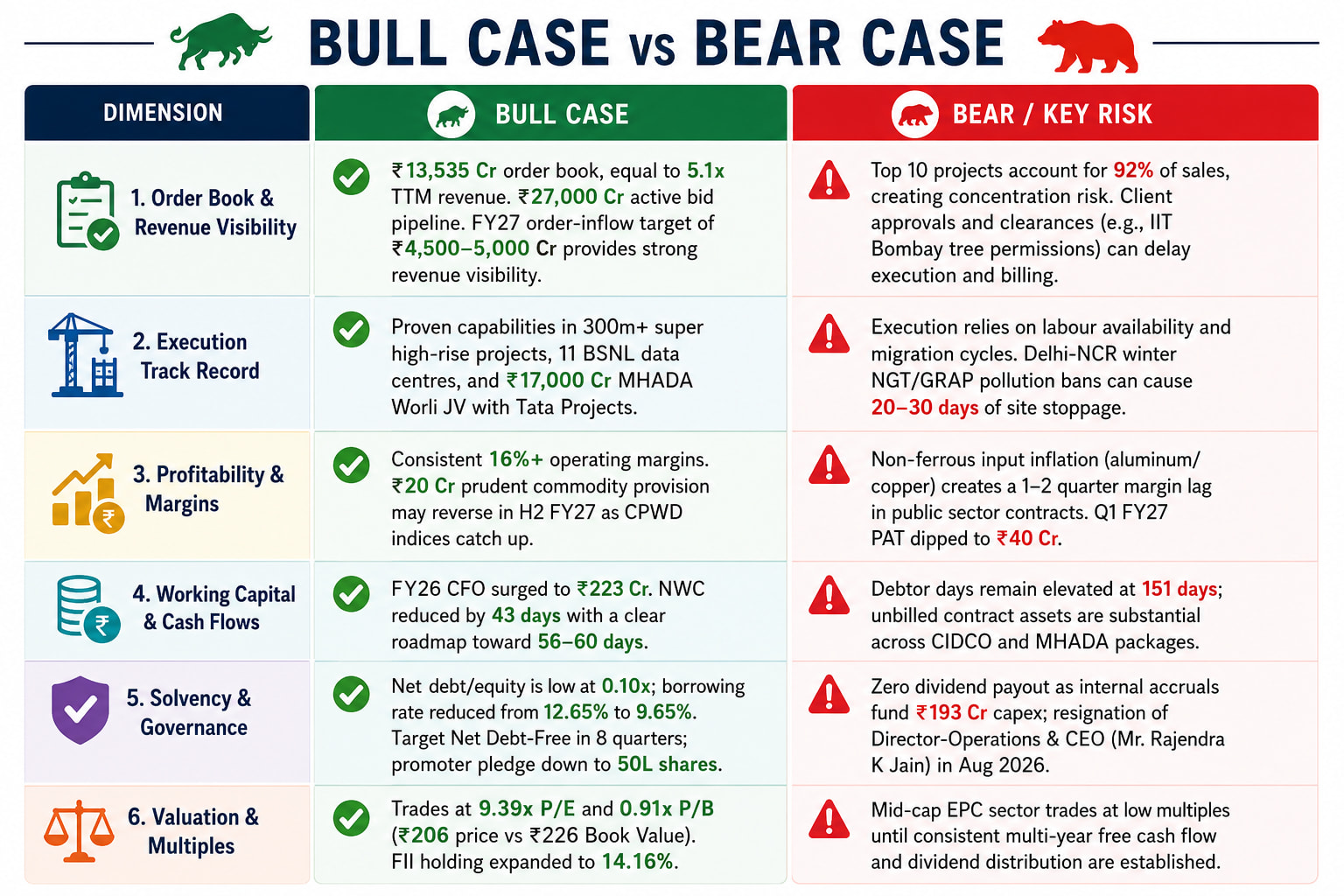
Capacit’e Infraprojects Ltd – Q4 FY26 & Q1 FY27 Concall Takeaways & Fundamental Snapshot

Sharing a detailed summary and operational notes from Capacit’e Infraprojects’ recent earnings concalls (Q4 FY26 and Q1 FY27)


1. Financial & Valuation Snapshot (At CMP ~₹206)

  • Market Cap: ~₹1,742 Cr

  • Trailing P/E: ~9.4x (vs. mid-cap civil construction peers trading at 15–22x)

  • Price-to-Book (P/B): 0.91x (Book Value: ₹226/share)

  • FY26 Financials: Revenue ₹2,623 Cr (+12% YoY), Operating Profit ₹427 Cr (16.3% OPM), PAT ₹193 Cr (EPS: ₹22.64).

  • Q1 FY27 Financials: Revenue ₹629 Cr (+7% YoY), EBITDA ₹99 Cr (15.7% margin), PAT ₹40 Cr (vs ₹47 Cr in Q1 FY26).

  • Order Book: ₹13,535 Cr as of June 30, 2026 (~5.1x TTM Revenue).


2. Q1 FY27 Ground Reality

₹20 Cr Commodity Provisioning (Accounting Prudence):

    • Non-ferrous inputs (aluminum jumped 35–40%, copper, and electricals) surged sharply over Feb–May.

    • In public sector item-rate contracts, government WPI/CPWD escalation indices lagged spot prices by 1–2 quarters (reflecting only ~2% escalation against an 18–20% input spike). In private contracts, they have 100% pass-through.

    • To remain conservative, management took a cumulative forward-looking provision of ₹20 Cr (₹10 Cr in Q4 FY26 + ₹10 Cr in Q1 FY27) to buffer purchases for the next 4 quarters.

    • Reversal potential: If CPWD indices catch up in Q3/Q4 FY27, these provisions are expected to reverse, lifting margins back to 16.5%–17.5%.

  1. Client-Side Start Delays:

    • IIT Bombay (~₹550 Cr): Fast-track 24-month project was delayed from Q4 to Q2 FY27 due to client-side tree-cutting clearances. This caused a loss of ~₹65–70 Cr in billing during Q1. Execution is starting now.
  2. Labor Disruption Normalization:

    • Labor count dipped to ~9,000–11,000 in May/June due to election migration and heatwaves.

    • As of August 2026, workforce is fully normalized to 14,000+ workers across all 30 project sites.


3. Order Book Quality & Bid Pipeline

  • Backlog Breakdown: ₹13,535 Cr (55% Public Sector / 45% Private Sector).

  • FY26 Inflow Beat: FY26 inflows came in at ₹4,446 Cr (vs. guidance of ₹3,500 Cr).

  • FY27 Inflow Target: Guided at ₹4,500–5,000 Cr (₹1,071 Cr booked YTD in Q1 alone from tier-1 private clients).

  • Active Bid Pipeline: Identified pipeline of ₹27,000 Cr for Q2–Q3 (₹22,000 Cr public + ₹5,000 Cr private). Near-term conversions under active LOI negotiation include CIDCO Maha Awas DRS Housing and Chennai Metro Commercial Complex.

  • Concentration: Top 10 projects contribute 92% of top-line revenue, reflecting a clear strategy to focus resources on mega-sites rather than scattered small packages.


4. Key Project Execution Roadmap (The Growth Drivers for H2)

  • NBCC Greater Noida (₹1,320 Cr): Certified billing crossed ₹300 Cr; profit booking has started. Billing is stepping up from ₹20 Cr/month to ~₹60 Cr/month starting August 2026.

  • MHADA BDD Worli (Tata-Capacit’e JV): Total JV package is ~₹17,000 Cr. MHADA has handed over ~50% scope (34 rehab buildings = ₹7,500–8,000 Cr at JV level). Capacit’e has a 35% economic interest. Subcontract turnover targeting ₹60 Cr in Q2 and ₹75 Cr+/quarter in H2.

  • CIDCO Mass Housing: Contract timeline extended to March 2028 with ~₹1,000 Cr+ remaining revenue to execute over the next 18 months. FY27 revenue guided at ₹500–600 Cr (delivered ₹400 Cr in FY26).

  • Signature Global & Raymond Wadala: Over 1,000 workers active at Signature Global; Raymond Wadala starting contributions by Q2-end.


5. Balance Sheet & Deleveraging Roadmap

  • Net Debt-Free Target: Gross debt stands at ₹522 Cr with net debt at <₹170 Cr (Net D/E: 0.10x). Management reiterated an explicit goal to be Net Debt-Free over the next 8 quarters.

  • Lower Interest Cost: Credit rating upgraded to BBB+; average borrowing cost dropped from 12.65% to 9.65% (a 300 bps cut), while BG commissions nearly halved.

  • Working Capital Compression: Net Working Capital (NWC) days reduced by 43 days in FY26 (by >50 days excluding retention). Management is targeting another 25–30 days reduction in FY27 toward pre-COVID levels of 56–60 days.

  • Operating Cash Flow: Surged to ₹223 Cr in FY26 (vs ₹52 Cr in FY25 and -₹39 Cr in FY24).

  • Promoter Pledge Reduction: Pledged shares reduced from 85.5 lakh shares (March 2026) to 50 lakh shares (August 2026); targeting 100% pledge release by FY27 end.

  • Non-Core Asset Monetization: From the ₹200 Cr post-COVID court settlement pool, ₹44 Cr was realized in FY26, with ₹50 Cr targeted for monetization in FY27 to assist debt paydown.


6. Key Headwinds & Monitorables to Track

  1. Debtor Days & Contract Assets: Debtor days remain high at 151 days. While management clarified that contract assets (CIDCO ~₹300 Cr, MHADA ~₹200 Cr) are standard unbilled milestone work and not aged defaults, converting these into hard cash remains the primary monitorable.

  2. H2 Execution Cadence: Management reiterated 20% revenue growth for FY27 (“101% confidence”), which requires quarterly revenue to hit ₹850 Cr+ in Q3 and Q4.

  3. Escalation Reversal: Whether the ₹20 Cr commodity buffer actually gets reversed in H2 once CPWD indices update.

  4. Seasonal NGT/GRAP Restrictions: Delhi-NCR winter construction bans (factored 20–30 days stoppage in guidance).


Bottomline

At ~9.4x P/E and 0.91x P/B, the stock continues to be priced with skepticism around civil EPC working capital cycles and public-client billing delays. However, the combination of a ₹13,535 Cr order book (~5.1x book-to-bill), borrowing costs declining to 9.65%, a credible 8-quarter net debt-free path, and strong H2 revenue visibility makes this an interesting deep-value operating leverage candidate if working capital days continue to compress toward 60 days.

Disc: Tracking / Educational purposes only. Not investment advice.

5 Likes