
Thanks for sharing this. What was the reason to exit ? (more so at a loss)
I looked at Brainbees because of the sharp price correction it has had since its IPO, I thought I would find a neglected high growth e-commerce company, but here’s what I found:
Startups tend to prioritize growth over profitability, as evident from last few quarters Brainbees has none of them, it is growing revenue at 10-11%, proftiability remains restricted to adjusted EBITDA only.
India (Multi-channel): 69% of Rev, out of which 80% is online and 20% is offline
International: 11% of Rev
Globalbees (D2C Brands): 21%
On India business and International business, Firstcry’s business model seems to have high competition from vertical e-comms like Amazon, Flipkart and Quick comms like Zepto, Blinkit and these competitors seems to offer better price, delivery times and service to the customers. Thus the core online business is at risk!
Market leaddership in terms of Revenue is there, but it is again growing very slow as evident from the last few quarters.
International business losing money, which again is growing at very low pace, citing competitive pressures from 2 horizontal e-comm companies.
Business from fashion category (52% of Rev), especially from own brands can give them an edge, but these brands, its goodwill and value to the customers needs to be evaluated.
Firstcry looks similar like a Myntra, with say a vertical e-commerce in multiple categories with multiple brands and no significant competitive advantage over vertical e-commerce and good D2C brands.
On Globalbees (D2C Brands): These looks like random brands in unrelated categories, company has spent ~1500 crs on these brands in the past, the current revenue from these brands is around 1500-1700 crs. These brands has no relation to product category of Firstcry, no competitive advantage, brand value of its own as such, they are just popular and top ranking on various horizontal e-commerce platforms, that is where the revenue comes from.
Verdict: Avoid as of now, look for strong signs of high growth and clear path profitability.
5 Likes
FirstCry: Built on Love. Judged on Returns.
Parents kept spending. The business kept growing. So why did ₹27,000 crore of market value disappear?
Indian parents can postpone almost anything for themselves.
A new phone.
A holiday.
Even a better car.
But for their children, the calculation changes.
A safer product.
A better book.
A healthier meal.
One more toy.
Because parents are rarely buying only a product.
They are buying trust, comfort and the possibility of something better for their child.
That instinct helped build FirstCry.
Yet somewhere between a category parents rarely compromise on and a company the market once celebrated, FirstCry’s market value fell from roughly ₹38,200 crore to ₹11,100 crore .
More than ₹27,000 crore disappeared .
Parents did not suddenly stop spending on their children.
But the market stopped paying a premium for the business serving them.
Which parts of the original thesis failed?
Which still survive?
And what must change before growth begins to carry weight again?
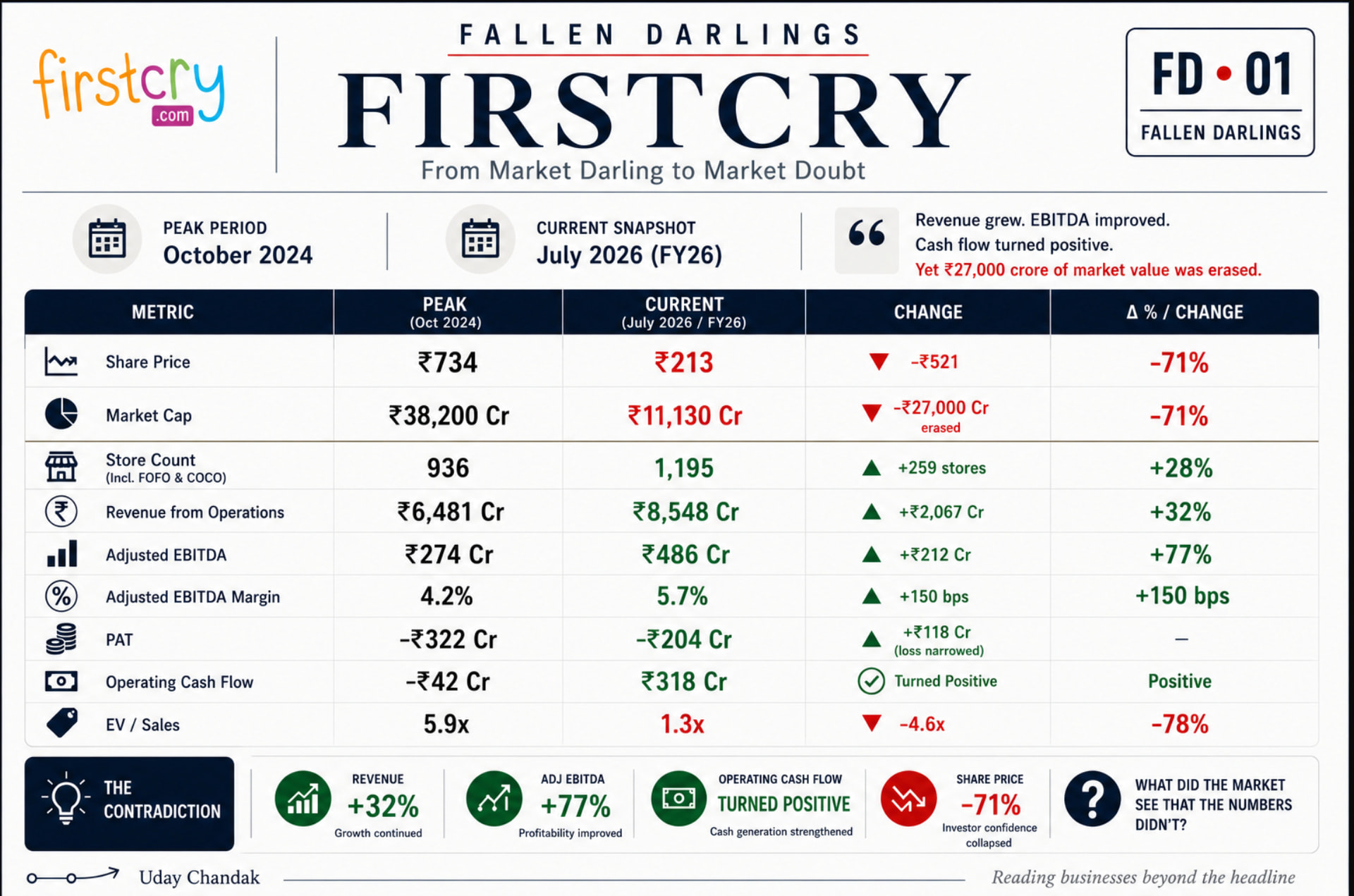
The contradiction is difficult to ignore.
The business became larger.
Revenue grew.
The store network expanded.
Operating profitability improved.
Cash flow turned positive.
Yet the market cut FirstCry’s valuation by more than 70%.
The question is no longer whether FirstCry built a real business.
It is whether that business can convert scale, trust and customer relevance into durable profits, cash flow and returns on capital.
That is where this investigation begins.
The Parenting Journey
Every retailer asks:
How do we bring the customer back?
FirstCry begins with a different question:
What will this family need next?
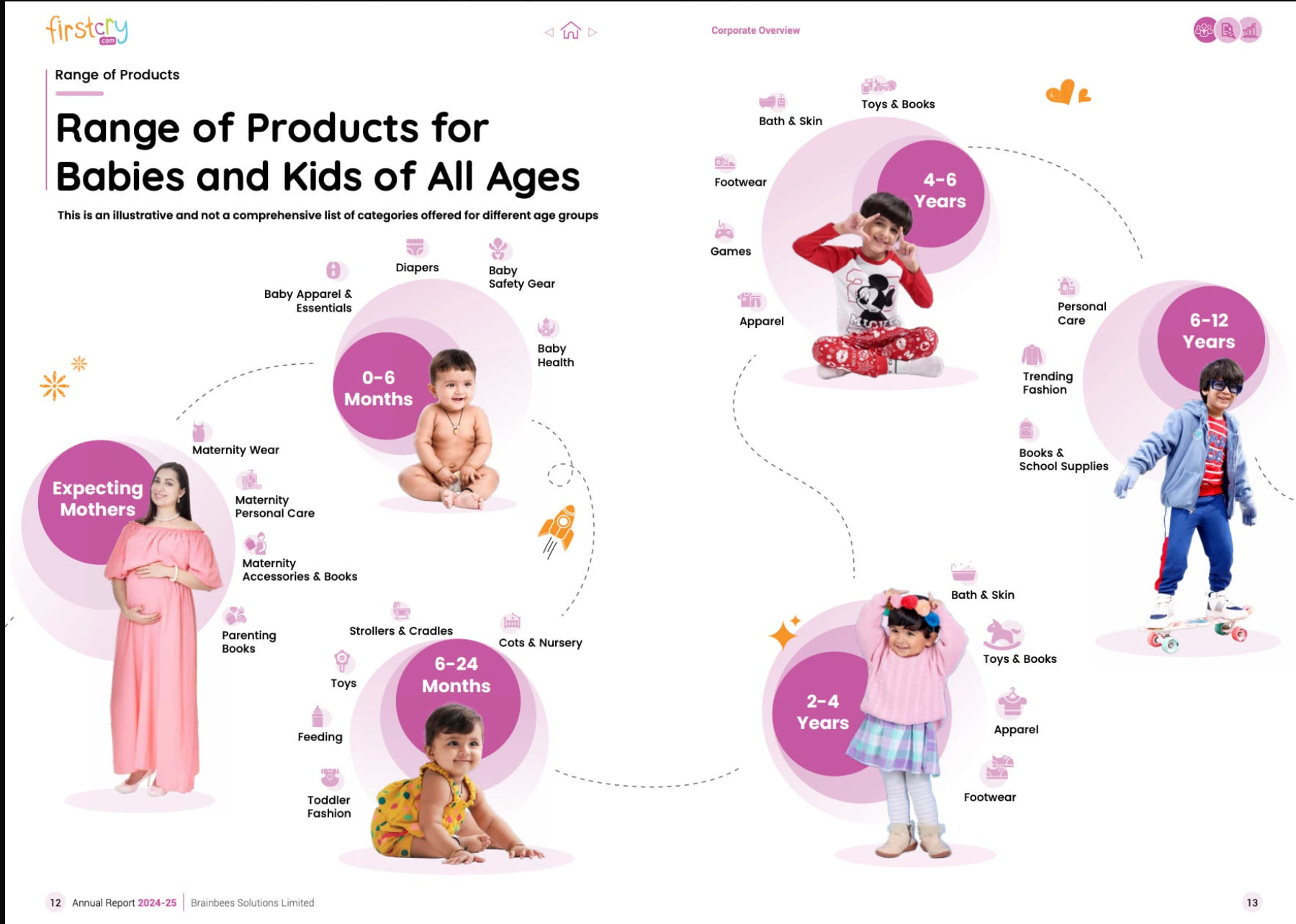
Its advantage is not one endlessly repeated purchase.
It is the progression of childhood itself.
Maternity becomes newborn care.
Diapers lead to feeding and nursery products.
Toys give way to apparel, footwear, books and school supplies.
The products change.
The family stays.
FirstCry tries to enter the relationship before birth and remain relevant until the child is roughly 12 years old.
Each part of the model supports that journey:
Online brings convenience, range and customer data.
Stores build trust, discovery and touch-and-feel.
Home brands improve differentiation and margin potential.
Content and community keep parents engaged between purchases.
The commercial loop is simple:
Enter early.
Understand the family.
Anticipate the next need.
Serve it through the channel the parent trusts.
That makes FirstCry more than a baby-products retailer.
It is a platform built around a long, visible and constantly changing sequence of family needs.
Childhood creates the demand.
The investment question is whether FirstCry can capture that demand profitably.
The Customer Engine
The parenting journey explains why customers should return.
The cohort data suggests many of them do.
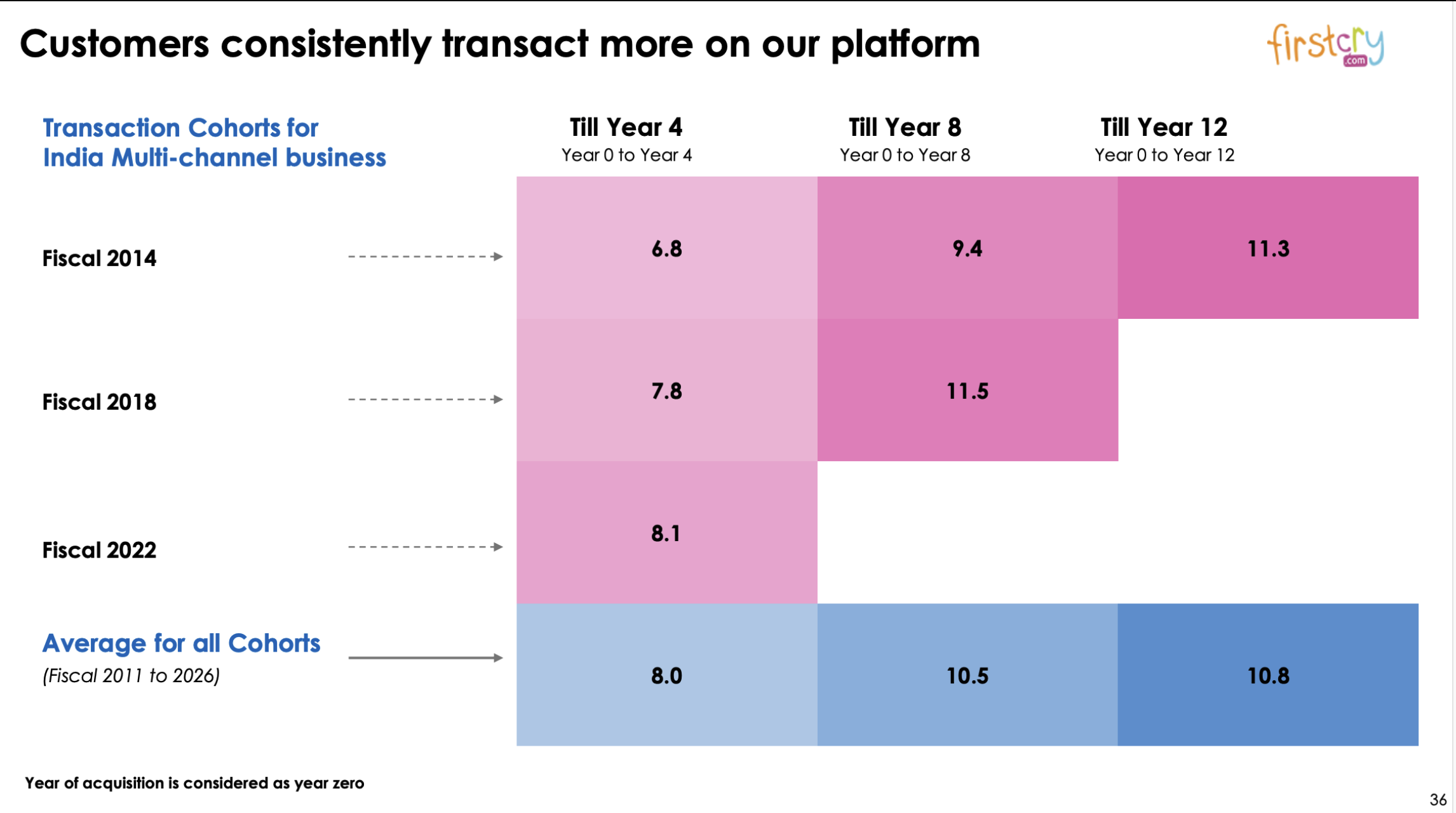
Customers acquired in earlier years continue transacting over long periods, while newer cohorts appear to build activity slightly faster at comparable stages.
That suggests FirstCry is not rebuilding demand from zero every year. The relationship appears to persist as children move through different needs and categories.
But the chart should not be overstated.
It shows cumulative transactions—not retention rates, customer lifetime value, contribution margins or cohort profitability. Older cohorts also naturally record more purchases because they have existed longer.
So the conclusion should remain disciplined:
Customer durability is visible.
Customer economics are not.
FirstCry has built a customer engine that keeps families returning.
The unanswered question is whether those returning customers become progressively more valuable.
The Ecosystem Test
FirstCry is trying to become more than a retailer.
Parenting content, hospital gifting, personalised recommendations and preschools extend the relationship beyond the transaction.
The reach is meaningful:
- hospital gifting touched more than 2.5 million births in FY25;
- preschools increased from 63 in FY22 to 436 in FY26 ;
- annual unique transacting customers reached 11.03 million in FY26.
These touchpoints may help FirstCry build trust earlier and remain relevant longer.
But their economic contribution remains opaque.
Management does not clearly disclose whether the ecosystem reduces customer-acquisition costs, improves repeat purchases, increases home-brand adoption, extends customer lifetime or generates meaningful standalone profits.
The ecosystem appears strategically valuable.
Its economic contribution remains unproven.
The real test is not how many touchpoints FirstCry can build.
It is whether those touchpoints translate into better retention, higher wallet share and stronger margins .
Why This Market Matters
A great business still needs the right market behind it.
Childcare has that advantage.
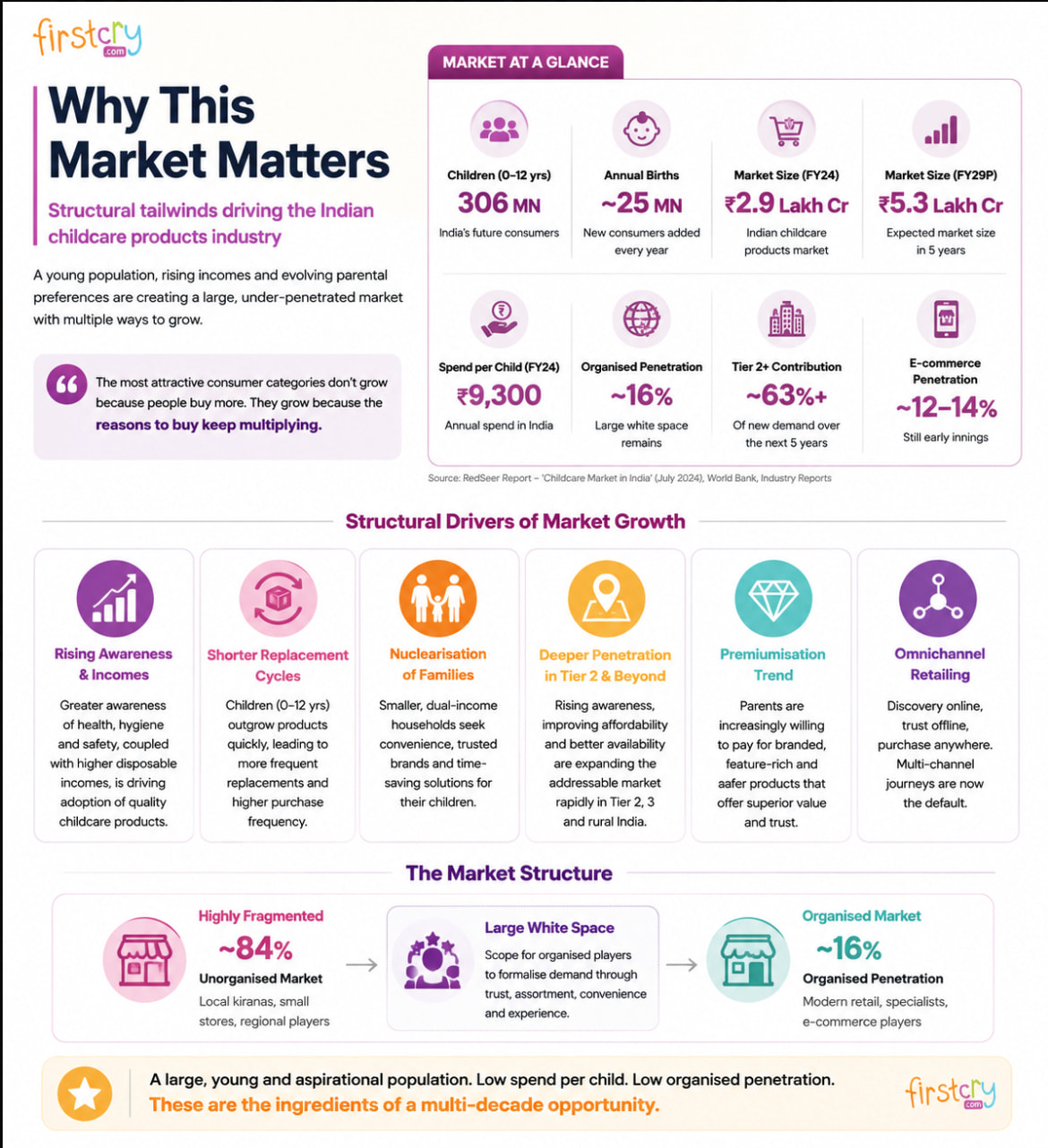
India has one of the world’s largest child populations.
Household incomes are rising.
Families are becoming more nuclear.
Parents are spending more on health, safety and convenience.
And organised retail still has significant room to grow.
The category also carries a natural replacement cycle.
Children outgrow clothes.
Shoes need replacing.
Books change every school year.
Diapers give way to feeding products, toys and learning essentials.
Demand keeps renewing—not because products wear out, but because childhood keeps moving.
That creates three powerful tailwinds:
- recurring demand across categories;
- a long runway for organised retail;
- increasing willingness to pay for trusted brands.
The market opportunity is real.
The harder question is who captures it profitably.
For FirstCry, demand is not the problem.
Execution is.
The Anatomy of the Fall
FirstCry’s fall was not caused by disappearing demand.
It was caused by the economics arriving later than the market expected.

Revenue crossed ₹8,000 crore.
Customers increased.
Stores expanded.
The India business strengthened.
But three gaps persisted.
The margin gap
Scale grew faster than operating leverage.
The profit gap
India’s improvement was absorbed by international losses, weaker GlobalBees economics and other group costs.
The cash-flow gap
Growth became visible years before durable free cash flow.
The valuation did not create these weaknesses.
It magnified them.
FirstCry did not need demand to collapse. Margins, consolidated profits and cash conversion only needed to arrive later than the price had assumed.
That was enough.
The market did not lose faith in the category.
It lost confidence in FirstCry’s ability to convert demand into shareholder value.
The fall was therefore not about one broken business model.
It was about three economic gaps that remained open for too long:
Margins. Profits. Cash.
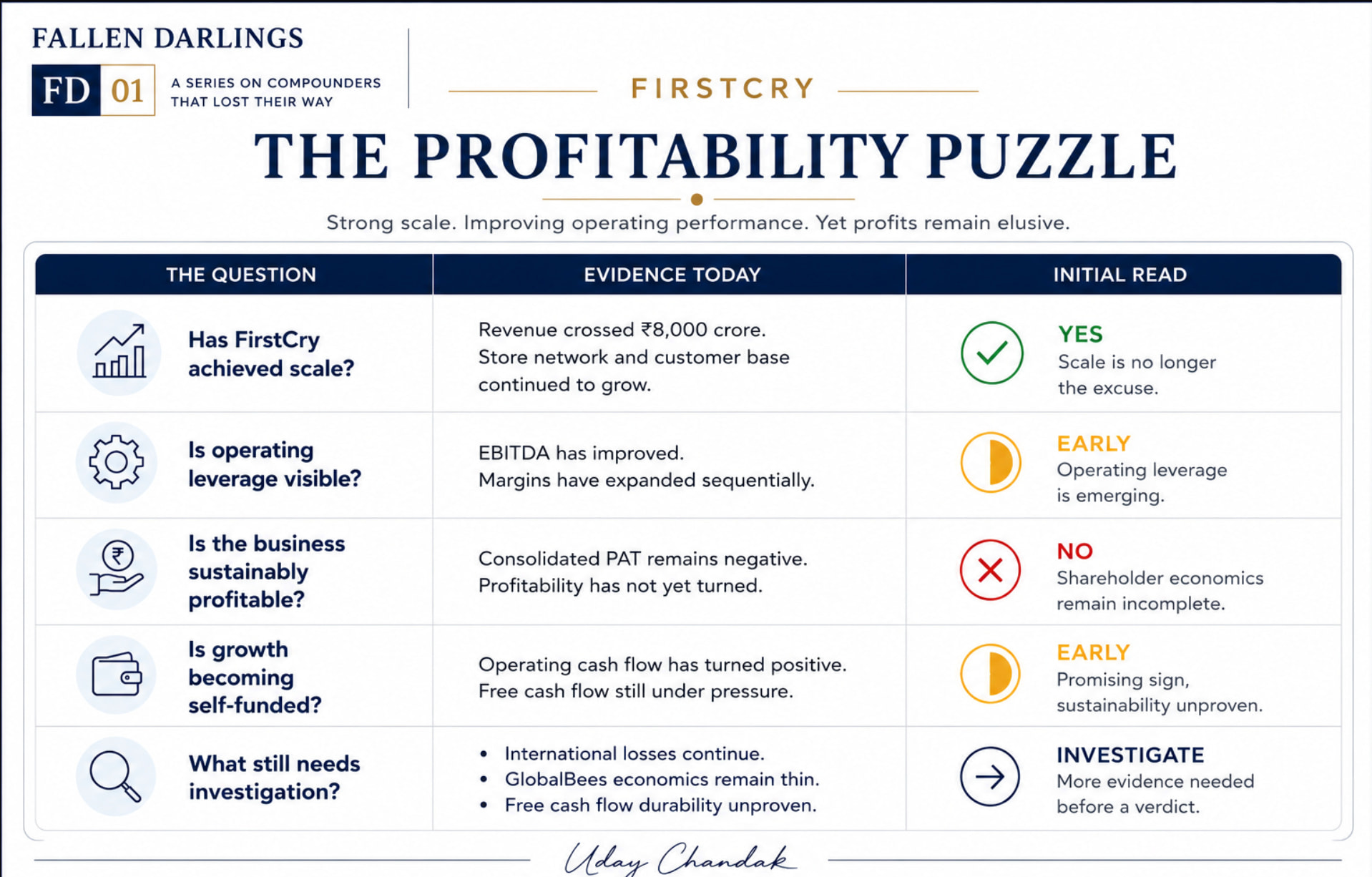
The Profitability Puzzle
At more than ₹8,000 crore of revenue, scale can no longer be the excuse.
Customers grew.
Stores expanded.
EBITDA improved.
Yet consolidated profitability remained weak.
Essentials such as diapers and wipes drive frequency—but transparent pricing and intense competition limit margins.
Home brands offer better economics—but bring inventory, fashion and markdown risk.
Gear and nursery products lift order values—but turn more slowly and consume more capital.
So the real challenge is not simply to grow GMV.
It is to improve the quality of GMV .
That requires:
- a better category mix;
- stronger home-brand economics;
- smarter sourcing;
- productive stores;
- tighter inventory discipline.
Essentials bring the customer.
Home brands must improve the margin.
Inventory discipline decides how much value survives.
FirstCry has proved that it can sell more.
It still has to prove that each additional ₹100 of sales leaves enough profit behind.
Where the Profit Gets Lost
One credible core.
Two unresolved drags.
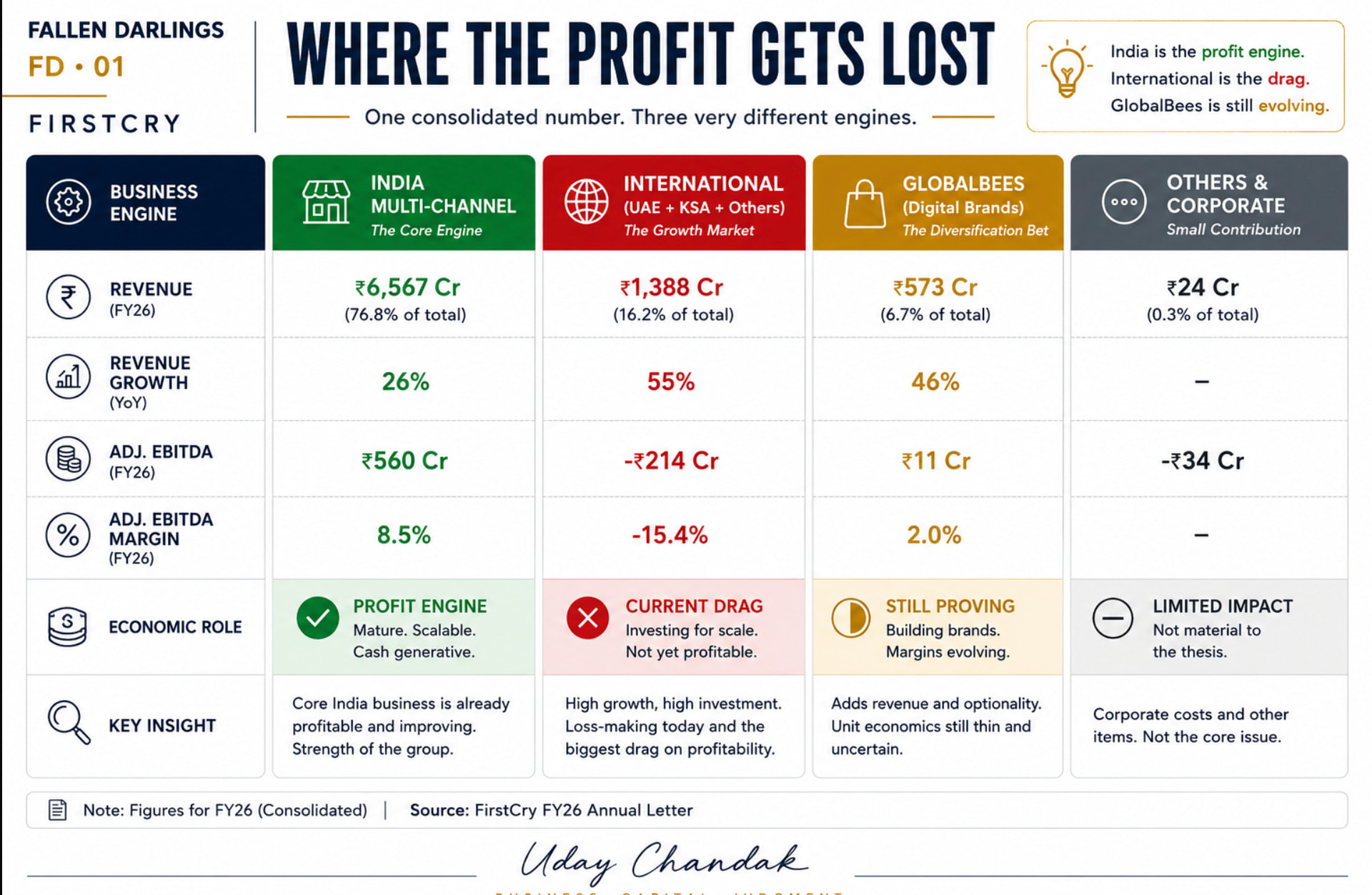
The India multi-channel business has crossed an important threshold.
Scale is now translating into operating profit.
That matters because it validates the original model: customer trust, omnichannel reach, home brands and a long parenting lifecycle can produce real economics.
The drag begins outside India.
International operations are growing, but remain loss-making.
The key question is no longer whether demand exists.
It is how much capital will be consumed before those markets mature—and what returns they will eventually earn.
GlobalBees presents a different problem.
It can add brands and revenue.
But acquisitions create value only when they produce attractive margins, cash flow and returns on invested capital.
India is proving the model.
International is testing patience.
GlobalBees is testing capital allocation.
So the consolidated loss is not coming from one broken business.
It is coming from one increasingly credible engine supporting businesses that have not yet earned the same confidence.
The shareholder question is simple:
Will India compound value—or continue funding lower-return experiments?
The answer will show up in international loss reduction, GlobalBees’ cash generation and the returns earned on every additional rupee deployed.
The Store Question
FirstCry’s store network has moved beyond experimentation.
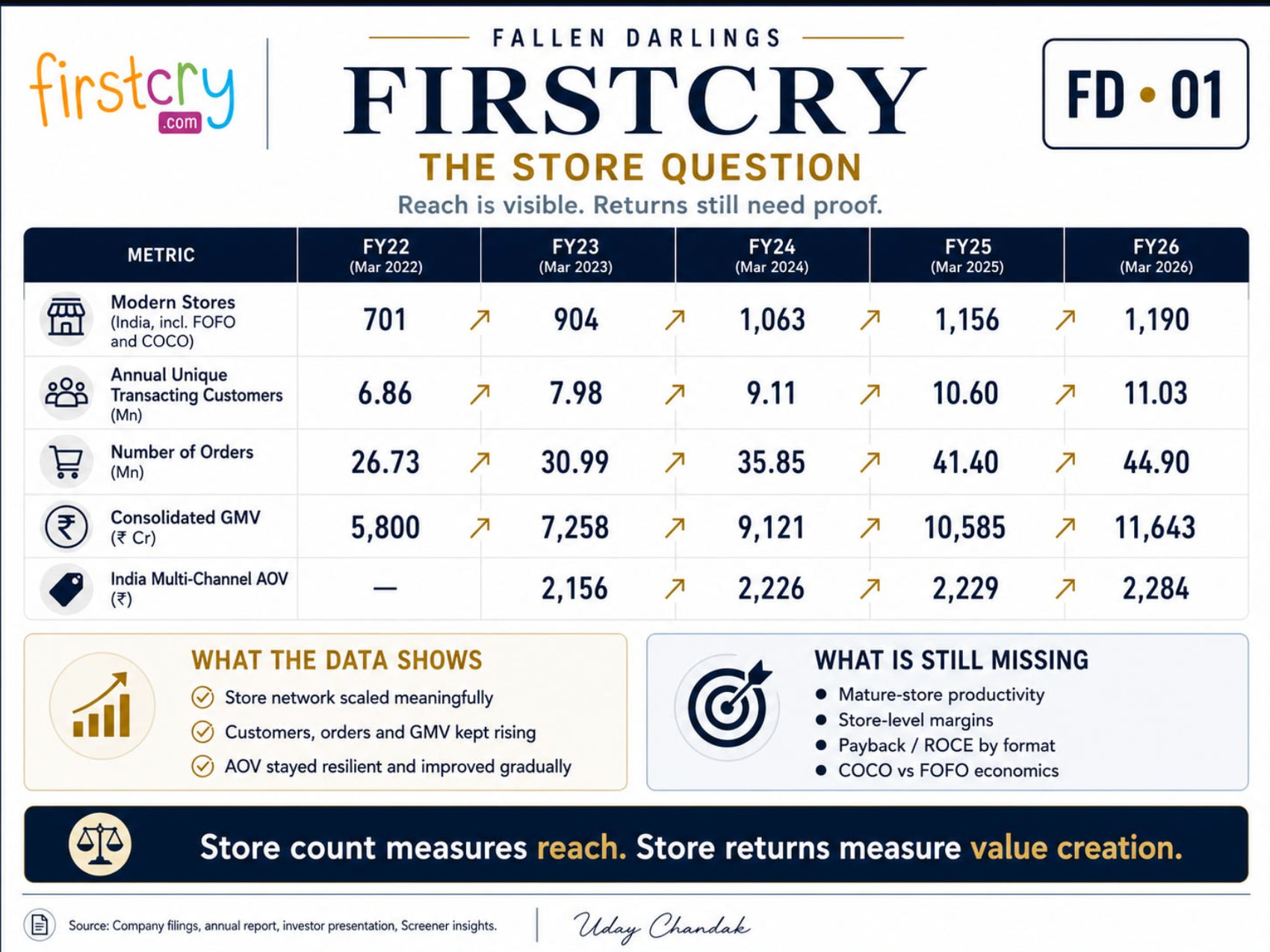
The expansion has grown alongside customers, orders and GMV, while average order value has remained resilient.
That suggests the stores are contributing to the wider omnichannel engine—not merely adding physical reach.
But the decisive economics remain undisclosed.
Investors still lack a clear view of:
- mature-store productivity;
- store-level margins;
- payback periods;
- closure rates;
- returns by format;
- COCO versus FOFO economics.
That matters because the two formats carry very different risks.
Franchise stores expand reach with limited capital.
Company-operated stores offer greater control and margin capture—but also bring leases, inventory and execution costs onto FirstCry’s balance sheet.
The network has proved its relevance.
It has not yet proved its returns.
The real question is no longer how many stores FirstCry can open.
It is whether each new cohort can mature without weakening working capital, cash conversion or lease-adjusted returns.
Until those numbers become visible, the network remains caught between two interpretations:
A powerful omnichannel moat—or a capital-intensive route to growth.
Cash Flow: The Turn That Needs to Hold
Profitability can be explained.
Cash eventually reveals the economics.
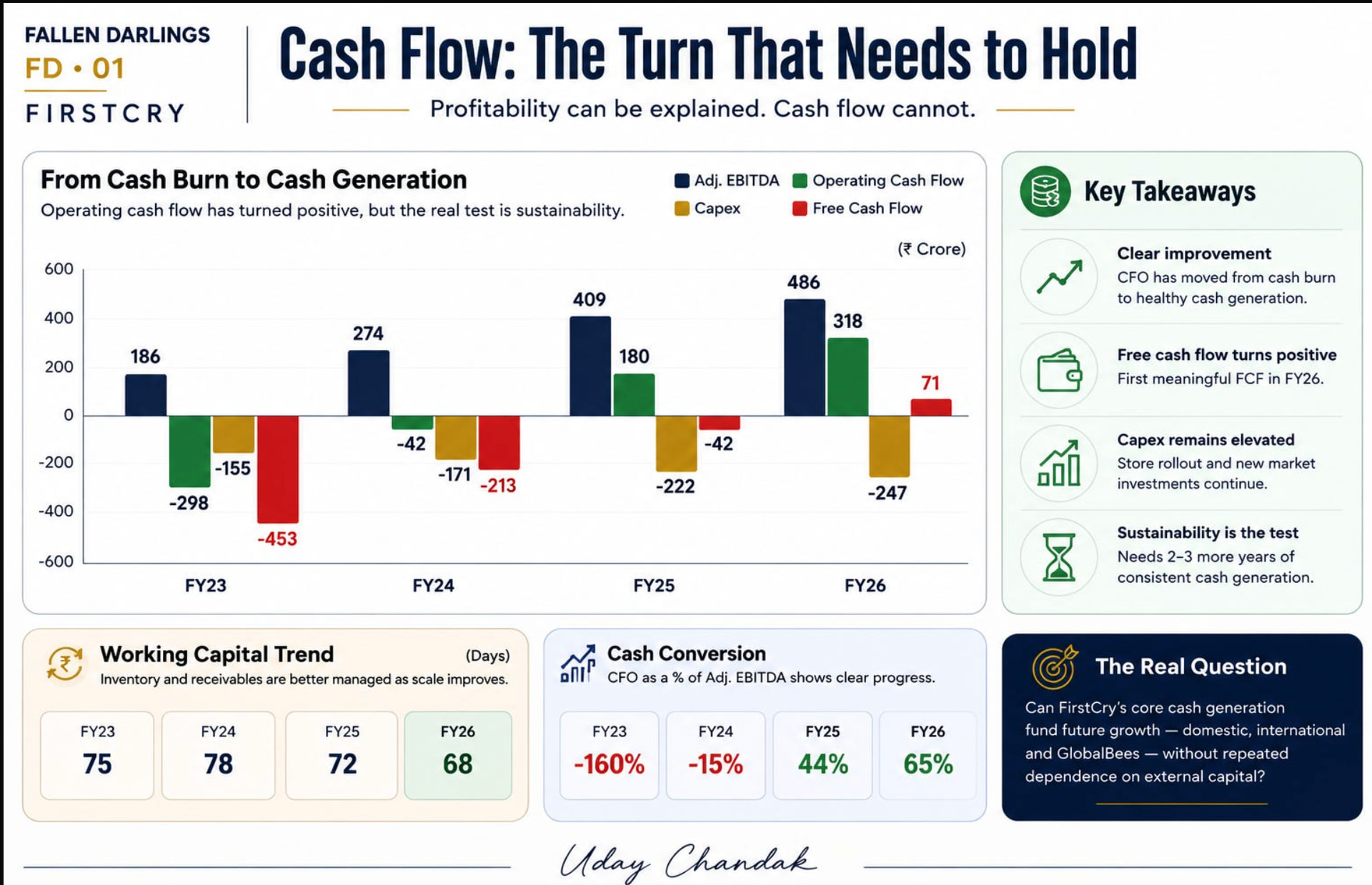
For years, FirstCry’s growth absorbed capital through inventory, stores, international expansion and acquisitions.
Now the direction has changed.
Operating cash flow reached ₹318 crore , free cash flow turned positive and working-capital efficiency improved.
That is meaningful.
It suggests the business may finally be moving from capital-consuming growth toward self-funded growth .
But one positive year is not enough.
Cash conversion must remain healthy while FirstCry continues expanding stores, supporting international operations and funding GlobalBees.
One year of positive cash flow is a signal.
Repeated cash conversion is the proof.
The decisive question is simple:
Can the India engine generate enough cash to fund growth—and still leave value for shareholders?
The turn may have begun.
Now it has to hold.
Category Leader. But Can It Win the Economics?
FirstCry has already won relevance.
For millions of parents, it is a natural destination for childcare products.
But category leadership is not economic leadership.
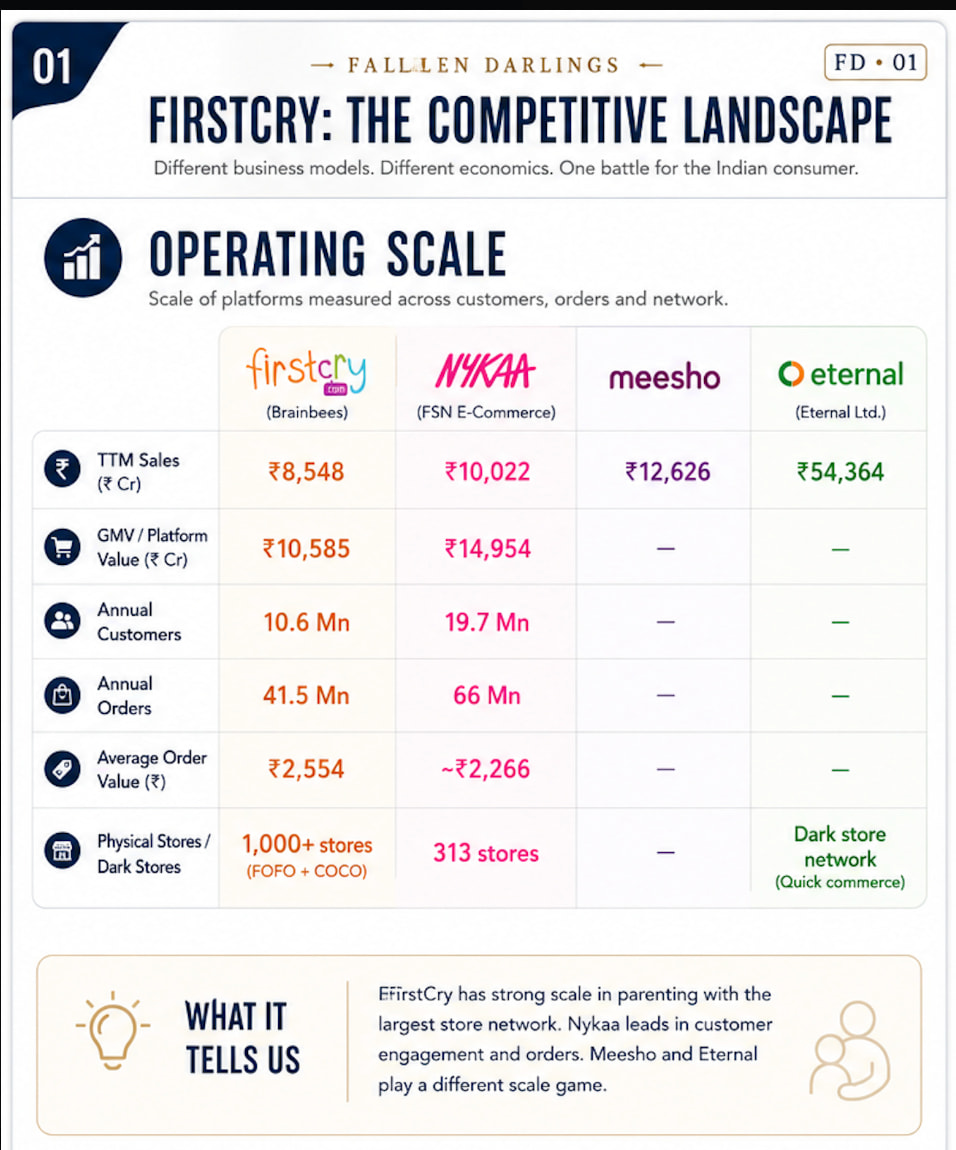
Nykaa shows what specialist retail can look like when scale converts into stronger margins, positive profits and better returns on capital.
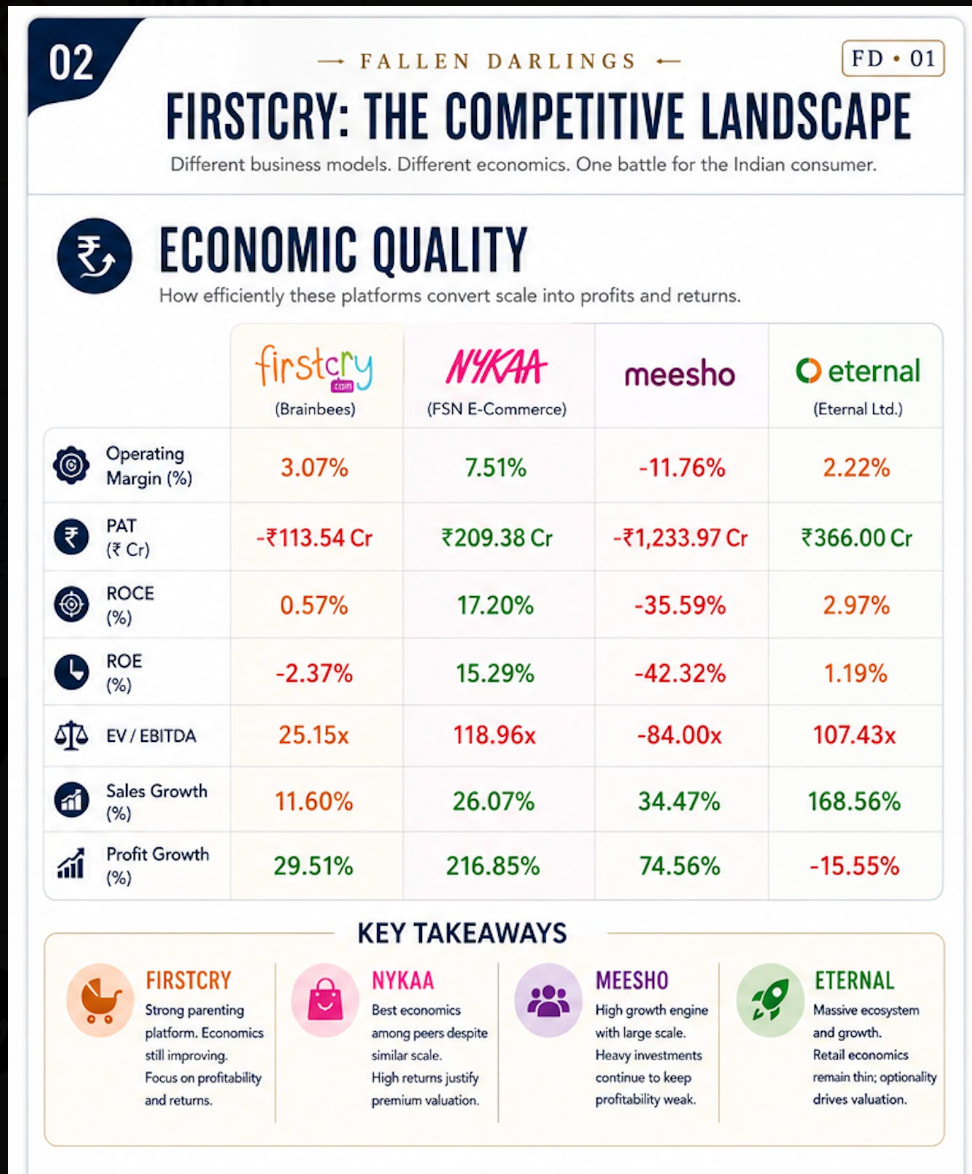
FirstCry has not reached that point yet.
FirstCry has won the category.
It has not yet won the economics.
The competitive threat is also becoming more fragmented.
Quick commerce can capture urgent essentials.
Amazon and Flipkart can win branded, comparable products.
Meesho can attack value apparel.
Local stores still offer immediacy and personal trust.
FirstCry remains strongest where specialist assortment, home brands and higher-consideration purchases matter.
But customers do not need to abandon FirstCry for its economics to weaken.
A parent can trust FirstCry—and still split the basket across several platforms.
The relationship may survive while the wallet fragments.
The moat will be proven when returning customers spend more, buy more profitably and generate stronger returns on capital.
Trust won the customer.
Economics must now win the wallet.
Many Moves. But Where Is the Destination?
FirstCry has explained what it is working on.
Stores. Home brands. Procurement. Technology. Faster fulfilment. International growth. GlobalBees. Margin improvement.

These are operating priorities.
What remains missing is a measurable medium- to long-term financial destination.
Investors still do not know clearly what FirstCry wants the group to economically become by FY29 or FY30—across margins, international break-even, store returns, free cash flow and consolidated ROCE.
Management has shared the direction of travel.
It has not yet defined the destination.
That does not imply the absence of strategy.
It means investors lack a public north star against which progress and capital allocation can be measured.
Until that blueprint is shared, execution must be judged through the numbers:
Are margins improving?
Are international losses narrowing?
Are stores earning better returns?
Is cash conversion becoming durable?
Is consolidated ROCE moving higher?
The real question is not what FirstCry plans to do next.
It is what all these moves are ultimately meant to create.
The Forensic Stress Test
A fallen darling is worth studying only if the balance sheet is still standing.
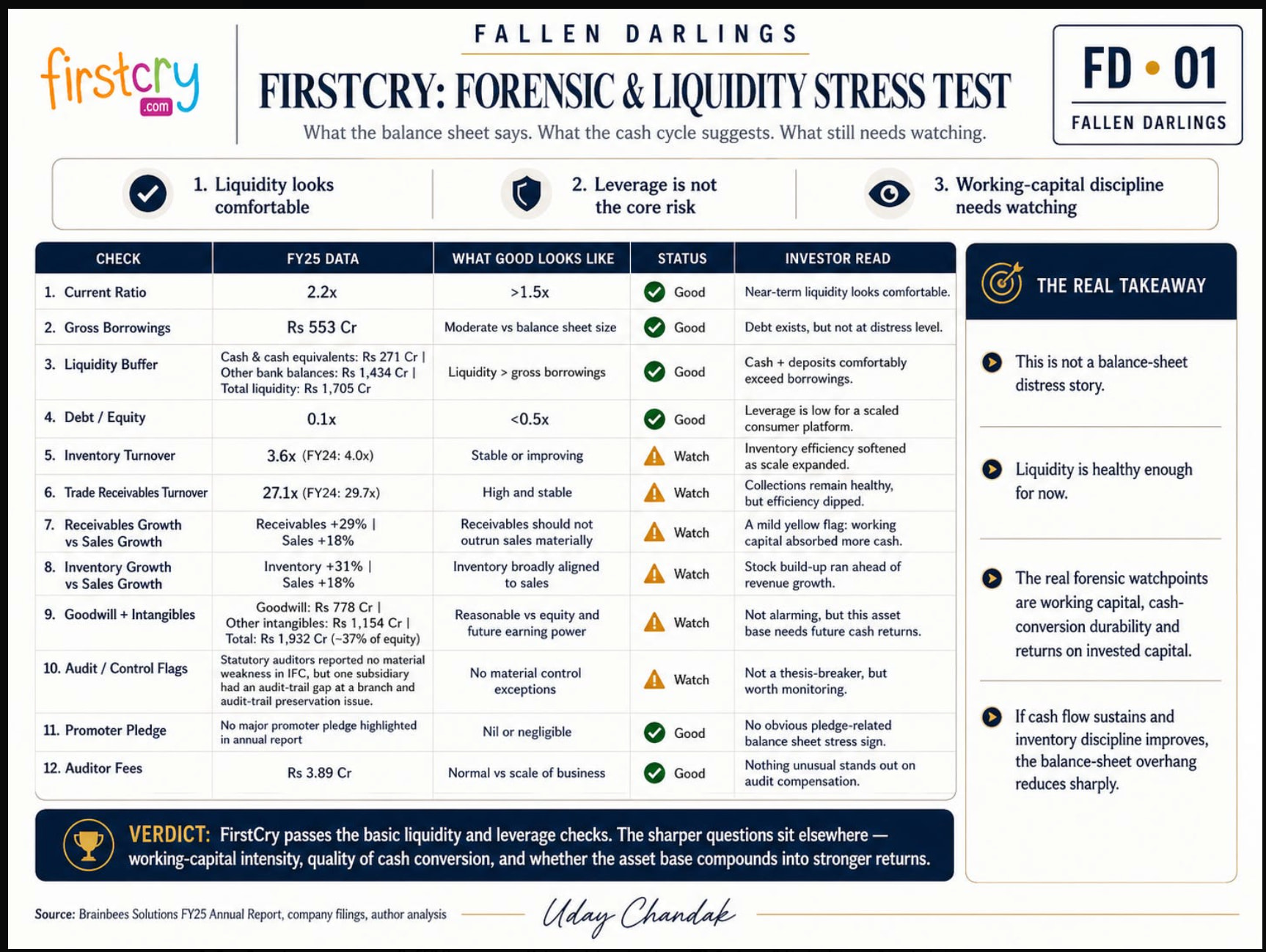
FirstCry passes the basic survival checks.
Liquidity is comfortable.
Conventional leverage is manageable.
There is no obvious sign of near-term solvency stress.
The real risk is not whether the company can fund itself.
It is whether the capital already deployed can earn enough.
Inventory remains heavy.
Lease liabilities make the store network more capital-intensive than headline debt suggests.
Goodwill and acquired intangibles—especially around GlobalBees—still need to be justified by stronger cash generation.
And despite improving operations, returns on capital remain weak.
This is not a survival problem.
It is a capital-productivity problem.
That changes what investors should track.
Not debt repayment alone.
But inventory discipline, repeatable cash conversion and improving returns on invested capital.
FirstCry’s balance sheet provides time.
The business must now prove that it can use that time productively.
The Price Was Part of the Problem
The euphoria is gone.
The business is not.
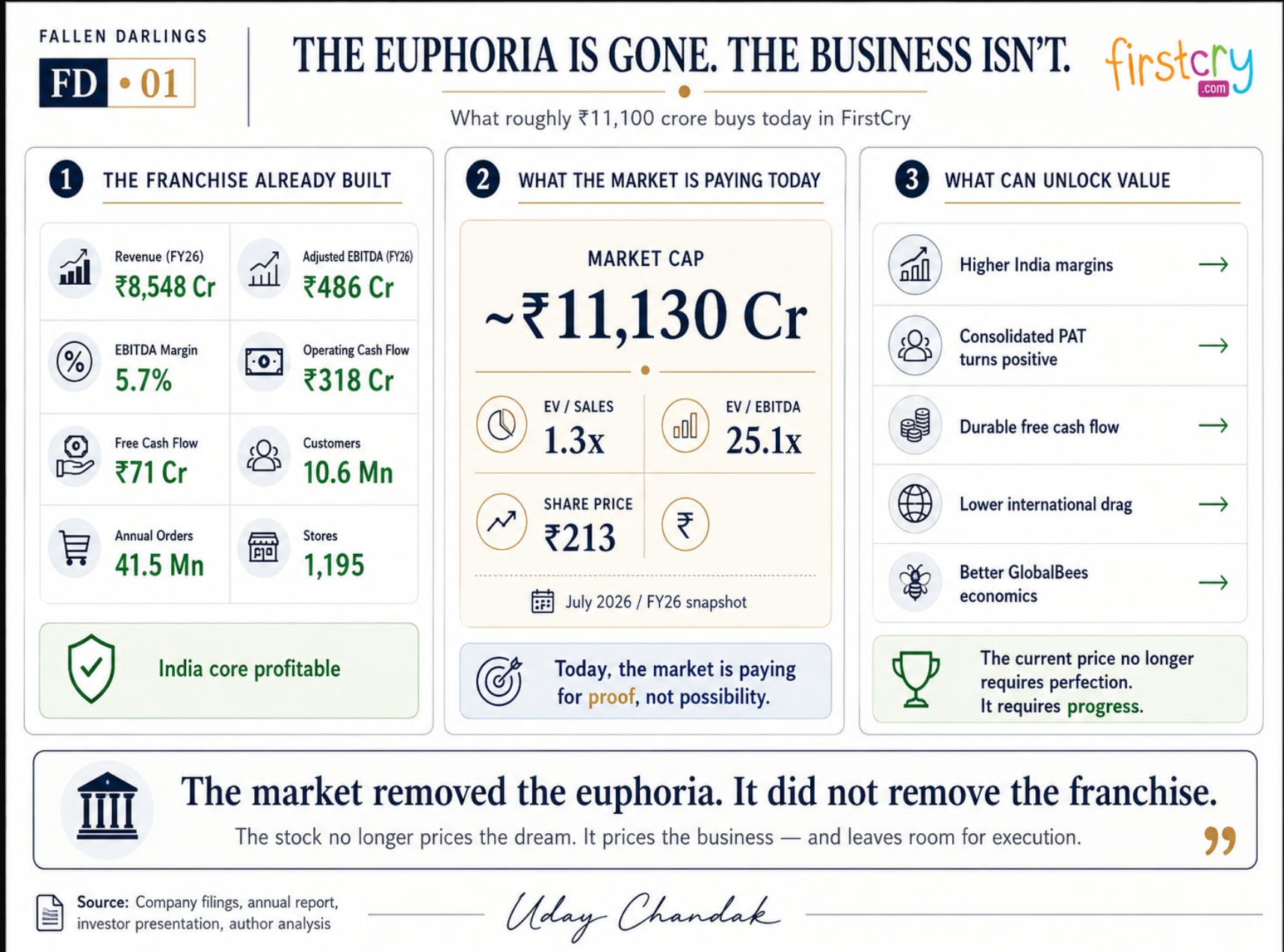
FirstCry is no longer being valued primarily on what it might become.
Investors are now looking at a business with scale, a profitable India core, improving EBITDA and positive cash flow.
That changes the nature of the thesis.
The valuation reset has been far sharper than the deterioration in the operating franchise. Several business metrics have, in fact, improved.
So today’s case does not require a dramatic turnaround.
It requires steady execution:
- India margins continue improving;
- cash conversion remains positive;
- international losses narrow;
- GlobalBees becomes less dilutive;
- consolidated profitability emerges.
This is no longer a bet on FirstCry proving it has a business.
It is a bet on an established franchise becoming more profitable.
The market has already removed much of the excitement.
From here, value creation depends less on narrative—and more on the economics continuing to improve.
The Burden of Proof
The franchise is no longer the debate.
The economics are.
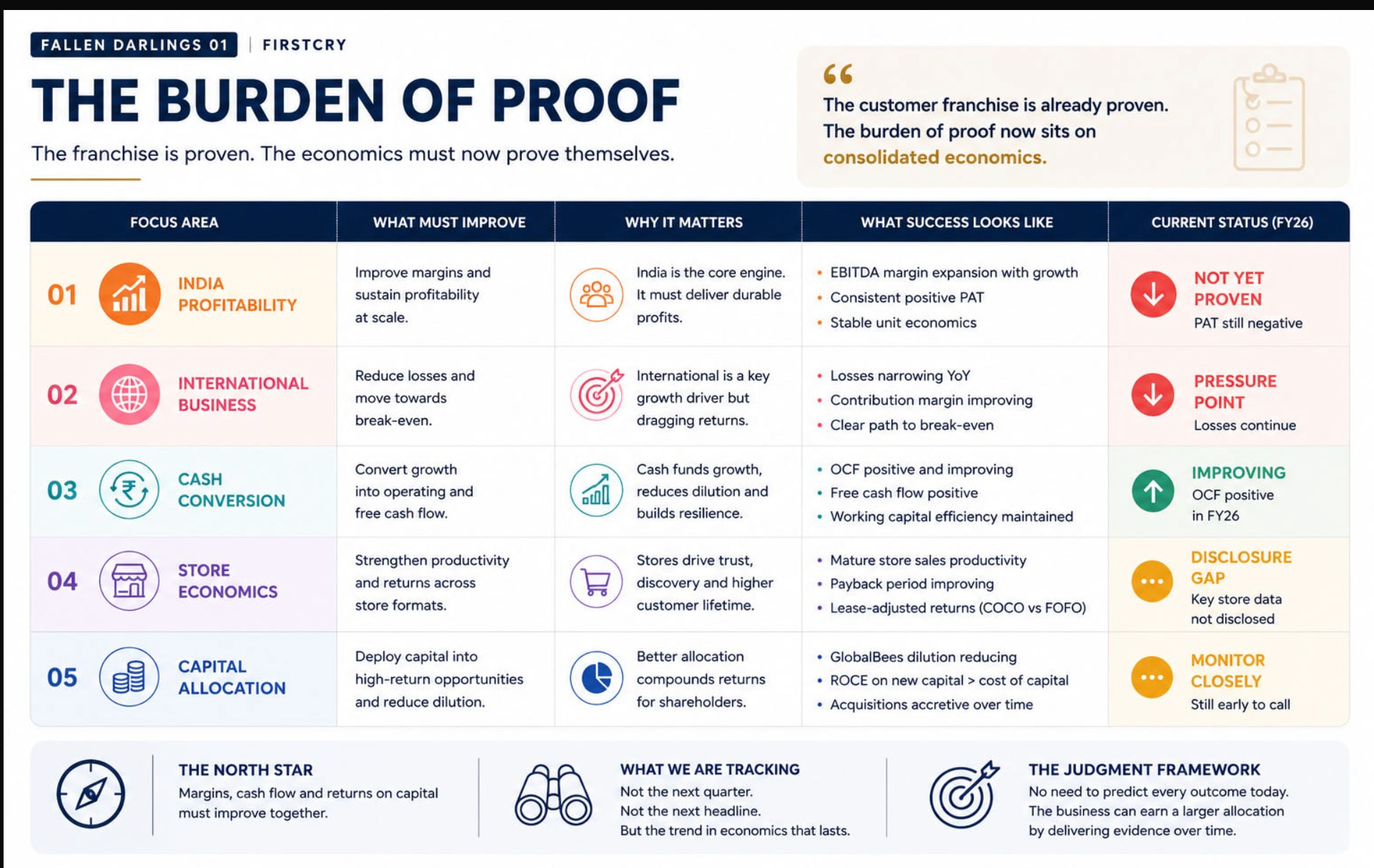
From here, the thesis should be judged on five outcomes:
India profitability must keep improving.
International losses must move toward break-even.
Cash conversion must become repeatable.
Store expansion must justify its lease and working-capital burden.
GlobalBees must strengthen—not dilute—group returns.
The customer franchise is already proven.
The burden of proof now sits on consolidated economics.
That means ignoring the easy signals.
Not store count.
Not GMV alone.
Not a short-term stock rebound.
The real evidence is whether margins, cash flow and returns on capital improve together .
Until then, participation may be justified.
Aggressive position sizing is not.
That is why FirstCry remains a tracking position—not yet a full-conviction allocation.
 Investment Status & Disclosure
Thesis Written On: 22 July 2026
Current Stance: Small tracking position. Biased by holding.
Disclosure: I am currently invested in Brainbees Solutions.
I have initiated a position of around 1% of my equity portfolio and intend to evaluate the business over the next 2–3 years .
The thesis is simple: FirstCry has built a strong customer franchise, but consolidated economics are still unproven.
I may add if margins, cash conversion, international losses, store productivity and returns on capital improve.
I may reduce or exit if growth continues without better cash generation, capital efficiency, execution discipline or governance comfort.
Formal Disclaimer
I am not a SEBI-registered research analyst or investment advisor. Nothing in this post is investment advice or a recommendation to buy or sell securities.
Brainbees Solutions carries risks including intense competition, weak consolidated profitability, international losses, GlobalBees execution risk, inventory and working-capital risk, store-expansion risk, capital-allocation risk, acquisition risk, corporate-governance risk, regulatory risk and valuation risk.
Please do your own due diligence.
Your capital. Your responsibility.
7 Likes
I visited their store recently and the staff rude behaviour is very dissappointing. They should educate their employees on the behaviour towards customer.
1 Like