
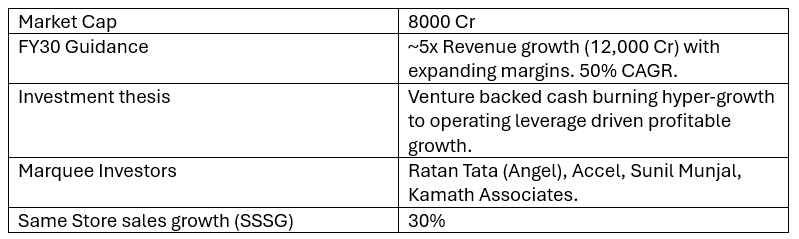
ORIGIN STORY - The Story of Bluestone is as fantastical as its rise from 0-8000 crores in under a decade. Gaurav Kushwaha (the founder of Bluestone Jewelry) had never been to a jewelry store in his life till it was time for him to do his wedding shopping. The business was born out of his own frustration as a first time consumer. He found the entire offline experience highly inefficient and lacking in transparency. His primary frustration was the complete lack of “discoverability.” If you wanted a specific design or had a specific price range in mind, you couldn’t just browse a catalog or filter options (like on an e-comm website). Instead, you had to physically travel from shop to shop, sitting across the counter from individual jewelers, and hope they had what you were looking for. Basically, there was zero innovation in how consumers shopped for fine jewelry.
Coming from an E-commerce (Amazon) background, he soon realized that if he could digitize the catalog, bring price transparency to the forefront, and allow couples to filter and discover designs from their living rooms, he could disrupt one of the oldest retail sectors in the country.
CONSUMER INSIGHTS – I do not want to get into the business model of a self-manufacturing Jeweler. I think that’s common knowledge. So, I will mainly focus on the insights that challenged the fundamental assumptions of how traditional jewelers operated.
1. The “Discoverability” Deficit - I touched on this previously. Basically, no way to filter based on style and budget. You just have to endure Indian traffic and physically go from store to store hoping you like something.
2. The Shift to “Everyday Wear” - Legacy family jewelers were entirely fixated on heavy, bridal, and festive jewelry because that was where the massive ticket sizes were. Kushwaha recognized an untapped shift in consumer behavior: modern, working women wanted lighter, design-led jewelry for everyday and office wear. Traditional jewelers were completely missing this high-frequency, lifestyle-driven segment
3. Inventory vs. Infinite Choice - An offline jeweler is constrained by physical inventory. To display ₹160 crore worth of variety, they had to lock up ₹100 crore in dead inventory. Kushwaha’s insight was that an online-first model, backed by 3D printing and just-in-time manufacturing, could offer 5,000+ designs to the consumer without the crippling capital requirements of holding physical stock for every design at multiple locations.
4. The Transparency Premium - The traditional jewelry industry was notoriously opaque regarding “making charges,” gold purity, and hidden costs. Kushwaha knew that younger, digitally native consumers (millennials and Gen Z) valued absolute transparency over long-standing family relationships. If BlueStone could unbundle the exact cost of the gold, the stones, and the crafting, they could win over the modern buyer.
5. The “Touch and Feel” Pivot - While the digital catalog solved discoverability, Kushwaha quickly ran into a harsh reality: consumers loved browsing online, but they hesitated to finalize high-ticket jewelry purchases without physically seeing it. This critical insight led to BlueStone’s introducing “Home Try-On” service and their eventual aggressive push into an omnichannel physical store network. They realized the ultimate consumer model was discovery online, trust and transaction offline. OR put differently “Omni-Channel” is the name of the game.
WHAT IS SO GREAT ABOUT “OMNI-CHANNEL” ISN’T IT JUST A BUZZWORD?
Just having multiple touch points, physical and digital doesn’t really make something or someone “omni-channel”. It is planning, structuring and building an entire business model around it that rewrites the underlying economics of a legacy (in this case capital heavy jewelry) business that truly makes one “omni-channel”. CaratLane and BlueStone didn’t just build a new way to sell jewelry, they engineered a vastly superior return on capital employed (ROCE) by solving the core inefficiencies that traditional jewelers and even Tanishq failed to address.
1. Capital Efficiency and Inventory Velocity
The traditional jewelry model is an asset trap. To display variety, a legacy jeweler must lock up massive amounts of working capital in physical inventory across every single store. A significant portion of this is “dead inventory”—designs that sit in the safe for months or years waiting for the right buyer.
The omni-channel model ( BlueStone, CaratLane) solves this through an online “endless aisle” of 5,000 – 10,000 designs, freeing them from manufacturing everything upfront. Physical stores serve as experiential hubs holding only curated, fast-moving items or try-on samples. Custom orders trigger just-in-time manufacturing, drastically increasing inventory turnover and generating far higher revenue per rupee of deployed capital.
2. Zero-Blind-Spot “Physical” Expansion
Traditional jewelers expand physical footprints based on demographic estimates and high-street foot traffic, which is highly speculative and capital-intensive.
A Bluestone or a CaratLane uses top-of-funnel digital data for risk-free physical expansion. Because they have years of web traffic, app downloads, and “Home Try-On” requests, they know exactly which pin codes contain their highest-converting customers. When BlueStone or CaratLane opens a new store, it is often in a highly targeted micro-market where they already have captive, localized digital demand. They aren’t hoping for footfall, they are just giving existing online browsers a physical place to transact.
3. Lower Customer Acquisition Cost (CAC) through the “Trust Bridge”
Jewelry is a high-trust, high-ticket category. Online-only customer acquisition eventually hits a ceiling because, beyond a certain price point, Indians want to physically hold the gold and verify the diamonds. Traditional offline acquisition relies heavily on expensive print, TV, and billboard marketing.
The omni-channel model uses highly targeted, cheaper digital marketing to drive discovery (top of the funnel), but uses the physical store or Home Try-On to close the sale (bottom of the funnel). The physical store acts as the ultimate conversion engine for digital traffic, lowering the blended CAC.
4. What were traditional jewelers and Tanishq missing – The Digital Silo Trap - When legacy players launched websites, they treated them as digital brochures or separate profit centers. In short, a lot of old-school folks don’t really understand “omni-channel” They think it is paying a bunch of randos to build you an app and a website to supplement your physical presence. For example - If a customer saw a ring on Tanishq’s website in say 2015, there was no seamless way to know if it was in the local store, book an appointment to try it, or customize it digitally. The online and offline experiences were siloed.
CaratLane and BlueStone built their tech stacks so that the digital and physical realms were a single, continuous loop. A customer could favorite five items on the app during their commute, and an algorithm would ensure those exact items were available to try on at their local store by the weekend.
Ultimately, Tanishq recognized this structural gap. Instead of trying to rebuild their legacy architecture to compete in the agile, everyday-wear omni-channel space, Titan threw in the towel and acquired CaratLane, validating that the omni-channel, tech-first approach was the future of the industry.
THE CARRATLANE ACQUISITION & WHY BLUESTONE IS WORTH MORE –
Titan bought out the remaining 27.18% stake of CaratLane in 2023 at a valuation of 8x trailing 12 month sales. This is a massive premium that on first glance seems unjustified, but here’s why Titan (according to me) thought that it makes sense and is highly strategic & synergistic.
1. The “Studded Ratio” Margin Expansion
In the jewelry business, plain gold is a low-margin volume game, while “studded” jewelry (diamonds and gemstones) is where the real gross margins live. Tanishq’s studded ratio typically hovers around 30-33%.
CaratLane, primarily selling lightweight, everyday diamond jewelry, boasted a studded ratio of 70%. By bringing CaratLane in-house, Titan acquired a high-velocity, high-gross-margin engine that structurally lifted the blended margin profile of its overall jewelry portfolio. Titan wasn’t just paying a multiple on revenue; they were paying for the quality and profitability of that specific revenue. Bluestone’s studded ratio is at approximately 62%-68%.
2. Capturing the “Missing” Demographic
Tanishq is an absolute juggernaut, but its brand equity is heavily anchored in high-ticket, traditional, and bridal purchases. It skews older.
CaratLane successfully captured the demographic that Tanishq was struggling to acquire: the younger, digitally native Gen Z and Millennial consumer looking for sub-₹50,000 everyday wear and gifting options. Instead of spending billions trying to rebrand Tanishq to appeal to 25-year-olds—and risking the alienation of its core older base—Titan paid a premium to own the dominant brand in that specific customer cohort.
3. Securing an Irreplicable Tech Stack
Titan realized that building a true omni-channel architecture from scratch is incredibly difficult for a legacy offline retailer. CaratLane had spent over a decade perfecting the digital-to-physical loop: the 3D virtual try-ons, the predictive inventory algorithms that send the right things to the right pin codes, and the logistics of the “Home Try-On” model.
The premium was effectively a “buy vs. build” decision. Titan acquired a battle-tested tech stack that would have taken them years and massive capital expenditures to replicate natively, during which time competitors like BlueStone would have captured the market.
Bluestone being a “me too” CaratLane probably deserves a similar consumer tech premium valuation instead of a traditional valuation based on Rev/Sqft or other such metrics used to value traditional jewelers**. You are not paying a premium for a company that sells gold.** You are paying a premium for a data engine that uses digital traffic to de-risk physical retail expansion, a captive high-frequency millennial audience (55%+ repeat customers) that legacy brands cannot easily acquire, and a structural product mix that yields double the gross margins of a traditional jeweler (higher studded mix). That is the exact DNA of a consumer tech platform and that is why it deserves a premium according to me.
COMPETITION ANALYSIS –
*Note – Caratlane and others Top line growth figures are not comparable, because they include sales to franchises. Bluestone’s numbers are exclusively only final sales to end customers.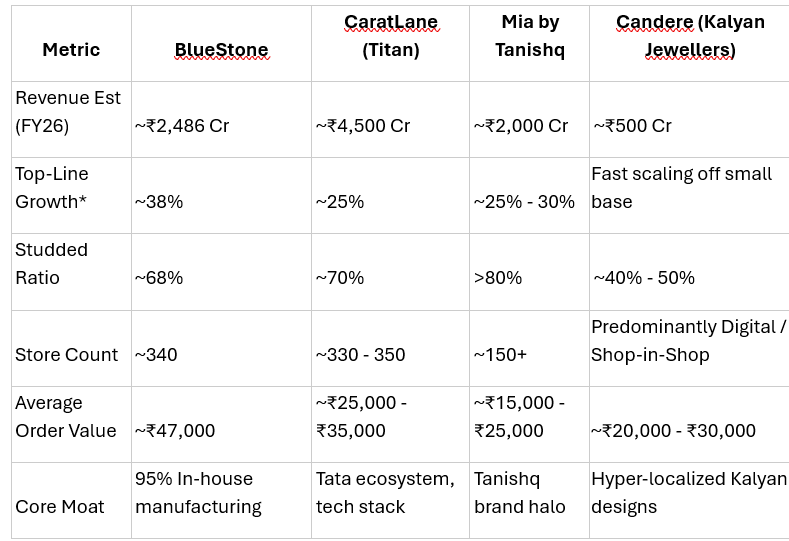
While all four brands target the working woman and the gifting market, their underlying operational structures are drastically different. Here is how BlueStone differentiates itself against these specific rivals:
1. BlueStone vs. CaratLane: The Upmarket AOV Advantage
CaratLane is BlueStone’s most direct and formidable competitor. However, they play slightly different games regarding ticket sizes. CaratLane dominates the highly accessible, sub-₹30,000 gifting market. BlueStone has successfully positioned itself slightly upmarket within the everyday-wear category. By maintaining an AOV near ₹47,000, BlueStone requires fewer individual transactions to reach store-level breakeven. Additionally, BlueStone’s 95% in-house manufacturing gives it tighter control over rapid design deployment and gross margins, whereas CaratLane relies more heavily on Titan’s massive vendor and supply-chain network.
2. BlueStone vs. Mia by Tanishq: Independent Agility vs. Corporate Cannibalization
Mia was launched by Titan to capture the 14k/18k lightweight segment. Mia pieces are highly affordable and heavily indexed on the lower-ticket demographic. BlueStone’s advantage over Mia is architectural. Mia exists as a sub-brand within the massive Titan machinery. When a customer walks into a Tanishq store that houses a Mia section, the sales staff are fundamentally incentivized to upsell the customer to heavier, high-margin Tanishq wedding sets rather than a ₹20,000 Mia necklace. BlueStone’s physical stores have no legacy “heavy gold” business competing for floor space; the entire staff and inventory are optimized to sell everyday studded jewelry
3. BlueStone vs. Candere: The Omni-Channel Maturity Gap
Kalyan Jewellers acquired Candere to compete in this digital space, but Candere’s omni-channel physical footprint is still deeply nascent compared to BlueStone. Candere is currently heavily reliant on online sales and leveraging existing Kalyan showrooms. BlueStone has spent over a decade perfecting the digital-to-physical loop—using “Home Try-On” data to de-risk real estate expansion and opening over 340 dedicated, data-backed standalone stores. The maturity of BlueStone’s tech stack and localized inventory prediction algorithms puts it years ahead of Candere’s current physical rollout capabilities.
Closing thoughts on competition -
The omni-channel jewelry market is currently a two-horse race between Titan (owning CaratLane and Mia) and BlueStone. With Titan effectively monopolizing the rest of the competitive set, BlueStone stands entirely alone as the only independent, scaled platform available to investors seeking pure-play exposure to the high-margin, millennial jewelry transition without the drag of legacy plain-gold retail.
RISKS-
-
LAB GROWN DIAMONDS - the “bull case” for Bluestone relied heavily on its 68% revenue share from studded jewelry (high margin) and its appeal to a younger, “daily wear” demographic. The rise of Lab-Grown Diamonds (LGDs) in India specifically attacks that exact thesis. LGDs are disrupting the “studded” category more than any other. In 2025, LGDs in India have moved from “niche” to “mainstream” for daily wear and engagement rings (Bluestone’s core territory). The Math Problem: LGDs sell for significantly less than natural diamonds (prices have crashed to ~$1,000/carat vs. ~$4,200/carat for natural). A growth in acceptance of LGD’s therefore directly affects Bluestones ASP and ultimately its per store economics and business model.
-
Inventory Build-up and Balance Sheet Stress: The degradation of the inventory turnover ratio from 1.8x to circa 1.3x is a critical. If the aggressive push to 705 stores results in lower-than-expected foot traffic in untested Tier-2 and Tier-3 cities, the company will be straddled with hundreds of crores in illiquid, slow-moving inventory.
-
Execution Risk of Offline Expansion: Transitioning from a digital-native brand to a manager of 705 distributed physical real estate assets introduces massive, complex operational variables. The increasing reliance on FOCO (Franchise owned Company operated) models exposes the brand to partner disputes, while COCO (company owned company operated) store expansion continuously drains cash. If average store throughput drops below the current ₹6 crore benchmark , operating leverage will violently reverse, crushing corporate margins.
-
Intensifying Competition and CAC: CaratLane, backed implicitly by Titan’s ₹3.6 lakh crore market capitalization , possesses vastly superior resources for engaging in prolonged pricing wars, securing prime retail real estate, and outbidding on customer acquisition costs. If incumbents like Kalyan and Malabar also aggressively discount making charges on studded jewelry to win back digital market share, BlueStone’s 40% gross margins will face severe and immediate compression.
MISSION 2030 – As of June 3, 2026, Management has laid out quite an aggressive FY2030 target -
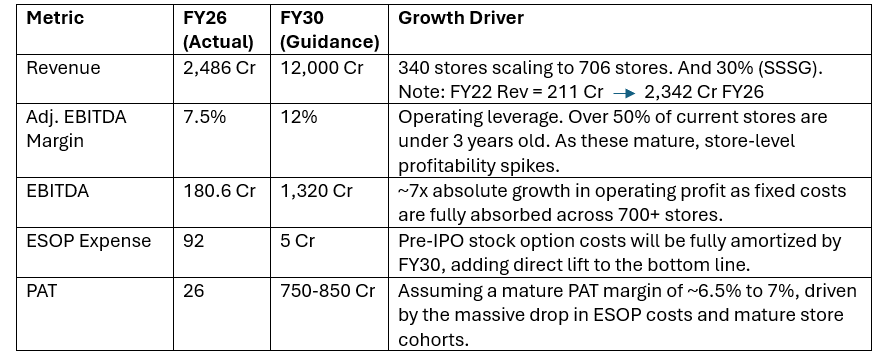
In conclusion - BlueStone is a high-margin tech platform cleverly disguised as an omnichannel jeweler. With its most expensive store buildouts and ESOP burdens finally in the rearview mirror, investors have a great window to buy in right as venture backed top-line vanity morphs into bottom-line sanity. In essence ee are buying a high growth profitable consumer facing “brand” for 10x FY30 Earnings.
Disclosure: Invested (circa 4% of PF). Biased. Do your own research.