
Atirek portfolio

Few months updates

Sold Nesco in my portfolio in July 2025 with a small profit

In the 2025 annual report, it was mentioned that the IT business would have only ~1.65 million sq. ft. (around 1× the current area) of chargeable area. This brought my CAGR estimate for the stock down to 15%–17%.

I generally invest in stocks only when I see the potential for a 20% CAGR; otherwise, I prefer investing in mutual funds.
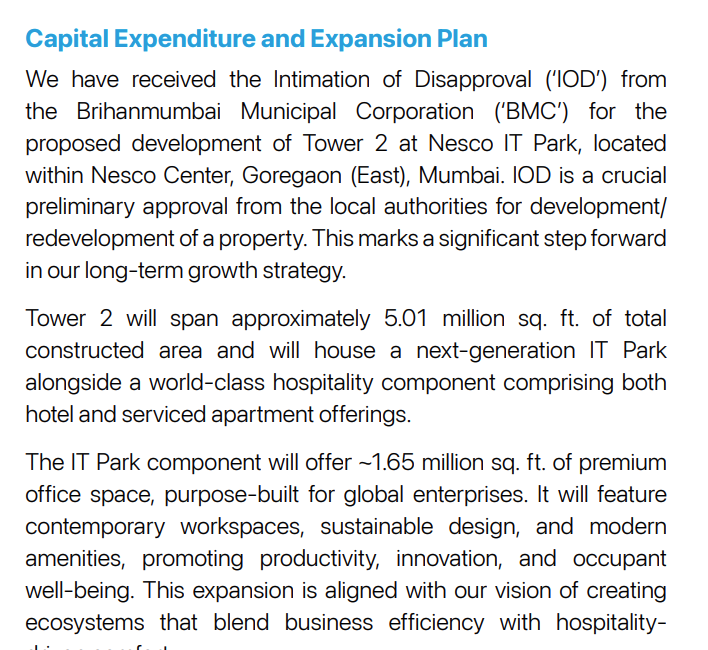
However, today when I went through their November presentation, they had changed the total new office leasable area back to 1.5× of the current leasable area (2.25 million sq. ft.), which supports my original buying decision.

I may need to check with the company why they changed it back to 1.5× of the current leasable area.

Sold Anjani Foods
I forgot to mention in my last update that I sold Anjani Foods(1% of my portfolio) at ₹29.20 in June, booking a loss of nearly low double digits, when I suspected that the company might have deployed the funds into its sister company. I was too inclined to invest in micro cap company and hence I invested in it.
Note to self → Need to find multiple candidates to invest before investing in one like I do now

Bought and sold Jayaswal Neco with lower single digit profit in November
It had perfect short-term, medium-term, and long-term triggers. Among the 4–5 companies I was tracking, it had the best set of triggers, and hence I decided to buy it. However, I was not really comfortable with the management and their ethics. As a result, I sold the stock a few days after buying it, booking a low single-digit profit.

Bought and sold Bajaj Housing Finance with lower single digit loss in December
Bajaj Housing Finance did not follow my rule of investing in stocks only when I can see more than 20% profit growth.
Though I invested in it as an alternative to a mutual fund at ₹97, with an estimated long-term profit growth of around 15%, I did not feel comfortable because I was aware that I had bought it at a premium valuation. Additionally, after analyzing why other stocks in the sector were falling—primarily due to competition from banks in housing loans, as banks have a lower cost of capital than HFCs—I sold it a few days after purchasing it.

Bought IEX in my sister portfolio at 135
I bought IEX in my sister’s portfolio (a comparatively very small portfolio) after having bought and sold it within a few days in my own portfolio. The main reason for buying it again was my belief that coupling of RTM is not technically feasible without a common platform. If RTM were to be coupled across exchanges, Grid India would need to act as the common matchmaker, which I believe is less probable as Grid India is a government body.
Additionally, the downside appeared to be protected.
RTM(more than 30 percent of the total revenue now) is the sector that is growing with more than 30-40% percent and will keep growing as more renewable energy comes on grid, as it is used to balance the frequency.

Other growth triggers

  1. BESS making more capacity available, filling supply gap in night- medium term and big trigger

  2. Renewable energy coming live - short term and big trigger

  3. BESS charging and discharging over the grid as seen in european countries - medium term and small trigger

  4. Peak demand increase due to GST cuts, 6th pay commission and AI boom - medium term and medium trigger
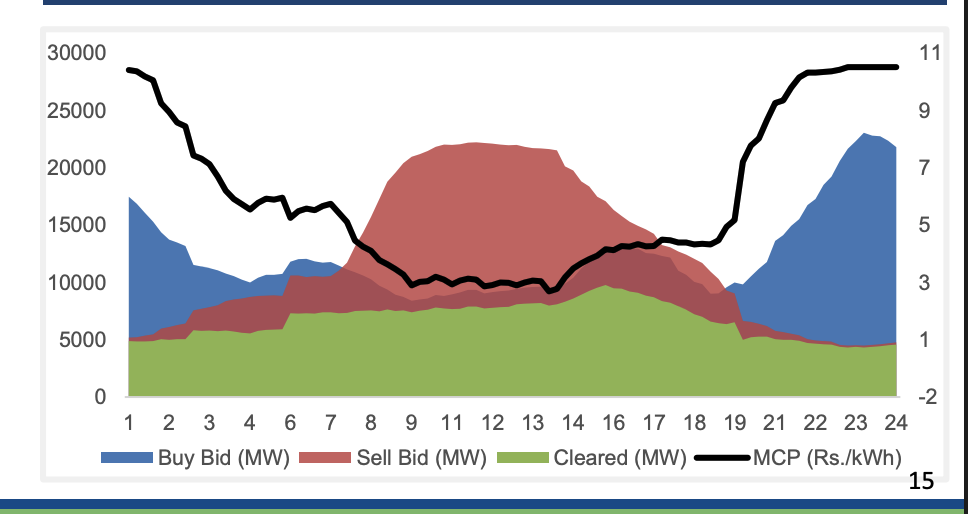
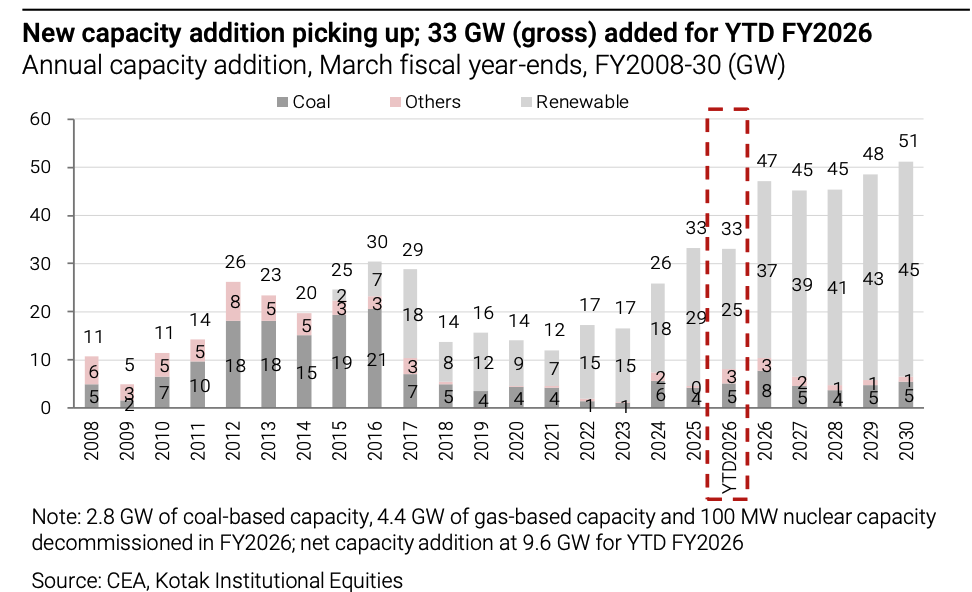
PE expansion possible
At 24 forward PE(135 Rs), considering DAM as well as RTM get coupled, they are trading at 40 PE currently, considering they are able to maintain a near 50 percent market share(which they are able to maintain in other similar segments)
Considering the new regulation of reducing the commission from Rs 2 to 1.5 Rs. They are trading at 50 PE. In the worst possible case, I don’t think there would be any PE expansion. They can be 20% compression, though. :slight_smile:

Though if RTM is not coupled(technically not possible without a common platform), we are up for the surprise. Due to growth in the RTM market, they would be able to maintain a lot of their market share in the DAM market even after coupling. Why?

  1. There is a concept of margin needed to buy electricity, and users will not find it comfortable to maintain a margin across different platforms. Also, in the DAM market, it takes hours for the margin to get released in DAM market. IEX might provide an option to use this margin in the RTM market. This is not possible in other exchanges. (Need to check with IEX management, how many customers who trade inthe DAM market trade electricity in the RTM market)
  2. I also feel there are fewer chances for the competition from a pricing point of view, as PTC can not procure electricity from HPX(its own exchange), and hence reducing price on HPX will make their competitor broker business more profitable. Other than that when the price of the TAM will be reduced to 1.25 paisa per unit from 2 paisa. HPX’s bottom line will be impacted the most, as TAM revenue is a large part of the revenue, which can make them loss making company. I don’t feel PXIL competes that aggressively by comparing the membership fees of three exchanges. Also, I feel that now, reducing the price further(from 1.5 paisa per unit) of the DAM market, the exchanges would just reduce the market size, which might impact them more negatively than simply trying to gain market share using other ways.
  3. Familarity with the tech platform
  4. Tech integration with different brokers for 20 percent of the revenue. Maybe DISCOM might also have some integration. (Need to check with the IEX management)
  5. IEX has been gaining market share in the TAM market which is analogous to coupling.

Valuation
Fair though it can get more fair in 1 year or so.

Debt
No

Margin expansion
Negligible. Though present after commission drops to 1.5 paisa per unit.

Stage analysis
Stage 1

Optionality
Other exchanges of the IEX

Negatives
Market coupling and the reduction in the commission.

Conclusion - It might take a few months to 1 year for these negatives to settle, after which all the IEX will have a better growth rate(due to a bigger base of RTM) and just triggers. :slight_smile:
It might also give us a better price to build a position, and then maybe I will build a position in it.
Normally, I avoid companies with headwinds like IEX.
Hence will wait until things become favorable and negatives settle down or play out.

International Stock portfolio
Sold all my international stock in December which consisted of Alphabet, Amazon and Alibaba to reduce compliance issue in filing ITR.

Portfolio performance in 2025
Year 2025 have been good for me and the most of the returns came from the portfolio that I don’t discuss here that is gold and us portfolio.
I had high single digit SGB in my portfolio which nearly doubled.
Nasdaq 100 based Indian mutual funds and the international stock exposure gave a lot of gain in 2025 which had low teens allocation at the start of the 2025.
Maharastra Scooters gave good returns.
My indian mutual fund which is dominated by parag parikh tax saver also gave positive returns.

Mutual fund updates
Started investing in small caps through the helios small cap fund.

Happy new year Valuepickers.

**

3 Likes

Bought Nesco again, but double my earlier quantity as my old thesis stands at avg price of 1122.
Bought few quantity of Neuland and JM Financial.

1 Like

April Updates

  1. Switched from JM Financial to the Nuvama, plus more. Nuvama is now more than 4% of my networth. Could not understand its lending syndicate business and nuvama seemed more pureplay on the SIP culture and had simpler business.
  2. Added 2.5% of SGRL(Shree ganesh Remedies) due to its shift to the patented molecule cdmo that would get played from this year. Avg price → 460.
  3. Sold the Garware Hitech Films over 4100 after the tariff was reduced on India. Reason behind is that I wanted to sell Garware Hitech Films as I did not wanted to increase my allocation even in its downfall due to the corporate governance issue(royalty issue) and investor relation misguiding me on it when confronted. Was just looking for the proper time to exit and took the exit. Was 2.5% of my networth.
  4. Added more of NESCO
1 Like

Where did you find the royalty payment?

I was aware of it and hence limited my position.

Thanks for the info. What did the investor relations team tell you ?

You can try yourself, write a email to them. They will give you the call.
I don’t remember exact details. It has been a long time.

Monthly updates

  1. Added Sai life lifesceiences at 1068 at 4% of my net worth.
  2. Sold 15-20% Neuland just a day before Q4 result to pool more money into Sai life sciences and Shree Ganesh(similar industry player with similar growth rate) to reduce concentration. I was not aware of Neuland export number at that time. Neuland is still 10% of my total net worth.
  3. Sold IEX at 135 in my sister account. No plan to buy again after it was announced that the grid india will work as the central market coupling operator. My whole thesis of RTM will not be coupled and hence we will keep seeing 20% growth rate in future from next few years after base expands stands defeated.
    When the news came, I did not sold and waited for some time before my price hit and I sold it. I know waiting for the price to come is anti pattern but my point was that no one understands or is buying on my thesis(or even discusses) and if it stands defeated then people will not sell based on that thesis failure. Other people have different thesis of buying which was different than me(which still stands) and stock is technically cheap(not my type of cheap though) and hence it would hit my price.
    Really not sure whether I did right waiting for the price or not but it did hit that price and I sold.
1 Like

Reason of buying Sai life sciences

Triggers

  1. Existing molecule expanding in commercial manufactoring specially - Qulipta + Ubrelvy, Blujepa, Simparica (medium)
  2. New molecules to be launched in fy27 - Tradipitant, Lorundrostat. Total 4 with 3 decent revenue quoted in q4fy26. (Short/medium)
  3. Capex increase - prior plan to expand from ~700 KL → ~1,150 KL
    continues. CFO indicated 225 KL
    comes online in 2H FY27
    , remaining 225 KL
    in the following year in q4fy26. Current utilisation near to 50-60%. (Medium)
  4. Increase in biotech funding good for CRO. 35% of total business growing 20%+. CRO client mix - 48% pharma / 52% biotech. (Near)

Best pipeline as per q4fy26
45 active molecules* –34 commercial,
with 11 Phase III / pre registration
• 155 in early phase development

Miscellaneous
Cdmo revenue H2 heavy due to Bilastine and Tyvaso.
35% research + 65% manufactoring.
Maybe double the revenue to 4000 crore in 2-3 years.
10% of the approved molecule are from sai life sciences in 2025 and 2024.

Valuation
Normal plus. No chance of rerating.

Margin expansion
Logically possible as commercial manufactoring in cdmo part increases. Though management guides for 28-30% peecent margin which is the near the current margin.

Debt
Net cash - long term debt > 90crore(good)

Optionality
Naperiglipron - Eli Lily Oral GLP-1R agonist in phase 2

Stage analysis
Stage 3
The company is at an inflection point margin expansion accelerating, capacity doubling, commercial molecule pipeline thickening, new modalities scaling, chemistry capabilities broadening into areas no Indian peer can match, and GLP-1 optionality providing a free call option.

Negatives
One molecule(Bilastine) going off patent.

Idea source
Sai life sciences valuepickr thread written by phreak and other people

1 Like

Reason for buying shree ganesh remedies
High margin business who is market leader in 2 chemistry in which it operate.
Growth triggers

  1. Two patented molecules work.
    Both to start production in 2027.
    One agro and one pharma. Pharma molecule to go off patent in 3-4 years.
    Discussion for one electronic speciality chemical in progress with client approval in mid 2026. Production if approved to start in 2027 (Near)
  2. Block 8 first GMP capacity expansion(Near)
  3. Block 7 will start commercial production in H2FY27 (Medium)
  4. Dahej expected commerialisation in 2028(Long)

Margin expansion
Possible with increase in revenue and utilisation of block 7

PE expansion
PE is not normalised but if it goes into cdmo, expansion is possible

Revenue
With cdmo coming online, we can get surprise

Debt
Long term debt - cash = 10 crore
Debt/Equity = 0.2
Comfortable

Valuation
Good at 500(bought at 470 avg)

Idea source
Sekhar from twitter

Current portfolio at current level
Neuland(10.5%)
NESCO(6.5%)
Nuvama(6.5%)
Sai life sciences(5%)
Maharastra scooters(4.5%)
Shree ganesh remedies(4.5%)

2 Likes

Added Coforge as 5% of my total portfolio at 1530.
Was comparing it with Infosys and Persistent.
Was preferring Persistant but was waiting for the right time then somehow things changed as written below and bought Coforge.
Ignored Infosys as Coforge and Persistent has better growth profile.
Also Coforge and Persistant has better deal wins in compared to size when compared to Infosys or any large caps even Wipro which provides 6% dividend yield. (better terminal Value)

Chosen Coforge over Persistant

  1. As Coforge has bought the double digit growing business but Persistant has bought the low single digit growth company. I don’t like huge mergers and hence it is important.
  2. I think the software business are more prone to disruption and hence I preferred Coforge which is not too much concentrated towards Software companies.
  3. I feel that it is not easy for the non tech person to code the production ready apps. Hence the software clients are more inclined to do things in house than the traditional companies for whom software is just a lever not their main business like banking or healthcare.
  4. Coforge is present in Trust mutual fund portfolio

Why IT?

  1. It is not easy for non technical person to code and make the production ready app. Think QA testing which might seem very easy from a distance but still it is outsourced.
  2. Maintainance of software required some technical knowledge as unknown issues will pop up when things get used, specially more at scale. Writing prompt requires giving some times techincal details, not easy for the non technical person.
  3. Solving bugs sometimes requires giving technical details not easy for non technical people
  4. Optimisation requires technical knowhow
  5. Building things without reviewing code will lead to bottleneck in future called tech debt which could make building more features erroneous.
  6. For the business for which software is non core of the business they don’t like this headache like banking, healthcare , government, etc. Even software companies outsource their non core parts to the SAAS company, think payments, project management like jira, communication(sms/emails), etc. Hence how can we hope that the traditional business will ever take the headache of writing software themselves.
  7. I have experienced people are building more complex apps with the advent of AI. Hence more code will be written.
  8. Better UI / UX and features with the advent of AI will lead to more software changes as people tends to change the software more often if it is in use.
  9. Better valuation
  10. More use cases due to AI

I will sell if the growth drops and my thesis fails but currently it is growing fast and FY27 seems to be an exceptional year(as per management and even we could guess due to expanding margin and new client wins).
It is available at 20 - 25 PE 1 year forward which is attractive valuation in compared to the growth.

Question to self → Am I building the stuffs up or is it grounded in what management is saying or reporting?

Other changes
Sold 2% of NESCO as its growth levers are little bit away and to invest more money in Coforge.
Added more of Maharastra Scooters as valuation looks attractive.

3 Likes

Note to self - There are three types of stock decision -
Buy
Sell
Do not understand clearly

Coforge Standard buying checklist
Shows all three things that I usually look into

  1. Revenue Growth
  2. PE expansion
  3. Margin expansion

I also look into that the company should have real short term, medium term and long term growth triggers. NESCO is an exception here in my portfolio.

Growth triggers

  1. Margin expansion to remain that we have seen in Q4Fy26(Short term)
  2. Gaining $650 million(excluding Encora as per last concall) dollar new business every quarter. Converting 650 to year is 2.6 billion, considering 8 year average contract value, it comes out to be 320 million revenue addition per year. Considering $2 billion revenue, it is healthy 15% on the constant currency basis. Considering the depreciation it is healthy 20%+ revenue. (Short and Mid term)
  3. Encora cost reduction(Short and mid term)
  4. Profit expansion after debt repayment after 3 years(insignificant, ignore)
  5. AI is a boon for the software developers(they would become more vital resources) and more software will get written.(Long term)

Margin expansion
Possible to 20% and management has guided the same.

PE expansion
Possible from the Normalised PE of 25-26

Debt
$500 million debt, not a issue considering IT services are cash cows and they have planned to repay it in 3 years.

Valuation
Comfortable at forward PE of 25

Negatives

  1. Acquisition statistically fails. Though it has bought low double digit growing business(in dollar terms) and has history of turning around the companies.
  2. IT services risk, but if growth is there then where is the risk?

Q1FY27 highlights
5% growth QoQ without the encora.
$691 million intake without the encora.
This quarter revenue had just 2 month of encora revenue.