
Echo the sentiment. For any student of finance (credit), micro finance in particular, and to check fhe nerve of the sector- no better way to learn than to follow / hear/ read Alok Patel. The man is a maverick and speaks from his heart. One can read the Q3 concall transcripts too- much along above lines. Free lessons in microfinance business and pulse of the sector.
21 Likes
Q1FY26 Results – Arman Financial Services Pvt Ltd
Q1FY26 numbers don’t look encouraging. Credit costs remain elevated, especially due to continued write-offs.
- Disbursements are lower YoY & QoQ, indicating that management is still not fully confident about underlying market conditions.
- Microfinance collection efficiency has inched down to 95.3% in Jun-25 from 95.5% in Mar-25, reflecting persistent stress.
- PAR 31–90 is the only silver lining, improving from 6.8% to 6.1%.
- Once again, management has demonstrated their strict stance on keeping the lowest NNPA in the industry—valuing collections over growth and being aggressive in write-offs, unlike many other MFI players.
Disclaimer: Invested. Not a buy/sell recommendation.
10 Likes
Results dont look good, but compared to most of the peers, its in a btter shape.
Was looking at fusion and spandhna, their loan books have taken a big knock, compared to Arman.
In entire MFI space, i think only credit access has posted better results, but that stock has also recovered all of the lost ground justifiably.
4 Likes
I request to look satin credit care results. GNPA is stable from q4 to q1 (3.7 %). SCNL is in profit for last 16 quarters. This quarter PAT is around 47 crore.Q1 being seasonally weak. Valued at P/B of 0.55. My gut feeling says that after credit access grameen and Armaan financial, it is much better than the likes of spandana and Fusion finance. Management also told in the recent concall that they will open 188 new branches this quarter. Opening new branches is clear sign that worst may be behind in terms of asset quality otherwise no Management will talk of growth. This is my way of reading between the lines. I may be wrong in my analysis.
Disclaimer: Holding and biased with average price of 148 rupees and eagerly waiting for GNPA no. to come in downward trend.
5 Likes
Yes Satin seems to be an exception, and looks heavily undervalued.
Even post the kind of results it posted over last few quarters.
Dont understams why it still trades beliw its BV
2 Likes
Because the sector perception is bad
1 Like
Huge undervaluation by market can also mean market is seeing something that we don’t see., especially in finance companies. I remember DHFL was also hugely undervalued…by any metrics compared to its peers…And I was so close to initating a position. But then came the scam and DHFL went bust. After that , I was hesitant to take undervaluation to its face.
4 Likes
Not all undervalued things are scam.
4 Likes
Found very good article comparing recent performance of MFI
3 Likes
Lots of strange things in Satins numbers over the past 12-15 months. For any company and especially lending companies, it is hard to catch if numbers arent representing reality. Perhaps thats what the market is feeling hence the low multiples:
- Probably the only company in the entire industry where disbursements have grown in FY25. High disbursements among industry stress is a big indicator of loan evergreening.
- Company has a history of loan evergreening in past microfinance industry crisis
- Collection efficiency is not much different from leading peers such as Arman (~95-96%), yet credit cost is very different from peers.
- High increase in opex despite growth in AUM points to stress also being felt by Satin. Yet, this is not being seen in credit costs to the extent of peers.
- In general, I think it is hard to believe that when most peers, including leading companies have lost >10% of opening FY24 book in credit costs in FY25 and the best company in the sector has provisioned 7.5%, that a company with a history of mediocrity such as Satin has outperformed the industry by such a large degree. Maybe if it looks too good to be true… it isnt?
On the flipside, probably the thing in favour of Satin is geographical mix. They are the only company in the sector to have taken such a big bet on Assam post the crisis there (Double digit AUM mix). Assam seems fairly untouched by the crisis since no other lender was willing to go there. However, even that 10% of AUM shouldnt be able to account for such a big variation in the credit cost vs peers.
12 Likes
Even if two lenders have the same collection efficiency (say 97–98%), their credit cost may diverge due to:
Stage of Delinquency
1)CE does not distinguish between 1–30 DPD, 30–90 DPD, or >90 DPD buckets.
2) If a lender has more loans slipping into higher buckets (even if collections look similar in the short term), provisions will be higher.
There is no public proof that Satin is currently evergreening loans.
However, given the nature of microfinance, past divergence in reported numbers, and Satin’s relatively weaker perception vs. peers, investor concerns about potential evergreening have existed.
Regulatory changes since 2021 make systemic evergreening difficult today.
Will love to hear more counter views as it helps to remove our biases.
2 Likes
Of all the earnings calIs, I probably enjoy Arman the most.
Some very important takeaways for me from the latest one include-
- Future of JLG- candid and unabashed acknowledgement that JLG as a model (and as business opportunity) might be dead. The question in my mind since start of year was whether the stress in the sector was just a cyclical or structural. Coming from an industry veteran, this for me was the final nail in the coffin. As investor, we need to re-calibrate the P/B, GNPA, growth expectations etc. in this sector
- Delinquency- Guardrail 2 in itself will result in higher delinquency by limiting evergreening. Evergreening was a way of life in MFI business- borrowers will not repay, if they sense you lender will not provide a new loan. So the worst is behind us is a fallacy.
- MSMEs are under stress too- reconfirmed again (my view- Govt probably sees the stress and slowdown, hence the GST cuts)- This has wider ramifications on how aggressively we should invest in the current environment
- Credit starvation resulting in increased gold loans- Higher degree of rejections means people are now forced to borrow against gold. In my view, gold loan companies should enjoy heightened growth over next 2-3 qtrs
- Underwriting changes- Assessing JLG customers as individual MSMEs which is driving higher Avg Ticket size even in a stressful environment ==> My view, this will significantly increase opex and reduce NIMs (cost increase is higher, Indiv assessment in <1L ticket loans can be extremely costly)
- Attrition: Cost of labour has gone up; alternate employment opportunities are coming up- credit is one of the most stressful jobs- no one wants to go on field to do recoveries. This is an amazing insight which indicates a shifting dynamics at platy and will have significant impact on opex on rural loans
There are few more pointers on business per se, but I enjoy Arman concalls more for the learnings on the sector one gets from listening to Mr. Alok Patel.
Again, highly recommend new and budding investors to listen to his concalls<<
21 Likes
Q2 FY26 Concall
- Consolidated AUM in line with their approach and they see encouraging signs of stabilization and a gradual return to growth. Credit Cost is going down since the past three quarters
- Collection efficiency improved to 95.6% in September and asset quality has started to show steady improvement.
- The portfolio created after September 2024 has a 99.4% zero DPD, disbursement in this quarter for the Namra have 25% increase year on year and a 24% sequential growth over Q1 FY26. They are currently disbursing only 20% of the loan applications received. [ Login vs. Disbursement Percentage]
- The BCM framework is now operational in 50% of the branches and they have observed about 40% lower delinquencies compared to loans from non-BCM branches. Also, mentioned that this framework allows them to diversify into other products.
- As of Sep, 67% of the MFI portfolio is covered under the CGFMU guarantee scheme which provides a 72.5% guarantee cover. They are extending this coverage to the unsecured MSME portfolio for loans under a 2 lakh; they have gotten the registration done in September.
- Overall they believe the worst of the credit cycle is behind and the portfolio is now positioned for a more stable and sustainable growth.
- The current crisis was not from external events (demonetization or Covid) but internal to the industry (overleveraged customers). The management will grow faster than many of it’s peers and their near term goal is to capture market share from competitors struggling with liquidity, leadership, or attrition issues.
- Their MSME portfolio is facing similar stress like MFI as it targets unsecured small ticket rural loans. The damage though is lesser and they are not looking to aggressively disburse here.
- A price hike is something the management is aware of but since this is sensitive to regulators, they are in the wait and watch mode.
- In both Sep and Oct 2025, they saw high disbursement demand, the MFI disbursements in October were approximately 140 crores and they can go as much as 180 crores per month which they see as a sign of normalization.
- Cost-to-Income ratio is elevated due to lower AUM, higher cost due to BCM, collection staff and attrition.
Delighted by the confidence shown by the management. Also, will suggest this for youtube video analysis which has excellently explained the concal as well.
Disc: Biased.
12 Likes
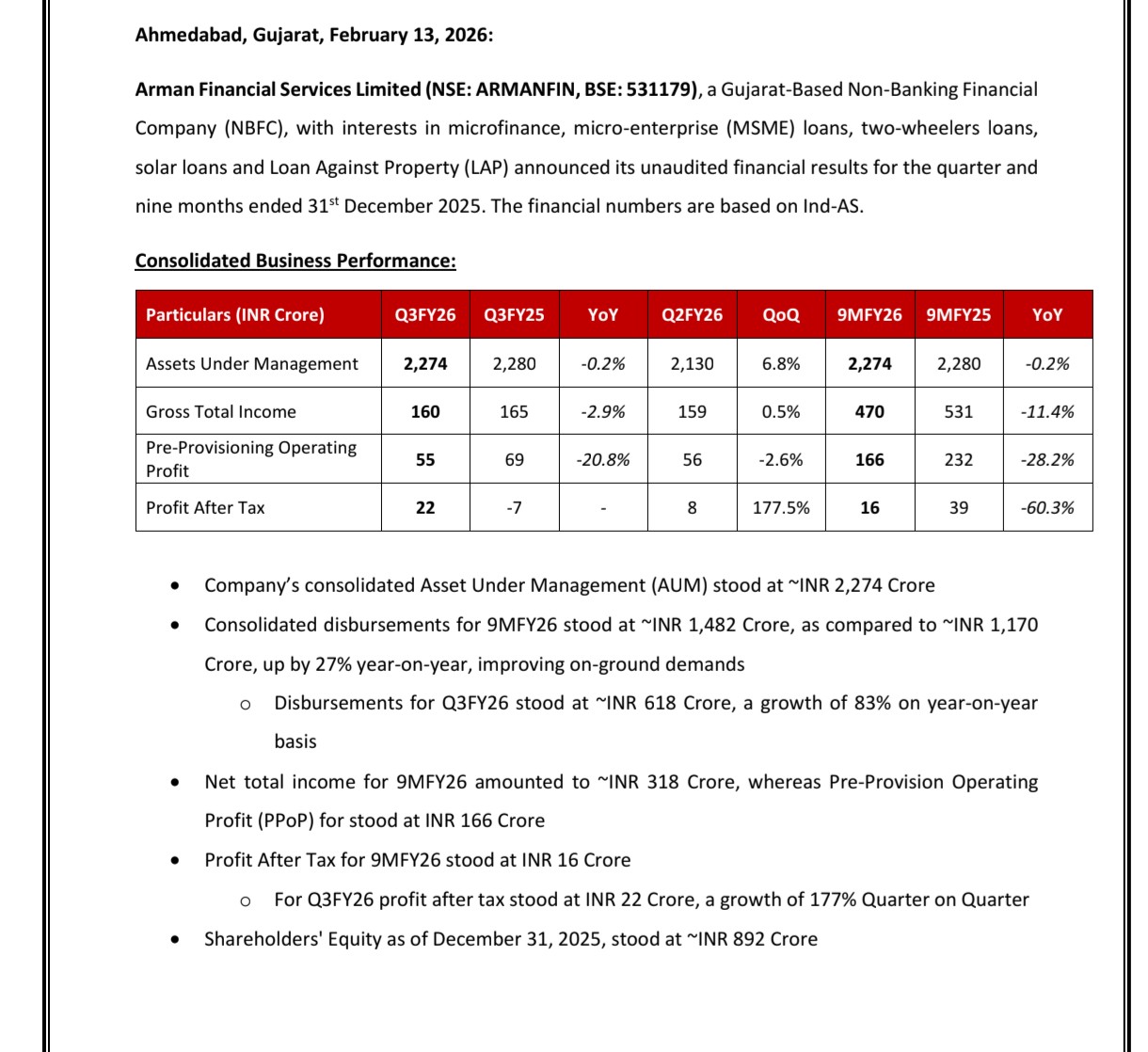

While GNPA has gone done slightly but NNPA has gone up significantly almost 40 bps.
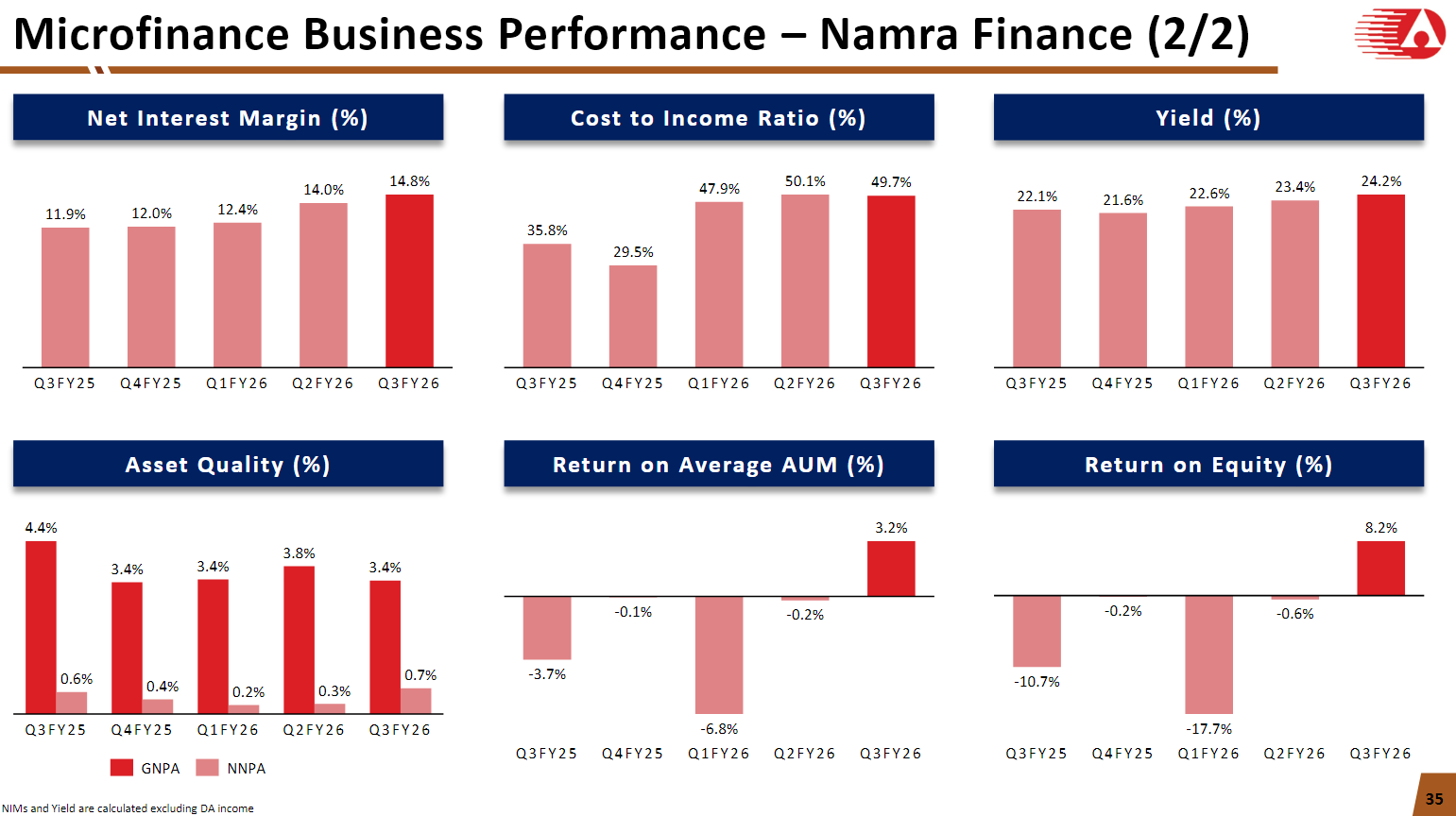

Disc - Not yet invested and not yet biased
1 Like
worth a read.
Disclaimer - Invested and biased
8 Likes
1 Like
Elevation Capital just sold 2% of the company. It does not make sense to me. The cycle is turning around. Aalok Patel said they are looking to grow AUM by 25% in FY27. The company is at very low valuations and the stock could double from here. Can someone help explain to me why they would sell at this point in time.
1 Like
They had been looking for an exit since 2-3 years. Already trimmed half the stake earlier and the crisis happened. Every investor has different goals in life 
8 Likes
My Q4 FY 26 Concall Notes
Disbursement and Credit assessment separation going well, benefiting us, resulting in better quality loan assets
But the opex costs have gone up
Rejection rates are elevated.
Better loan quality because of higher rejection rates rather than the environment getting better
Product mix change. Yield less because LAP yields less than MSME
3.5 to 4% ROA in FY 27 if macro doesn’t worsens and our growth trajectory remains consistent
He has a ROE number that he’s targeting. Just hesitant to say it out loud.
Lap growth 20 to 25%
Msme 25% growth in FY 27 in AUM
“Not the year to push growth hard” he said about FY 27.
“Unlikely to reach peak PAT in FY27 but we will get it close”
“Collections are fairly good”
LAP is hard. It’s secure. It’s competitive
“At the expense of sounding arrogant, our system is far superior than the so called one size type data”
“Will try to get opex down to 7% (of Assets)”
______________________
My story in this stock and a little rant please
I bought the stock in Oct and Nov of 2024. I was a large cap investor prior to this and had only known 12 to 15% returns. Arman’s 30%+ growth attracted me. It had another thing going for it that it had a history of raising money at high valuations creating book value growth for us common investors. I liked it alot.
It also went from book value per share of 200 to 800 from 2020 to 2025. Aalok Patel said that the typical crisis in Microfinance lasts for 18 months. I made all these models that the microfinance crisis will be over in 2 years. In the next 6 years i.e. by 2032, the company will grow at 30% or will quadruple book value per share which will be aided by fresh capital infusion and its price to book will double to 4 times like it has always been in the past.
That reality appears to be pretty much impossible now. As I have lived through nearly 2 years of stagnation in this, my expectations and outlook have also come down. I only wanted a 3x on my investment in 6 years by 2030 end, prior to this concall but now that dream has also been shattered.
In Q3 concall Aalok said that we are well capitalised and will have an advantage in the beginning vs other players. A number, 25% loan growth was also thrown out although it was not formal guidance.
I guess it could grow at 20% a year and the PB multiple could grow at 1.5x making my 3x possible. But that could also not happen.
A Buffett quote comes to mind. He said during the internet bubble that if a company is at 500b then it must make 50b each year to generate 10% returns. But if it doesn’t make money for 1 year, then it must make 55b perpetually to generate that 10% return. That appears to be relevant here. Microfinance industry also goes through downturns. Although I haven’t done the math on how this would work.
Lastly the results came after Market closing on May 27. On next trading day, Arman stock was fine early trading day. So it must not be the market reaction to the results. Later in the day, the stock fell 7% while nifty was down 1.25% due to Iran stuff. Why go through such drawdowns if the ultimate reward isn’t even extraordinary?
4 Likes